Full-System Architectural Exploration Sandbox Eriko Nurvitadhi and - - PDF document

full system architectural exploration sandbox
SMART_READER_LITE
LIVE PREVIEW

Full-System Architectural Exploration Sandbox Eriko Nurvitadhi and - - PDF document

Full-System Architectural Exploration Sandbox Eriko Nurvitadhi and James C. Hoe Computer Architecture Lab (CALCM) Carnegie Mellon University Nurvitadhi & Hoe, CMU/ECE WARFP 2005, February 2005, Slide 1 Sandbox Desiderata A PC where I


slide-1
SLIDE 1

1

WARFP 2005, February 2005, Slide 1 Nurvitadhi & Hoe, CMU/ECE

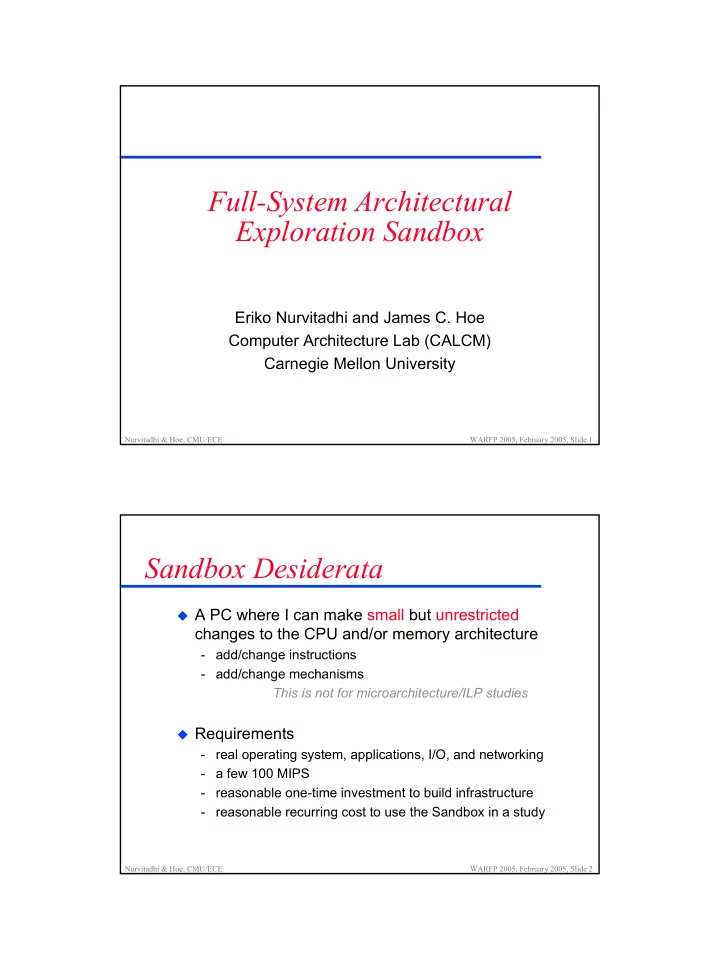
Full-System Architectural Exploration Sandbox

Eriko Nurvitadhi and James C. Hoe Computer Architecture Lab (CALCM) Carnegie Mellon University

WARFP 2005, February 2005, Slide 2 Nurvitadhi & Hoe, CMU/ECE

Sandbox Desiderata

A PC where I can make small but unrestricted

changes to the CPU and/or memory architecture

  • add/change instructions
  • add/change mechanisms

This is not for microarchitecture/ILP studies

Requirements

  • real operating system, applications, I/O, and networking
  • a few 100 MIPS
  • reasonable one-time investment to build infrastructure
  • reasonable recurring cost to use the Sandbox in a study
slide-2
SLIDE 2

2

WARFP 2005, February 2005, Slide 3 Nurvitadhi & Hoe, CMU/ECE

Sandbox Platform

PCI Bus

hard disk ethernet host memory bridge host DRAM host CPU CPU FPGA M.C. FPGA

local bus local SRAM Processor Module Sandbox PC System

5 I n t e l e n g i n e e r s d e s i g n e d 4 M

  • T

f

  • r

P 4 . H

  • w

t

  • m

a k e a n x 8 6 w i t h 1 s t u d e n t

  • n

F P G A ?

WARFP 2005, February 2005, Slide 4 Nurvitadhi & Hoe, CMU/ECE

We can do it because …

We don’t need a P4

  • detailed microarchitecture and ILP are second-order
  • DRAM and I/O devices are relatively faster

Pentium or simpler will suffice for IPC=1 at 100MHz

We don’t need “full” x86 compliance

  • use C++ code from Bochs as ISA spec
  • use Bochs simulation for reference behavior

(http://bochs.sourceforge.net) Bochs-compliance is good enough to boot Linux and Windows

We can use high-level HDL and FPGA

  • emphasis on correctness rather than optimality
  • incremental development
slide-3
SLIDE 3

3

WARFP 2005, February 2005, Slide 5 Nurvitadhi & Hoe, CMU/ECE

Preliminary Experience

x86 CISC instruction decoding

  • as little as 1 byte, as many as 16 bytes per instruction
  • yields 947 distinct behaviors (according to Bochs)
  • nly 558 in pre-MMX x86
  • a major source of complexity in real x86 implementations

the real reason there is a trace cache in Intel P4

Bochs C++ to VHDL

  • naïve, straightforward translation of C++ code to

combinational logic in VHDL

  • synthesize to Xilinx XC2V6000-6
  • 5% resource
  • 50MHz

WARFP 2005, February 2005, Slide 6 Nurvitadhi & Hoe, CMU/ECE

Bochs Example:BX_CPU_C::ADD_EbGb

BX_CPU_C::ADD_EbGb(bxInstruction_c *i) { Bit8u op2, op1, sum;

  • p2 = BX_READ_8BIT_REGx(i->nnn(),i->extend8bitL());

if (i->modC0()) {

  • p1 = BX_READ_8BIT_REGx(i->rm(),i->extend8bitL());

sum = op1 + op2; BX_WRITE_8BIT_REGx(i->rm(), i->extend8bitL(), sum); } else { read_RMW_virtual_byte(i->seg(), RMAddr(i), &op1); sum = op1 + op2; Write_RMW_virtual_byte(sum); } SET_FLAGS_OSZAPC_8(op1, op2, sum, BX_INSTR_ADD8); }

slide-4
SLIDE 4

4

WARFP 2005, February 2005, Slide 7 Nurvitadhi & Hoe, CMU/ECE

To Conclude

A powerful tool for architectural studies

  • complete control of CPU and memory controller
  • run real operating system and applications

I am not saying it is easy, but it definitely is doable

  • Bochs as specification and reference behavior
  • incremental development in FPGA

Why not just use SIMICS, Bochs, etc?

  • 10 MIPS out of the box, but performance degrades very

quickly when you tack on new behavior or detail

Why not use Pentium RTL models?

  • real RTL models are hard to come by
  • real RTL models are impossible to modify

WARFP 2005, February 2005, Slide 8 Nurvitadhi & Hoe, CMU/ECE

TRUSS

Computer Architecture Lab (CALCM) Carnegie Mellon University http://www.ece.cmu.edu/CALCM