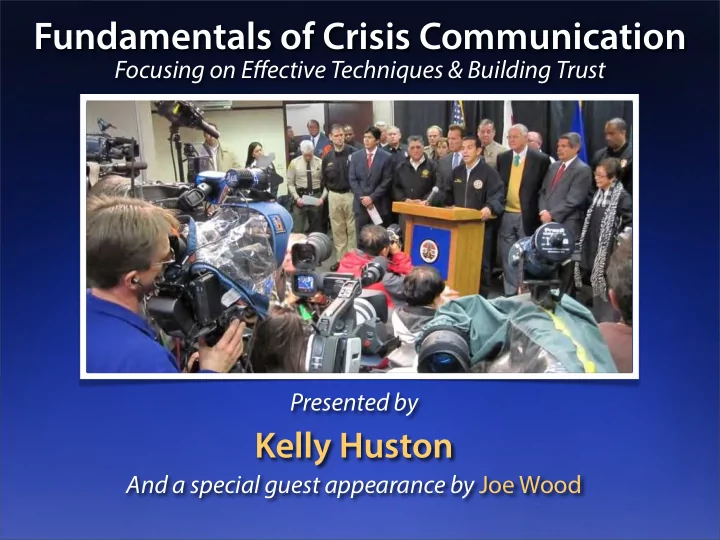
SLIDE 1 Fundamentals of Crisis Communication
Focusing on Effective Techniques & Building Trust Presented by
Kelly Huston
And a special guest appearance by Joe Wood
SLIDE 2
- 1. Who you are
- 2. What do you hope to learn today
- 3. The thing you’re most passionate about
(personal or professional)
SLIDE 3
SLIDE 4
Keeping Perspective
SLIDE 5
What Really Matters?
SLIDE 6
Case study
SLIDE 7
SLIDE 8 Crash: September 12, 2008 at 4:22 pm Consequences: 25 deaths, 135 injured This press conference was around 10am the morning after
SLIDE 9 Team Exercise
- What did she do right?
- What, if anything, did she do wrong?
- How would you have done it?
SLIDE 10
You are here.
SLIDE 11
Art
Skills arising from the exercise of intuitive faculties (and common sense)
SLIDE 12
Science
Expertness or exactness regarded as the result of knowledge of laws and principles
SLIDE 14 Today
- Risk & Crisis Communication
- Case Studies & Team Exercises
- How to Craft Effective Messages
- The “Communication Flow”
- 10 Commandments for Successful
Interviewing
SLIDE 15
What Happened Here?
SLIDE 16 Anatomy of a Crisis
- Complexity of the situation
- High stress on all involved
- Need for preparation & practice
- Need for focus
SLIDE 17 Impact on the Public
- “Normal” life interrupted
- Concern for safety of loved ones,
themselves
- Confusion and fear
- Looking for leadership and support
SLIDE 18
Leadership
SLIDE 19
Public’s Expectations
SLIDE 20
20 years ago 24 hours 10 years ago 4 hours Today 4 minutes Speed of Info Flow Through the Media
SLIDE 21
Risk & Crisis Communication
SLIDE 22 Risk Communication: Key Concepts
- Over 8000 articles in peer reviewed
journals, over 2,000 books and major survey reviews of the field
Center for Change/Risk Communication
SLIDE 23 Risk Communication: Key Concepts
- Risk communication is a science-
based discipline
- High concern situations change the
rules of communication
- The key to success is Anticipation,
Preparation and Practice (APP)
SLIDE 24 Risk Communication: Key Concepts
- People focus much more on
negative information
- Process information well below their
grade level (AGL-4)
- Actively seek out additional sources
to reduce risk
- “Four Hit Theory” of belief formation
SLIDE 25 Four Hit Theory of Belief Formation
- Once formed, a belief is difficult or
impossible to change
- Four (on average) unanswered
credible hits makes a belief
- Less than four hits is still opinion
- A hit from one side can be negated
by a hit from the other side
SLIDE 26 3 Goals of Risk Communication
to make knowledgeable decisions
- Build trust and credibility
- Persuade & convince,
appropriate to what we know
SLIDE 27 When people are stressed or concerned
- Want to know that you care
before they care what you know
understanding, and remembering information
- Focus most on what they hear
first and last
SLIDE 28
What are the key messages?
SLIDE 29
What are the key messages?
SLIDE 30 Considerations
- What were her messages?
- What were the mayor’s messages?
- What does the public want to hear?
- What did you see?
SLIDE 31
Mental Noise
Your brain’s ability on a good day During high stress or concern 80% 20% Mental noise can reduce the ability to process information by up to 80%
SLIDE 32
What factors build trust during a crisis?
SLIDE 33 Trust Determination Model
- Competence & Expertise
- Honesty & Openness
- Listening, Caring, Compassion,
Empathy
The Determinants of Trust and Credibility in Environmental Risk Communication: An Empirical Study Richard G. Peters, Vincent T. Covello, David B. McCallum - Risk Analysis, 1997
SLIDE 34 Trust Determination Model
What factors build trust during a crisis?
17% 17% 50% 17%
Competence & Expertise Honesty / Openness Listening / Caring / Empathy / Compassion All Other Factors
Determination in first 9-30 seconds
SLIDE 35 Communication Tools
- 95% Rule
- Rule of 3
- CCO
- 27/9/3
- IDK
- 1N=3P
- AGL-4
- Primacy/Recency
- Message Mapping
SLIDE 36
95% Rule
95% of all questions and concerns that will be raised by any stakeholder (the press) in any controversy (crisis) can be predicted in advance. Implications?
SLIDE 37 3
Rule of 3
Low Stress
Brain can hold on average
7
High Stress
Brain can hold on average
Messages Messages
George A. Miller (Department of Psychology, Princeton University) The Psychological Review, 1956, vol. 63, pp. 81-97
SLIDE 38
27/9/3
SLIDE 39 27/9/3
- 27 Words
- 9 Seconds
- 3 Messages
- This is what your audience can
successfully process Simple Declarative Statements
SLIDE 40 Message Map
Stakeholder Question or Concern
Key Message/Fact
1
Keywords or Supporting Fact 1.1 Key Message/Fact
2
Key Message/Fact
3
Keywords or Supporting Fact 1.2 Keywords or Supporting Fact 1.3 Keywords or Supporting Fact 1.1 Keywords or Supporting Fact 1.2 Keywords or Supporting Fact 1.3 Keywords or Supporting Fact 1.1 Keywords or Supporting Fact 1.2 Keywords or Supporting Fact 1.3
SLIDE 41
27/9/3
SLIDE 42 Message Map
Stakeholder Question or Concern
Key Message/Fact #1
Keywords or Supporting Fact 1.1
Key Message/Fact #2 Key Message/Fact #3
Keywords or Supporting Fact 1.2 Keywords or Supporting Fact 1.2 Keywords or Supporting Fact 2.1 Keywords or Supporting Fact 2.2 Keywords or Supporting Fact 2.2 Keywords or Supporting Fact 3.1 Keywords or Supporting Fact 3.2 Keywords or Supporting Fact 3.3
9/11/01 I’m scared. What is happening now? Highest Levels President Military Safe as possible Doing Everything We Can NYPD Other Agencies Safe as possible You’re not alone
People suffering with you
Help Support
SLIDE 43
Listen Again: 27/9/3
SLIDE 44 Message Map Exercise
Stakeholder Question or Concern
Key Message/Fact #1
Keywords or Supporting Fact 1.1
Key Message/Fact #2 Key Message/Fact #3
Keywords or Supporting Fact 1.2 Keywords or Supporting Fact 1.2 Keywords or Supporting Fact 2.1 Keywords or Supporting Fact 2.2 Keywords or Supporting Fact 2.2 Keywords or Supporting Fact 3.1 Keywords or Supporting Fact 3.2 Keywords or Supporting Fact 3.3
SLIDE 45
C C O
SLIDE 46 C C O
- Compassion and show empathy
- Conviction that you and your team
can do the job
- Optimism tempered by reality
SLIDE 47
C C O
SLIDE 48
IDK: I don’t know
SLIDE 49
IDK
SLIDE 50 IDK: I Don’t Know
- It is okay not to have the answer
- Do not risk your credibility by
creating an answer
SLIDE 51
Guiliani Using IDK
SLIDE 52 IDK Template
- Say you don’t know (or can’t answer)
- Give the reason why you don’t know
- Indicate follow-up with a deadline
- Bridge to what you can say, such as
your core messages
SLIDE 53
Case Study
SLIDE 54 Team Exercise
- You’re the spokesperson for this
company
- What will be the public’s reaction?
- How will you respond?
- Develop key messages on flip chart
SLIDE 55
The Communication Flow
SLIDE 56
Hurricane Rita & General Honore
SLIDE 57 Considerations?
- Who was the General talking to?
- What were his key messages?
- Was he effective?
- What does the affected public need?
SLIDE 58
The Communication Flow
SLIDE 59 Public, families, critics, supporters, colleagues, naïve folks, etc.
Remember who you’re really talking to when you do an interview or go
The Communication Flow
Public Official (that’s you!)
news media
SLIDE 60
SLIDE 61 Techniques “Bridging”
- Using a bridge or transition to get
to your key message(s).
- Question g Answer g Bridge to g
Key Message
- Refer to your handout examples
SLIDE 62 Techniques “Flagging”
- Notifying the interviewer (or
viewer) that you’re about to say something important.
- Question g Flag g Key Message
SLIDE 63 Techniques “Flagging”
Examples:
- “What is important to remember is...”
- “Let me take a step back and repeat that...”
- “Most people are concerned about...”
- “Here’s the main thing that the Mayor did..”
- “Although it can be confusing, here’s the
bottom line...”
SLIDE 64
Do You Prepare?
SLIDE 65
10 Commandments For Successful Interviewing
SLIDE 66 10 Commandments For Successful Interviewing
- 1. Ask yourself “Why am I doing this interview?”
- 2. Research the reporter & the topic
- 3. Prepare, prepare, prepare
- 4. Develop key messages & practice
- 5. Adopt a cooperative, positive attitude
SLIDE 67 10 Commandments For Successful Interviewing
6. Be aware of your non-verbal communication (Metrolink & General) 7. Don’t repeat the negative 8. Never lie, guess or bluff 9. Avoid “no comment” and “off-the-record” statements
- 10. Review & verify with the reporter
SLIDE 68
Recommended Reading
SLIDE 69
SLIDE 70
Kelly Huston
(916) 436-1711 kbhuston@gmail.com
www.ProCommunicator.com/hah