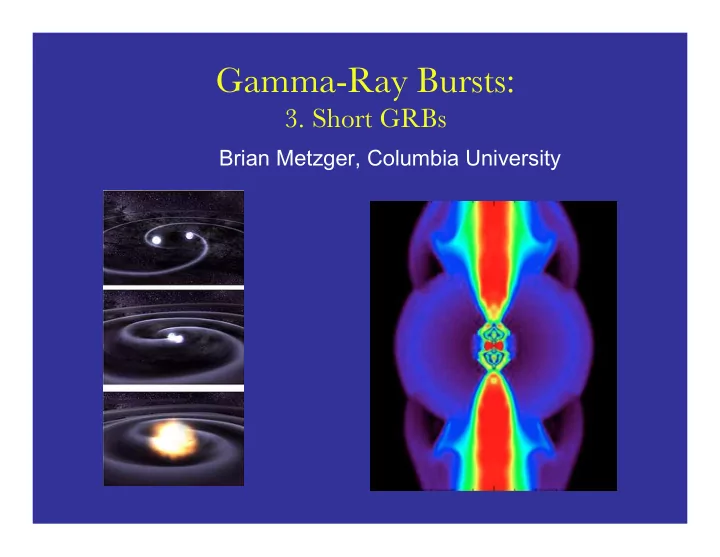
Gamma-Ray Bursts: 3. Short GRBs Brian Metzger, Columbia University - - PowerPoint PPT Presentation

gamma ray bursts
SMART_READER_LITE
LIVE PREVIEW

Gamma-Ray Bursts: 3. Short GRBs Brian Metzger, Columbia University - - PowerPoint PPT Presentation

Gamma-Ray Bursts: 3. Short GRBs Brian Metzger, Columbia University Binary Neutron Star Mergers Gravitational Waves Gravitational Waves G 3 M 2 " 1 dP dt = 48 NS NS NS NS a a c 5 a 4 P 5 10 Known Galactic NS-NS Binaries


slide-1
SLIDE 1

Gamma-Ray Bursts:

  • 3. Short GRBs

Brian Metzger, Columbia University

slide-2
SLIDE 2

Binary Neutron Star Mergers

NS NS NS NS

˙ N

merge ~ 10-5 "10-4 yr-1

10 Known Galactic NS-NS Binaries 10 Known Galactic NS-NS Binaries

(Lorimer 2008)

T Tmerge

merge

= 300 = 300 Myr Myr

( (Kalogera Kalogera et al. 2004) et al. 2004)

Hulse-Taylor Pulsar " 1 P dP dt = 48 5 G3 c 5 M 2 a4

a a Ω Ω Gravitational Waves Gravitational Waves

slide-3
SLIDE 3
slide-4
SLIDE 4

LIGO (North America) LIGO (North America) Virgo (Italy) Virgo (Italy)

LIGO 6th Science Run LIGO 6th Science Run (2010) Range ~ 20-50 (2010) Range ~ 20-50 Mpc Mpc “ “Advanced Advanced” ” LIGO+Virgo LIGO+Virgo (~2016) Range ~ 300-600 (~2016) Range ~ 300-600 Mpc Mpc

Credit: Kip Thorne Credit: Kip Thorne

“ “chirp chirp” ”

Ground-Based Interferometers

Gravitational Waves from Inspiral and Merger

slide-5
SLIDE 5

Courtesy M. Shibata (Tokyo U)

Numerical Simulation - Two 1.4 M Numerical Simulation - Two 1.4 M

 NSs

slide-6
SLIDE 6

Courtesy M. Shibata (Tokyo U)

Numerical Simulation - Two 1.4 M Numerical Simulation - Two 1.4 M

 NSs

slide-7
SLIDE 7

Re Remn mnant Ac Accretion Di Disk

  • Disk Mass ~0.01 - 0.1 M & Size ~ 10-100 km
  • Hot (T > MeV) & Dense (ρ ~ 108-1012 g cm-3)
  • Neutrino Cooled: (τν ~ 0.01-100)
  • Equilibrium

⇒ Ye ~ 0.1

Lee et al. 2004

e" + p #$ e + n

e+ + n "#

e + p vs

vs. . ˙ M ~ 10"2 "10M! s-1 Short GRB Engine? Accretion Rate Accretion Rate

t visc ~ 0.1 M• 3M! " # $ % & '

1/ 2 (

0.1 " # $ % & '

)1

Rd 100 km " # $ % & '

3/ 2 H /R

0.5 " # $ % & '

)2

s

(e.g. Ruffert & Janka 1999; Shibata & Taniguchi 2006; Faber et al. 2006; Chawla et al. 2010; Duez et al. 2010; Foucalt 2012; Deaton et al. 2013)

slide-8
SLIDE 8

Relativistic Jets and Short GRBs

Rezzolla et al. 2010

MHD Powered ν Powered

Aloy et al. 2005

Zhang & MacFadyen 2009

slide-9
SLIDE 9

BATSE Bursts

Nakar 07

Shor Short & & Long Gamma-Ray Bursts

Nakar 07

slide-10
SLIDE 10

BATSE Bursts

Supernova Connection

Long GRBs = Death of Massive Stars

Nakar 07

Shor Short & & Long Gamma-Ray Bursts

Nakar 07

GRB 030329 ⇔ SN 2003dh

Stanek et al. 2003

Star-Forming Host Galaxies (zavg~2-3)

slide-11
SLIDE 11

BATSE Bursts

Supernova Connection

Long GRBs = Death of Massive Stars

Nakar 07

Shor Short & & Long Gamma-Ray Bursts

Nakar 07

GRB 030329 ⇔ SN 2003dh

Stanek et al. 2003

Short

??? ???

Star-Forming Host Galaxies (zavg~2-3)

slide-12
SLIDE 12

Swift Swift

KECK Bloom+06

GRB050509b

HUBBLE Fox+05

GRB050709 z = 0.225 SFR < 0.1 M yr-1 z = 0.16 SFR = 0.2 M yr-1

Bloom+ 06

GRB050724

Berger+05

z = 0.258 SFR < 0.03 M yr-1

Short GRB Host Galaxies

slide-13
SLIDE 13

Swift Swift

KECK Bloom+06

GRB050509b

HUBBLE Fox+05

GRB050709 z = 0.225 SFR < 0.1 M yr-1 z = 0.16 SFR = 0.2 M yr-1

Bloom+ 06

GRB050724

Berger+05

z = 0.258 SFR < 0.03 M yr-1

Short GRB Host Galaxies

GRB050724

  • Lower redshift

(z ~ 0.1-1)

  • Eiso~ 1049-51 ergs
  • Older Progenitor

Population

(e.g. Fong+ 2010; Leibler & Berger 2010)

Bloom +06

No Supernova

slide-14
SLIDE 14

Berger 2013

slide-15
SLIDE 15
slide-16
SLIDE 16

Radial Offsets from Host Galaxy

Berger 2013

NS receive kick velocity vk ~ 100 km s-1 > vesc ⇒ short GRBs may occur outside host galaxy

Faucher-Giguere & Kaspi 2006

In place pulsar velocity (km s-1) D =100 kpc v 100 km s-1 " # $ % & ' t Gyr " # $ % & '

slide-17
SLIDE 17

Not that Short After All….

BATSE Examples (Norris & Bonnell 2006)

GRB080503

SEE/SGRB ~ 30 Perley, BDM et al. 2009

GRB 050709

  • 1/4 Swift Short Bursts have X-ray Tails
  • Rapid Variability ⇒ Ongoing Engine Activity
  • Energy up to ~30 times Burst Itself!

Extended Emission Extended Emission

slide-18
SLIDE 18

??? taccretion ~ 0.1-1 s

Why Two Timescales? Why the Delay?

?

Lee et al. (2004) Lee et al. (2004)

slide-19
SLIDE 19

Local Disk Mass Σπr2 (M)

Angular Momentum Angular Momentum Entropy Entropy

Heating Heating Cooling Cooling

"# "t = 3 r " "r r1/ 2 " "r $#r1/ 2

( )

% & ' ( ) *

T dS dt = ˙ q

visc " ˙

q

#

Viscous Evolution of the Viscous Evolution of the Remnant Disk Remnant Disk

Metzger, Piro & Quataert 2008, 2009

t = 0.01 s t = 1 s

J = MdRdvK " MdRd

1/ 2

# Rd " Md

$2

BH

slide-20
SLIDE 20

Late-Time Disk Outflows ( Late-Time Disk Outflows (‘Evaporation vaporation’)

  • Recombination: n + p ⇒ He
  • Thick Disks Marginally Bound

After t ~ After t ~ 1 seconds, R ~ 300 km & 1 seconds, R ~ 300 km & T < 1 T < 1 MeV MeV

E EBIND

BIND ~ GM

~ GMBH

BHm

mn

n/2R ~

/2R ~ 5 5 MeV MeV nucleon nucleon-1

  • 1

Δ ΔE ENUC

NUC ~

~ 7 7 MeV MeV nucleon nucleon-1

  • 1
slide-21
SLIDE 21

Late-Time Disk Outflows ( Late-Time Disk Outflows (‘Evaporation vaporation’)

  • Recombination: n + p ⇒ He
  • Thick Disks Marginally Bound

}

After t ~ After t ~ 1 seconds, R ~ 300 km & 1 seconds, R ~ 300 km & T < 1 T < 1 MeV MeV

E EBIND

BIND ~ GM

~ GMBH

BHm

mn

n/2R ~

/2R ~ 5 5 MeV MeV nucleon nucleon-1

  • 1

Δ ΔE ENUC

NUC ~

~ 7 7 MeV MeV nucleon nucleon-1

  • 1

Sizable Fraction of Initial Disk Unbound! Sizable Fraction of Initial Disk Unbound!

BH

Disk Blows Apart

slide-22
SLIDE 22

Axisymmetric Torus Evolution

  • P-W potential with MBH = 3,10 M
  • hydrodynamic α viscosity
  • NSE recombination 2n+2p ⇒ 4He
  • run-time Δt ~ 1000-3000 torb
  • neutrino self-irradiation: “light bulb”

+ optical depth corrections:

(Fernandez & Metzger 2012, 2013)

R ∈ [2,2000] Rg Nr = 64 per decade Nθ = 56

angular emission pattern

peak emission radius

Equilibrium Torus Mt ~ 0.01-0.1 M R0 ~ 50 km uniform Ye = 0.1

slide-23
SLIDE 23
slide-24
SLIDE 24

Late Disk Outflows (Evaporation)

Time (s)

˙ M

BH

˙ M

  • ut (with " recombination)

Mej ~ 0.05 M 0.05 Mt

t Vej ~ 0.1 c

˙ M

  • ut (NO " recombination)
  • utflow robust
  • unbound outflow

powered by viscous heating and α recombination

  • neutrino heating

subdominant

slide-25
SLIDE 25

??? taccretion ~ 0.1-1 s

Why Two Timescales? Why the Delay?

?

Lee et al. (2004) Lee et al. (2004)

slide-26
SLIDE 26

Stable Neutron Star Remnant?

(e.g. Rasio 99; BDM+08; Ozel et al. 2010; Bucciantini et al. 2012; Zhang 13; Giacomazzo & Perna 13; Falcke & Rezzolla 13; Kiziltan 2013)

  • Requires: low total mass binary, stiff EOS*, and/or mass loss during merger

*supported by recent discovery of 2M NS by Demorest et al. 2011

  • Rotating near centrifugal break-up with spin period P ~ 1 ms
  • Magnetic field amplified by rotational energy ⇒ “Magnetar” ?

Giacomazzo & Perna 2013

(e.g. Thompson & Duncan 92; Price & Rosswog 2006; Zrake & MacFadyen 2013)

slide-27
SLIDE 27

(BDM et al. 2008; Bucciantini, BDM et al. 2012)

Magnetar wind confined by merger ejecta

Bucciantini et al. 2011

Theoretical Light Curves

  • vs. observed X-ray tails

(magnetar outflow model from Metzger et al. 2011) P0 = 1.5 ms, Bdip = 2×10¹⁵ G

Jet

Magnetar Wind Merger Ejecta

Magnetar Spin-Down Powered Extended Emission

Jet may continue to inject energy into forward shock or produce lower level prompt emission

(Zhang & Meszaros 2001; Dall’Osso et al. 2011; Rowlinson et al. 2013; Gompertz et al. 2013)

slide-28
SLIDE 28

Radio constraints on long-lived NS merger remnants

(BDM & Bower 2014)

  • Rotational energy

eventually transferred to ISM ⇒ bright radio emission

  • Observed 7 short GRBs with VLA
  • n timescales ~1-3 years after burst
  • NO DETECTIONS ⇒ rules out

stable NS remnant in 2 GRBs with known high ISM densities

  • Additional EVLA observations now

would be much more constraining

  • Upcoming radio surveys (e.g.

ASKAP) will strongly constrain population of stable NS merger remnants ⇒ indirectly probes EoS

Frail et al. 2012

10-4 yr-1 gal-1

Rest-Frame Time Since GRB (years) 1.4 GHz Luminosity (erg s-1)

Radio survey constraints

slide-29
SLIDE 29

Accretion-Induced Collapse (AIC)

  • O-Ne WD built to Mchandra
  • Collapse of rapidly-rotating WD ⇒

Disk around PNS: Mdisk ~ 10-2 - 0.3 M

  • Evolution similar to NS merger disks

(Metzger+ 08,09)

(e.g. Nomoto & Kondo 1991)

Nomoto & Kondo 1991

slide-30
SLIDE 30

Similar Systems - Distinct Origins

NS-NS NS-NS / BH-NS / BH-NS Mergers Mergers Accretion- Accretion- Induced Induced Collapse Collapse

BH NS

M ~ M ~ 0.01-0.1 M 0.01-0.1 M

R ~ 100 km Neutron Star Circinus X-1 Γ > 15 ! (Fender et al. 2004)

slide-31
SLIDE 31

Magnetar wind confined by merger ejecta

Bucciantini et al. 2011

Theoretical Light Curves

  • vs. observed X-ray tails

(magnetar outflow model from Metzger et al. 2011) P0 = 1.5 ms, Bdip = 2×10¹⁵ G

Jet

Magnetar Wind Merger Ejecta

slide-32
SLIDE 32

The Composition of Ultra High Energy Cosmic Rays

Pierre Auger Observatory RMS(Xmax) 〈Xmax〉 Energy (eV)

protons Iron

PAO Collaboration (review by Kotera & Olinto 2011)

Highest energy UHECRs dominated by heavy nuclei !

slide-33
SLIDE 33

Candidate Astrophysical Sources

Hillas: RL= E/ZeB < Rsource

UHECR candidates Source Size Magnetic Field Strength

slide-34
SLIDE 34

Candidate Astrophysical Sources

UHECR candidates Source Size Magnetic Field Strength Z < Z Z < 10 Z Z ~ ??

Hillas: RL= E/ZeB < Rsource

slide-35
SLIDE 35

Nucleosynthesis in Thermally-Driven GRB Outflows

(Lemoine 2002; Pruet et al. 2002; Beloborodov 2003)

n" nb ~ 4 #104 Lj,iso 1052erg s-1 $ % & ' ( )

*1/ 4

R0 107cm $ % & ' ( )

1/ 2

+

j

300 $ % & ' ( ) ,t exp ~ ms

  • vs. Big Bang Nucleosynthesis

n" nb ~1010 #texp ~ min

d α

Lemoine 2002

GRB Fireball

}

free nucleons

High entropy ⇒ D bottleneck ⇒

mostly 4He

α Recombination @ T ~ 100 keV

slide-36
SLIDE 36

Nucleosynthetic Yield of Proto-Magnetar Winds

Mass Fraction in Heavy Nuclei Xh

If proton-rich: Xh~ 0.3-0.8 (XHe=1-Xh) and 〈A〉 ~ 56 (Fe group) If neutron-rich: Xh~ 1 and 〈A〉 ~> 90 (possibly r-process elements)

proton-rich wind neutron-rich wind

Metzger, Giannios & Horiuchi 2011 (see also Kotera 2012)

Ω

slide-37
SLIDE 37

UHECR Acceleration by Internal Shocks

Maximum Cosmic Ray Energy Optical Depth to Photo-Disintegration During this epoch, heavy nuclei can both reach energies E > 1020 eV and survive destruction via γN ⇒ n N’

slide-38
SLIDE 38

Propagating Heavy Nuclei to Earth

"75 #170 E 1020 eV $ % & ' ( )

*1.5 A

56 $ % & ' ( )

1.3

Mpc

Mean Free Path for Photodisintegration by EBL/CMB:

Accessible Volume ∝ χ3 ∝ A3.9 ⇒ even a small fraction of ultra-heavy sources dominate composition at highest energies

E3 dN/dE Log10(E)

(Calculation by D. Allard)

Model vs. Auger Data (Preliminary!) XFe = 0.5, XHe = 0.5