Generation of an Advanced Helicopter Experimental Aerodynamic - - PowerPoint PPT Presentation

generation of an advanced helicopter experimental
SMART_READER_LITE
LIVE PREVIEW

Generation of an Advanced Helicopter Experimental Aerodynamic - - PowerPoint PPT Presentation

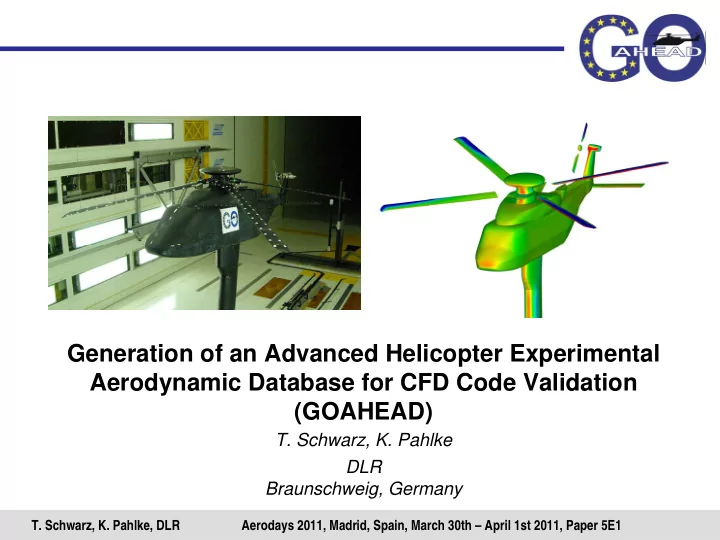
Generation of an Advanced Helicopter Experimental Aerodynamic Database for CFD Code Validation (GOAHEAD) T. Schwarz, K. Pahlke DLR Braunschweig, Germany Folie 1 T. Schwarz, K. Pahlke, DLR Aerodays 2011, Madrid, Spain, March


slide-1
SLIDE 1

Folie 1

  • T. Schwarz, K. Pahlke, DLR Aerodays 2011, Madrid, Spain, March 30th – April 1st 2011, Paper 5E1

Generation of an Advanced Helicopter Experimental Aerodynamic Database for CFD Code Validation (GOAHEAD)

  • T. Schwarz, K. Pahlke

DLR Braunschweig, Germany

slide-2
SLIDE 2

Folie 2

2

  • T. Schwarz, K. Pahlke, DLR Aerodays 2011, Madrid, Spain, March 30th – April 1st 2011, Paper 5E1
  • Motivation
  • The GOAHEAD project
  • Wind tunnel experiment
  • CFD activities
  • Conclusions

Outline

slide-3
SLIDE 3

Folie 3

3

  • T. Schwarz, K. Pahlke, DLR Aerodays 2011, Madrid, Spain, March 30th – April 1st 2011, Paper 5E1

INTRODUCTION

State of the art in CFD in Europe 2005

  • before 2005 two RANS flow solvers have been applied to complete

helicopters  elsA (ONERA) and FLOWer (DLR)

  • Demonstration of capability, not a careful validation
  • Considered was one test case only
  • Challenging because of high computational costs
  • A lack of experimental validation data was observed. Previous wind

tunnel experiments focussed on isolated rotors or fuselages, or complete helicopter experiments with focus on vibrations or acoustics.  set-up of the European „GOAHEAD“-Project

Z X Y

VorticityMagnitude 0.10 0.09 0.08 0.07 0.05 0.04 0.03 0.02

vortex of the precedingblade tip vortex

Isolated rotors hover/forw. flight Isolated fuselages Complete helicopter first demonstration in Europe 2002

slide-4
SLIDE 4

Folie 4

4

  • T. Schwarz, K. Pahlke, DLR Aerodays 2011, Madrid, Spain, March 30th – April 1st 2011, Paper 5E1

Objectives of GOAHEAD

  • GOAHEAD = Generation Of Advanced Helicopter Experimental

Aerodynamic Database for CFD code validation

  • STREP, 6th Framework Program, total budget 5M€, EU-funding 3M€

Objectives of GOAHEAD

  • To enhance the aerodynamic prediction capability with respect to

complete helicopter configurations.

  • create an experimental database for the CFD-validation
  • evaluate and validate Europe’s most advanced URANS solvers
slide-5
SLIDE 5

Folie 5

5

  • T. Schwarz, K. Pahlke, DLR Aerodays 2011, Madrid, Spain, March 30th – April 1st 2011, Paper 5E1

INTRODUCTION

GOAHEAD consortium

Project leader: DLR

slide-6
SLIDE 6

Folie 6

6

  • T. Schwarz, K. Pahlke, DLR Aerodays 2011, Madrid, Spain, March 30th – April 1st 2011, Paper 5E1

Configuration

  • Generic Mach scaled model,

similar to modern transport helicopter

  • existing components are reused, in
  • rder to put high effort into measurements,
  • fuselage: slightly modified NH90
  • instrumented 4-bl. main rotor

(7AD geometry)

  • instrumented 2-bl. tail rotor (BO 105)
  • main rotor diameter 4.2 m: 1/3.9 scale
  • model prepared by

Agusta (fuselage shell), ONERA (rotor blades), DLR (assembly and testing)

slide-7
SLIDE 7

Folie 7

7

  • T. Schwarz, K. Pahlke, DLR Aerodays 2011, Madrid, Spain, March 30th – April 1st 2011, Paper 5E1

Model Instrumentation

  • Fuselage:
  • balances for the fuselage and the horizontal stabilizer
  • 130 unsteady pressure sensors, 292 steady transducers
  • 38 hot wires for detection of transition and flow separations
  • Main rotor
  • rotor balance
  • 125 unsteady pressure sensors
  • 40 hot wires
  • 29 strain gauges for blade

deformation measurements

  • Tail rotor
  • 38 unsteady pressure sensors
  • 4 strain gauges for thrust measurement
  • Torque meter
  • CAD data of configuration based on model scan with structured-light

3D scanner

slide-8
SLIDE 8

Folie 8

8

  • T. Schwarz, K. Pahlke, DLR Aerodays 2011, Madrid, Spain, March 30th – April 1st 2011, Paper 5E1

Wind tunnel experiment

  • Wind tunnel experiment in the DNW-LLF, Marknesse, The Netherlands
  • Test were performed in the 6m * 8m closed test section
  • Duration: 14 days from March 28th to April 14th, 2008
  • Model was operated by DLR
  • Seven Partners involved in measurements
  • Almost all data as originally planned were gathered during the experiment.
  • Challenging wind tunnel experiment
  • Model could only be tested in

lab conditions before

  • Model must be operated like a

real helicopter based on measured loads

slide-9
SLIDE 9

Folie 9

9

  • T. Schwarz, K. Pahlke, DLR Aerodays 2011, Madrid, Spain, March 30th – April 1st 2011, Paper 5E1

Executed Test matrix

  • Only four flight states were considered to allow detailed experimental

analysis

  • Low speed, pitch up (M=0.059)
  • Cruise / tail shake (M=0.204)
  • Dynamic stall (M=0.259)
  • High speed (M=0.28)
  • Tests with and without rotors ( isolated fuselage and complete helicopter)

Experimental data base

  • data base with more than 400 GB data
  • data postprocessor developed by Glasgow University
  • comprehensive documentation available

Experimental results

  • M. Raffel et al.: “Generation of an advanced helicopter experimental aerodynamic database”, ERF 2009

Pitch-up Tail shake

slide-10
SLIDE 10

Folie 10

10

  • T. Schwarz, K. Pahlke, DLR Aerodays 2011, Madrid, Spain, March 30th – April 1st 2011, Paper 5E1

Experimental results - PIV

Isolated fuselage, Vortices behind back door

  • Dyn. Stall
  • n highly

loaded rotor Detailed flow field analysis with particle image velocimetry (3C PIV) pitch up- condition

slide-11
SLIDE 11

Folie 11

11

  • T. Schwarz, K. Pahlke, DLR Aerodays 2011, Madrid, Spain, March 30th – April 1st 2011, Paper 5E1

Experimental results

  • Transition detection,

top: IR, bottom: hot films on main rotor

transition vortex

  • Blade deformation measurements with

Strain Pattern Analysis (SPA) and Stereo Pattern recognition (SPR)

  • Top : SPR markers, bottom: bending and

torsion (r/R = 0.8, cruise condition)

slide-12
SLIDE 12

Folie 12

12

  • T. Schwarz, K. Pahlke, DLR Aerodays 2011, Madrid, Spain, March 30th – April 1st 2011, Paper 5E1

CFD METHODS

CFD Code Research

  • rganisations

Helicopter industry elsA ONERA EC SAS FLOWer DLR, CU, USTUTT-IAG, ECD HMB ULIV WHL ROSITA PoliMi Agusta ENSOLV NLR FORTH in house FORTH

CFD codes applied in GOAHEAD

  • Codes were applied in a blind test phase in order to assess the prediction

capabilities and a post test phase to refine CFD results

  • At the end of the project with all codes complete helicopter simulations were

performed

  • Budget in GOAHEAD for CFD-validation only, significant activities for code

improvement paid by internal funding of partners

slide-13
SLIDE 13

Folie 13

13

  • T. Schwarz, K. Pahlke, DLR Aerodays 2011, Madrid, Spain, March 30th – April 1st 2011, Paper 5E1

CFD validation, cross plots

top: pressures in symmetry plane, isolated fuselage (ECD, NLR, CUN) Unsteady pressures

  • n fuselage

(cruise condition, DLR, POM) main rotor pressures at r/R = 0.82, (cruise condition, ULI, NLR, POM, WHL)

  • Application of several codes to same test cases allowed to assess different

solution approaches e.g. Chimera / sliding meshes, rigid / elastic blades, turbulence models, …

  • Best practice guidelines have been established

Boelens et al.: “The blind test activity of the GOAHEAD project”, ERF 2007 Antoniadis et al.: Assessment of CFD methods against experimental flow measurements for helicopter flows”, ERF 2010

slide-14
SLIDE 14

Folie 14

14

  • T. Schwarz, K. Pahlke, DLR Aerodays 2011, Madrid, Spain, March 30th – April 1st 2011, Paper 5E1
  • Within the GOAHEAD project a comprehensive data base with high quality

data and documentation for complete helicopters has been generated.

  • A full understanding of the data base will require many more years of

research and data analysis like for any other experimental data base.

  • All CFD-solvers are capable to simulate the unsteady flow about complete

helicopters with good accuracy for certain features. Interaction phenomena are partly captured. This is a big step forward having in mind that the first successful RANS helicopter simulations in Europe have been published in 2002.

  • due to the complexity and instationarity of the flow the solution

accuracy has not reached the same level like for fixed wing

  • applications. Further CFD developments and validation is required in
  • rder to further improve the CFD software, e.g. coupling of CFD

methods to structural mechanics and flight mechanics, turbulence and transition modelling, and CPU time reduction.

  • CFD-simulations for complete helicopters are still a challenge
  • Access to modern supercomputers is crucial

Conclusions (1/2)

slide-15
SLIDE 15

Folie 15

15

  • T. Schwarz, K. Pahlke, DLR Aerodays 2011, Madrid, Spain, March 30th – April 1st 2011, Paper 5E1
  • The European helicopter industry took advantage from the improvements

and validation of their URANS-CFD tools. By working jointly with research centers industry extended the range of applications for in-house simulations.

  • However, due to the large computational effort complete helicopter

simulations will not be routinely run in near future in industry.

Conclusions (2/2)

slide-16
SLIDE 16

Folie 16

16

  • T. Schwarz, K. Pahlke, DLR Aerodays 2011, Madrid, Spain, March 30th – April 1st 2011, Paper 5E1

Thank you GOAHEAD Generation Of Advanced Helicopter Experimental Aerodynamic Database for CFD code validation

slide-17
SLIDE 17

Folie 17

17

  • T. Schwarz, K. Pahlke, DLR Aerodays 2011, Madrid, Spain, March 30th – April 1st 2011, Paper 5E1

Background from European R&D projects

  • long history of CFD applications to helicopters in European projects
  • EROS: development of a mesh generator and Euler solver for rotors
  • HELIFUSE: validation of RANS methods for fuselages
  • Development of RANS solvers for rotors with national funding
  • GOAHEAD: validation of CFD for complete helicopters

1990 - 1994 1995 - 1999 2000 - 2004 2005 - 2009 2010 CFD devlopment Helicopter wind tunnel experiments

DACR O ECARP EROS ROSAA HELI- NOISE SCIA HELI- SHAPE HELI- FUSE HELIFLOW HELINOVI GOAHEAD

= application of CFD

slide-18
SLIDE 18

Folie 18

18

  • T. Schwarz, K. Pahlke, DLR Aerodays 2011, Madrid, Spain, March 30th – April 1st 2011, Paper 5E1

Critical Path

Work plan of GOAHEAD

05 2006 2007 2008 2009 effort Definition model & test matrix 9 PM Model manufacturing 79 PM Model assembly and testing Wind tunnel experiment CFD blind test phase 127 PM CFD post test phase Experimental data analysis 76 PM Comparison Exp-CFD

  • Total planned effort (including project management 14PM): 305 PM = 25.4 PY
  • Real effort significantly higher (many partners used internal funding)
slide-19
SLIDE 19

Folie 19

19

  • T. Schwarz, K. Pahlke, DLR Aerodays 2011, Madrid, Spain, March 30th – April 1st 2011, Paper 5E1

Partnership

Short Name Legal Name Country DLR Deutsches Zentrum für Luft- und Raumfahrt e.V. Germany ONERA Office National d’Etudes et de Recherches Aérospatiales France CIRA Centro Italiano Ricerche Aerospaziali S.C.P.A. Italy FORTH Foundation for Research and Technology Greece NLR Stichting Nationaal Lucht-en Ruimtevaartlaboratorium NL ECD EUROCOPTER Deutschland G.m.b.H. Germany EC SAS EUROCOPTER S.A. France Agusta Agusta S.p.A. Italy WHL Westland Helicopters UK UG University of Glasgow UK CU Cranfield University UK PoliMi Politecnico di Milano Italy USTUTT-IAG Institut für Aerodynamik und Gasdynamik Uni Stuttgart Germany ULIV University of Liverpool UK AS Aktiv Sensor GmbH Germany

Partners in GOAHEAD

slide-20
SLIDE 20

Folie 20

20

  • T. Schwarz, K. Pahlke, DLR Aerodays 2011, Madrid, Spain, March 30th – April 1st 2011, Paper 5E1

Thank you GOAHEAD Generation Of Advanced Helicopter Experimental Aerodynamic Database for CFD code validation

Preparation for 3D surface scan