Geography, Inequality and Oxford Danny Dorling, Inaugural lecture, 3 - - PowerPoint PPT Presentation

geography inequality and oxford
SMART_READER_LITE
LIVE PREVIEW

Geography, Inequality and Oxford Danny Dorling, Inaugural lecture, 3 - - PowerPoint PPT Presentation

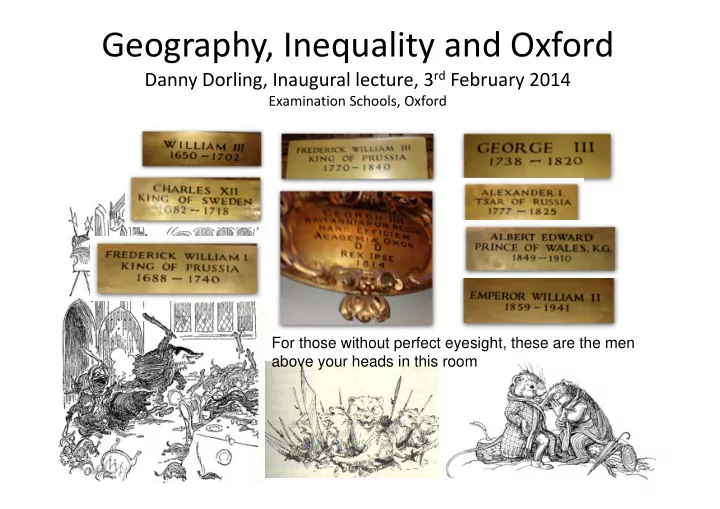
Geography, Inequality and Oxford Danny Dorling, Inaugural lecture, 3 rd February 2014 Examination Schools, Oxford For those without perfect eyesight, these are the men above your heads in this room Geography, Inequality and Oxford .on a


slide-1
SLIDE 1

Geography, Inequality and Oxford

Danny Dorling, Inaugural lecture, 3rd February 2014

Examination Schools, Oxford For those without perfect eyesight, these are the men above your heads in this room
slide-2
SLIDE 2

Geography, Inequality and Oxford

….on a tributary of the Thames 'W-e-ll,' replied the Rat, 'let me see. The squirrels are all right. AND the rabbits—some of 'em, but rabbits are a mixed lot. And then there's Badger, of

  • course. He lives right in the heart of it; wouldn't live anywhere else, either, if

you paid him to do it. Dear old Badger! Nobody interferes with HIM. They'd better not,' he added significantly. 'Why, who SHOULD interfere with him?' asked the Mole. 'Well, of course—there—are others,' explained the Rat in a hesitating sort of way. 'Weasels—and stoats—and foxes—and so on. They're all right in a way—I'm very good friends with them—pass the time of day when we meet, and all that—but they break out sometimes, there's no denying it, and then—well, you can't really trust them, and that's the fact.' The Mole knew well that it is quite against animal-etiquette to dwell on possible trouble ahead, or even to allude to it; so he dropped the subject. THE WIND IN THE WILLOWS, By Kenneth Grahame,

Author Of "The Golden Age," "Dream Days”, old boy of St. Edwards, etc.

slide-3
SLIDE 3

Why Geography matters now

(why it matters to me and to Oxford) 1) Geography: Is increasingly important for revealing inequalities, especially in wealth 2) Inequality: Has been rising in terms of health and wealth for a third of a century, but fastest in the last five years (since 2008) 3) Oxford: Is associated with the 1%, the ‘top cornflakes’, but widening inequalities are not in the interest of the vast majority of its students and staff (possibly over 99%)

Have you noticed your position has changed?

slide-4
SLIDE 4

Income of the rich 1910‐2009, UK

each line does not include the group above, but is the next richest group

50 100 150 200 250 300 350 400 450 1910 1920 1930 1940 1950 1960 1970 1980 1990 2000 1 in 10,000 1 in 1,000 less 0.01% 1 in 100 less 0.1% 1 in 10 less 1%

Multiples of mean average income received by the: 1908 Wind in the Willows published 1934 the two Cutteslowe walls built in time for Christmas 1959 the walls were demolished 2008 crash, temporary dip?

slide-5
SLIDE 5

Today our rising walls are invisible barriers. We don’t need deadly spikes to keep people out.

One of the two Cutteslow walls built to separate adults and children living in different types of housing in Oxford in 1934

slide-6
SLIDE 6

Same data, just another perspective

If there were no income inequality the red line would be at 10%, green at 1%....

Total share of all income in the UK received by the:

10 20 30 40 50 60 1910 1920 1930 1940 1950 1960 1970 1980 1990 2000 1 in 10 1 in 100 1 in 1,000 1 in 10,000

1934 the two Cutteslowe walls built in time for Christmas 1959 the walls were demolished < 18 years >

slide-7
SLIDE 7

wall I grew up in Oxford, some Time after the Cutteslow wall had been torn down but before the motorway to London had been finished; and before it again became as divided a city as it is today. This map from Olly O’Brien

  • f CASA shows the hierarchy

is much the same, but the gaps are now far wider between areas. M40 error My dad’s Practice Area

slide-8
SLIDE 8

Your postcode tells us more and more

When I was growing up in Oxford I used the same underpass to get to school each day. Years later I saw someone had drawn graffiti on its walls to indicate which entrance and exit lead to what rank of estate. "good puppies this way ‐ bad puppies that way" were the precise words used.

Me and my brothers sometime in the 1980s I am the shy one hiding at the back…

slide-9
SLIDE 9

You cannot easily escape your geography; mine was varied.

But it was not as varied as it is today around the same roundabout: 1) Schools 2) Jobs 3) Incomes 4) House prices 5) and mortality. Like the UK as a whole, Oxford was more equal. Green Road roundabout (underpass)

slide-10
SLIDE 10

In Olden Times (80s)

Oxford has always had wide inequalities but around 1991 and before that in the 1980s they were lower than we see today. Look at how low average equity was in housing 25 to 30 years ago (this is of residents, not landlords).

Brimblecombe, N., Dorling, D. and Shaw, M. (1999) Where the poor die in a rich city: the case of Oxford Health and Place, 5, 4, 287‐300

Average positive housing equity (£). And Standardized Mortality Ratio (SMR), 100 is national average rate.

slide-11
SLIDE 11

You can draw places as faces, then colour them in by how areas vote

I was born here, just to the west of the smile in the pink face. And moved to its right cheek! The pink face looks

  • lder because it has

smaller eyes. It relied

  • n older industry

when this was drawn using 1981 data.

These faces represent parliamentary constituencies. Their colour represents their political complexion and

  • ther facial features correspond to other attributes.
slide-12
SLIDE 12

Broaden your horizons and what you thought was variety looks bland

The happy pink face was quite an unusual place, not many places near it were like it. To the north, in the centre of Birmingham, life was more grim. Where the faces stop smiling is where unemployment was high when I was at school.

slide-13
SLIDE 13

Liverpool

Zoom out further and the picture was less rosy again

Oxford East Birmingham Yardley

slide-14
SLIDE 14

Chris Brunsdon, Stan Openshaw, Martin Charlton, me and Bruce Tether

We are all partly products of our travels

In 1989 I moved to Newcastle to study and met the people I would later start a PhD with and draw images like this

slide-15
SLIDE 15

Making the invisible visible

This map was drawn using data from 1981 and the election results of 1987. It shows a picture of a divided country that is very reminiscent today. For 99% of the people income inequalities are again similar to what they were shortly after this time. So perhaps all those faces in the south would not be so happy today?

slide-16
SLIDE 16

The colour triangle shows the colours for safe parliamentary seats and for marginal seats. The two faces show the extremes of facial features. Eye size shows the proportion of employed people in service industries, Nose size shows the percentage turnout of the electorate. Mouth shape shows the percentage unemployed. The fatness of the cheeks shows the mean housing

  • price. This form of mapping works because things cluster.
slide-17
SLIDE 17

Back in the early 1980s people were asked to take a step down, just as they were in 1931 and again as they are asked now

“Sacrifice” by James Francis Horrabin, Plebs Journal, 1931 In Leeds with Phil Rees and colleagues we calculated how many people in 2001 would have to move home if spatial polarization in Britain were to be reduced to the level in

  • 1971. The answer was

3.4%. To get rid of it completely would take 13.3% moving home.

slide-18
SLIDE 18

In 2005 in Sheffield Bethan Thomas and I used the census to assign each neighbourhood a score based on life

  • chances. We found that the middle was dropping out.

This graph shows how near to the UK average neighbourhoods are. If this was normally distributed, you would expect a bell-shaped

  • curve. Instead you find a skewed distribution

with the suggestion of twin peaks. An average neighbourhood is becoming less common. Benefit Street Wealth Row

slide-19
SLIDE 19

We need less subtle images now

2014: The 85 richest people in the world have the same wealth as the poorest half of all humanity (Oxfam). As your zoom in the scale

  • f inequality tends to
  • decrease. Here is a

summary for the UK where the 1% have half

  • f all liquid wealth.
slide-20
SLIDE 20

We have not been

  • ne of the world’s or

Europe’s largest centres of net immigration

Iain Banks, writer, 1954‐2013, final interview Net lifetime immigration Net lifetime emigration Source, worldmapper, 1945-2005 These are images from Worldmapper. The size of each country is proportional to their total net lifetime migration. Because this is

  • f net migration, none of the countries on

the upper map appear on the lower map which are those with net emigration. Western Europe is purple, and this blob is the UK, dwarfed by the rest of Europe

slide-21
SLIDE 21

Households with children in private renting, % in England 1984‐2012 We have turned into a country that is rapidly reverting back to its past. By now it is likely that more than a quarter of children in Britain live in families with a private

  • landlord. But we are not

becoming more European:

2008 Countries as different as Switzerland and the Netherlands are continuing to reduce inequality, steadily and slowly over time.

Figure 3.4 of Social Mobility and Child Poverty Commission (2013) State of the Nation 2013 October 2013, London: The Stationery Office https://www.gov.uk/government/ uploads/system/uploads/attachment_data/file/251213/State_of_the_Nation_2013.pdf

slide-22
SLIDE 22

Economic insecurity affects education

As economic inequality in the UK rose the countries which make it up began to slip down various international league tables. Our young adults are now less numerate than their contemporaries in almost all other OECD nations. This might explain why so few people appear to understand that only 1% of all can ever be in the 1%.

slide-23
SLIDE 23

Source: http://www.ifs.org.uk/comms/r81.pdf (Figure 3.17)

numeracy levels might explain why it is possible to instigate tax and benefit changes that harm almost everyone but in most cases those beneath you by a little more than you. However once wage cuts and stagnation are taken into account the 99% have equalized slightly.

slide-24
SLIDE 24

Who is most affected alters where is hit most by Tax (VAT) and multiple benefit changes In 2013 the children’s commissioner explained what is happening in the UK due to the nature

  • f cuts and austerity: “Families with children will

lose more of their income than families without

  • children. However, lone parents will lose the

most out of everyone”.

Office of the Children’s Commissioner (2013) A Child Rights Impact Assessment of Budget Decisions‐ children and young people's version, 27th June, http://www.childrenscommissioner.gov.uk/content/publications/content_701

slide-25
SLIDE 25

Source: Figure 4 in: http://pubs.aeaweb.org/doi/pdfplus/10.1257/jep.27.3.3

Geographical comparisons show that those countries which reduced top rate taxes the most since 1960s have seen the 1% gain the most since 1960. Currently the top 1% take 20% in the USA and near to 15% in the UK. The global race is run in different ways in different places

This graph shows how government policies rather than global market forces have changed the status quo in different countries since 1960.

slide-26
SLIDE 26

Some Thankyous

before turning to Oxford

Tony Champion, Mike Coombes, David Fairbairn, Ludi Simpson and Rachel Woodward. I have written and contributed to many books, but, to be honest, have had an extraordinary amount of help to do so. Anyone who has received an email from me will probably appreciate the obvious need for that.

slide-27
SLIDE 27

Thanks for helping with the spelling and showing me where to look

Dave Gordon, Ron Johnston, Dave Rossiter, Rich Mitchell, Jan Rigby, Ben Wheeler

slide-28
SLIDE 28

Anna Barford and Mark Newman The whole world sized by the profits made from financial exports as measured in 2005. Along with the UK, Luxembourg and Switzerland completely dominate the picture

http://www.bbc.co.uk/blogs/thereporters/markeaston/2009/04/map_of_the_week_checks_and_the.html And this is the world, then, by financial imports:

And the advanced maths and basic grammar that was beyond me…

…there is always someone who is better than you…

slide-29
SLIDE 29

Ben Hennig, Dimitris Ballas, Bethan Thomas, George Davey Smith, and Mary Shaw

…the thinking

slide-30
SLIDE 30

And the publishers

slide-31
SLIDE 31

And my parents and brothers

slide-32
SLIDE 32

http://www.guardian.co.uk/news/datablog/gallery/2013/feb/11/whats‐in‐a‐ name?CMP=twt_fd#/?picture=403827997&index=0

So let’s turn to Oxford: stereotypes are often based on

some truth: In producing statistics, a bit of lateral thinking can sometimes be quite revealing

slide-33
SLIDE 33

Acclaimed author, academic, and working class child, Marshall Berman said of his student days: “The experience of studying at Columbia, Oxford and Harvard was intellectually exciting but socially lonely. They all catered to the rich, to the current and wannabe ruling class, and I felt I didn’t fit in” Marshall’s 1960s student cohort, in their forties by the 1980s, mostly got to join – if not the ruling class – then at least the top 10% of society by income, which then saw, and partly arranged for themselves to pull away from the rest. That is not happening now. Only the 1% is now pulling away and that group is too small for all but a minority of graduates to fit into.

Loughan, S. Kuppens, P. et al. (2011) Economic Inequality Is Linked to Biased Self‐Perception, Psychological Science, 22, 10, 1254‐1258, http://www.psych.unimelb.edu.au/sites/live‐1‐14‐1.msps.moatdev.com/files/Loughnan%20Psych%20Sciene.pdf Homberger, E. (2013) Marshall Berman obituary, The Guardian, September 27th, http://www.theguardian.com/books/2013/sep/27/marshall‐berman

Stereotypes are often based on some truth

slide-34
SLIDE 34

The names of young women at Oxford, not compared to footballer’s wives and girlfriends, but to the norm.

slide-35
SLIDE 35

So now we worry again about privilege, as we did in the 1930s

The most prestigious one hundred schools in Britain, 84% of them private, secure 30% of all Oxbridge places. The national debate on higher education is often accused of being dominated by interest in entry to these two universities, but to many in the 1% (the only people with the financial means to be able to afford to seriously influence their chance of a place in those few schools) such entry really matters.

[Sutton Trust (2011) Degrees of Success: University Chances by Individual School, London: The Sutton Trust. On the 1930s and Oxbridge entry see Political Arithmetic: A Symposium of Population Studies (1938). Editor: Lancelot Hogben, just £13 from Abebooks.

slide-36
SLIDE 36

Our increasingly unequal society is tilting the playing field

On any given day a fifth of children in Britain qualify for free school meals, but only one in a hundred of those children get to go to either Oxford or Cambridge University . Given that four private schools (and one highly selective state sixth form college) send more children than do 2000

  • ther secondary schools to these two universities

that statistic is hardly surprising. And it reflects not the schools, but the society we have become.

Williams, Z. (2012) What's the point of social mobility? It still leaves some in the gutter, The Guardian, May 23rd, http://www.guardian.co.uk/commentisfree/2012/may/23/social‐mobility‐nick‐clegg Berg, S. (2011) Five schools 'send more to Oxbridge than 2,000 others', BBC News, July 8th, http://www.bbc.co.uk/news/education‐14069516 Sutton Trust (2011) Degrees of Success: University Chances by Individual School, London: The Sutton Trust., http://www.suttontrust.com/public/documents/sutton‐trust‐he‐destination‐report‐final.pdf

slide-37
SLIDE 37

And in the end it is about money

Data from Reay, D. (2012) What would a socially just education system look like? London: Centre for Labour and Social Studies. USA Private education in the UK is much less about an alternative approach to education and far more about segregation and financially loading the dice

slide-38
SLIDE 38

99% of us have reason to worry

Income inequality has now reached a new maximum and for the first time in a century even those just below the richest 1% are beginning to suffer, to see their disposable income drop. When you exclude the top 1%, income inequality within the rest of the population, within the 99%, is now lower than at any time since Mrs Thatcher was in power. Put in economist speak by the Institute for Fiscal Studies last year: “Over the past two decades … inequality among the bottom 99% has fallen: the Gini coefficient for the bottom 99% was 5% lower in 2011–12, at 0.30, than in 1991”

Cribb, J., Hood, A., Joyce, R. and Phillips, D. (2013) Living Standards, Poverty and Inequality in the UK: 2013, Institute for Fiscal Studies Report R81, (p. 30,45), http://www.ifs.org.uk/comms/r81.pdf, page 40

We are used to change being gradual, but sometimes you come to a point where the change is sudden, where it is possible to draw a line; the top 1% is such a point.

slide-39
SLIDE 39

Thanks to Mark Fransham for these maps To begin to bring this to an end take a look at how segregated the city of Oxford itself has become. NS‐SeC is what in the 1930s was called “Class”. the country and city was more equal when the University built more in concrete.

NS-Sec stands for the National Statistics Socio-economic Classification.

slide-40
SLIDE 40

There is an acute housing shortage in Oxford and yet there are areas where up to 5% of all homes are second homes.. A small town retreat for people who have their main residence elsewhere.

slide-41
SLIDE 41

Households in some parts of Oxford use twice as much electricity a year as in

  • ther areas.

These are average consumption rates for entire areas. Consumption rates for individual households vary to a far greater extent.

slide-42
SLIDE 42

Households in some parts of Oxford use as much as two and a half times more gas a year to heat their homes as in

  • ther areas.

Its not because the houses are bigger or more rooms in them are

  • ccupied.

It’s because they can.

slide-43
SLIDE 43

So what is to be done?

The elite is shrinking. It really is now only 1% of the population who are maintaining their very high standard of living. The majority of graduates, even from a university like Oxford, cannot expect to fit within that 1% even if they all wished to only do the kinds of jobs that pay so much. For the rest, for the majority of all

  • ur young people, either they should expect to see

their standards of living fall in future, while a few continue to consume more and more, or they need to learn how to better control the richest people in our

  • society. Don't control them and first they make the

poorest poorer, and then gradually work upwards.

slide-44
SLIDE 44

Increasing social exclusion began in places like Oxford in the 1960s (‘tipping

  • ut’). Then on a largest

scale in Westminster borough in the 1980s and is now expanding. The maps shows where in Oxford are people most likely to live who do not have 5 GCSE’s A‐C or the equivalent for their day (often a school certificate).

slide-45
SLIDE 45

GCSE’s now

Today’s school age children are much more than twice as likely to gain basic qualifications in some parts of the city as compared to

  • thers and this is

just the state school

  • divide. Now four

times as many children go private in Oxford than nationally.

slide-46
SLIDE 46

Our inequality experiment failed

Stefan Collini, the professor of 'English Literature and Intellectual History' at the University of Cambridge explained, when commenting on the latest international education statistics last year, that ‘….countries committed to high‐quality comprehensives, such as Finland, yet again come out on top. A stratified and class‐segregated school system is not the answer: it’s the problem.’ There is way too much hierarchy and stratification among UK schools. Across the European mainland children are far more used to almost all going to local state

  • schools. That may be because almost every other European

country is more economically equal than the UK.

Collini, S. (2013) This literacy report is not a story of England's national decline, The Guardian, October 8th, http://www.theguardian.com/commentisfree/2013/oct/08/oecd‐literacy‐report‐class‐failing‐schools Van den Bos, K., Van Lange, P. A. M., Lind, E. A., Venhoeven, L. A., Beudeker, D. A., Cramwinckel, F. M., Smulders, L., & Van der Laan, J. (2011). On the benign qualities of behavioural disinhibition: Because of the pro‐social nature of people, behavioural disinhibition can weaken pleasure with getting more than you deserve. Journal of Personality and Social Psychology, 101, 791‐811 http://www.paulvanlange.com/s/VandenBosetalJPSP2011.pdf

slide-47
SLIDE 47

Mortality inequality is large, but lower in Oxford than elsewhere, I suspect because many of the sick cannot afford to stay and people leave the orange areas on retirement. But there is absolutely no need for gaps of this size. They were nowhere near this in the 1980s.

420

Port Meadow BARTON SANDHILLS BOTL EY SUMMERTOWN QUARRY

A34 Western Bypass

WOLVERCOTE

Botley Road

South Park RISINGHURST

A34 Southern Bypass

OSNEY JERICHO ROSE HILL COWLEY LITTLEMORE BLACKBIRD LEYS

Abingdon Road

MARSTON HEADINGTON

A40 Northern Bypass C

  • w

le y R

  • a

d I ffley R

  • a

d H igh S tr e e t M ars t

  • n F

e r r y R

  • a

d A 41 4 2 E a s tern B y p a s s B anbu r y Roa d W

  • dst
  • c

k Roa d Win d mill Ro a d

City Centre

Least deprived areas

Difference in life expectancy at birth

  • 6.6 yrs
  • 8.3 yrs

Most deprived areas

Oxford by death

Longest life expectancy Shortest life expectancy

slide-48
SLIDE 48

But much has also got better in Oxford as compared to when I was a child. The National Front are largely gone (from here at least), the buses are out of Cornmarket and the city is one of the first to slowdown. Today 12.5 million people live in areas where cars travel more slowly. Although nationally pedestrian deaths on the road are still rising, but Oxford is ahead.

Thanks to Rod King and Ben Hennig for these slides

Pedestrian deaths as a % of all road crash deaths

slide-49
SLIDE 49

A population cartogram shows places with an area proportional to its population, in this case 20mph areas Bellow: All causes of death of 17 to 19 year olds, Britain (2006–07 deaths) Total 20 means having a default speed limit of 20mph in residential areas except for selected roads. The causes of death pie chart is for 17 to 19 year olds, but would look similar if it was from age 5 to age 25 years: Population cartogram showing 20mph places

Authorities doing Total 20 Authorities committed to Total 20 Authorities without action yet

slide-50
SLIDE 50

And some other things have got worse Sitting in an area of housing shortage between London and Birmingham Oxford is still not big enough to gets its own circle in this

  • diagram. Which is

partly why it has London housing

  • prices. And partly

why the roads

  • utside are so full.

This is a chart about total equity, not total housing value, so it is about the relative wealth of these places as much as about the cost of housing.

slide-51
SLIDE 51

Coming to Oxford has helped me finish off the next book with a little more anger than a Sheffield based academic might.. Its on housing The book begins:

“If people hoarded food on the basis that its value was sure to go up when others began to starve and would pay anything, we would stop their hoarding. But hoarding is now happening with shelter in the most unequal and affluent parts of the

  • world. Increasingly it is the financing of

housing that is our biggest problem: the mortgage or rent, the bills and the inequitable taxes.”

slide-52
SLIDE 52

Its not just the homeless, the bedroom tax, and tenants losing their rights. The book ends:

“In January 2014 the Financial Times released an analysis showing that over the course of just the last five years the equity of mortgage holders in Britain had fallen by £169 billion while that of landlords had risen by a massive £245 billion. There is no surer sign of a housing crisis turning into a disaster than this” … (the estate agent Savills used geographical mortgage data at postcode level to determine this). Landlords' total equity has more than doubled from £384bn a decade ago to £818bn today. The total equity of homeowners with mortgages has dropped by £169bn because on average buyers now borrow more.

  • K. Allen (2014) Personal Communication on "cash buyers versus mortgages, the Savills analysis", January 16th,

published as K. Allen, Home buyers left behind in Britain’s two‐speed housing market, Financial Times, January 18th

Effects of the cuts 2010-16

Oxfam (2012) The Perfect Storm

slide-53
SLIDE 53

“Mole knew well that it is quite against animal-etiquette to dwell on possible trouble ahead, or even to allude to it; so he dropped the subject” But moles are the kinds of animals that like sticking their heads in the ground. Conclusions: 1) Geography: Is increasingly important for revealing

  • ften invisible inequalities.

2) Inequality: Has been rising in terms of health and wealth for a third of a century, but fastest in the last five years (too early for published confirmation). 3) Oxford: Is associated with the 1%, but the vast majority of its students cannot fit within such a small elite; most of its staff see the cost of living crisis most acutely through their housing costs. Those costs are increasingly tribute payments to the 1%.

slide-54
SLIDE 54

Thank you for your patience!

Schoolchildren walk through the newly broken down wall in Cutteslow in

  • 1959. Picture courtesy of Jean Stubbs

(one of the teachers in the picture).

http://www.eyes-and- ears.co.uk/pennine/details.asp?Title=The%20Cutteslowe%20Walls

http://www.bbc.co.uk/oxford/content/articles/2009/03 /26/cutteslowe_feature.shtml

In 1934 it may have been almost impossible to imagine how many walls could be pulled down in the next 25 years as equality rose.