
SLIDE 1
Georgia Regents University/ East Georgia State College Collaboration - - PowerPoint PPT Presentation
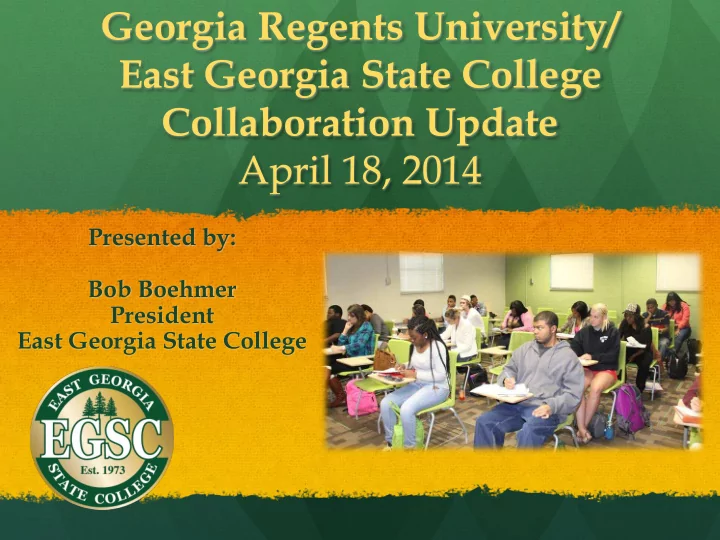
Georgia Regents University/ East Georgia State College Collaboration Update April 18, 2014 Presented by: Bob Boehmer President East Georgia State College A Promising Collaboration Between Two Fundamentally Different Institutions GRU
Mission
Selective Undergraduate and Graduate Research and Teaching
Funding per FTE
$14,462 per FTE
Mission
Open Access Undergraduate Teaching Typical course load is 15-16 credit hours
Funding per FTE
$2,634 per FTE
GRU/EGSC Collaboration 2
GRU/EGSC Collaboration 5
Gender Fall 2013 Spring 2014
Black
Female 39 50 Male 15 26
White
Female 15 26 Male 16 25
Asian
Male 1 1 Female 1 1
Other
Female 6 6
Male 3 4 Total 96 139
Statesboro
Spring 2014 Black 45% White 46%
Swainsboro
Spring 2014 Black 30% White 55%
Augusta
Spring 2014 Black 55% White 35%
GRU/EGSC Collaboration 6
Consider
Applications for fall 2013 135 applications 98 registrations (73%) Compare 52% Statesboro 44% Swainsboro Applications for spring 2014 95 applications 60 registrations (60%) Compare 46% Statesboro 45% Swainsboro
Compare
Applications for summer 2014 27 As of 04/14/2014 Applications for fall 2014 180 As of 04/14/2014
GRU/EGSC Collaboration 7
Who are the Full-Time Faculty?
Cook, Sally R. (F)
READ 0099 Learning Support Reading (4 hours D) GAC 1100 Student Success (1 hour UN) Master of Education: Reading (Augusta State University, 1990) Bachelor of Science: Urban Planning (Georgia State University, 1971)
Edgens, Jefferson Gordon (F)
POLS 1101 American Government (3 hours UT) Doctorate degree: Environmental Policy (Michigan State University, 1997) Master's degree: Public Administration (University of West Florida, 1992) Bachelor's degree: History (Presbyterian College, 1989)
Lane, Cynthia (F)
HIST 2101 U.S. History to 1865 (3 hours UT) HIST 2102 U.S. History since 1865 (3 hours UT) Master of Education: Secondary Ed (Augusta State University, 1996) Bachelor of Arts: History/ Political Science (Augusta College,1976) Education Specialist: History (Augusta State University, 2007)
Van Blount II, Linden (F)
ENGL 0099 Learning Support English (4 hours D) ENGL 1101 English Composition I (3 hours UT) Master of Arts: English Literature (University of Georgia, 2010) Bachelor of Arts: English Literature Bachelor of Science: Biology (Augusta State University, 2007)
Veldboom, Betsy V. (F)
MATH 0099 Learning Support Math (4 hours D) MATH 1111 College Algebra (3 hours UT) Masters of Education in Mathematics (Augusta State University, 2002) Bachelor of Science: Mathematics (Augusta State University,1999)
In addition to approximately 5 part time faculty
Jeff Edgens Director Ph.D. Michigan State University Nick Kelch Assistant Director M.A. Victory Christian College Elizabeth Henry ACE Coordinator Ph.D. Georgia State University Edward Floyd ACE tutor B.S. University of the South Charlene Blankenship Admin. Assistant Certificate Barr Business School
GRU/EGSC Collaboration 9
GRU/EGSC Collaboration 10
GRU/EGSC Collaboration 11
Payne Hall Administrative Offices and ACE Galloway Hall Classrooms
GRU/EGSC Collaboration 12
Payne Hall This 1800 square foot area consists of offices for the director, assistant director, administrative assistant, part time faculty space, storage space, and the ACE. In the near future, faculty will move from prior ASU offices to this space in Payne Hall. At that time, ACE will move to Galloway.
GRU/EGSC Collaboration 13
Campus Dates CRN Course Sec Title CR Enr Max
RU 06-JAN-14 - 28-APR-14 20433 ART 1100 R Introduction to Art 3 23 30 RU 06-JAN-14 - 28-APR-14 20434 ART 1100 RA Introduction to Art 3 4 30 RU 06-JAN-14 - 28-APR-14 20447 BIOL 1103 R Introductory Biology I 4 3 28 RU 06-JAN-14 - 28-APR-14 20464 EGAC 1100 R Student Success 1 4 35 RU 06-JAN-14 - 28-APR-14 20465 EGAC 1100 RA Student Success 1 13 35 RU 06-JAN-14 - 28-APR-14 20466 EGAC 1100 RB Student Success 1 22 35 RU 06-JAN-14 - 28-APR-14 20467 EGAC 1100 RC Student Success 1 8 35 RU 06-JAN-14 - 28-APR-14 20435 ENGL 0099 R Learning Support English 4 11 25 RU 06-JAN-14 - 28-APR-14 20438 ENGL 1101 R Composition I 3 25 25 RU 06-JAN-14 - 28-APR-14 20504 ENGL 1101 RA Composition I 3 22 25 RU 06-JAN-14 - 28-APR-14 20436 ENGL 1102 R Composition II 3 25 25 RU 06-JAN-14 - 28-APR-14 20437 ENGL 1102 RA Composition II 3 28 25 RU 06-JAN-14 - 28-APR-14 20453 HIST 2111 R U.S. History to 1865 3 27 35 RU 06-JAN-14 - 28-APR-14 20454 HIST 2112 R U.S. History since 1865 3 31 35 RU 06-JAN-14 - 28-APR-14 20442 MATH 0099 R Learning Support Math II 4 26 30 RU 06-JAN-14 - 28-APR-14 20443 MATH 0099 RA Learning Support Math II 4 10 30 RU 06-JAN-14 - 28-APR-14 20444 MATH 1111 R College Algebra 3 25 35 RU 06-JAN-14 - 28-APR-14 20445 MATH 1111 RA College Algebra 3 23 35 RU 06-JAN-14 - 28-APR-14 20513 MILS 1021 B Military Science at Augusta 3 2 RU 06-JAN-14 - 28-APR-14 20439 MUSC 1100 R Music Appreciation 3 18 30 RU 06-JAN-14 - 28-APR-14 20455 POLS 1101 R American Government 3 23 35 RU 06-JAN-14 - 28-APR-14 20456 POLS 1101 RA American Government 3 14 35 RU 06-JAN-14 - 28-APR-14 20460 PSYC 1101 R General Psychology 3 34 35 RU 06-JAN-14 - 28-APR-14 20461 PSYC 1101 RA General Psychology 3 31 35 RU 06-JAN-14 - 28-APR-14 20441 READ 0099 RA Learning Support Reading 4 4 25 RU 06-JAN-14 - 28-APR-14 20462 SOCI 1101 R Introduction to Sociology 3 20 35 RU 06-JAN-14 - 28-APR-14 20463 SOCI 1101 RA Introduction to Sociology 3 22 35
Our focus is Areas A, C, and E of the Core, and our intent is to expand course
based on student need.
GRU/EGSC Collaboration 14
GRU/EGSC Collaboration 15
GRU/EGSC Collaboration 16
GRU/EGSC Collaboration 17
Enrollment Minority enrollment Credit hours completed Retention rate GPA Success rate in key courses at EGSC Students ready for transfer to GRU Success following transfer to GRU
GRU/EGSC Collaboration 18
GRU/EGSC Collaboration 19
Number of Students Military Target Military Actual Non- Military Minority Target Non- Military Minority Actual Non- Military White Target Non- Military White Actual Fall 2013 20 85 62 95 31 Spring 2014 27 1 73 82 80 51
GRU/EGSC Collaboration 20
Note: some students choose not to report race
Target number of credit hours to be completed per student through spring 2015 is 30 This assumes approximately 12 hours attempted each semester for fall and spring This assumes an approximate 2/3 success rate in those courses Students must successfully complete 7.5 hours per semester of credit to achieve this target Actual number of credit hours completed per student in the first semester was 8.47 12.9 attempted 11.67 passed 8.47 earned (does not include learning support) Compare 8.46 Swainsboro 8.12 Statesboro
GRU/EGSC Collaboration 21
Actual retention rate was 84.38%
74.74% Swainsboro 72.58% Statesboro
GRU/EGSC Collaboration 22
Target GPA for fall 2013 was 2.10 Actual GPA was 2.07 Compare 2.52 Swainsboro 2.10 Statesboro Target success rate in specific courses Target for ENGL 1011 for FY 2014 is 30% Actual for fall 2013 was 86.21% Compare 76.27% Swainsboro 60.5% Statesboro Target for MATH 1111 for FY 2014 is 30% Actual for fall 2013 was 63.27% Compare 42.94% Swainsboro 60.95% Statesboro
GRU/EGSC Collaboration 23
Actual number ready for transfer is yet to be known
Must have at least 30 hours and 2.0 GPA Estimated number who will be ready for transfer at that point in time is 8
GRU/EGSC Collaboration 24
1st term GPA at GRU with an institutional GPA of at least 2.0 2nd term GPA at GRU with an institutional GPA of at least 2.2 (cumulative) 80 of the cohort to register for at least 15 credit hours in each of their first two GRU semesters
GRU/EGSC Collaboration 25
GRU/EGSC Collaboration 26
GRU/EGSC Collaboration 27
Specifically – a science lab for BIOL 1107 and ISCI 1101 is needed now. Classrooms to be fully utilized in Galloway Hall at night and on weekends as numbers increase Expect to see faculty triple in Payne Hall within two
need additional space after 2016.
GRU/EGSC Collaboration 28
Questions? Comments?
GRU/EGSC Collaboration 29