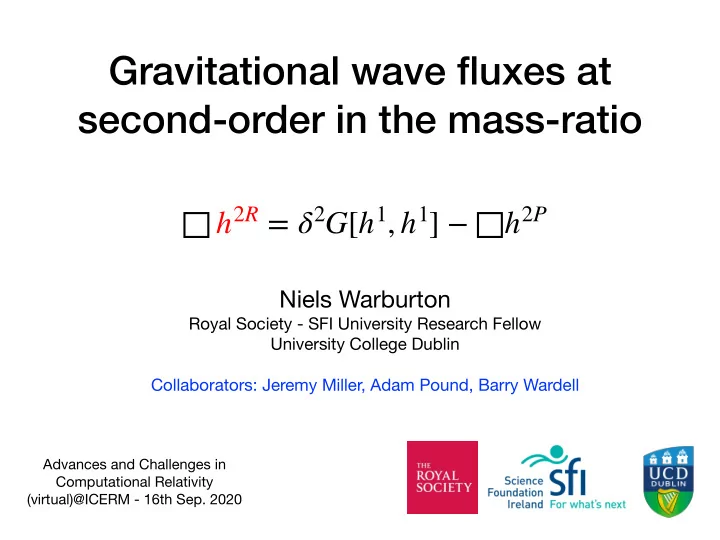
Gravitational wave fluxes at second-order in the mass-ratio h 2 R = - - PowerPoint PPT Presentation

gravitational wave fluxes at second order in the mass
SMART_READER_LITE
LIVE PREVIEW

Gravitational wave fluxes at second-order in the mass-ratio h 2 R = - - PowerPoint PPT Presentation

Gravitational wave fluxes at second-order in the mass-ratio h 2 R = 2 G [ h 1 , h 1 ] h 2 P Niels Warburton Royal Society - SFI University Research Fellow University College Dublin Collaborators: Jeremy Miller, Adam Pound, Barry


slide-1
SLIDE 1

Gravitational wave fluxes at second-order in the mass-ratio

Advances and Challenges in Computational Relativity (virtual)@ICERM - 16th Sep. 2020

Niels Warburton

Royal Society - SFI University Research Fellow University College Dublin Collaborators: Jeremy Miller, Adam Pound, Barry Wardell

□ h2R = δ2G[h1, h1] − □h2P

slide-2
SLIDE 2

Overview

Motivation Structure of the calculation Comparison with PN Comparison with NR

slide-3
SLIDE 3

Motivation: extreme mass-ratio inspirals

Image credit: A. Pound

  • Binary with an extremely small 


mass ratio

  • Primary: massive black hole
  • Secondary: compact object such as a


stellar-mass black hole, neutron star

  • For LISA EMRIs: = 10-4 - 10-7

ϵ = m2/m1 ≪ 1 ϵ

Key Features:

  • Millihertz gravitational-wave source
  • Over 100,000+ orbits in strong field
  • Visible for months to years in LISA band
  • No spin alignment expected
  • Considerable eccentricity
  • Rich waveform phenomenology
  • Very low instantaneous SNR in LISA

m2 m1

slide-4
SLIDE 4

Motivation: intermediate mass-ratio inspirals

IMRIs: ϵ ≃ 10−2 − 10−4 For quasi-circular inspirals into non-rotating black holes there is evidence that the perturbation theory results can be very effective even at large mass ratios

Periastron advance: Le Tiec+, arXiv:1106.3278 Waveform phase: van de Meent + Pfeiffer, arXiv:2006.12036

slide-5
SLIDE 5

Black Hole Perturbation Theory

A key question in any perturbative expansion is: how high in the expansion do I need to go in order to capture the physics I am interested in?

Good enough for detection and rough parameter estimation for astrophysics of EMRIs of bright sources From the orbit averaged piece

  • f first-order self-force ⟨Fα

1⟩

can be related to the fluxes, thus avoiding a local calculation of the self-force

⟨Fα

1⟩

Adiabatic

Needed for precision tests of GR Potential application to IMRIs Two contributions:

  • Oscillatory pieces of the first
  • rder self-force
  • Second-order orbit averaged

self-force ⟨Fα

2⟩

Needed to extract all sources

Post-Adiabatic order

Φ = ϵ−1Φ−1 + Φ0 + 𝒫(ϵ)

Waveform phase:

slide-6
SLIDE 6

Black Hole Perturbation Theory: field equations

Gαβ[¯ gαβ + ϵh(1)

αβ + ϵ2h(2) αβ ] = 8πTαβ

ϵ0 : Gαβ[¯ g] = 0

ϵ1 : G1

αβ[h1] = 8πTαβ

ϵ2 : G1

αβ[h2] + G2 αβ[h1, h1] = 0

Field equations from coefficients:

ϵn

slide-7
SLIDE 7

Black Hole Perturbation Theory: field equations

Gαβ[¯ gαβ + ϵh(1)

αβ + ϵ2h(2) αβ ] = 8πTαβ

ϵ0 : Gαβ[¯ g] = 0

ϵ1 : G1

αβ[h1] = 8πTαβ

ϵ2 : G1

αβ[h2] = − G2 αβ[h1, h1]

Field equations from coefficients:

ϵn

slide-8
SLIDE 8

Black Hole Perturbation Theory: field equations

Gαβ[¯ gαβ + ϵh(1)

αβ + ϵ2h(2) αβ ] = 8πTαβ

ϵ0 : Gαβ[¯ g] = 0

ϵ1 : G1

αβ[h1S + h1R] = 8πTαβ

ϵ2 : G1

αβ[h2S + h2R] = − G2 αβ[h1, h1]

Field equations from coefficients:

ϵn

slide-9
SLIDE 9

Black Hole Perturbation Theory: field equations

Gαβ[¯ gαβ + ϵh(1)

αβ + ϵ2h(2) αβ ] = 8πTαβ

ϵ0 : Gαβ[¯ g] = 0

ϵ1 : G1

αβ[h1R] = 8πTαβ − G1 αβ[h1S]

ϵ2 : G1

αβ[h2R] = − G2 αβ[h1, h1] − G1 αβ[h2S]

uβ∇βuα = Fα

self[∇h1R, ∇h2R]

Equations of motion Mino, Sasaki, Tanaka 1997 Quinn and Wald 1997 MiSaTaQuWa equations Pound 2012 Gralla 2012 Field equations from coefficients:

ϵn

  • Non-compact
  • Diverges at the particle
slide-10
SLIDE 10

Frequency domain implementation

We perform a two-timescale expansion by introducing a “slow time” . This allows for a frequency domain decomposition:

˜ t = ϵt

By evaluating at infinity we can compute the second-

  • rder flux to infinity

R2R ℱ(2)

□0 R2R = 2δ2G0 − □0R2P − □1R1

Hereafter we focus on quasi-circular inspirals into a Schwarzschild black hole Work in the Lorenz gauge and solve radial equations

  • n hyperboloidal slices

∇β¯ hαβ = 0

∂˜

th1 = ·

r0∂r0h1

From the monopole mode we can calculate the second-order binding energy: Phys. Rev. Lett. 124 2, 021101, arXiv:1908.07419

See Miller+Pound, arXiv:2006.11263 for TT details

slide-11
SLIDE 11

Expansion in the symmetric mass ratio

So far we have been expanding using the small mass-ratio ϵ = m2/m1 Let’s also introduce the large mass-ratio and the symmetric mass-ratio:

q = m1/m2 = 1/ϵ

ν = m1m2 M2 = q (1 + q)2 where M = m1 + m2 Also instead of parametrising the orbit by we will use

r0 x = (MΩ)2/3

ℱ(r0, ϵ) = ϵ2 · E(1)(r0) + ϵ3 · E(2)(r0) + O(ϵ4)

Using these definitions we can rewrite the form

ℱ(x, ν) = ν2 · E(1)

ν (x) + ν3 ·

E(2)

ν (x) + O(ν4)

where ·

E(1)

ν = ·

E(1), · E(2)

ν = ·

E(2)

ν ( ·

E(1), · E(2), d · E(1)/dx)

slide-12
SLIDE 12

Comparison with post-Newtonian theory

For this talk, let’s look at the mode

l = 3, m = 1

ℱPN

31 = (

ν2 1260 − ν3 315 ) x6 + (− 4ν2 945 + ν3 63+ 4ν4 945) x7 + ( πν2 630 − 2πν3 315 ) x15/2 + O(x8) The (3,3) and (3,1) fluxes were derived to 3.5 PN order in Faye+ arXiv:1409.3546 We want to compare agains the pieces of this

O(v3)

ℱ(2)PN

31

= − x6 315 + x7 63 − 2 315 πx15/2 − 1291x8 31185 + 13 420 πx17/2 +x9 ( 26 log(x) 6615 − 389π2 120960 + 52γ 6615 − 117030737 7945938000 − log2(1024) 7875 + 4 log2(2) 315 + 52 log(2) 6615 ) + O(x19/2)

This is all the known terms at for the (3,1) mode up to 3.5PN

O(ν3)

slide-13
SLIDE 13

Comparison with post-Newtonian theory

ℱ(2)PN

31

= − x6 315 + x7 63 − 2 315 πx15/2 − 1291x8 31185 + 13 420 πx17/2 +x9 ( 26 log(x) 6615 − 389π2 120960 + 52γ 6615 − 117030737 7945938000 − log2(1024) 7875 + 4 log2(2) 315 + 52 log(2) 6615 ) + O(x19/2)

0.02 0.05 0.10 0.20 10-17 10-15 10-13 10-11 10-9 10-7 x=(M )2/3

  • (2)

(l,m)=(3,1)

slide-14
SLIDE 14

Comparison with post-Newtonian theory

ℱ(2)PN

31

= − x6 315 + x7 63 − 2 315 πx15/2 − 1291x8 31185 + 13 420 πx17/2 +x9 ( 26 log(x) 6615 − 389π2 120960 + 52γ 6615 − 117030737 7945938000 − log2(1024) 7875 + 4 log2(2) 315 + 52 log(2) 6615 ) + O(x19/2)

0.02 0.05 0.10 0.20 10-17 10-15 10-13 10-11 10-9 10-7 x=(M )2/3

  • (2)

(l,m)=(3,1)

slide-15
SLIDE 15

Comparison with post-Newtonian theory

ℱ(2)PN

31

= − x6 315 + x7 63 − 2 315 πx15/2 − 1291x8 31185 + 13 420 πx17/2 +x9 ( 26 log(x) 6615 − 389π2 120960 + 52γ 6615 − 117030737 7945938000 − log2(1024) 7875 + 4 log2(2) 315 + 52 log(2) 6615 ) + O(x19/2)

0.02 0.05 0.10 0.20 10-17 10-15 10-13 10-11 10-9 10-7 x=(M )2/3

  • (2)

(l,m)=(3,1)

slide-16
SLIDE 16

Comparison with post-Newtonian theory

ℱ(2)PN

31

= − x6 315 + x7 63 − 2 315 πx15/2 − 1291x8 31185 + 13 420 πx17/2 +x9 ( 26 log(x) 6615 − 389π2 120960 + 52γ 6615 − 117030737 7945938000 − log2(1024) 7875 + 4 log2(2) 315 + 52 log(2) 6615 ) + O(x19/2)

0.02 0.05 0.10 0.20 10-17 10-15 10-13 10-11 10-9 10-7 x=(M )2/3

  • (2)

(l,m)=(3,1)

slide-17
SLIDE 17

Comparison with post-Newtonian theory

ℱ(2)PN

31

= − x6 315 + x7 63 − 2 315 πx15/2 − 1291x8 31185 + 13 420 πx17/2 +x9 ( 26 log(x) 6615 − 389π2 120960 + 52γ 6615 − 117030737 7945938000 − log2(1024) 7875 + 4 log2(2) 315 + 52 log(2) 6615 ) + O(x19/2)

|-0.15 x19/2| reference line 0.02 0.05 0.10 0.20 10-17 10-15 10-13 10-11 10-9 10-7 x=(M )2/3

  • (2)

(l,m)=(3,1)

Can estimate unknown PN terms

O(ν3)

slide-18
SLIDE 18

Comparison with numerical relativity

For this comparison it’s useful to consider the flux normalised by the leading PN coefficient, e.g., for the (2,2) PN flux we have ̂ ℱPN

22 = ℱPN 22

ℱ0PN

22

= 1 + 1 21 (55ν − 107)x + 4πx3/2 + O (x2) ℱPN

22 = 32ν2x5

5 + 32 105 ν2(55ν − 107)x6 + 128 5 πν2x13/2 + O (x7) To compute the NR flux we write the waveform as hlm(t) = Alm(t)eiΦlm(t) ℱNR

lm (t) =

1 16π | · hlm(t)|2 x(t) = (M · Φ(t)/m)2/3 From these two we can compute ℱNR

lm (x)

slide-19
SLIDE 19

Comparison with numerical relativity

3.5PN 0.05 0.10 0.15 0.20 0.82 0.84 0.86 0.88 0.90 0.92 0.94 x=(M )2/3 /0 PN (l,m)=(2,2) q=10 innermost stable circular orbit

3.5PN series from Faye+ arXiv:1204.1043

slide-20
SLIDE 20

Comparison with numerical relativity

3.5PN NR 0.05 0.10 0.15 0.20 0.82 0.84 0.86 0.88 0.90 0.92 0.94 x=(M )2/3 /0 PN (l,m)=(2,2) q=10 innermost stable circular orbit

3.5PN series from Faye+ arXiv:1204.1043 NR data from SXS:BBH:1132

slide-21
SLIDE 21

Comparison with numerical relativity

3.5PN NR 1GSF 0.05 0.10 0.15 0.20 0.82 0.84 0.86 0.88 0.90 0.92 0.94 x=(M )2/3 /0 PN (l,m)=(2,2) q=10 innermost stable circular orbit

3.5PN series from Faye+ arXiv:1204.1043 NR data from SXS:BBH:1132

slide-22
SLIDE 22

Comparison with numerical relativity

3.5PN NR 1GSF 2GSF 0.05 0.10 0.15 0.20 0.82 0.84 0.86 0.88 0.90 0.92 0.94 x=(M )2/3 /0 PN (l,m)=(2,2) q=10 innermost stable circular orbit

3.5PN series from Faye+ arXiv:1204.1043 NR data from SXS:BBH:1132

slide-23
SLIDE 23

Comparison with numerical relativity

NR data from SXS:BBH:1132

Equal mass binaries: q = 1, ν = 1/4

3.5PN NR 1GSF 2GSF 0.05 0.10 0.15 0.20 0.82 0.84 0.86 0.88 0.90 0.92 0.94 x=(M )2/3 /0 PN (l,m)=(2,2) q=1 innermost stable circular orbit

3.5PN series from Faye+ arXiv:1204.1043

slide-24
SLIDE 24

Comparison with numerical relativity

Higher modes

3.5PN NR 1GSF 2GSF 0.05 0.10 0.15 0.20 0.6 0.7 0.8 0.9 1.0 x=(M )2/3

  • (l,m)=(4,4)

q=10 innermost stable circular orbit

slide-25
SLIDE 25

Comparison with numerical relativity

Higher modes

Why does the second-order flux not compare well against NR for the (4,4)-mode? ℱPN,leading

44

= 8192 567 (ν2 − 6ν3+9ν4) x7 Compare this with the PN series for the (2,2)-mode:

ℱPN

22 = 32ν2x5

5 + 32 105 ν2(55ν − 107)x6 + 128 5 πν2x13/2 + 8 (19136ν2 − 87691ν3+23404ν4) x7 6615 + O (x15/2)

ℱ2GSF,resum

44

= [ ν2 · E1GSFν

44

+ ν3 · E2GSFν

44

ℱPN,leading

44

+ O(ν4)] ℱPN,leading

44

This ensures that

̂ ℱ2GSF,resum

44

= 1 + …

We can try a simple resummation to include some information from the PN series

νn≥4

slide-26
SLIDE 26

Comparison with numerical relativity

Higher modes

3.5PN NR 1GSF 2GSF 0.05 0.10 0.15 0.20 0.6 0.7 0.8 0.9 1.0 x=(M )2/3

  • (l,m)=(4,4)

q=10 innermost stable circular orbit

slide-27
SLIDE 27

Comparison with numerical relativity

Higher modes

3.5PN NR 1GSF 2GSF 2GSF,resum 0.05 0.10 0.15 0.20 0.6 0.7 0.8 0.9 1.0 x=(M )2/3

  • (l,m)=(4,4)

q=10 innermost stable circular orbit

slide-28
SLIDE 28

Comparison with numerical relativity

Higher modes

lm

2 GSF

lm

2 GSF,resum

0.10 0.12 0.14 0.16 5.×10-4 0.001 0.005 0.010 x |1-lm/lm

NR|

(l,m)=(2,2) 0.10 0.12 0.14 0.16 5.×10-4 0.001 0.005 0.010 x (l,m)=(3,3) 0.10 0.12 0.14 0.16 0.001 0.005 0.010 0.050 0.100 x (l,m)=(4,4)

Pure 2GSF comparison with NR worsens for higher

  • modes
  • suggests that 2GSF comparison will be worse for orbits with lots of power

in higher modes, e.g., highly eccentric or strong-field Kerr orbits

(l, m)

But… higher modes contribute less to the total flux and it seems a simple resummation can give large improvements

slide-29
SLIDE 29

Comparison with SEOBNRv4

Currently SXS catalogue has no entries for . We can compute waveforms for higher from approximants, e.g., SEOBNRv4

q > 10 q

3.5PN 1GSF 2GSF SEOBNRv4

0.00 0.05 0.10 0.15 0.80 0.82 0.84 0.86 0.88 0.90 0.92 0.94 x=(M )2/3 /0 PN (l,m)=(2,2) q = 30, =0.031 innermost stable circular orbit

0.06 0.08 0.10 0.12 0.14 0.16

  • 5. ×10-5
  • 1. ×10-4
  • 5. ×10-4

0.001 0.005

  • Rel. Diff. |1-2 GSF/SEOBNRv4|
slide-30
SLIDE 30

Summary

We can compute the second-order metric perturbation The second-order flux agree with PN We see nice agreement with NR even for small q Comparison with high NR simulations? Calibration of approximants? Horizon flux, local force and check the balance law Waveform (+transition to plunge?) Conservative invariants Kerr and eccentric orbits

q

Future work

slide-31
SLIDE 31

Extra slides

2GSF 1GSF PN SEOBNRv4

0.00 0.05 0.10 0.15 0.20 0.80 0.82 0.84 0.86 0.88 0.90 0.92 0.94 x=(M )2/3 /0 PN (l,m)=(2,2) q = 100, =0.0098 innermost stable circular orbit

0.06 0.08 0.10 0.12 0.14 0.16

  • 5. ×10-6
  • 1. ×10-5
  • 5. ×10-5
  • 1. ×10-4
  • 5. ×10-4

0.001 0.005

  • Rel. Diff. |1-2 GSF/SEOBNRv4|