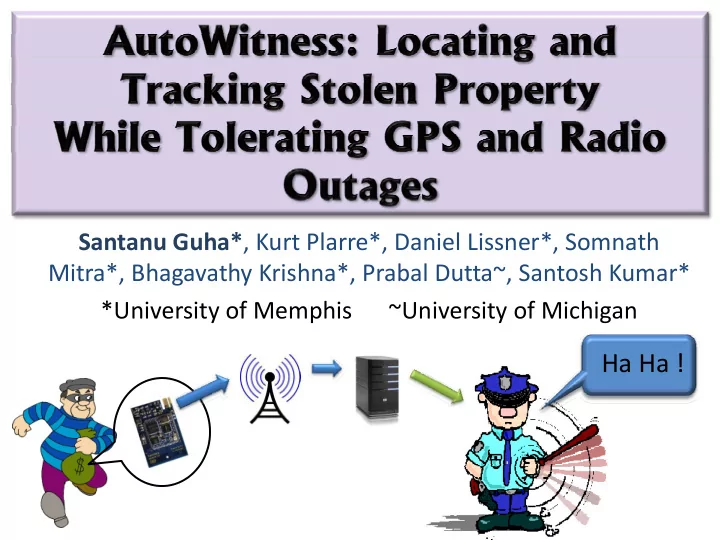
SLIDE 1 Santanu Guha*, Kurt Plarre*, Daniel Lissner*, Somnath Mitra*, Bhagavathy Krishna*, Prabal Dutta~, Santosh Kumar* *University of Memphis ~University of Michigan
Ha Ha !
SLIDE 2
In United States: Over 2 million reported burglaries in 2009 ~ An average $ 2000 loss per incident
SLIDE 3
- Either deter or detect burglary incidents
Existing Theft Detection Systems
SLIDE 4
- Radio Outages
- Unsuitable for smaller assets
Existing Tracking Systems
SLIDE 5
We need a system that is…
Immune to Radio Outages 1 year 2 years Stealthy Long Life
SLIDE 6 Our “AutoWitness” system
Detects Burglary Autonomously
- Using Vehicular Movement as an identifier
- f theft
Tracks Asset, Pinpoints Final Location
- Using a HMM based model to track burglars
using only inertial estimates.
SLIDE 7
AutoWitness Tag Node Server
Embedded in expensive items Used for Map Matching
SLIDE 8
SLIDE 9
How does AutoWitness work ?
Autonomous Detection of Burglary by the Tag Node
SLIDE 10
Vehicular Movement Indicates Theft
SLIDE 11
How does AutoWitness work ?
Autonomous Detection of Burglary by the Tag Node Detection of Theft initiates tracking of assets
SLIDE 12 Cell Tower Map Matching
AutoWitness Server
SLIDE 13
How does AutoWitness work?
Autonomous Detection of Burglary by the Tag Node Detection of Theft initiates tracking of assets Track is provided to law enforcement officials when cell tower is available completing the process of asset recovery
SLIDE 14 Cell Tower Map Matching
AutoWitness Server Asset Location
SLIDE 15 Thank you AutoWitness !
- Classifies Theft by Detecting
Vehicular Signature
- Produce inertial estimates using
accelerometers and gyroscopes
- Computes track of burglar using
a HMM
SLIDE 16 Key System Challenges: AutoWitness
Real Life Deployment presents several system challenges
Challenges
SLIDE 17
Key System Challenges: Tag Node
Producing Accurate Inertial Estimates Choosing appropriate Hardware Re‐orientating Tag Node
Developing Theft Classifier
SLIDE 18 Choice of Hardware for Tag Node
Vibration Dosimeter
- Filters out insignificant vibrations and
prolongs tag node lifetime Wake Up Circuit
SLIDE 19
- 3 axis accelerometer
- 3 axis Gyroscope
Distance = d Angle = Θ
Choice of Hardware for Tag Node
SLIDE 20 Choice of Hardware for Tag Node
All integrated in a Epic Core Platform Cell Tower AutoWitness Server
Choice of Hardware for Tag Node
SLIDE 21
Light Weight detection of burglary on Tag Node
Vehicular movement is taken as indicator of theft
Significant Vibrations Accelerometers Decision Tree Theft
Extensive Data Collected for different movement scenarios
Classifier Built using 10 fold cross validation in Weka
SLIDE 22 Producing accurate inertial estimates
- Distance Computation using inertial sensors
‐ Remove noise ‐ Re‐orient Tag Node ‐ Correct for Radial Acceleration ‐ Correct for drift
Producing Accurate Inertial Estimates
SLIDE 23 Distance Computation
Noise
Mean between stops to correct drift
Integrate
Also remove component radial acceleration for curves
SLIDE 24
Distance Computation
All Filtration Steps No Reorientation No Radial Acceleration Correction No Drift Correction Distance Error < 12.6 %
SLIDE 25
Key System Challenges: Server Side
Using only Inertial Estimates Reconstruct the path driven by burglar Pinpoint the asset’s final location
SLIDE 26
Hidden Markov Model Reconstruct Path driven by Burglar
Start State i State j Observable i P (Si|Start) P (State j|State i) P (Oi|State i) Existing Systems using HMM for map matching require GPS coordinates as inputs
SLIDE 27 Start Probabilities
No of Intersections = 4 Start Probability = 1/4 Start states emerge from Intersections within uncertainty range
Stolen item
location
SLIDE 28 Transition Probabilities (TPs)
We want to assign TPs Gets highest TP since closest to measured distance Gets TP proportional to their distance from actual measured dist From the system’s perspective
d
Error Range of Distance Computation
States are Road Segments
SLIDE 29
Observables
Speed of the Car ? Curvatures of Roads ? Sequence of distances between every pair of turns and/or stops experienced by the burglar’s car
SLIDE 30 Let’s say there are two road segments of identical length
Road Segment A Road Segment B
Discrimination using location
- f traffic lights on roads
SLIDE 31
Real Life Test
SLIDE 32
Real Life Test‐Return Path
SLIDE 33 Set up for the evaluations:
- We used Openstreetmap.org GIS data base
- Chose 100 different locations through out the
city as our starting locations
- Fort each stating location chose 10 different
directions for a fixed travelled distance
- Created synthetic paths from the database
marking a set of intersections as STOP
Evaluations at Scale
SLIDE 34
Evaluations of Map Matching
Stopping Sequence, Localization at Destination Max Distance Computation Error 92 % 73 %
SLIDE 35
Evaluations of Map Matching
Stopping Sequence, Localization at each Turn Max Distance Computation Error 98 % 93 %
SLIDE 36 Conclusions
- Achieves over 90% accuracy in identifying the
path driven by the burglar using inertial estimates
- Immune to Radio Outages
- Life Time prolonged due to filtration by Vibration
Dosimeter Future Work
- Locate apartment or house of the burglar
SLIDE 37 Road Segment A Road Segment B Stops
RS B pruned as no traffic light matched Traffic light pinned as it falls within error margin Stopping estimates refined by pinning to matched traffic lights
SLIDE 38 Both lights within the error range
Branch 1 Branch 2
SLIDE 39
Evaluations of Map Matching
Cumulative Prob. of correct path in K top weighted paths 91 % Chance