SLIDE 1
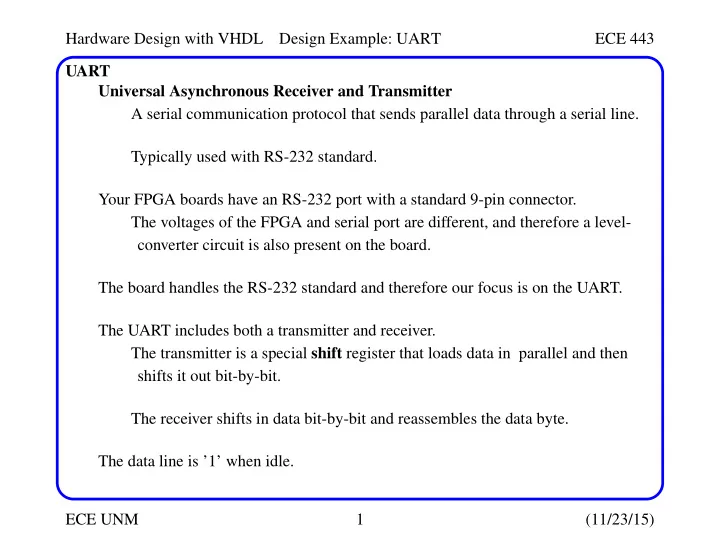
Hardware Design with VHDL Design Example: UART ECE 443 ECE UNM 1 (11/23/15) UART Universal Asynchronous Receiver and Transmitter A serial communication protocol that sends parallel data through a serial line. Typically used with RS-232 standard. Your FPGA boards have an RS-232 port with a standard 9-pin connector. The voltages of the FPGA and serial port are different, and therefore a level- converter circuit is also present on the board. The board handles the RS-232 standard and therefore our focus is on the UART. The UART includes both a transmitter and receiver. The transmitter is a special shift register that loads data in parallel and then shifts it out bit-by-bit. The receiver shifts in data bit-by-bit and reassembles the data byte. The data line is ’1’ when idle.
SLIDE 2
Hardware Design with VHDL Design Example: UART ECE 443 ECE UNM 2 (11/23/15) UART Spec Transmission starts when a start bit (a ’0’) is sent, followed by a number of data bits (either 6, 7 or 8), an optional partity bit and stop bits (with 1, 1.5 or 2 ’1’s). This is the transmission of 8 data bits and 1 stop bit. Note that no clk signal is sent through the serial line. This requires agreement on the transmission parameters by both the transmitter and receiver in advance. This information includes the band rate (number of bits per second), the num- ber of data bits and stop bits, and whether parity is being used. Common baud rates are 2400, 4800, 9600 and 19,200. d0 d1 d2 d3 d4 d5 d6 d7 idle start stop
SLIDE 3 Hardware Design with VHDL Design Example: UART ECE 443 ECE UNM 3 (11/23/15) UART Receiving Subsystem An oversampling scheme is commonly used to locate the middle position of the trans- mitted bits, i.e., where the actual sample is taken. The most common oversampling rate is 16 times the baud rate. Therefore, each serial bit is sampled 16 times but only one sample is saved as we will see. The oversampling scheme using N data bits and M stop bits:
- Wait until the incoming signal becomes ’0’ (the start bit) and then start the sampling
tick cnter.
- When the cnter reaches 7, the incoming signal reaches the middle position of the
start bit. Clear the cnter and restart.
- When the cnter reaches 15, we are at the middle of the first data bit. Retrieve it and
shift into a register. Restart the cnter.
- Repeat the above step N-1 times to retrieve the remaining data bits.
- If optional parity bit is used, repeat this step once more.
- Repeat this step M more times to obtain the stop bits.
SLIDE 4
Hardware Design with VHDL Design Example: UART ECE 443 ECE UNM 4 (11/23/15) UART Receiving Subsystem The oversampling scheme replaces the function of the clock. Instead of using the rising edge to sample, the sampling ticks are used to esti- mate the center position of each bit. Note that the system clock must be much faster than the baud rate for oversampling to be possible. The receiver block diagram consists of three components The interface circuit provides a buffer and status between the UART and the com- puter or FPGA. baud rate generator clk rx rx tick s_tick d_out UART rx_done_tick interface circuit d_out r_data rd_uart rx_empty receiver
SLIDE 5
Hardware Design with VHDL Design Example: UART ECE 443 ECE UNM 5 (11/23/15) UART Receiving Subsystem The baud rate generator generates a sampling signal whose frequency is exactly 16 times the UART’s designated baud rate. To avoid creating a new clock domain, the output of the baud rate generator will serve to enable ticks within the UART rather than serve as the clk signal. The whole system will use one clk as we will see. For a 19,200 baud rate, the sampling rate has to be 307,200 (19,200*16) ticks per second. With a system clk at 50 MHz, the baud rate generator need a mod-163 cnter (50 MHz/307,200). Therefore, the tick output will assert for one clk cycle every 163 clk cycles of the system clk. The following code from page 83 of the text can be used to implement a mod-163 cnter.
SLIDE 6
Hardware Design with VHDL Design Example: UART ECE 443 ECE UNM 6 (11/23/15) UART Receiving Subsystem: mod-163 cnter library ieee; use ieee.std_logic_1164.all; use ieee.numeric_std.all; entity mod_m_cnter is generic( N: integer := 4; M: integer := 10; ); port( clk, reset: in std_logic; max_tick: out std_logic; q: out std_logic_vector(N-1 downto 0); ); end mod_m_cnter; architecture arch of mod_m_cnter is signal r_reg: unsigned(N-1 downto 0); signal r_next: unsigned(N-1 downto 0);
SLIDE 7 Hardware Design with VHDL Design Example: UART ECE 443 ECE UNM 7 (11/23/15) UART Receiving Subsystem: mod-163 cnter begin process(clk, reset) begin if (reset = ’1’) then r_reg <= (others => ’0’); elsif (clk’event and clk=’1’) then r_reg <= r_next; end if; end process; end arch;
r_next <= (others => ’0’) when r_reg=(M-1) else r_reg + 1;
q <= std_logic_vector(r_reg); max_tick <= ’1’ when r_reg=(M-1) else ’0’; end arch;
SLIDE 8
Hardware Design with VHDL Design Example: UART ECE 443 ECE UNM 8 (11/23/15) UART Receiving Subsystem: UART receiver The ASMD chart for the receiver is shown below: D_BIT indicates the number of data bits and SB_TICK indicates the number of ticks needed for the stop bits (16, 24 and 32 for 1, 1.5 and 2 stop bits). idle rx = 0 F s <= 0 start s_tick=1 F s=7 s <= s+1 F s <= 0 n <= 0 data s_tick=1 F s=15 s <= s+1 s <= 0 b <= rx&(b>>1) n=D_BIT-1 F n <= n+1 F stop s_tick=1 F s=SB_TICK-1 s <= s+1 F rx_done_tick <= 1 states: idle, start, data, stop s_tick is enable tick from baud generator.
SLIDE 9
Hardware Design with VHDL Design Example: UART ECE 443 ECE UNM 9 (11/23/15) UART Receiving Subsystem: UART receiver We will assign D_BIT and SB_TICK to 8 and 16, respectively, in our design. library ieee; use ieee.std_logic_1164.all; use ieee.numeric_std.all; entity uart_rx is generic( DBIT: integer := 8; SB_TICK: integer := 16; ); port( clk, reset: in std_logic; rx: in std_logic; s_tick: in std_logic; rx_done_tick: out std_logic; dout: out std_logic_vctor(7 downto 0) ); end uart_rx;
SLIDE 10
Hardware Design with VHDL Design Example: UART ECE 443 ECE UNM 10 (11/23/15) UART Receiving Subsystem: UART receiver architecture arch of uart_rx is type state_type is (idle, start, data, stop); signal state_reg, state_next: state_type; signal s_reg, s_next: unsigned(3 downto 0); signal n_reg, n_next: unsigned(2 downto 0); signal b_reg, b_next: std_logic_vector(7 downto 0); begin process(clk, reset) -- FSMD state and data regs. begin if (reset = ’1’) then state_reg <= idle; s_reg <= (others => ’0’); n_reg <= (others => ’0’); b_reg <= (others => ’0’); elsif (clk’event and clk=’1’) then state_reg <= state_next; s_reg <= s_next; n_reg <= n_next;
SLIDE 11 Hardware Design with VHDL Design Example: UART ECE 443 ECE UNM 11 (11/23/15) UART Receiving Subsystem: UART receiver b_reg <= b_next; end if; end process;
process (state_reg, s_reg, n_reg, b_reg, s_tick, rx) begin state_next <= state_reg; s_next <= s_reg; n_next <= n_reg; b_next <= b_reg; rx_done_tick <= ’0’; case state_reg is when idle => if (rx = ’0’) then state_next <= start; s_next <= (others => ’0’); end if;
SLIDE 12
Hardware Design with VHDL Design Example: UART ECE 443 ECE UNM 12 (11/23/15) UART Receiving Subsystem: UART receiver when start => if (s_tick = ’1’) then if (s_reg = 7) then state_next <= data; s_next <= (others => ’0’); n_next <= (others => ’0’); else s_next <= s_reg + 1; end if; end if; when data => if (s_tick = ’1’) then if (s_reg = 15) then s_next <= (others => ’0’); b_next <= rx & b_reg(7 downto 1); if (n_reg = (DBIT - 1)) then state_next <= stop; else
SLIDE 13
Hardware Design with VHDL Design Example: UART ECE 443 ECE UNM 13 (11/23/15) UART Receiving Subsystem: UART receiver n_next <= n_reg + 1; end if; else s_next <= s_reg + 1; end if; end if; when stop => if (s_tick = ’1’) then if (s_reg = (SB_TICK-1)) then state_next <= idle; rx_done_tick <= ’1’; else s_next <= s_reg + 1; end if; end if; end case; end process; dout <= b_reg; end arch;
SLIDE 14 Hardware Design with VHDL Design Example: UART ECE 443 ECE UNM 14 (11/23/15) UART Receiving Subsystem: Interface Circuit The receiver interface circuit has two functions:
- It provides a mechanism to signal the availability of a new word
- It provides buffer space between the receiver and main system.
Several architectures are possible, including one with a FIFO. Here is one with a flag FF (to indicate the reception of a data byte) and a one byte buffer. Here, rx_done_tick is connected to set_flag while the system connects to clr_flag. The system checks rx_empty to determine when a data byte is available. baud rate generator clk rx rx tick s_tick d_out UART rx_done_tick register d_out r_data rd_uart rx_empty receiver q en register set_flag flag clr_flag rd_uart
SLIDE 15
Hardware Design with VHDL Design Example: UART ECE 443 ECE UNM 15 (11/23/15) UART Receiving Subsystem: Interface Circuit When rx_done_tick is asserted, the received byte is loaded to the buffer and the flag FF is asserted. The receiver can continue to fetch the next byte, giving time for the system to retrieve the current byte. library ieee; use ieee.std_logic_1164.all; entity flag_buff is generic(W: integer := 8); port( clk, reset: in std_logic; clr_flag, set_flag: in std_logic; din: in std_logic_vector(W-1 downto 0); dout: out std_logic_vector(W-1 downto 0); flag: out std_logic ); end flag_buff;
SLIDE 16 Hardware Design with VHDL Design Example: UART ECE 443 ECE UNM 16 (11/23/15) UART Receiving Subsystem: Interface Circuit architecture arch of flag_buff is signal buf_reg, buf_next: std_logic_vector(W-1 downto 0); signal flag_reg, flag_next: std_logic; begin process(clk, reset) begin if (reset = ’1’) then buf_reg <= (others =>’0’); flag_reg <= ’0’; elsif (clk’event and clk=’1’) then buf_reg <= buf_next; flag_reg <= flag_next; end if; end process;
SLIDE 17 Hardware Design with VHDL Design Example: UART ECE 443 ECE UNM 17 (11/23/15) UART Receiving Subsystem: Interface Circuit process (buf_reg, flag_reg, set_flag, clr_flag, din) begin buf_next <= buf_reg; flag_next <= flag_reg; if (set_flag = ’1’) then buf_next <= din; flag_next <= ’1’; elsif (clr_flag = ’1’) then flag_next <= ’0’; end if; end process;
dout <= buf_reg; flag <= flag_reg; end arch;
SLIDE 18
Hardware Design with VHDL Design Example: UART ECE 443 ECE UNM 18 (11/23/15) UART Transmitting Subsystem The UART transmitting subsystem is similar to the receiving subsystem. It consists of UART transmitter, baud rate generator and interface circuit. Roles are reversed for the interface circuit, i.e., the system sets the flag FF or writes the buffer interface circuit while the UART transmitter clears FF or reads the buffer. The transmitter is essentially a shift register that shifts out data bits. Since no oversampling is involved, the frequency of the ticks are 16 times slower than that of the receiver. However, instead of introducing another cnter, the transmitter usually shares the baud rate generator and uses an internal cnter to cnt through the 16 ticks. library ieee; use ieee.std_logic_1164.all; use ieee.numeric_std.all;
SLIDE 19
Hardware Design with VHDL Design Example: UART ECE 443 ECE UNM 19 (11/23/15) UART Transmitting Subsystem entity uart_tx is generic( DBIT: integer := 8; SB_TICK: integer := 16; ); port( clk, reset: in std_logic; tx_start: in std_logic; s_tick: in std_logic; din: out std_logic_vctor(7 downto 0) tx_done_tick: out std_logic; tx: out std_logic ); end uart_tx;
SLIDE 20
Hardware Design with VHDL Design Example: UART ECE 443 ECE UNM 20 (11/23/15) UART Transmitting Subsystem architecture arch of uart_tx is type state_type is (idle, start, data, stop); signal state_reg, state_next: state_type; signal s_reg, s_next: unsigned(3 downto 0); signal n_reg, n_next: unsigned(2 downto 0); signal b_reg, b_next: std_logic_vector(7 downto 0); signal tx_reg, tx_next: std_logic; begin process(clk, reset) -- FSMD state and data regs. begin if (reset = ’1’) then state_reg <= idle; s_reg <= (others => ’0’); n_reg <= (others => ’0’); b_reg <= (others => ’0’); tx_reg <= ’1’;
SLIDE 21 Hardware Design with VHDL Design Example: UART ECE 443 ECE UNM 21 (11/23/15) UART Transmitting Subsystem elsif (clk’event and clk=’1’) then state_reg <= state_next; s_reg <= s_next; n_reg <= n_next; b_reg <= b_next; tx_reg <= tx_next; end if; end process;
process (state_reg, s_reg, n_reg, b_reg, s_tick, tx_reg, tx_start, din) begin state_next <= state_reg; s_next <= s_reg; n_next <= n_reg; b_next <= b_reg; tx_next <= tx_reg;
SLIDE 22
Hardware Design with VHDL Design Example: UART ECE 443 ECE UNM 22 (11/23/15) UART Transmitting Subsystem tx_done_tick <= ’0’; case state_reg is when idle => tx_next <= ’1’; if (tx_start = ’1’) then state_next <= start; s_next <= (others => ’0’); b_next <= din; end if; when start => tx_next <= ’0’; if (s_tick = ’1’) then if (s_reg = 15) then state_next <= data; s_next <= (others => ’0’); n_next <= (others => ’0’); else s_next <= s_reg + 1;
SLIDE 23
Hardware Design with VHDL Design Example: UART ECE 443 ECE UNM 23 (11/23/15) UART Transmitting Subsystem end if; end if; when data => tx_next <= b_reg(0); if (s_tick = ’1’) then if (s_reg = 15) then s_next <= (others => ’0’); b_next <= ’0’ & b_reg(7 downto 1); if (n_reg = (DBIT - 1)) then state_next <= stop; else n_next <= n_reg + 1; end if; else s_next <= s_reg + 1; end if; end if;
SLIDE 24
Hardware Design with VHDL Design Example: UART ECE 443 ECE UNM 24 (11/23/15) UART Transmitting Subsystem when stop => tx_next <= ’1’; if (s_tick = ’1’) then if (s_reg = (SB_TICK-1)) then state_next <= idle; rx_done_tick <= ’1’; else s_next <= s_reg + 1; end if; end if; end case; end process; tx <= tx_reg; end arch;
SLIDE 25
Hardware Design with VHDL Design Example: UART ECE 443 ECE UNM 25 (11/23/15) Entire UART System Block diagram of whole system baud rate generator clk rx rx tick s_tick d_out UART rx_done_tick register w_data r_data rd_uart rx_empty receiver r_data wr register set_flag flag clr_flag rd_uart tx s_tick d_in UART tx_done_tick transmitter tx tx_start register r_data w_data wr_uart tx_full w_data rd register set_flag flag clr_flag wr_uart
SLIDE 26
Hardware Design with VHDL Design Example: UART ECE 443 ECE UNM 26 (11/23/15) Entire UART System See text for the UART main module that instantiates the entities discussed above. Note text uses a FIFO buffer so the diagram above is different. The text also includes a loop-back circuit that instantiates the UART and connects the outputs of the receiver with the inputs of the transmitter on the FPGA. It also adds ’1’ to the incoming data before looping it back to the computer. Windows hyperterminal is discussed as a mechanism to communicate directly to the serial ports on your computer.