Harvesting, Handling, and Storage Logistics and Econom ics James A. - - PowerPoint PPT Presentation

harvesting handling and storage logistics and econom ics
SMART_READER_LITE
LIVE PREVIEW

Harvesting, Handling, and Storage Logistics and Econom ics James A. - - PowerPoint PPT Presentation

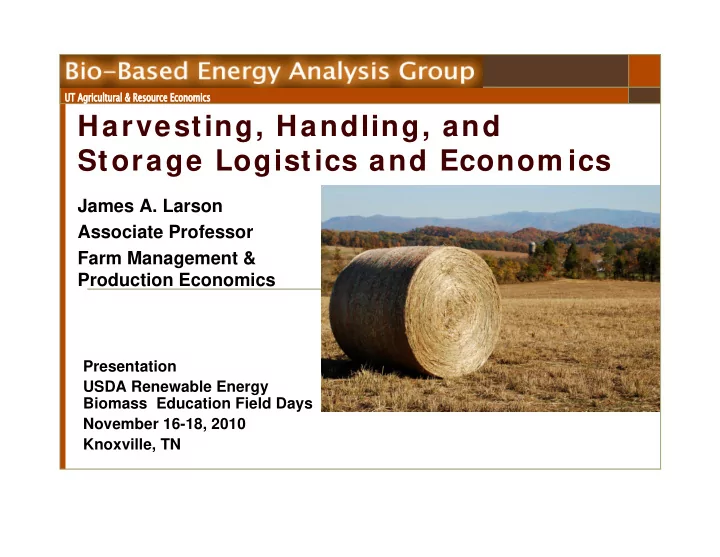
Harvesting, Handling, and Storage Logistics and Econom ics James A. Larson Associate Professor Farm Management & Production Economics Presentation USDA Renewable Energy Biomass Education Field Days November 16-18, 2010 Knoxville, TN


slide-1
SLIDE 1

Harvesting, Handling, and Storage Logistics and Econom ics

James A. Larson Associate Professor Farm Management & Production Economics

Presentation USDA Renewable Energy Biomass Education Field Days November 16-18, 2010 Knoxville, TN
slide-2
SLIDE 2
  • Alternative harvest and storage

methods may have certain advantages and disadvantages in a potential switchgrass feedstock supply chain.

  • Dry matter losses during harvest,

staging, storage, and transport.

  • Area covered and biomass gathered

during harvest window.

  • Density of biomass and costs of

transportation.

  • Quality of dry matter (potential

ethanol yield).

Harvest and Storage Managem ent I ssues in Tennessee/ Southeast U.S.

slide-3
SLIDE 3

Presentation Outline

  • Switchgrass bale harvest and storage study.
  • Switchgrass harvest and storage logistics economic

feasibility study.

  • Look at potential of an industrial compactor-baler-wrapper

from the garbage industry (BaleTech) as a preprocessing step to increase the density and provide protection for feedstock before the storage and transportation functions within the feedstock supply chain.

  • Current harvest and storage logistics research at the

University of Tennessee.

slide-4
SLIDE 4

Bale Harvest & Storage Study

Participants:

  • Burton C. English
  • James A. Larson
  • Donald D. Tyler
  • Daniel F. Mooney

Research supported by US DOE Grant Project entitled “UT Switchgrass Project”

Gravel

slide-5
SLIDE 5

Bale Harvest & Storage Study

Objectives:

  • Estimate storage dry matter losses under alternative

storage methods and weather.

  • Estimate chemical composition & ethanol yield of

switchgrass bales under alternative storage methods and weather.

  • Develop guidelines to visually estimate the quality of

stored biomass.

  • Correlate ethanol content of bales with weather, %

moisture, and storage method.

  • Calculate switchgrass harvest and storage costs under

alternative storage methods and weather.

slide-6
SLIDE 6

Data Collection

  • Harvest methods:
  • 5 ft × 4 ft round bales
  • 4 ft × 8 ft rectangular bales
  • Storage Covers:
  • Tarp on top
  • No tarp
  • Storage Surfaces:
  • Well drained ground
  • Gravel
  • Pallets
  • In barn (500 days only)
slide-7
SLIDE 7

Methods

  • Bales entered storage Jan. 25,

2008.

  • Bales were removed from

storage every 100 days for 5 sampling periods.

  • Bales were weighed,

mechanically separated, and photographed.

  • Samples were collected based
  • n a visual estimate of

weathered areas.

  • Wet and dry sample weights

and proportions of different weathered areas were used to estimate dry matter losses for each treatment.

slide-8
SLIDE 8

Sam pling Protocol

slide-9
SLIDE 9

W eathering—Uncovered Round Bales

100 Days 200 Days 300 Days 400 Days

slide-10
SLIDE 10

W eathering—Uncovered Square Bales

100 Days 200 Days 300 Days 400 Days

slide-11
SLIDE 11

Sw itchgrass Bale Storage Losses

slide-12
SLIDE 12

Estim ated Dry Matter Losses by Bale Type, Storage Cover, and Days in Storage using a Mitscherlich-Baule Functional Form

slide-13
SLIDE 13

Storage Method Profitability Map

120 100 80 60 40 20 50 100 150 200 250 300 350 400 450 500

Days in storage

  • The map indicates which storage
  • ption is most profitable for a given

storage period

  • Longer storage periods imply greater

losses

  • Higher prices increase the “payback”

to protective expenditures

  • Low prices & short storage periods

favor square bales

  • High prices & long storage periods

favor round bales Square uncovered Square covered Round uncovered Round covered

Price $71.00

slide-14
SLIDE 14

Sw itchgrass Harvest and Storage Logistics Econom ic Feasibility Study Participants:

  • James A. Larson
  • Edward Yu
  • Burton C. English
  • Daniel F. Mooney
  • Chenguang Wang

Research supported by Southeastern Sun Grant Initiative Project entitled “Evaluating the Economics of Incorporating Preprocessing Facilities in Biomass Supply Logistics with an Application in East Tennessee.”

slide-15
SLIDE 15

Background

  • Regional biomass preprocessing facilities as a part of the

supply chain feeding into a biorefinery (Carolan, Joshi, and Dale , 2007) .

  • Potential preprocessing facility functions:
  • Cleaning, separating and/or sorting;
  • Chopping, grinding, and/or mixing/blending;
  • Moisture control;
  • Densification and packaging of feedstock before it is placed into

storage or transported to the biorefinery.

  • The key question is whether the potential saving in

storage and transportation costs more than offset the investment in preprocessing technologies.

slide-16
SLIDE 16

Objectives

  • To analyze the cost of various logistic methods of

switchgrass, ranging from conventional hay methods to the potentially more capital intensive preprocessing

  • ption, using enterprise budgeting and GIS methods.
  • This study evaluates tradeoffs in dry matter losses during

storage, investment and operating costs of equipment and facility, and the potential savings in transportation costs among different methods.

slide-17
SLIDE 17

Biorefinery Assum ptions

  • Annual capacity of 25 million gallon per year of ethanol.
  • Ethanol conversion rate of 76 gallons/dry ton of

switchgrass (Wang, Saricks, and Santini, 1999).

  • Biorefinery requires ~329,000 dry tons of biomass

annually.

  • Single harvest system between Nov 1 and Mar 1:
  • 1/3 of harvested biomass directly brought to plant during harvest

window for conversion to ethanol.

  • 2/3 of harvested biomass placed into storage.
  • Inventory in storage was assumed to be uniformly delivered to the

plant from March through October.

slide-18
SLIDE 18

Feedstock Logistics Scenarios

1.

Harvest using a large round baler and storing the feedstock on-farm;

2.

Harvest using a large rectangular baler and storing the feedstock on-farm; and

3.

Harvest using a forage chopper and hauling to a preprocessing facility for densification and packaging using an industrial compactor-baler-wrapper before being placed in on-site storage at the facility.

slide-19
SLIDE 19

Operations Sequence by Harvest & Storage Method

Operation Round Bale Rectangular Bale Compactor Baler Wrapper Mow 1 1 1 Rake 2 2 2 Bale 3 3

  • Chop
  • 3

Truck to preprocessing facility

  • 4

Dump in holding area

  • 5

Front-end load into conveyer

  • 6

Compact/Bale/Wrap

  • 7

Front end load to storage 4 4 8 Store 5 5 9 Front-end load to truck 6 6 10 Haul by semi-truck to biorefinery 7 7 11

slide-20
SLIDE 20

Estim ated Harvest Tim e

Month* Item Nov Dec Jan Feb Total Available Time

  • -------------------------Days/Hours------------------------

Days 14 14 13 12 53 Hours 86 82 78 79 325 *Estimated harvest days assuming that 70% of the days per month when precipitation was less than 0.01 inches were available for harvest operations (Knoxville, TN, precipitation data). Available harvest hours assume an average 60%

  • f daylight hours (Knoxville, TN, daylight hours) of harvest time per available

harvest day (Sources: Dry days, NOAA, U.S. Department of Commerce, Daylight hours, U.S. Naval Observatory).

slide-21
SLIDE 21

Feedstock Draw Area

  • Circles typically used to represent

feedstock area in bioenergy analysis.

  • Typical road system can be represented by

an east-west, north-south grid system.

  • Loci of points that are equidistant from a

processing plant will form a diamond shaped area (English, Short, and Heady, 1981).

  • Assumed feedstock draw area is diamond

shaped with a maximum shipping distance

  • f 50 miles.
  • For round and rectangular bale systems,

average distance from farms to biorefinery is 35.5 miles.

slide-22
SLIDE 22

Satellite Preprocessing Facilities Feedstock Draw Areas

Zone Travel distance to ethanol refinery Travel distance within the zone

  • A. Conversion facility

15.6 miles 15.6 miles

  • B. North preprocessing

30 miles 17.7 miles

  • C. Southeast

preprocessing 26 miles 18.8 miles

  • D. West preprocessing

30 miles 16.0 miles

A B

D

C

Center zone A will chop and deliver directly to the conversion facility the during the harvest season and has about a 1,667 square mile draw area. Remaining area is split into three equal area regions each with a draw area of about 1,111 square miles each.

slide-23
SLIDE 23

Satellite Preprocessing Facility

  • 15 acre industrial park site with road and

utility access ($25,000/acre).

  • Storage shed capable of holding 2 days

inventory of chopped biomass.

  • BaleTech Compactor-Baler-Wrapper:
  • $1.4 M investment cost/machine,
  • 88 days operated during season,
  • 16 hours/day,
  • 60 dry ton/hour capacity,
  • Produces 2 ton (dry) bale, and
  • Negligible storage dry matter losses.
  • Chopper (14/Compact Baler):
  • 20 dry tons/hour capacity, and
  • 6 tandem axel trucks/chopper.
slide-24
SLIDE 24

Round & Rectangular baler Harvest Costs

  • Round baler:
  • Lowest initial investment among baler options.
  • 5.5 dry ton/hour harvest capacity (Mooney et al., 2009).
  • Large rectangular baler:
  • Higher initial investment—2 to 3 times more than round baler.
  • Larger tractor requirement.
  • 12 tons/hour harvest capacity (English et al., 2008).
  • Staging and stacking:
  • Bale loader/spear: 1 rectangular or 2 round bales per trip.
  • Uncovered round stored store in a end-to-end row.
  • Covered round stored in 3-2-1 pyramid.
  • Covered rectangular stored in 2-2-1 pyramid.
slide-25
SLIDE 25

Enterprise Budgeting

  • Budgets for the equipment, materials, and labor for the

establishment, annual maintenance, harvest, storage and transportation of switchgrass were from UT Department of Agricultural and Resource Economics (English Larson, and Mooney, 2008; Gerloff, 2008; Mooney et al., 2009; Wang, 2009).

  • Costs were calculated assuming a 5 year contract and an average

harvested yield of 6 dry ton/acre.

  • Opportunity cost on land used for switchgrass production was

$22/acre, the pastureland/hayland rental rate reported by the Tennessee Agricultural Statistics Service (Tennessee Agriculture 2009).

  • Cost calculated on available harvest time during a 4 month season

and estimated dry matter losses during storage using a Mitscherlich- Baule Functional Form.

slide-26
SLIDE 26

Results

  • Harvest season capacities for each system.
  • Selected costs going into storage.
  • Costs to produce, harvest, store, and deliver switchgrass

using the round and rectangular bale systems to a biorefinery for different storage periods.

  • Comparison of weighted average costs of traditional bale

systems with the preprocessing system:

  • Cost per dry ton at the plant gate, and
  • Initial investment.
slide-27
SLIDE 27

Estim ated Land Area Covered and Biom ass Harvested

Month I tem Nov Dec Jan Feb Total Land Area Covered

  • ----------- --------Acres-------------------

Round Baler 7 9 7 5 7 2 7 2 2 9 8 Rectangular Baler 1 7 3 1 6 4 1 5 7 1 5 7 6 5 1 Forage Chopper 2 8 8 2 7 3 2 6 1 2 6 2 1 ,0 8 4 Biom ass Harvested

  • -----------------Dry tons-----------------

Round Baler 4 7 5 4 5 1 4 3 1 4 3 2 1 ,7 8 9 Rectangular Baler 1 ,0 3 6 9 8 3 9 4 0 9 4 3 3 ,9 0 3 Forage Chopper 1 ,7 2 7 1 ,6 3 9 1 ,5 6 7 1 ,5 7 2 6 ,5 0 5

slide-28
SLIDE 28

Operation Round Bale Rectangular Bale Com pactor Baler W rapper Pre-harvest 2 1 .3 3 2 1 .3 3 2 1 .3 3 Harvest 2 8 .5 5 2 0 .3 0 1 8 .2 1 Stage to storage at side of the field 1 4 .8 8 1 4 .8 8

  • Haul by truck to preprocessing

facility

  • 7 .1 6

Com pact-Bale-W rap

  • 8 .8 1

Store No protection 0 .0 0 0 .0 0

  • Tarp + Pallet

7 .7 5 5 .6 4

  • Total before storage or delivery

Bale: w ithout protection 5 7 .1 2 5 0 .0 4

  • Bale: tarp + pallet

6 4 .8 0 5 5 .6 3

  • Com pactor-Baler-W rapper
  • 5 4 .6 6

Transportation to biorefinery 1 1 .9 5 9 .8 4 5 .1 0

Selected Costs ( $ / dry ton) going into Storage

slide-29
SLIDE 29

Costs to Produce, Harvest, Store, and Deliver Sw itchgrass to a Biorefinery for Different Storage Periods

slide-30
SLIDE 30

W eighted Average Costs ( $ / dry ton) for Alternative Harvest and Storage System s

Rectangular Bales

  • -------------------Round Bales-------------------

Dupont Danisco indicates that $75/dry ton is breakeven.

slide-31
SLIDE 31

I nvestm ent in each System

Operation Round Bale Rectangular Bale Compactor Baler Wrapper Harvest equipment 4,586,000 7,808,500 4,078,000 Preprocessing facilities Compactor-Baler-Wrapper

  • 4,200,000

Buildings

  • 1,790,827

Land

  • 72,823

Subtotal

  • 6,131,150

Vehicles Tractors/front-end loaders 26,169,000 12,012,000 6,073,500 Tandem axle trucks

  • 2,940,00

Semi-trucks and trailers 1,200,000 960,000 480,000 Subtotal 27,369,000 12,972,000 9,426,000 Total 31,955,000 20,780,500 19,635,150

slide-32
SLIDE 32

Required Operating Cash Flow for each Harvest & Storage System a

Annual Operating Cash Flow I nitial Discount Rate % Round System I nvestm ent 1 0 % 2 0 % System Round $ 3 1 ,9 5 5 ,0 0 0 $ 5 ,2 0 0 ,5 2 9 $ 7 ,6 2 1 ,9 9 5 1 0 0 % Rectangular $ 2 0 ,7 8 0 ,5 0 0 $ 3 ,3 8 1 ,9 3 1 $ 4 ,9 5 6 ,6 2 2 6 5 % Com pact $ 1 9 ,6 3 5 ,1 5 0 $ 3 ,1 9 5 ,5 3 0 $ 4 ,6 8 3 ,4 3 0 6 1 %

a Operating Cash Flow=Net Income +Depreciation.

slide-33
SLIDE 33

Conclusions & Future Research

  • Industrial baler system reduced delivered costs over

conventional hay methods for a 25 million-gallon-per-year biorefinery in East Tennessee

  • Up to 32% without considering dry matter losses during storage.
  • Up to 40% because of potential reduction in dry matter losses.
  • Operating cash flow to meet a given rate of return on the

initial investment was 35% to 39% lower than for the traditional harvest and storage systems.

  • Need to field test assumptions to prove technology:
  • Can a the technology consistently make a 2-3 dry ton switchgrass

bale under field conditions?

  • Do dry matter throughput assumptions hold up under real world

conditions?

  • Are storage dry matter losses negligible compared to traditional

hay systems?

slide-34
SLIDE 34

Second Phase Harvest & Storage Study, Vonore, TN ( 2 0 1 0 -2 0 1 2 )

Sample Points (days) Bale Tech Round

Wet Plastic Wet Mesh Dry Plastic Dry Mesh Mesh Twine Mesh Tarped Bale Total

0a

  • 28
  • 28
  • 28
  • 28
  • 28
  • 28
  • 28
  • 196

25b 4 4 4 4 4 4 4 28 50b 4 4 4 4 4 4 4 28 100b 4 4 4 4 4 4 4 28 200b 4 4 4 4 4 4 4 28 300b 4 4 4 4 4 4 4 28 400b 4 4 4 4 4 4 4 28 500b 4 4 4 4 4 4 4 28

a The number of bales going into storage on day zero for each treatment assuming four

replications for each treatment. Each bale will be sampled for dry matter (8-10 cores or grab samples per bale) before placed into storage.

b The number of bales removed from storage at each sampling point for each treatment

assuming four replications for each treatment.

slide-35
SLIDE 35
  • Tennessee and the southeast US:
  • Road networks,
  • Railroad networks,
  • Industrial park locations, and
  • Production modeled on a 5 mile

grids.

  • Evaluate alternative feedstock

supply chains.

Sim ulation, Mathem atical Program m ing, and GI S Optim ization Fram ew ork