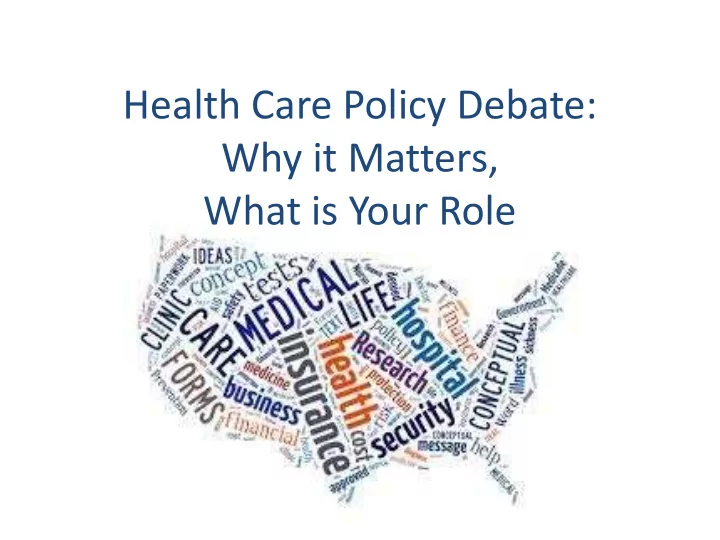
Health Care Policy Debate: Why it Matters, What is Your Role Rylin - - PowerPoint PPT Presentation

health care policy debate why it matters what is your
SMART_READER_LITE
LIVE PREVIEW

Health Care Policy Debate: Why it Matters, What is Your Role Rylin - - PowerPoint PPT Presentation

Health Care Policy Debate: Why it Matters, What is Your Role Rylin Rodgers ryrodger@iu.edu Leader Training Director, Family Leadership Coordinator, Riley Child Development Center (LEND) State Coordinator, Director, Family Voices


slide-1
SLIDE 1

Health Care Policy Debate: Why it Matters, What is Your Role

slide-2
SLIDE 2
slide-3
SLIDE 3

Rylin Rodgers ryrodger@iu.edu

  • Leader

– Training Director, Family Leadership Coordinator, Riley Child Development Center (LEND) – State Coordinator, Director, Family Voices Indiana – Coordinator of Care Coordination Program, IU School of Medicine

  • Family

– Mom to Matthew (Freshman in College) and Laura (Jr. in High School) – Bipartisan Marriage to David, High School Teacher, former County Councilman – Drink way too much caffeine

slide-4
SLIDE 4

Jane Gerhardt jane.gerhardt@cchmc.org

– Policy Specialist , University of Cincinnati UCEDD LEND – Former LEND Family Trainee – Attorney – Mom to Charlie, Anne, Hank

slide-5
SLIDE 5
slide-6
SLIDE 6

What We Hope to Cover

  • Policy and Your Life and Work
  • What is happening now

– Background – ACA

  • What Can You Do

– Share Your Voice – Phone – Visit

  • More Options, Tips and Resources
slide-7
SLIDE 7

Related Systems and Issues

PWD

ACA Medicaid Medicare SSI Tax Code Education Research funding Vaccines

slide-8
SLIDE 8

American Health System Today

Medicaid Expansion

Provided coverage to millions of people, including individuals with I/DD and other disabilities

Market Place Insurance non-discrimination provisions

Bans the exclusion of people from health insurance coverage based on pre-existing conditions Prevents insurers from charging people with disabilities and health conditions significantly more for health insurance coverage Eliminates annual and lifetime caps on health coverage were included.

Plus

Expands mental health parity provisions Requires coverage for dependents until age 26 Improves accessibility of medical diagnostic equipment Habilitative Care

ACA also expanded access to long term supports and services by:

Creating the Community First Choice Option Extending the Money Follows the Person Rebalancing Demonstration Creating the Balancing Incentives Program to incentivize states to increase access to non- institutional LTSS

slide-9
SLIDE 9

President Trump has begun to “repeal and replace” the Affordable Care Act.

Legislative ACA repeal budget resolution

  • January 12th, Senate 51 to

48

  • January 13th, House 227 to

198

  • The resolution includes

instructions to repeal large parts of ACA through reconciliation Executive Action

  • January 20th, Executive

Order Minimizing the Economic Burden of the Patient Protection and Affordable Care Act Pending Repeal

  • Nomination of Tom Price to

lead the Department of Health and Human Services

“better health care for more people at less cost”-- 1/25/17

slide-10
SLIDE 10

What’s Next

  • The repeal bill moves forward, starting in the House as it's a revenue bill. The

House committees with jurisdiction over health care will mark up legislation, then send the work to the House Budget Committee, which will put the bill together.

  • After committee approval, the repeal bill will go to the House floor for a vote.

– Speaker Paul Ryan wanted health reform to be done by the end of March. – According to Ryan, House Republicans will mark up their reconciliation package within the next few weeks and bring it to the floor as soon as late February. –

  • Rep. Diane Black told reporters that the goal is to be ready to vote on the bill by the first week of

March, at the latest

  • The bill will go to the Senate floor. It'll be subject to a lengthy debate period

and another vote.

  • Lawmakers will deal with differences between the House and Senate versions

either in a conference committee or a House vote on the Senate-approved

  • bill. This will probably be fast.
  • The final bill goes to the White House for Trump's signature.
  • Repeal becomes law once signed.
slide-11
SLIDE 11

Replace

Needs

 Access to coverage  Cost of coverage

 Cost of care

 Pre-existing conditions  Life time  Annual cap  Up to age 26  Essential benefit  Medicaid

 Expansion  Maintenance of Effort CHIP

Ideas

  • Risk pools
  • Tax credits
  • Health Savings Accounts
  • Insurance across state lines
  • Block Grant Medicaid
slide-12
SLIDE 12

State vs. Federal Branches

slide-13
SLIDE 13

Who Matters

Your Elected Officials Federal

  • Two US Senators
  • Representative from

district where you are registered to vote or where patient lives State

  • Your Governor
  • State Legislators

Extra Influential

  • Leadership Positions
  • Committee Membership
  • Undeclared/persuadable
slide-14
SLIDE 14

How to find

http://cqrcengage.com/aucd/congressionaldirectory

slide-15
SLIDE 15

Why Advocacy?

  • You have expertise and passion
  • Your work and life will be

impacted by policymakers’ decisions

  • You vote and can hold

policymakers accountable

  • If you don’t speak up, someone

else will speak for you

slide-16
SLIDE 16

Things to Do…

  • Register to vote and VOTE!!!
  • Inform yourself
  • Know your legislators

– Follow them on Facebook – Follow on Twitter – Sign up for their newsletter – Follow in Media

  • Contact your legislators

– Call – Email – Fax – Meet

  • Testify at public hearings
  • Contact media (letter to

editor, op ed)

  • Testify about regulations
  • Attend public forums
slide-17
SLIDE 17

Ready Set Dial

Calling

  • 1. Your story

1. Who you are 2. Why issue is important 3. Your story 4. What you would like to see 5. Thank you

Tips and Hints

  • 27-9-3 rule

27 words 9 seconds 3 points

  • After hours
  • Once is not enough
  • Follow ups
slide-18
SLIDE 18

In District or In D.C.

Visit

  • Schedule online
  • Be early, prepared, polite
  • Concise intro -Who you are, what

your organization does – Your story –personalize the message on the fact sheet – Practice it aloud – Be brief

  • Limit acronyms or technical terms
  • Do not disparage government or

his/her record or party

  • Do not guess, assume or over reach
  • Offer your future assistance
  • Leave your fact sheet & business card

Follow-up

  • Follow up with thank you

email

  • Provide any information you

promised

  • Keep in touch during

legislative session

  • Follow on social & old school

media

  • Show up at an event they host
  • r attend
  • Contact, comment, like,

retweet as appropriate

Disability Policy Seminar 2017 Monday, March 20, 2017- Wednesday, March 22, 2017 Website Link http://disabilitypolicyseminar.org/

slide-19
SLIDE 19

Remember

  • Legislators are generalists; they can see over

1000 bills a year.

  • Be a source of knowledge for them.
  • If you don’t know something, say so, and then

get back to them with the information.

slide-20
SLIDE 20

AUCD Policy alerts Advocacy Alerts are Not Spam 

  • Use advocacy and action alerts to tell you:

– When to act – Type of action – What message to use

  • Remember – you are the expert, these are building

your expertise

  • Have information to personalize your message
slide-21
SLIDE 21

Ethics (Don’t Ruin Your Career)

  • According to IRS definitions, “advocacy” refers

to general work that is done for or against a particular issue.

  • “Lobbying” is defined by the IRS as attempting

to influence legislation.

slide-22
SLIDE 22
slide-23
SLIDE 23

Bonus Material

  • Block Grants

http://khn.org/news/block-grants-medicaid-faq/

  • High Risk Pool

http://on.wsj.com/2ji6ewh

  • Selling across state lines

https://www.youtube.com/watch?v=cKzkmLodi Bg&t=70s

slide-24
SLIDE 24

Media

  • http://khn.org/
  • www.politico.com
  • www.rollcall.com
  • www.politifact.com/truth-o-meter
  • http://thehill.com/

National

slide-25
SLIDE 25

Advanced Opportunities

  • Policy Fellowships

– AUCD – Kennedy

  • Campaigns

– Policy

  • Policy Staff
  • Internships