SLIDE 1
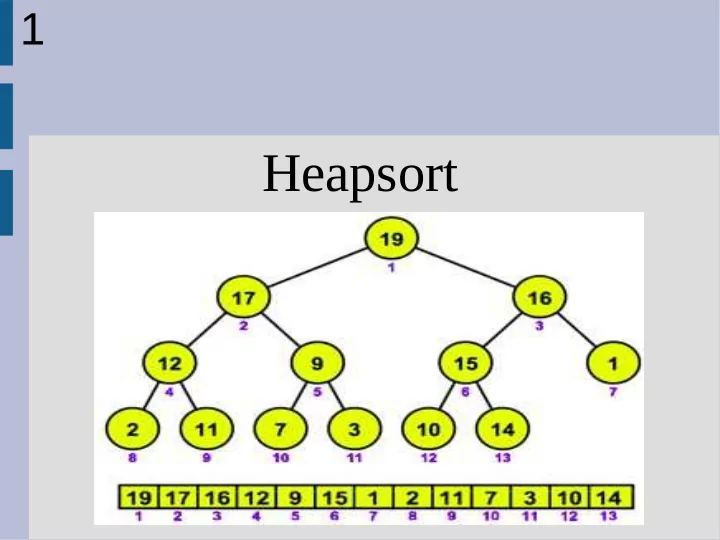
Heapsort
1
SLIDE 2
Moodle had issues last night, homework due tonight at 11:55pm
Announcements
2
SLIDE 3
Binary tree as array
It is possible to represent binary trees as an array
1|2|3|4|5|6|7|8|9|10
4
SLIDE 4
Binary tree as array
index 'i' is the parent of '2i' and '2i+1'
1|2|3|4|5|6|7|8|9|10
5
SLIDE 5
Binary tree as array
Is it possible to represent any tree with a constant branching factor as an array? 6
SLIDE 6
Binary tree as array
Is it possible to represent any tree with a constant branching factor as an array? Yes, but the notation is awkward 7
SLIDE 7
Heaps
A max heap is a tree where the parent is larger than its children (A min heap is the opposite) 8
SLIDE 8 Heapsort
The idea behind heapsort is to:
- 1. Build a heap
- 2. Pull out the largest (root)
and re-compile the heap
9
SLIDE 9 Heapsort
To do this, we will define subroutines:
- 1. Max-Heapify = maintains heap
property
sequence into a max-heap 10
SLIDE 10
Max-Heapify
Input: a root of two max-heaps Output: a max-heap 11
SLIDE 11
Max-Heapify
Pseudo-code Max-Heapify(A,i): left = left(i) // 2*i right = right(i) // 2*i+1 L = arg_max( A[left], A[right], A[ i ]) if (L not i) exchange A[ i ] with A[ L ] Max-Heapify(A, L) // now make me do it! 12
SLIDE 12
Max-Heapify
Runtime? 13
SLIDE 13
Max-Heapify
Runtime? Obviously (is it?): lg n T(n) = T(2/3 n) + O(1) // why? Or... T(n) = T(1/2 n) + O(1) 14
SLIDE 14
Master's theorem
Master's theorem: (proof 4.6) For a > 1, b > 1,T(n) = a T(n/b) + f(n) If f(n) is... (3 cases) O(nc) for c < logb a, T(n) is Θ(nlogb a) Θ(nlogb a), then T(n) is Θ(nlogb a lg n) Ω(nc) for c > logb a, T(n) is Θ(f(n)) 15
SLIDE 15
Max-Heapify
Runtime? Obviously (is it?): lg n T(n) = T(2/3 n) + O(1) // why? Or... T(n) = T(1/2 n) + O(1) = O(lg n) 16
SLIDE 16
Build-Max-Heap
Next we build a full heap from an unsorted sequence Build-Max-Heap(A) for i = floor( A.length/2 ) to 1 Heapify(A, i) 17
SLIDE 17
Build-Max-Heap
Red part is already Heapified 18
SLIDE 18
Build-Max-Heap
Correctness: Base: Each alone leaf is a max-heap Step: if A[i] to A[n] are in a heap, then Heapify(A, i-1) will make i-1 a heap as well Termination: loop ends at i=1, which is the root (so all heap) 19
SLIDE 19
Build-Max-Heap
Runtime? 20
SLIDE 20
Build-Max-Heap
Runtime? O(n lg n) is obvious, but we can get a better bound... Show ceiling(n/2h+1) nodes at any level 'h', with h=0 as bottom 21
SLIDE 21 Build-Max-Heap
Heapify from height 'h' takes O(h) sumh=0
lg n ceiling(n/2h+1) O(h)
=O(n sumh=0
lg n ceiling(h/2h+1))
(sumx=0
∞ k xk = x/(1-x)2, x=1/2)
=O(n 4/2) = O(n) 22
SLIDE 22
Heapsort
Heapsort(A): Build-Max-Heap(A) for i = A.length to 2 Swap A[ 1 ], A[ i ] A.heapsize = A.heapsize – 1 Max-Heapify(A, 1) 23
SLIDE 23
Heapsort
You try it! Sort: A = [1, 6, 8, 4, 7, 3, 4] 24
SLIDE 24
Heapsort
First, build the heap starting here A = [1, 6, 8, 4, 7, 3, 4] A = [1, 6, 8, 4, 7, 3, 4] A = [1, 7, 8, 4, 6, 3, 4] A = [8, 7, 1, 4, 6, 3, 4] - recursive A = [8, 7, 4, 4, 6, 3, 1] - done 25
SLIDE 25
Heapsort
Move first to end, then re-heapify A = [8, 7, 4, 4, 6, 3, 1], move end A = [1, 7, 4, 4, 6, 3, 8], heapify A = [7, 1, 4, 4, 6, 3, 8], rec. heap A = [7, 6, 4, 4, 1, 3, 8], move end A = [3, 6, 4, 4, 1, 7, 8], heapify A = [6, 3, 4, 4, 1, 7, 8], rec. heap A = [6, 4, 4, 3, 1, 7, 8], next slide.. 26
SLIDE 26
Heapsort
A = [6, 4, 4, 3, 1, 7, 8], move end A = [1, 4, 4, 3, 6, 7, 8], heapify A = [4, 4, 1, 3, 6, 7, 8], move end A = [3, 4, 1, 4, 6, 7, 8], heapify A = [4, 3, 1, 4, 6, 7, 8], move end A = [1, 3, 4, 4, 6, 7, 8], heapify A = [3, 1, 4, 4, 6, 7, 8], move end A = [1, 3, 4, 4, 6, 7, 8], done 27
SLIDE 27
Heapsort
28
SLIDE 28
Heapsort
Runtime? 29
SLIDE 29
Heapsort
Runtime? Run Max-Heapify O(n) times So... O(n lg n) 30
SLIDE 30
Sorting comparisons:
Name Average Worst-case Insertion[s,i] O(n2) O(n2) Merge[s,p] O(n lg n) O(n lg n) Heap[i] O(n lg n) O(n lg n) Quick[p] O(n lg n) O(n2) Counting[s] O(n + k) O(n + k) Radix[s] O(d(n+k)) O(d(n+k)) Bucket[s,p] O(n) O(n2) 31
SLIDE 31
Sorting comparisons:
https://www.youtube.com/watch?v=kPRA0W1kECg
32
SLIDE 32
Selection
33
SLIDE 33
Priority queues
Heaps can also be used to implement priority queues (i.e. airplane boarding lines) Operations supported are: Insert, Maximum, Exctract-Max and Increase-key 34
SLIDE 34
Priority queues
Maximum(A): return A[ 1 ] Extract-Max(A): max = A[1] A[1] = A.heapsize A.heapsize = A.heapsize – 1 Max-Heapify(A, 1), return max 35
SLIDE 35
Priority queues
Increase-key(A, i, key): A[ i ] = key while ( i>1 and A [floor(i/2)] < A[i]) swap A[ i ], A [floor(i/2)] i = floor(i/2) Opposite of Max-Heapify... move high keys up instead of low down 36
SLIDE 36
Priority queues
Insert(A, key): A.heapsize = A.heapsize + 1 A [ A.heapsize] = -∞ Increase-key(A, A.heapsize, key) 37
SLIDE 37
Priority queues
Runtime? Maximum = Extract-Max = Increase-Key = Insert = 38
SLIDE 38
Priority queues
Runtime? Maximum = O(1) Extract-Max = O(lg n) Increase-Key = O(lg n) Insert = O(lg n) 39
SLIDE 39
Selection
Selection given a set of (distinct) elements, finding the element larger than i – 1 other elements Selection with... i=n is finding maximum i=1 is finding minimum i=n/2 is finding median 40
SLIDE 40
Maximum
Selection for any i is O(n) runtime Find max in O(n)? 41
SLIDE 41
Maximum
Selection for any i is O(n) runtime Find max in O(n)? max = A[ 1 ] for i = 2 to A.length if ( A[ i ] > max ) max = A[ i ] 42
SLIDE 42
Max and min
It takes about n comparisons to find max How many would it take to find both max and min at same time? 43
SLIDE 43
Max and min
It takes about n comparisons to find max How many would it take to find both max and min at same time? Naïve = 2n Smarter = 3/2 n 44
SLIDE 44
Max and min
smin = min(A[ 1 ], A[ 2 ]) smax = max(A[ 1 ], A[ 2 ]) for i = 3 to A.length step 2 if (A[ i ] > A[ i+1 ]) smax = max(A[ i ], smax) smin = min(A[ i+1], smin) else smax = max(A[ i+1], smax) smin = min(A[ i ], smin)
45
SLIDE 45
Randomized selection
Remember quicksort? Partition step 46
SLIDE 46 Randomized selection
To select i:
- 1. Partition on random element
- 2. If partitioned element i, end
- therwise recursively partition
- n side with i
47
SLIDE 47
Randomized selection
{2, 6, 4, 7, 8, 4, 7, 2} find i = 5 Pick pivot = 4 {2, 6, 4, 7, 8, 2, 7, 4} {2, 6, 4, 7, 8, 2, 7, 4} {2, 6, 4, 7, 8, 2, 7, 4} {2, 4, 6, 7, 8, 2, 7, 4} {2, 4, 6, 7, 8, 2, 7, 4} {2, 4, 6, 7, 8, 2, 7, 4} 48
SLIDE 48
Randomized selection
{2, 4, 6, 7, 8, 2, 7, 4} {2, 4, 2, 7, 8, 6, 7, 4} {2, 4, 2, 7, 8, 6, 7, 4} {2, 4, 2, 4, 7, 8, 6, 7} 1, 2, 3, 4, 5, 6, 7, 8 i=5 on green side, recurse 49
SLIDE 49
Randomized selection
{7, 8, 6, 7} pick pivot = 6 {7, 8, 7, 6} {7, 8, 7, 6} {7, 8, 7, 6} {7, 8, 7, 6} {6, 7, 8, 7} 5, 6, 7, 8 found i=5, value = 6 50
SLIDE 50
Randomized selection
Quicksort runs in O(n lg n), but we only have sort one side and sometimes stop early This gives randomized selection O(n) running time (proof in book, I punt) 51
SLIDE 51 Randomized selection
Just like quicksort, the worst case running time is O(n2) This happens when you want to find the min, but always partition
52
SLIDE 52 Select
A worst case O(n) selection is given by Select: (see code)
- 1. Make n/5 groups of 5 and find
their medians (via sorting)
- 2. Recursively find the median of
the n/5 medians (using Select)
- 3. Partition on median of medians
- 4. Recursively Select correct side
53
SLIDE 53
Select
Proof of the general case: T(n) = sumi T(kin + qi) + O(n) // assume T(n) is O(n) T(n) = cn – cn+c sumi(kin + qi)+an so T(n) is O(n) if: – cn+c sumi(kin + qi)+an < 0 an < c( n (1 - sumi ki) - sumi qi) 54
SLIDE 54
Select
an < c( n (1 - sumi ki) - sumi qi) an/(n(1-sumi ki) -sumi qi) < c // Pick n > 2(sumi qi/(1 – sumi ki)) c>a 2(sumi qi/(1-sumi ki))/(sumi qi) c > 2 a / (1- sumi ki) Done as sumi ki < 1 55
SLIDE 55
Select
Select runs in: T(n) = T(ceiling(n/5)) +T(7n/10 + 6) + O(n) By the previous proof this is O(n): ceiling(n/5) + 7n/10 + 6 < n/5 + 1 + 7n/10 + 6 = 9n/10 + 7 sumi ki = 9/10 < 1, done 56
SLIDE 56
Select
Does this work for making: (1) n/3 groups of 3? (2) n/7 groups of 7? (3) n/9 groups of 9? 57