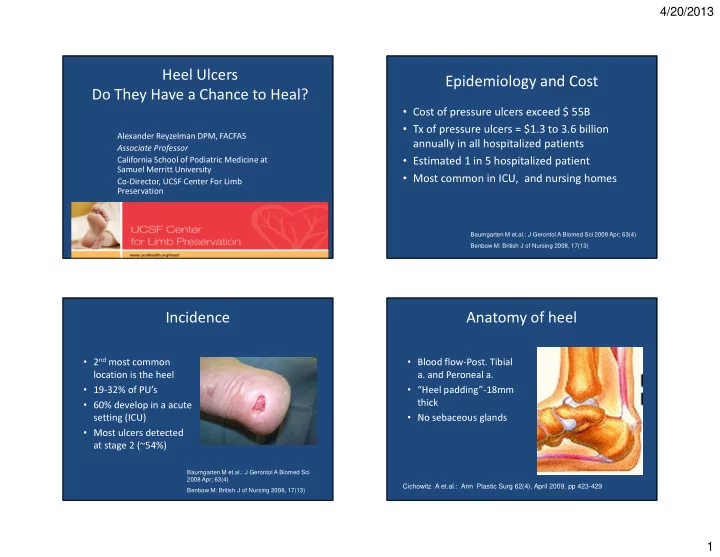
Heel Ulcers Epidemiology and Cost Do They Have a Chance to Heal? - - PowerPoint PPT Presentation

heel ulcers epidemiology and cost do they have a chance
SMART_READER_LITE
LIVE PREVIEW

Heel Ulcers Epidemiology and Cost Do They Have a Chance to Heal? - - PowerPoint PPT Presentation

4/20/2013 Heel Ulcers Epidemiology and Cost Do They Have a Chance to Heal? Cost of pressure ulcers exceed $ 55B Tx of pressure ulcers = $1.3 to 3.6 billion Alexander Reyzelman DPM, FACFAS annually in all hospitalized patients Associate


slide-1
SLIDE 1

4/20/2013 1

Heel Ulcers Do They Have a Chance to Heal?

Alexander Reyzelman DPM, FACFAS Associate Professor California School of Podiatric Medicine at Samuel Merritt University Co-Director, UCSF Center For Limb Preservation

Epidemiology and Cost

  • Cost of pressure ulcers exceed $ 55B
  • Tx of pressure ulcers = $1.3 to 3.6 billion

annually in all hospitalized patients

  • Estimated 1 in 5 hospitalized patient
  • Most common in ICU, and nursing homes

Benbow M: British J of Nursing 2008, 17(13) Baumgarten M et.al.: J Gerontol A Biomed Sci 2008 Apr; 63(4)

Incidence

  • 2nd most common

location is the heel

  • 19-32% of PU’s
  • 60% develop in a acute

setting (ICU)

  • Most ulcers detected

at stage 2 (~54%)

Benbow M: British J of Nursing 2008, 17(13) Baumgarten M et.al.: J Gerontol A Biomed Sci 2008 Apr; 63(4)

Anatomy of heel

  • Blood flow-Post. Tibial
  • a. and Peroneal a.
  • “Heel padding”-18mm

thick

  • No sebaceous glands

Cichowitz A et.al.: Ann Plastic Surg 62(4), April 2009, pp 423-429

slide-2
SLIDE 2

4/20/2013 2

Risks factors

  • PAD
  • Age
  • Pressure
  • Friction
  • Shear
  • Immobility
  • Diabetes*
  • Edema
  • CVA
  • Neuropathy
  • Hip fractures
  • Low serum albumin*
  • Low Braden score*

*Walsh J: Poster Adv. Wound Care, April 2006

Pathophysiology

Skin breakdown

Deep tissue injury (DTI) “Reperfusion hyperemia” Tissue Hypoxia Increase Pressure, Shear, and Friction

Classification

Stage Description 1 Non-blanching erythema/purple hue of skin, changes in temperature and sensation 2 Partial thickness skin loss i.e. blister or shallow crater 3 Full thickness skin loss involving necrosis of subcutaneous tissue 4 Full thickness skin loss with extensive necrosis to tendon, muscle, bone, or joint *Unstageable Ulcer with eschar-wound base can’t be assess *DTI Purple non blanchable area of intact skin which demarcates between 24-48 hours due to deep tissue destruction. Adapted from National PU Advisory panel (NPUAP) 2007

Classification

Unstageable wound Deep tissue injury

slide-3
SLIDE 3

4/20/2013 3

Two Types of Heel Ulcers

Plantar ulcers Non-plantar Posterior lateral and medial ulcers

Plantar vs. Non-Plantar Heel Ulcers

  • Plantar ulcers

– Not decubitus in etiology – Occur in ambulatory/younger individuals – Heel walkers – Frequently occurs after a failed Achilles lengthening procedure – Typically have adequate arterial perfusion

  • Non-plantar ulcers

– Low pressure over long period of time (decubitus) – Bedbound/ older patients – Typically have poor arterial perfusion.

Management

  • Offloading is a must- in ALL stages
  • Blood Flow has to be assessed
  • Stage 1-2 foam, hydrocolloid dressings
  • Stage 3-4-Know when to debride,

controversial

  • Nutritional assessment
  • DM related to poor outcomes

Farid KJ: Ostomy Wound Manag 2007; 53(4)

Offloading

  • Prevent drop foot
  • Reduce heel

pressure below 32mmHg

  • meticulous skin

care

Langemo D: Advances in Skin & Wound Care 2008, Heel Pressure Ulcers: Stand Guard

(Posterior heel ulcer)

slide-4
SLIDE 4

4/20/2013 4

Offloading Plantar heel ulcers Results

  • Meta-analysis
  • 1457 subjects/104 studies
  • Pressure relieving surfaces were associated

with significantly lower incidence of heel ulcers when compared with standard mattress

  • Insufficient research to conclude heel

protective devices prevent heel ulcers.

Langemo D: Advances in Skin & Wound Care 2008

Adjunctive Therapy

  • NPWT*
  • Bioengineered

tissue**

Main Reasons For Failure

  • Lack of Arterial

Perfusion

  • Can’t adequately
  • ffload

Osteomyelitis

slide-5
SLIDE 5

4/20/2013 5

When to debride?

Yes No

Surgical Approach

  • Is the patient able to ambulate or transfer?
  • Is there adequate arterial perfusion?

– Revascularization if needed

  • Surgical debridement

– In office/clinic vs Operating Room

  • Partial vs. Total Calcanectomy

Corticeal erosion Corticeal erosion

slide-6
SLIDE 6

4/20/2013 6

Literature Review

  • Systematic review of literature for partial and

total calcanectomies. Reviewed 26 publications that met the following criteria

  • Inclusion Criteria:

– Calcaneal osteomyelitis – Partial or total calcanectomy – Ambulatory pre-operatively – Follow up of at least 12 mos

Schade V., JAPMA 2012

Results

  • 60% of patients had no complications
  • 85% maintained ambulatory status post operatively
  • 83% returned to ambulation with the use of normal
  • r custom shoes with or without custom orthotics
  • Patients with DM had nearly 5 times greater risk of

major lower extremity amputation compared to patients without DM.

Schade V., JAPMA 2012

slide-7
SLIDE 7

4/20/2013 7

Post-OP Management Conclusion:

  • Systematic approach to heel ulcers should include:

– Ambulation assessment – Vascular assessment – Infection assessment

  • If conservative therapy fails, surgical approach is

warranted in the appropriate patients

  • Partial and/or Total Calcanectomy is a viable

alternative to BKA.

Thank You! Minor exostectomy

slide-8
SLIDE 8

4/20/2013 8

Results

  • Randomized clinical trial (level 2 evidence)
  • 338 adults, 3 pressure -reduction devices
  • 12 heel ulcers developed

– Bunny boot=3.9% – Egg crate=4.6% – Foot waffle=6.6%

  • No statistical significance

Gilcreast DM et.al.: J Wound Ostomy Continence 2005; 32

When to debride?

No Yes

When to debride? CS

Initial presentation 3 weeks

CS

3 months 4 months

slide-9
SLIDE 9

4/20/2013 9

Partial calcanectomy Results

  • Review 50 cases
  • 52-83% failure rate
  • To evaluate factors that

affects healing

– MRSA – PAD – Albumin levels – Ulcer stage

  • Review 9 feet (8 pts)
  • 2/9 procedures BKA
  • Ambulatory patients prior

to surgery remained ambulatory

  • 20 PC, 11 TC during 10 year

period

  • 18 DM pts-Primary healing
  • nly in 4 pts
  • 65% Overall failure in DM

Cook J et.al.: JFAS 2007, 46(4) Randall D et.al.: JAPMA 2005 July/Aug; 95(4) Crandall, Wagner: JBJS Am 1981, 63(1)

slide-10
SLIDE 10

4/20/2013 10

HPI

  • 45 y/o HF, DM2 x 15 years presents to ED c/o

painful left heel ulcer x 2 weeks. Began as a blister 2nd to shoe rub, that progressed to

  • ulceration. She received tx in Mexico

consisting of Cipro and local wound care. She was d/c from care in Mexico 3 days prior to ED

  • visit. She noticed increased pain, swelling,

redness and drainage.

Admission

  • Nausea, vomiting, fever and chills x 2 days
  • WBC 20.5
  • A1C=12.2
  • Vasc: palp pulses except L PT (edema)
  • Neuro: decreased protective sensation

Clinical Picture Day of Admission

Hospital course

  • Zosyn 4.5 q 8H
  • Evening of admission-

I&D with removal of all necrotic tissue

slide-11
SLIDE 11

4/20/2013 11

Culture results

  • Tissue from 1st I&D

– Staph aureus – Strep B – Viridans

Clinical Picture Post op day 4 Clinical Picture Post- op day 5

slide-12
SLIDE 12

4/20/2013 12

Post op day 10

Post Ostectomy Day 2

Wound vac placed immediately after 2nd I&D

Post debridement day 1

slide-13
SLIDE 13

4/20/2013 13

Hosp course on readmission

  • Debridement of necrotic tendon, application
  • f wound vac
  • Plastics did fasciocutaneous flap from calf and

2 STSG from thigh

Case-BH

  • 64 y/o F with heel

ulcer, LE bypass by vascular surgeon

  • Stagnant for 2

months

  • DM, HTN, CAD
  • Heavy smoker
  • Caregiver

Case-BH Application Case-BH 1 week post-application

slide-14
SLIDE 14

4/20/2013 14

Case-BH 2 week post-application Case-BH 4 week post-application