
SLIDE 1
March 3rd, 2019; ISAPP school 2019 @ the Pierre Auger Observatory.
High-energy astrophysics and black holes.
Gustavo E. Romero Instituto Argentino de Radioastronomía (IAR) and University of La Plata
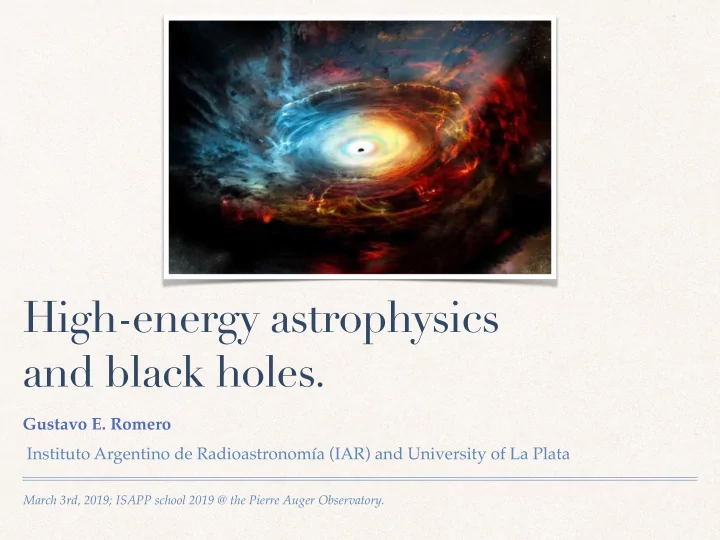
High-energy astrophysics and black holes. Gustavo E. Romero - - PowerPoint PPT Presentation
High-energy astrophysics and black holes. Gustavo E. Romero Instituto Argentino de Radioastronoma (IAR) and University of La Plata March 3rd, 2019; ISAPP school 2019 @ the Pierre Auger Observatory. <latexit
March 3rd, 2019; ISAPP school 2019 @ the Pierre Auger Observatory.
Gustavo E. Romero Instituto Argentino de Radioastronomía (IAR) and University of La Plata
Einstein’s equations ds2 = gµνdxµdxν
Gαβ = Rαβ − 1
2gαβR
dynamics of matter
A black hole is a spacetime region, i.e. what characterizes the black hole is its metric and its curvature. What is peculiar of this spacetime region is that it is causally disconnected from the rest of the spacetime: no events in this region cannot affect events outside the region.
Roy Kerr
ds2 = gttdt2 + 2gtφdtdφ − gφφdφ2 − Σ∆−1dr2 − Σdθ2 gtt = (c2 − 2GMrΣ−1) gtφ = 2GMac−2Σ−1r sin2 θ gφφ = [(r2 + a2c−2)2 − a2c−2∆ sin2 θ]Σ−1 sin2 θ Σ ≡ r2 + a2c−2 cos2 θ ∆ ≡ r2 − 2GMc−2r + a2c−2.
<latexit sha1_base64="(nul)">(nul)</latexit><latexit sha1_base64="(nul)">(nul)</latexit><latexit sha1_base64="(nul)">(nul)</latexit><latexit sha1_base64="(nul)">(nul)</latexit>a = J/M
<latexit sha1_base64="(nul)">(nul)</latexit><latexit sha1_base64="(nul)">(nul)</latexit><latexit sha1_base64="(nul)">(nul)</latexit><latexit sha1_base64="(nul)">(nul)</latexit> Kerr black hole
stationary particle:
When gtt ≤ 0 the stationary condition cannot be fulfilled, and hence a massive
particle cannot be stationary inside the surface defined by gtt = 0 —> ergosphere
Back holes, nevertheless, can act on the external
such action might occur:
Accretion of matter and fields onto the black hole. Effects of the ergosphere. Tidal disruptions. Perturbation of spacetime (generation of gravitational waves). Generation of bow-shocks. Effects on background light. Effects on the CMB. Evaporation.
The idea of BH was not widely accepted until Lynden-Bell paper (1969) and the interpretation of the X-ray emission of binaries by accretion
Standard disk model (Shakura & Sunyaev 1973): conservation of angular momentum leads to the formation of a disk around the BH. Energy is dissipated through radiation created by
thick each ring radiates as a blackbody of different temperature.
Basic equations for (thin) accretion disks
Simplifying assumptions:
axis is H << R .
z-direction.
Equation of continuity Equation of momentum transfer Energy dissipation in the disk Viscous stresses Equation of state Opacity law Relation between electron and proton temperature.
ν = αasH.
<latexit sha1_base64="(nul)">(nul)</latexit><latexit sha1_base64="(nul)">(nul)</latexit><latexit sha1_base64="(nul)">(nul)</latexit><latexit sha1_base64="(nul)">(nul)</latexit>P = Pgas + Prad = ρkT
µmp + 4σSB 3c T.
<latexit sha1_base64="(nul)">(nul)</latexit><latexit sha1_base64="(nul)">(nul)</latexit><latexit sha1_base64="(nul)">(nul)</latexit><latexit sha1_base64="(nul)">(nul)</latexit>κ = κ (ρ, T) .
<latexit sha1_base64="(nul)">(nul)</latexit><latexit sha1_base64="(nul)">(nul)</latexit><latexit sha1_base64="(nul)">(nul)</latexit><latexit sha1_base64="(nul)">(nul)</latexit> Structure of the thin disks
pressure and the opacity is due to free-free absorption.
radiation pressure but opacity is due to Thomson scattering off electrons.
gas pressure and opacity is mainly due to scattering.
Thin accretion disk
Iν(ν, R) = Bν(ν, R) ≡
2hν3 c2[exp(hν/kT )−1].
<latexit sha1_base64="(nul)">(nul)</latexit><latexit sha1_base64="(nul)">(nul)</latexit><latexit sha1_base64="(nul)">(nul)</latexit><latexit sha1_base64="(nul)">(nul)</latexit>Fν(ν) = cos θd
d2
R Rout
Rin
2π R Iν dR.
<latexit sha1_base64="(nul)">(nul)</latexit><latexit sha1_base64="(nul)">(nul)</latexit><latexit sha1_base64="(nul)">(nul)</latexit><latexit sha1_base64="(nul)">(nul)</latexit>The flux grows as Fν / ν2 for photon energies hν ⌧ kT(Rout), and decreases exponentially for hν kT(Rin). For intermediate energies the spectrum has the characteristic dependence Fν / ν1/3. As T(Rout) approaches T(Rin) this part
The total flux at frequency ν detected by an observer at a distance d whose line of sight forms and angle θd with the normal to the disk is:
<latexit sha1_base64="(nul)">(nul)</latexit><latexit sha1_base64="(nul)">(nul)</latexit><latexit sha1_base64="(nul)">(nul)</latexit><latexit sha1_base64="(nul)">(nul)</latexit>Spectrum
Changes in the accretion disk spectrum with different parameters
Diagnostics through Fe K-alpha lines It is possible to determine the spin
parameter a
The spectrum of X-ray binaries is more complex: more components
The Eddington luminosity, also referred to as the Eddington limit, is the maximum luminosity that can be achieved when there is balance between the force of radiation acting outward and the gravitational force acting inward. The state of balance is called hydrostatic equilibrium. ˙ MEdd = LEdd
c2
≈ 0.2 × 10⁸ ⇣
M M
⌘ M yr1.
<latexit sha1_base64="(nul)">(nul)</latexit><latexit sha1_base64="(nul)">(nul)</latexit><latexit sha1_base64="(nul)">(nul)</latexit><latexit sha1_base64="(nul)">(nul)</latexit>TEdd = ⇣
LEdd 4πσSBR2
Schw
⌘ ≈ 6.6 × 10⁷ ⇣
M M
⌘−1/4 K.
<latexit sha1_base64="(nul)">(nul)</latexit><latexit sha1_base64="(nul)">(nul)</latexit><latexit sha1_base64="(nul)">(nul)</latexit><latexit sha1_base64="(nul)">(nul)</latexit>Eddington limits
The super-Eddington wind is driven by radiation pressure.
ADAF
The assumption that all the heat generated by viscosity is radiated away does not hold for all accretion rates. Under some conditions the radial velocity of the accretion flow becomes large and the heat cannot be transformed into radiation and emitted fast enough. A significant fraction of the heat is stored as kinetic energy in the flow and advected onto the
assumption breaks down. This regime is known as “Advected Dominated Accretion Flow” (ADAF).
ADAF
There are two types of advection-dominated accretion flows. Optically thick ADAFs develop at very high accretion rates, typically larger than the Eddington value. In this limit the radiation gets trapped in the accretion flow and is advected because the optical depth is very large. Optically thin ADAFs occur in the opposite limit of sufficiently low accretion rates. In this regime the cooling timescale of the flow is longer than the accretion timescale, resulting again in a significant fraction of the energy being advected. These models are similar to the disk + corona models.
Super-Eddignton Sub-Eddignton
Main ADAF assumptions:
✦ The total pressure is considered as the sum of the pressure of a two-
temperature gas and the magnetic pressure.
✦ The heat generated by viscosity is preferably transferred to ions.
Hence, Ti>>Te
✦
Electrons cool completely.
The spectrum of AGNs extends along the whole e.m. range: there is non-thermal emission
Black holes power jets
Jet
Mechanisms of Jet Dissipa1on
Par1cle-dominated
Poyn1n
Current-driven instabili1es + reconnec1on Internal shocks + Fermi accelera1on Shear instab. (KH, CD) + reconnec1on Poyn1ng- dominated
Also observed in micoquasars
Basic equations that rule the outflow (ideal MHD)
r ⇥ ~ B = 4⇡ c ~ J, r · ~ B = 0, r ⇥ ~ E = 0, r · ~ E = 4⇡⇢e, ~ E + 1 c~ v ⇥ ~ B = 0, r ⇥ ⇣ ~ v ⇥ ~ B ⌘ = 0, r · (⇢~ v) = 0, ⇢ (~ v · r)~ v = rP ⇢rΦ + 1 4⇡ ⇣ r ⇥ ~ B ⌘ ⇥ ~ B.
<latexit sha1_base64="(nul)">(nul)</latexit><latexit sha1_base64="(nul)">(nul)</latexit><latexit sha1_base64="(nul)">(nul)</latexit><latexit sha1_base64="(nul)">(nul)</latexit>Maxwell Ohm Induction Continuity Euler
~ B = ~ Bp + Bφ ˆ .
<latexit sha1_base64="(nul)">(nul)</latexit><latexit sha1_base64="(nul)">(nul)</latexit><latexit sha1_base64="(nul)">(nul)</latexit><latexit sha1_base64="(nul)">(nul)</latexit>~ Bp ≡ Brˆ r + Bzˆ z
<latexit sha1_base64="(nul)">(nul)</latexit><latexit sha1_base64="(nul)">(nul)</latexit><latexit sha1_base64="(nul)">(nul)</latexit><latexit sha1_base64="(nul)">(nul)</latexit>Br = −1 r ∂Ψ ∂z Bz = 1 r ∂Ψ ∂r .
<latexit sha1_base64="(nul)">(nul)</latexit><latexit sha1_base64="(nul)">(nul)</latexit><latexit sha1_base64="(nul)">(nul)</latexit><latexit sha1_base64="(nul)">(nul)</latexit>The poloidal component is given by the flux function
(steady state and conductivity
The jet structure and evolution is determined by the Grad-Shafranov or transfield equation and the Euler equation.
Axisymmetric flows are nested magnetic surfaces of constant magnetic flux. These surfaces are equipotential. Plasma flows along these surfaces.
The origin of jets is related to the central compact object
Black hole
Both the black hole itself and the accretion disk can launch outflows
Rotation + poloidal field —> outflow
✤ Jets are produced by rapidly rotating BHs with magnetized accretion
disks.
✤ Power source - the rotational energy. ✤ The energy is extracted via magnetic torque as Poynting flux. ✤ Jet collimation is due to external medium. ✤ Jet acceleration is via conversion of the electromagnetic energy into the
bulk kinetic energy.
✤ Jet emission is via energy dissipation at shocks (kinetic energy) and/or
reconnection sites (magnetic energy).
Magnetic model of jets
Accretion-disk driven jets
Φoff = − GMBH √ r2 + z2 − 1 2Ω2
mr2.
<latexit sha1_base64="(nul)">(nul)</latexit><latexit sha1_base64="(nul)">(nul)</latexit><latexit sha1_base64="(nul)">(nul)</latexit><latexit sha1_base64="(nul)">(nul)</latexit>Φoff = −GMBH " r0 √ r2 + z2 + 1 2 ✓ r r0 ◆2# .
<latexit sha1_base64="(nul)">(nul)</latexit><latexit sha1_base64="(nul)">(nul)</latexit><latexit sha1_base64="(nul)">(nul)</latexit><latexit sha1_base64="(nul)">(nul)</latexit>∂2Φoff ∂s2 (r0, 0) = −GMBH r3
< 0.
<latexit sha1_base64="(nul)">(nul)</latexit><latexit sha1_base64="(nul)">(nul)</latexit><latexit sha1_base64="(nul)">(nul)</latexit><latexit sha1_base64="(nul)">(nul)</latexit> inflow
accretion disk Kerr black hole
Mass loading argument favours BH over accretion disk heavy mass loading weak mass loading slow wind relativistic jet magnetic field suppresses plasma transport from the disk corona to the BH magnetosphere Support from numerical simulations
Ergospheric jets
✤ While plasma is carried into the hole only (not
ejected), electromagnetic power is ejected along the rotation axis.
✤ This Poynting power should eventually be
turned into particles and a very fast jet.
✤ Magnetic field is tied to infalling plasma, not
horizon.
✤ Frame dragging in the ergosphere twists up the
field lines just as in the non-relativistic accretion disk case.
✤ Back-reaction of the magnetic field accelerates
the ergospheric plasma to relativistic speeds counter to the hole’s rotation: negative energy plasma.
✤ Accretion of negative energy plasma spins
down the hole
LEM ∼ EB 4π c πR2
g ∼ B2cR2 g.
<latexit sha1_base64="(nul)">(nul)</latexit><latexit sha1_base64="(nul)">(nul)</latexit><latexit sha1_base64="(nul)">(nul)</latexit><latexit sha1_base64="(nul)">(nul)</latexit> Mass load of jets
In the laboratory frame, the rotation of the magnetic field will induce an electric field. If not screened, this field could in principle be tapped for the acceleration of particles. By Gauss’ law, the induced electric field is supported by a local charge density corresponding to a particle number density (commonly referred to as the Goldreich– Julian [GJ] density well inside the light cylinder. The charge density in the vicinity of accreting black holes may well be so high that a significant fraction of this potential is screened and thus no longer available for particle acceleration
Particles accelerated in the gap can trigger electromagnetic cascades
Neutrons produced in the disk by pp collisions can decay inside the jet injecting p and electrons.
Additional load by entrainment of external medium
Evolution of magnetisation in the outflow Pelle, Romero, Pellizza 2019
Gamma-ray bursts: Collapsar Pair load by neutrino annihilation Neutron dragging?
Collapsar: jet interactions
Short gamma-ray bursts: binary neutron star merger
Neutrino cooled accretion disks
Simulations
Janiuk 2017
ß= Pgas/Pmag
Neutrino cooled accretion disks
Depending on the viewing angle, these events can be detected with LIGO for d<100 Mpc (Romero et
Tidal effects
Some objects can approach the BH close enough to undergo tidal effects Differential acceleration
Sgr A*
Gravitational capture:
Cloud G2
G2 was likely a light binary system, a protostar, or a clump in a stream.
Other tidal disruption events (TDE)
TDE rate: 10−4–10−5/yr/galaxy Several tens detected Formation of transient accretion disks and jets Both thermal and non-thermal emission Super-Eddington accretion rates Timescales from months in X-rays to years in radio
ASASSN-14li, the closest tidal disruption discovered in ten years.
For more comprehensive treatments and discussions –Thank you
Gravitational waves from BH mergers
µν = 0.
<latexit sha1_base64="(nul)">(nul)</latexit><latexit sha1_base64="(nul)">(nul)</latexit><latexit sha1_base64="(nul)">(nul)</latexit><latexit sha1_base64="(nul)">(nul)</latexit>µν = <[Aµν exp (ikαxα)].
<latexit sha1_base64="(nul)">(nul)</latexit><latexit sha1_base64="(nul)">(nul)</latexit><latexit sha1_base64="(nul)">(nul)</latexit><latexit sha1_base64="(nul)">(nul)</latexit> as for December 2018