High-Mass Stars General Astronomy: Sequence of - - PowerPoint PPT Presentation

high mass stars
SMART_READER_LITE
LIVE PREVIEW

High-Mass Stars General Astronomy: Sequence of - - PowerPoint PPT Presentation

ASTR 1120 High-Mass Stars General Astronomy: Sequence of expansion/contraction Stars & Galaxies repeats as higher and higher elements begin to fuse Each heavier element requires higher core temperatures to fuse Core structure


slide-1
SLIDE 1

ASTR 1120 General Astronomy: Stars & Galaxies

  • Homework #4 on Mastering Astronomy,

due on Thursday this week, 10/08, by 5pm

  • Next Extra Credit Observing Night:

–Thursday, 10/08 at Sommers-Bausch

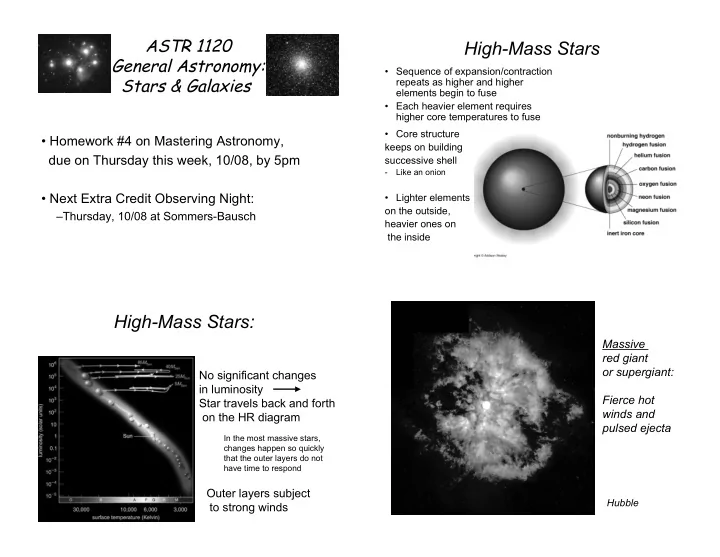
  • Sequence of expansion/contraction

repeats as higher and higher elements begin to fuse

  • Each heavier element requires

higher core temperatures to fuse

High-Mass Stars

  • Core structure

keeps on building successive shell

  • Like an onion
  • Lighter elements
  • n the outside,

heavier ones on the inside

No significant changes in luminosity Star travels back and forth

  • n the HR diagram

In the most massive stars, changes happen so quickly that the outer layers do not have time to respond

High-Mass Stars:

Outer layers subject to strong winds Massive red giant

  • r supergiant:

Fierce hot winds and pulsed ejecta

Hubble

slide-2
SLIDE 2

Wildest of all ! ETA CARINAE Supermassive star (150 MSUN ) late in life, giant outburst 160 yr ago Violent bipolar ejecta + disk at equator Question: why do we see the glowing gas surrounding the star to grow in time?

Note: the star emitted a pulse of radiation some time ago.

Star V838 Monocerotis HST-ACS

`Light Echo’ from pulse Red Giant with intense brightening

  • Most elements are formed via Helium Capture

– A helium (2 protons) nucleus is absorbed, energy is released

  • The elements are created going up the periodic

table in steps of 2

slide-3
SLIDE 3

Other Reactions

Carbon (6), Oxygen (8), Neon (10) Magnesium (12)….

E ARE STAR STUFF!!

  • Carl Sagan

“We are all star-stuff” - Carl Sagan

  • All heavy elements are created and dispersed

through the galaxy by stars

  • Without high mass stars, very little heavier

than carbon

  • Our atoms were once parts of stars that died

more than 4.6 billion years ago, whose remains were swept up into the solar system when the Sun formed

slide-4
SLIDE 4

What is the heaviest element that can be created through fusion?

  • A. Carbon
  • B. Silicon
  • C. Iron
  • D. Uranium

Clicker Question

What is the heaviest element that can be created through fusion?

  • A. Carbon
  • B. Silicon
  • C. Iron
  • D. Uranium

Clicker Question

HIGH mass stars keep creating elements up the periodic table UNTIL…. IRON (Fe, 26 protons )

  • Iron does not

release energy through fusion or fission

– Remember: All energy created by the loss of mass from the fusion (E=mc2)

  • The core of a high

mass star accumulates iron as the layers above it fuse

  • Without any outward

pressure, the core

  • nce again starts to

contract.

  • Electron degeneracy

pressure supports the core for awhile until the mass of iron gets too heavy (how heavy?)

slide-5
SLIDE 5
  • When mass is too large

(>1.4Msun), core collapses and iron atoms get compressed into pure neutrons

  • protons + electrons neutrons

+ neutrinos

– This takes less than 0.01 seconds

  • Electron degeneracy pressure -

GONE!

– Core collapses completely

  • Eventually neutron degeneracy pressure stops the

collapse abruptly

  • Infalling atmosphere impacts on the core.
  • Time for a demo…

Basketball & Super ball Demo

  • What do you think will happen?
  • A. The two balls will bounce up together
  • B. The little ball will bounce higher than the

basketball but no higher than when the little ball is dropped alone

  • C. The little ball will bounce much higher than the

basketball

Clicker Question

Supernova!

  • The lightweight atmosphere impacts on

the heavy core and is “bounced” off in a huge explosion

  • Plus huge energy release from

neutrinos!

e sta former surface zooms outwar i a veloci of 10,000 km/s!

“Massive Star SUPERNOVA”

  • Exploding remnant
  • f massive star

disperses heavy elements through the galaxy

  • Inside may be a

neutron star – a remnant core of pure neutrons!

Crab Nebula (M1), first seen as SUPERNOVA

  • n 4 July 1054 from China -- visible in daytime
slide-6
SLIDE 6

Was Crab SN recorded in Chaco?

  • Petroglyph from

Chaco Canyon (New Mexico):

– Correct configuration relative to the new moon for the Crab Supernovae – Of course it could also just be Venus with the moon!

  • Chinese records also

report a “guest star” in the sky in 1054 A.D.

Observing Supernovae

  • About 1 per century per galaxy

(none in Milky Way since 1604)

  • Bright explosions visible for

weeks/months

– some visible in daytime!

  • Remnant visible for 100’s of

thousands of years as huge bubbles and “veils”

Supernovae in Other Galaxies

  • Bright enough to be seen

as a sudden, bright point in other galaxies

  • Scores of amateur and

pro astronomers monitor nearby galaxies nightly to catch them

– (1 per 100 years per galaxy means that monitoring 100 galaxies will get you 1 supernova per year)

SN 1987A: Nearest One Since 1604

  • Exploded in the Large

Magellanic Cloud (companion dwarf galaxy to MW, 150,000 ly away)

  • Seen only from southern

hemisphere

– But neutrino detectors in Ohio, Japan, and Russia detected neutrinos from the explosion!

  • Ring structure: illuminated

remnants of an earlier stellar wind or gas left

  • ver from star’s formation
slide-7
SLIDE 7

Betelgeuse (In Orion) Is Currently In Its Red Supergiant Phase

might be next…

  • nly 1500 ly

away.. would be

very dramatic…

The ultimate fate of a massive star

Core burns to Fe, leading to a core collapse SUPERNOVA

What happens to the Fe core? Neutron Star - for star masses < 30-40 Msun Black Hole - for star masses > 30-40 Msun

The Stellar Graveyard

What’s In The Stellar Graveyard?

  • Low mass stars white dwarfs

– Gravity vs. electron degeneracy pressure

  • High mass stars neutron stars

– Gravity vs. neutron degeneracy pressure

  • Even more massive stars black holes

– Gravity wins

slide-8
SLIDE 8

When a high-mass star (M>8Msun)ends its life, what does it leave behind?

  • A. A neutron star or black hole
  • B. A white dwarf
  • C. A black hole
  • D. A neutrino ball
  • E. A red supergiant

Clicker Question

When a high-mass star (M>8Msun)ends its life, what does it leave behind?

  • A. A neutron star or black hole
  • B. A white dwarf
  • C. A black hole
  • D. A neutrino ball
  • E. A red supergiant

Clicker Question

Binary Systems: The Algol Paradox

  • Algol is a binary system consisting of a 3.7

solar mass main sequence star and a 0.8 solar mass red giant. Why is this strange?

  • A. A 3.7 MSun star should have become a red giant

before a 0.8 MSun star

  • B. Binary stars usually have the same mass
  • C. 0.8 MSun stars usually never become red giants

Clicker Question

Binary Systems: The Algol Paradox

  • Algol is a binary system consisting of a 3.7

solar mass main sequence star and a 0.8 solar mass red giant. Why is this strange?

  • A. A 3.7 MSun star should have become a red giant

before a 0.8 MSun star

  • B. Binary stars usually have the same mass
  • C. 0.8 MSun stars usually never become red giants

Clicker Question

slide-9
SLIDE 9

Algol Binary System

  • Binary stars can

have different masses but usually ARE formed at the same time.

  • More massive star

should have had a shorter main sequence lifetime

What happened?

  • The 0.8 solar mass star once

was more massive (3.0), with a 1.5 mass companion

  • As it became a red giant, it

swelled and poured material

  • nto its companion (lost 2.2)
  • The red giant (0.8) is now

less massive than its companion (3.7)

  • Future: when the other star

becomes red giant, it may pour gas back…?

Binary Mass Exchange

3.0 1.5

  • 2.2

0.8 3.7

early MS now

Moral of the story: Choose your companions wisely, for they may determine your fate

White Dwarfs: summary

  • For <8 MSun star = a hot core of carbon

(can also be oxygen for higher mass stars) Size ~ Earth !! Density – 1 cm3 is about 5 tons Held up by electron degeneracy pressure Cool from white-blue through red to black Maximum mass = 1.4 Msun

White Dwarfs in Binary Systems

  • Mass transfer from a

companion red giant spirals into an accretion disk

  • Inner parts become

VERY hot; glow in UV (mostly), X-rays

slide-10
SLIDE 10

Novae (not Supernovae!)

  • Accretion of hydrogen

gas onto the white dwarf can heat and fuse for while (only on surface)

  • Star becomes much

brighter nova (new star)

– Dimmer than supernova but still impressive!

White Dwarf Supernovae

  • If enough mass is

accreted, electron degeneracy is

  • vercome

– Limit = 1.4 Solar masses (recall the Chandrasekhar Limit)

  • Star then collapses,

carbon fusion begins in its core (explosively)

– Bye bye white dwarf!

  • Dr. Chandrasekhar says:

“Do not weigh more than 1.4 solar masses or you will collapse!”

Comparing The Two Types of Supernovae

  • Massive star SN (collapse of massive star)

– Found in young star formation regions – Make neutron stars or black holes

  • White dwarf SN (flash burning of WD)

– Binary systems only – Occurs in older star populations – Nothing left inside

We’ll be looking at these again as distance measurement tools!