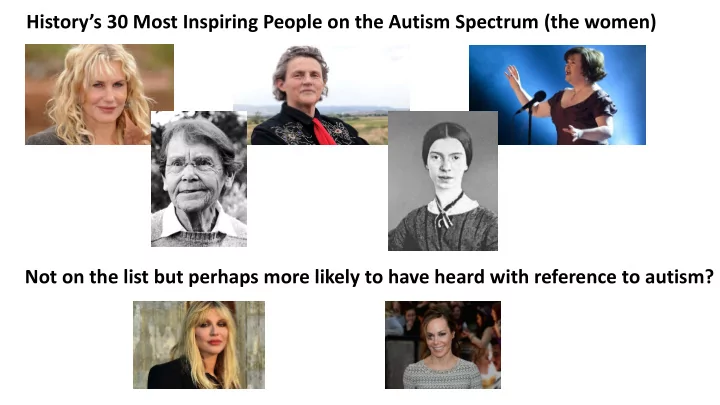
Historys 30 Most Inspiring People on the Autism Spectrum (the women) - - PowerPoint PPT Presentation

history s 30 most inspiring people on the autism spectrum
SMART_READER_LITE
LIVE PREVIEW

Historys 30 Most Inspiring People on the Autism Spectrum (the women) - - PowerPoint PPT Presentation

Historys 30 Most Inspiring People on the Autism Spectrum (the women) Not on the list but perhaps more likely to have heard with reference to autism? I think being a woman is hard. Being an autistic woman is even harder Rose Hughes


slide-1
SLIDE 1

History’s 30 Most Inspiring People on the Autism Spectrum (the women) Not on the list but perhaps more likely to have heard with reference to autism?

slide-2
SLIDE 2

“I think being a woman is hard. Being an autistic woman is even harder”

  • Gender bias in screening & stereotypes (based on male characteristics)
  • Apparent higher social motivation and greater capacity for traditional friendships – but

based on analytical thinking and strategies such as rote learning, imitation, scripts, masking and camouflaging with better language skills

  • Ability to camouflage social difficulties in social situations, on periphery, led by others
  • Quiet / passive behaviours more acceptable for girls
  • ‘Special’ interests may be less obvious (more ‘normal’) but more intense than peers
  • Better imagination, pretend play but maybe escapism or scripted
  • Less obvious ‘physical’ characteristics e.g. repetitive & ritualistic behaviours
  • Internalising behaviours rather than externalising
  • Diagnostic overshowing – coexisting conditions may be part of autism presentation
  • Assessment based on traditional ‘male’ presentation and so females missed in terms of

recognition and diagnosis with the ensuing explanation, help and support

  • ‘Misdiagnosis or missed diagnosis’ - Impacts

Rose Hughes

slide-3
SLIDE 3

What is the experience of being a women with autism? In your group discuss your

  • wn experiences

“Empowering women and girls with autism”

United Nations

slide-4
SLIDE 4

References

Dean, M. Harwood, R & Kasari, C. (2017). The art of camouflage: gender differences in the social behaviours of girls and boys with autism spectrum disorder. Autism 21 (6) pp678-689. Gould, J. & Aston-Smith, J. (2011). Missed diagnosis or misdiagnosis: girls and women on the spectrum. Good autism practice 12 (1) pp34-41.

  • Nasen. (2016). Girls and autism: Flying under the radar. Tamworth:

Nasen

slide-5
SLIDE 5

Interesting article with 6 women with autism www.bbc.co.uk/news/resources/idt- sh/women_late_diagnosis_autism NAS information on women and girls with autism – the second

  • ne in particular has some links to interesting articles

www.autism.org.uk/womensday http://www.autism.org.uk/about/what-is/gender.aspx