Home Health Agencies: g Regulatory and Enforcement Trends - - PowerPoint PPT Presentation

home health agencies g regulatory and enforcement trends
SMART_READER_LITE
LIVE PREVIEW

Home Health Agencies: g Regulatory and Enforcement Trends - - PowerPoint PPT Presentation

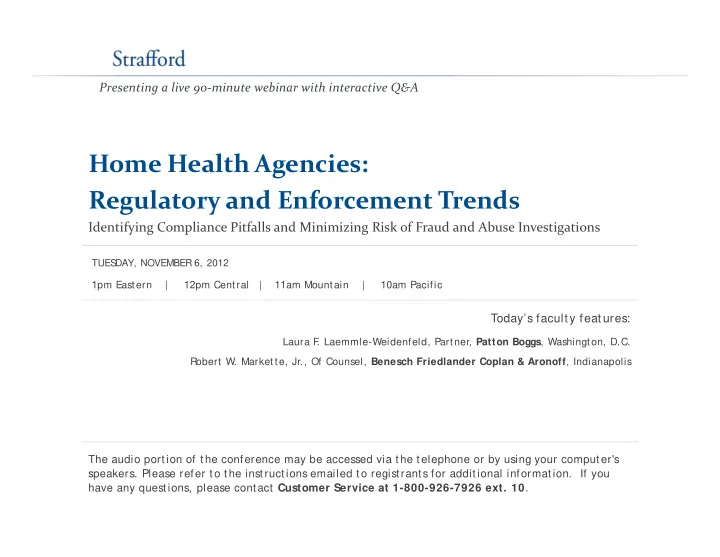
Presenting a live 90 minute webinar with interactive Q&A Home Health Agencies: g Regulatory and Enforcement Trends Identifying Compliance Pitfalls and Minimizing Risk of Fraud and Abuse Investigations TUES DAY, NOVEMBER 6, 2012 1pm


slide-1
SLIDE 1

Presenting a live 90‐minute webinar with interactive Q&A

Home Health Agencies: g Regulatory and Enforcement Trends

Identifying Compliance Pitfalls and Minimizing Risk of Fraud and Abuse Investigations

T d ’ f l f

1pm Eastern | 12pm Central | 11am Mountain | 10am Pacific TUES DAY, NOVEMBER 6, 2012

Today’s faculty features:

Laura F . Laemmle-Weidenfeld, Partner, Patton Boggs, Washington, D.C. Robert W. Markette, Jr., Of Counsel, Benesch Friedlander Coplan & Aronoff, Indianapolis

The audio portion of the conference may be accessed via the telephone or by using your computer's

  • speakers. Please refer to the instructions emailed to registrants for additional information. If you

have any questions, please contact Customer Service at 1-800-926-7926 ext. 10.

slide-2
SLIDE 2

Tips for Optimal Quality

S d Q lit S

  • und Quality

If you are listening via your computer speakers, please note that the quality of your sound will vary depending on the speed and quality of your internet connection. If the sound quality is not satisfactory and you are listening via your computer speakers, you may listen via the phone: dial 1-866-370-2805 and enter your PIN when prompted Otherwise please send us a chat or e mail when prompted. Otherwise, please send us a chat or e-mail sound@ straffordpub.com immediately so we can address the problem. If you dialed in and have any difficulties during the call, press *0 for assistance.

Viewing Qualit y

To maximize your screen, press the F11 key on your keyboard. To exit full screen, press the F11 key again press the F11 key again.

slide-3
SLIDE 3

Continuing Education Credits

FOR LIVE EVENT ONLY

For CLE purposes, please let us know how many people are listening at your location by completing each of the following steps:

  • In the chat box, type (1) your company name and (2) the number of

attendees at your location attendees at your location

  • Click the word balloon button to send
slide-4
SLIDE 4

H H lth A i R l t d H H lth A i R l t d Home Health Agencies: Regulatory and Home Health Agencies: Regulatory and Enforcement Trends Enforcement Trends

November 6, 2012 November 6, 2012

i f Laura Laemmle-Weidenfeld Partner, Patton Boggs LLP lweidenfeld@pattonboggs.com (202) 457-6542

WASHINGTON DC | NORTHERN VIRGINIA | NEW JERSEY | NEW YORK | DALLAS | DENVER | ANCHORAGE | DOHA | ABU DHABI

slide-5
SLIDE 5

Billing/Coding/Documentation Enforcement

  • Significant documentation requirements for

ff HHA combined with difficulty overseeing compliance => perfect compliance storm

  • Enforcement focus
  • Particular areas of risk
  • How to minimize risks

5

slide-6
SLIDE 6

Billing/Coding/Documentation Enforcement

  • Significant enforcement focus

– Criminal Ci il (F l Cl i A t) – Civil (False Claims Act) – Administrative (OIG)

6

slide-7
SLIDE 7

Criminal Enforcement Focus Criminal Enforcement Focus

  • Applicable laws:

Applicable laws:

– Wire fraud – Mail fraud – Health care fraud Health care fraud – Conspiracy – Other

  • Increasing activity
  • Increasing activity

– DOJ-HHS Health Care Fraud Prevention and Enforcement Action Team (HEAT) created in May 2009

  • Operates nationwide
  • Operates nationwide
  • Medicare Fraud Strike Force

– Focus on both corporate entities and individuals

7

slide-8
SLIDE 8

Recent Enforcement Actions

  • Federal jury in Detroit convicted physician, HHA owner and patient recruiter for

participating in $14 5 million Medicare fraud scheme (October 2012) participating in $14.5 million Medicare fraud scheme (October 2012)

– Patient recruiters allegedly paid beneficiaries to sign blank documents for PT services not provided and/or medically unnecessary – HHA allegedly paid physicians to sign referrals and other therapy documents necessary to bill Medicare PTs and PTAs would allegedly create fake medical records to make it appear services – PTs and PTAs would allegedly create fake medical records to make it appear services actually were rendered

  • October 2012 take-down by Strike Force

– 7 cities – charges against 91 individuals – Indictments charged more than $230 million in Medicare home health fraud

  • Owner of Miami HHA sentenced to 120 months in prison for $42M health care

fraud scheme involving paying patient recruiters and physicians for false plans of fraud scheme involving paying patient recruiters and physicians for false plans of care and medical certification and falsifying patient files (Oct. 2012) 8

slide-9
SLIDE 9

Civil False Claims Act

  • Civil False Claims Act (FCA), 31 U.S.C. §3729

et seq.

  • Revised in 2009 (Fraud and Enforcement

Recovery Act), 2010 (Patient Protection and Affordable Care Act) C t i ll fil d b i t hi tl bl

  • Cases typically filed by private whistleblowers

(qui tam provisions) before D t t f J ti h ibilit f

  • Department of Justice has responsibility for

investigating, enforcing (Civil Frauds, USAOs)

9

slide-10
SLIDE 10

Conduct Prohibited Under FCA

  • Submitting a claim for payment OR causing claim to be submitted

for payment, by Government funds. 31 U.S.C. § 3729(a)(1)(A). p y , y § ( )( )( )

  • Making or using, or causing to be made or used, false records or

statements material to a false claim. 31 U.S.C. §3729(a)(1)(B).

  • Making or using, or causing to be made or used, false records or

statements material to an obligation to pay money or property to the Government, or knowingly concealing or improperly avoiding

  • r decreasing an obligation to pay money to the Government 31
  • r decreasing an obligation to pay money to the Government. 31

U.S.C. §3729(a)(1)(G).

  • Conspiring to commit a violation of the FCA. 31 U.S.C.

§3729( )(1)(C) §3729(a)(1)(C).

  • All require “knowledge” and link to Government funding.

10

slide-11
SLIDE 11

Key Provisions

  • Knowledge:

– Defined by the statute as

A t l k l d th t th l i t t t f l OR

  • Actual knowledge that the claim or statement was false, OR
  • Deliberate ignorance of truth or falsity of the claim or statement,

OR

  • Reckless disregard of the truth or falsity of the claim or

t t t statement

– Proof of specific intent to defraud is NOT required

  • Materiality: having a tendency to influence or be

Materiality: having a tendency to influence or be capable of influencing payment or receipt of money

  • r property
  • Obligation: established duty, including that arising out
  • f retention of any overpayment

11

slide-12
SLIDE 12

Damages and Penalties under the FCA

The FCA imposes:

  • Treble the “amount of damages which the

t t i b f th t” government sustains because of the act” giving rise to liability.

  • A civil penalty of $5,500 to $11,000 for each

false claim false claim.

12

slide-13
SLIDE 13

HHS-OIG’s Exclusion Authority

  • Exclusion: Medicare Medicaid and other Federal
  • Exclusion: Medicare, Medicaid and other Federal

health programs won’t reimburse services provided,

  • rdered or prescribed by individual or entity
  • HHS-OIG has exclusive authority
  • Issue arises in FCA cases and criminal cases as well
  • Issue arises in FCA cases and criminal cases, as well

as administrative exclusion matters

  • Mandatory and permissive 42 U S C §1320a-7

Mandatory and permissive, 42 U.S.C. §1320a 7

– Criminal convictions for health care fraud offenses => mandatory exclusion – Submission of false claims => permissive exclusion

13

slide-14
SLIDE 14

Home Health Services and OIG Work Plan for 2013 OIG Work Plan for 2013

2013 OIG W k Pl l d O b 13 2012

  • 2013 OIG Work Plan released October 13, 2012
  • Home Health Face-to-Face Requirement

Home Health Face to Face Requirement

  • Employment of Home Health Aides with Criminal

Convictions

  • Missing or Incorrect Patient Outcome and

Missing or Incorrect Patient Outcome and Assessment Data

14

slide-15
SLIDE 15

Home Health Services and OIG Work Plan for 2013 OIG Work Plan for 2013

  • Medicare Administrative Contractors’

Oversight of Claims Oversight of Claims

  • Home Health Prospective Payment System

Home Health Prospective Payment System Requirements

  • Duplicate Payments by Medicare and

Medicaid

  • Screening of Health Care Workers

15

slide-16
SLIDE 16

Home Health Services and OIG Work Plan for 2013 OIG Work Plan for 2013

  • Provider Compliance and Beneficiary

Eligibility

  • Homebound Requirements
  • Personal Care Services – Compliance with

Payment Requirements Payment Requirements

16

slide-17
SLIDE 17

HHS-OIG Studies/Reports

  • Inappropriate and Questionable Billing by

Medicare Home Health Agencies (OEI-04- 11 00240 A t 2012) 11-00240 August 2012)

17

slide-18
SLIDE 18

High-Risk Billing/Coding/Documentation Issues Issues

  • Issues at administrative level involving clinical

and/or personnel issues

  • Issues in field at caregiver level or supervisor

level level

  • Issues in billing office
  • Issues in billing office

18

slide-19
SLIDE 19

Clinical and Personnel-Related Administrative Issues Administrative Issues

  • OASIS data

Physician signatures/dates on plans of care 485

  • Physician signatures/dates on plans of care, 485

forms

  • Prior authorization signatures
  • Background checks
  • Qualifications of caregiver
  • Exclusion checks
  • Exclusion checks

– Required by CIAs – If employee is excluded but HHA bills anyway, repayment is required regardless of knowledge required regardless of knowledge

  • Documentation of homebound status
  • (Documentation of improvement standard)

19

slide-20
SLIDE 20

Caregiver Documentation Issues

  • Inaccurately recording dates and times worked

P ddi ti – Padding times – Dates patient was in hospital, SNF, or deceased

  • Pre-filling notes

g

  • Inaccurately recording care given, vitals taken
  • Forging patients/families’ signatures
  • Homebound requirement (where applicable)
  • Billing time concurrent with another HHA

P t ti l f ll i ith ti t d/ f ili

  • Potential for collusion with patients and/or families

20

slide-21
SLIDE 21

Supervisory Issues

  • Inaccurate documentation regarding date of

supervisory visit I t d t ti di h th

  • Inaccurate documentation regarding whether

supervisory visit occurred

  • Accurately documenting training and

qualifications of individual caregivers qualifications of individual caregivers, assigning appropriately

21

slide-22
SLIDE 22

Billing Issues

  • Billings all impacted by issues identified on

prior slides prior slides

  • Failure to verify timesheet documentation

Failure to verify timesheet documentation prior to billing

  • Billing for higher level of service than

provided

  • Dual eligibles

22

slide-23
SLIDE 23

Mitigating Risks of Documentation/Coding/Billing Issues Documentation/Coding/Billing Issues

  • Recognize risks are real despite good intentions of

management management

  • Create culture that values compliance, from CEO

p , down to lowest-skill caregiver Task e er one in organi ation ith responsibilit for

  • Task everyone in organization with responsibility for

identifying and stopping errors and fraud

  • Create and maintain an effective compliance program

23

slide-24
SLIDE 24

Elements of an Effective Compliance Program Program

  • Written standards of conduct

D i d li ffi d l d i

  • Designated compliance officer and related governing

bodies

  • Regular effective education and training programs

Regular, effective education and training programs for all employees

  • Process to receive complaints, maintain anonymity of

complainants, and protect them from retaliation

  • Disciplinary system
  • Auditing
  • Auditing
  • Investigation and remediation

24

slide-25
SLIDE 25

How Not To Market: How Not To Market: Common Ways to Market Yourself Into Prison Yourself Into Prison

Robert W. Markette, Jr. CHC Of Counsel Benesch, Friedlander, Coplan & Aronoff LLP One American Square Suite 2300 One American Square, Suite 2300 Indianapolis, IN 46282 E-mail: rmarkette@beneschlaw.com

slide-26
SLIDE 26

MY BENESCH MY TEAM

NOTE:

The materials and opinions presented by the speaker p p y p at this session represent the speaker’s views, are for educational and informational purposes only, are not intended to be legal advice and should not be used for legal guidance or to resolve specific legal problems. The speaker expressly reserves the right to advocate The speaker expressly reserves the right to advocate

  • ther positions on behalf of clients. In all cases, legal

advice applicable to your organization’s own specific advice applicable to your organization s own specific circumstances should be sought.

26

slide-27
SLIDE 27

MY BENESCH MY TEAM

Marketing and the Medicare/Medicaid Provider: Here comes the law !

27

slide-28
SLIDE 28

MY BENESCH MY TEAM

Many marketing practices that are considered Many marketing practices that are considered good business in other industries are considered illegal for Medicare/Medicaid Providers (including illegal for Medicare/Medicaid Providers (including Waiver).

28

slide-29
SLIDE 29

MY BENESCH MY TEAM

This is due to federal fraud and abuse laws This is due to federal fraud and abuse laws. No remedy for fraud and abuse problems will be as No remedy for fraud and abuse problems will be as good as avoiding them in the first place.

29

slide-30
SLIDE 30

MY BENESCH MY TEAM

Basic Federal Fraud and Abuse Law s

Brief overview of the following laws: The Anti Kickback Statute 42 U S C § 1320a 7b(b); The Anti-Kickback Statute, 42 U.S.C. § 1320a-7b(b); Physician Self-Referral Law (Stark), 42 U.S.C. § 1395nn; The Civil Monetary Penalties Statute, 42 U.S.C. § 1320a-7a; and, The False Claims Act 31 U.S.C. §§ 3729, et. seq.

30

slide-31
SLIDE 31

MY BENESCH MY TEAM

Outside “marketing” companies There are many options to contract with outside PR i f k ti PR companies for marketing. OIG h t dl t t d h t OIG has repeatedly stated such arrangements should NOT involve commissions.

31

slide-32
SLIDE 32

MY BENESCH MY TEAM

Outside “marketing” companies Recently, providers are being approached by “marketers” who are not really marketers. They are individuals with “access” to a pool of referrals.

32

slide-33
SLIDE 33

MY BENESCH MY TEAM

Outside “marketing” companies This may be through relationships or job. Marketer t b th ’ k ti t ff proposes to become the agency’s marketing staff. R t f f l U ll fl t $250 Requests a fee per referral. Usually a flat $250 - $500. May request a “subscription fee” with bonuses.

33

slide-34
SLIDE 34

MY BENESCH MY TEAM

Outside “marketing” companies This type of arrangement is extremely risky. It is

  • ne to be avoided.

Yes, someone else may pay the fee, but you are seriously at risk for going to jail if you do.

34

slide-35
SLIDE 35

MY BENESCH MY TEAM

Inappropriate Marketing: Prizes, Gifts, and Other “Perks” , Many non-healthcare businesses provide gifts to customers who refer clients to the business. Since the purpose of giving a gift or having a prize giveaway is to generate goodwill with referral sources and/or patients, it meets the one purpose test.

35

slide-36
SLIDE 36

MY BENESCH MY TEAM

Prizes, Gifts and other “Perks” Other Examples: p Meals H H Happy Hour Spa Day

36

slide-37
SLIDE 37

MY BENESCH MY TEAM

Prizes, Gifts and other “Perks” Recent Face to Face example: p Physician requesting agency pay “administrative y q g g y p y fee” before physician will prepare face to face documentation.

37

slide-38
SLIDE 38

MY BENESCH MY TEAM

Prizes, Gifts and other “Perks” Providing items of value to patients as an Providing items of value to patients as an inducement to select the provider for reimbursable services violates the CMP reimbursable services violates the CMP statute.

38

slide-39
SLIDE 39

MY BENESCH MY TEAM

Prizes, Gifts and other “Perks” Examples: p Free Services F E i t Free Equipment Free Chair

39

slide-40
SLIDE 40

MY BENESCH MY TEAM

Prizes, Gifts and other “Perks” Examples: p Movie Tickets T t ti OIG i i l tt Transportation – OIG opinion letters Other Gifts

40

slide-41
SLIDE 41

MY BENESCH MY TEAM

Prizes, Gifts and other “Perks” OIG will not prosecute violations that involve “nominal value ” “nominal value.” Nominal Value means less than $10 per person p p and totaling no more than $50 per year to each person. p Think small gifts.

41

slide-42
SLIDE 42

MY BENESCH MY TEAM

Free Services OIG has issued a number of advisory opinions di th i i f f it i regarding the provision of free items or services to beneficiaries and in almost every instance, the f it i t b fi i i f d free items or services to beneficiaries were found to be a violation of the fraud and abuse laws.

42

slide-43
SLIDE 43

MY BENESCH MY TEAM

Free Services Two Examples: Advisory Opinion on Free Home Safety A t Assessments Ad i O i i f F H O Advisory Opinion of Free Home Oxygen

43

slide-44
SLIDE 44

MY BENESCH MY TEAM

Free Services In both of these cases, OIG looked at the “perceived value” of the services As a result the “perceived value” of the services. As a result, the minimal value exception did not apply. This means if you provide free items or services, even if it does not cost you a lot it is probably not even if it does not cost you a lot, it is probably not minimal value.

44

slide-45
SLIDE 45

MY BENESCH MY TEAM

Special Cases Health Fairs Health fairs are one of the most common forms

  • f home health marketing. Many agencies

participate in health fairs as a way to generate p p y g new business. Recent Opinion on Free Blood Pressure Recent Opinion on Free Blood Pressure Screening.

45

slide-46
SLIDE 46

MY BENESCH MY TEAM

Free Staffing to Referral Source This situation can come up in a number of ways. A home health agency might send a nurse to a g y g referring physician’s office to help them complete their paperwork to obtain reimbursement. A p p hospice may provide staff to a nursing facility to perform duties that would otherwise be performed p p by nursing facility staff.

46

slide-47
SLIDE 47

MY BENESCH MY TEAM

Free Staffing to Referral Source If you provide staff for free or below fair market value to a referral source to perform the duties value to a referral source to perform the duties normally performed by the referral source’s staff, you are providing them with something of value you are providing them with something of value – staff.

47

slide-48
SLIDE 48

MY BENESCH MY TEAM

Free Staffing to Referral Source If the free staffing is being provided to increase g g p referrals, it is a violation. Hard to explain why staff being provided for free.

48

slide-49
SLIDE 49

MY BENESCH MY TEAM

Free Staffing to Referral Source A provider may provide staffing to a referral if th t i t t d t t source if the arrangement is structured to meet what is known as the personal services safe h b t th A ti Ki kb k l harbor to the Anti-Kickback law. Thi f h b i t th thi This safe harbor requires, amongst other things, fair market value.

49

slide-50
SLIDE 50

MY BENESCH MY TEAM

Free Staffing to Referral Source Home health agencies have provided referring physicians with smart phones and other physicians with smart phones, and other communications devices in order to “ensure care coordination ” coordination. This is also a violation. While you may argue it is provided for a legitimate reason it can be used by provided for a legitimate reason, it can be used by the physician for any number of other purposes.

50

slide-51
SLIDE 51

MY BENESCH MY TEAM

Medical Directors If the physician who acts as your medical director is a source of referrals, the relationship can violate not only the Anti-Kickback statute, but also the Stark law.

51

slide-52
SLIDE 52

MY BENESCH MY TEAM

Medical Directors The AKS and the Stark Law have a safe harbor/exception into which a medical director relationship can fit. p

52

slide-53
SLIDE 53

MY BENESCH MY TEAM

Medical Directors Medical director relationships must be provided t t t t th t t ll f th pursuant to a contract that meets all of the requirements of the Exception/Safe Harbors. Both the Safe Harbor and the Exception require th ti b f i k t l the compensation be fair market value.

53

slide-54
SLIDE 54

MY BENESCH MY TEAM

Medical Directors Some providers “hire” medical directors simply as a way to secure referrals Risks: way to secure referrals. Risks: Multiple medical directors Paying more than FMV Paying for services not rendered

54

slide-55
SLIDE 55

MY BENESCH MY TEAM

Medical Directors

Having the contract in place is not enough. Relationship must operate in compliance with contract. You must be prepared to prove compliance.

  • Document. Document. Document.

Q: Can you prove what physician is doing, other than referring patients, to justify payments? referring patients, to justify payments?

55

slide-56
SLIDE 56

MY BENESCH MY TEAM

Fraud and Abuse In LTC Relationships OIG has issued a number of bulletins outlining its b t th i k i h h lth d concerns about the risks in home health and hospice relationships with facilities. Concerns f i k i ill ff i d t t focus on risk agencies will offer inducements to “gain access.”

56

slide-57
SLIDE 57

MY BENESCH MY TEAM

Fraud and Abuse In LTC Relationships Example: A nursing home requests a hospice p g q p provide items or services to a hospice beneficiary that is covered by the nursing home y y g per diem.

57

slide-58
SLIDE 58

MY BENESCH MY TEAM

Fraud and Abuse In LTC Relationships Because the services are covered by the nursing y g home per diem, if the hospice provides them instead, the nursing home reduces its costs. This g increases the nursing homes profits and is remuneration to the home.

58

slide-59
SLIDE 59

MY BENESCH MY TEAM

Fraud and Abuse In LTC Relationships A facility may request the agency provide staff generally or staff the agency’s patients at a level generally or staff the agency’s patients at a level that is not indicated. Again, if the hospice staff is providing care the facility would otherwise provide providing care the facility would otherwise provide as part of the nursing home per diem, the nursing home is receiving remuneration home is receiving remuneration.

59

slide-60
SLIDE 60

MY BENESCH MY TEAM

Fraud and Abuse In LTC Relationships Other examples: Facility requests hospice to provide Facility requests hospice to provide “continuous care” to all hospice patients in facility. F ilit t id l t d th Facility requests provider use related therapy company and then “suggests” excessive services to ti t patients.

60

slide-61
SLIDE 61

MY BENESCH MY TEAM

Fraud and Abuse In LTC Relationships Other examples: Facility requests agency provide supplies that Facility requests agency provide supplies that are covered by per diem or excessive amounts of supplies for hospice patients supplies for hospice patients. Facility requests agency take on “marginal cases.”

61

slide-62
SLIDE 62

MY BENESCH MY TEAM

Fraud and Abuse In LTC Relationships Last summer, OIG issue report outlining concerns b t t i “l t ” h i ti t b i about certain “long term” hospice patients being cared for in facilities. RISK: Taking on marginal patients to please f i f ilit referring facility.

62

slide-63
SLIDE 63

MY BENESCH MY TEAM

Fraud and Abuse In LTC Relationships These types of issues can come up in relationships These types of issues can come up in relationships with other facilities as well. Assisted living facilities for example for example.

63

slide-64
SLIDE 64

MY BENESCH MY TEAM

Fraud and Abuse In LTC Relationships Assisted Living Facilities may “offer” an agency Assisted Living Facilities may offer an agency

  • ffice space.

May request a provider perform certain services.

64

slide-65
SLIDE 65

MY BENESCH MY TEAM

Fraud and Abuse In LTC Relationships Example: ALF requests agency keep an RN on- Example: ALF requests agency keep an RN on site at all times, because agency’s patients may “need to talk to someone.” ALF then advertises need to talk to someone. ALF then advertises “RN available 24/7.”

65

slide-66
SLIDE 66

MY BENESCH MY TEAM

Fraud and Abuse In LTC Relationships May “request” agency use facility or related therapy t ff t h h lth ti t i th staff to serve home health agency patients in the facility. They may also “advocate” for more services on POC POC.

66

slide-67
SLIDE 67

MY BENESCH MY TEAM

Avoiding problems In your practice as a Medicare or Medicaid provider you must be sensitive to the fact that provider, you must be sensitive to the fact that many arrangements that are acceptable business practices in other fields are fraud and abuse practices in other fields are fraud and abuse violations.

67

slide-68
SLIDE 68

MY BENESCH MY TEAM

Avoiding problems You also must be sensitive to the fact that both f d l d t t t b i federal and state governments are becoming more aggressive in their attempt to eliminate i d tili ti d t t t perceived over-utilization and to cut costs.

68

slide-69
SLIDE 69

MY BENESCH MY TEAM

Avoiding problems 1. Train, train, and retrain your marketing personnel The pressure to go compete in home

  • personnel. The pressure to go compete in home

health and to “successfully” market, can lead marketing personnel to try to keep up with marketing personnel to try to keep up with

  • competitors. This can lead you into violations of

federal laws federal laws. Training is key to compliance.

69

slide-70
SLIDE 70

MY BENESCH MY TEAM

Avoiding problems For marketing compliance, your marketers, and certain clinical staff, are most likely to see or to be approached about suspect arrangements. They need to know where the lines are at to avoid crossing them.

70

slide-71
SLIDE 71

MY BENESCH MY TEAM

Avoiding problems 2. Make sure you have compliance oversight

  • f new marketing categories and efforts
  • f new marketing categories and efforts.

3 Ensure arrangements meet applicable safe 3. Ensure arrangements meet applicable safe harbors on paper and in practice. Requires auditing of relationships auditing of relationships.

71

slide-72
SLIDE 72

MY BENESCH MY TEAM

Avoiding problems g 4 When in doubt about a potential 4. When in doubt about a potential marketing practice or joint venture, seek the advice of counsel seek the advice of counsel.

72

slide-73
SLIDE 73

MY BENESCH MY TEAM

Avoiding problems If you rely upon a safe harbor that relates to values per individual or totals in a year – TRACK AMOUNTS GIVEN. This applies to “minimal value” and non-monetary compensation.

73

slide-74
SLIDE 74

OVERPAYMENTS OVERPAYMENTS

74

slide-75
SLIDE 75

Overpayments Overpayments

  • Potential liability under the civil False Claims

Act (FCA) for failure to return overpayments

  • Obligation to return “overpayments” created

under 2009 Fraud Enforcement and under 2009 Fraud Enforcement and Recovery Act (FERA) and 2010 Patient Protection and Affordable Care Act (ACA)

  • ec o

a d

  • dab e Ca e

c ( C )

75

slide-76
SLIDE 76

FCA and Overpayments

  • Relevant FCA provision for “reverse false claims”

includes knowingly concealing or improperly avoiding

  • r decreasing an obligation to pay money to the

Government §3729(a)(1)(G) (emphasis added) Government, §3729(a)(1)(G) (emphasis added)

  • Added by FERA in 2009
  • “Obligation” in the FCA redefined under FERA to

include “retention of any overpayment” include retention of any overpayment

  • 60-day repayment requirement imposed by ACA

76

slide-77
SLIDE 77

Overpayments and 60-Day Rule

  • Statutory 60-day rule (Social Security Act § 6402)

– Requires specifically that all providers report and return

  • verpayments within the later of sixty (60) days of identifying
  • verpayments within the later of sixty (60) days of identifying

the overpayment or the date the corresponding cost report is due, “if applicable.” 42 U.S.C. § 1320a-7k(d). – Defines “overpayment” to mean “any funds that a person receives or retains under [a FHCP] to which the person after receives or retains under [a FHCP] to which the person, after applicable reconciliation, is not entitled under such title.” 42 U.S.C. § 1320a-7k(d)(2). – Defines an overpayment retained after such deadline as an “ bli i ” d h FCA 42 U S C § 1320 7k(d)(3) “obligation” under the FCA. 42 U.S.C. § 1320a-7k(d)(3). – Defines terms “knowing” and “knowingly” as having the same meaning given under the FCA, but the statute

  • therwise does not employ those terms, leaving definitions

p y , g for terms that otherwise are not used. 42 U.S.C. § 1320a- 7k(4)(A).

77

slide-78
SLIDE 78

Overpayments and 60-day Rule (continued)

  • Proposed 60-day regulations (issued by CMS on

February 16 2012) February 16, 2012)

– Proposed rule applies only to Medicare Part A and Part B providers and suppliers – Proposes to adopt the statutory definition of “overpayment” p p y p y which applies broadly to almost any time a provider/supplier receives more reimbursement that it should have – Proposes that a provider/supplier has “identified” an

  • verpayment once it has “actual knowledge of the existence
  • verpayment once it has actual knowledge of the existence
  • f the overpayment or acts in reckless disregard or

deliberate ignorance of the overpayment” – CMS references self-audits and compliance checks as being generally required to avoid deliberate ignorance and generally required to avoid deliberate ignorance and reckless disregard

78

slide-79
SLIDE 79

Overpayments and 60-day Rule (continued)

  • Proposed 60-day regulations (continued)

– Proposed timeline for reporting and returning overpayments: – Proposed timeline for reporting and returning overpayments:

  • If an overpayment is claims-related, the provider must report and return

the overpayment within sixty (60) days of identifying the overpayment. If the overpayment is the type that ordinarily would be reconciled through the cost reports, then the provider can report and return the

  • erpa ment either

ithin si t (60) da s after identif ing the

  • verpayment either within sixty (60) days after identifying the
  • verpayment or on the date that the cost report is due.
  • Receipt of information by a provider or supplier regarding a potential
  • verpayment “creates an obligation to make a reasonable inquiry” to

determine whether an overpayment has, in fact, occurred. Then, “[i]f y the reasonable inquiry reveals an overpayment, the provider then has 60 days to report and return the overpayment.”

  • If the provider or supplier fails to make a reasonable inquiry, or fails to

conduct such an inquiry “with reasonable speed,” then the provider or supplier could be viewed as having knowingly retained the supplier could be viewed as having knowingly retained the

  • verpayment on the grounds that it had “acted in reckless disregard or

deliberate ignorance” of an overpayment. 79

slide-80
SLIDE 80

Overpayments and 60-day Rule (continued)

  • Proposed 60-day regulations (continued)

– Fails to specify whether quantifying the overpayment is inherent in the definition of “identifying” the overpayment. – Proposed 10-year look-back period (through extension of time to re-open claims)

  • Effectively adopting FCA statute of limitations
  • Could create significant issues for providers

– Self-reporting under CMS’s Medicare Self-Referral Disclosure Protocol (SRDP) and HHS-OIG’s Self-Disclosure Protocol (SDP) tolls repayment obligation

80

slide-81
SLIDE 81

Overpayments and Exclusion

Th Ci il M t P lti (CMP) t t t

  • The Civil Monetary Penalties (CMP) statute

was amended by PPACA to impose CMPs for knowing about an overpayment and failing to knowing about an overpayment and failing to report or return it. 42 U.S.C. § 1320a- 7a(a)(10).

  • Permissive exclusion provisions permit HHS-

OIG to exclude any provider/supplier that OIG to exclude any provider/supplier that violates the CMP statute. 42 U.S.C. § 1320a- 7(b)(7).

81

slide-82
SLIDE 82

Open Questions Regarding Overpayments When is an overpayment “identified”?

  • When is an overpayment “identified”?
  • At what point does the PPACA 60-day rule

begin to run and what triggers it? g gg

  • What level of legal and regulatory certainty is

required for there to be an “overpayment”? How far back must a provider look for

  • How far back must a provider look for
  • verpayments?
  • What level of review for overpayments is

p y necessary for a provider to have made a reasonable inquiry?

82

slide-83
SLIDE 83

MY BENESCH MY TEAM

PREFERRED PROVIDER AGREEMENTS AND OTHER AGREEMENTS AND OTHER ARRANGEMENTS

83

slide-84
SLIDE 84

MY BENESCH MY TEAM

  • Health care reform is leading to more
  • Health care reform is leading to more

collaboration across the continuum of care. ACO’s bundling and similar pilot projects as ACO s, bundling and similar pilot projects, as well as reimbursement pressures are resulting in providers looking to partner in providers looking to partner.

84

slide-85
SLIDE 85

MY BENESCH MY TEAM

Preferred Provider Agreements Preferred provider agreements have been an accepted arrangement in the hospital and physician accepted arrangement in the hospital and physician realm for many years. These arrangements are coming to long term care as agencies and facilities look to “partner” with as agencies and facilities look to partner with each.

85

slide-86
SLIDE 86

MY BENESCH MY TEAM

Preferred Provider Agreements In a preferred provider agreement, one party or both parties designate the other one as preferred both parties designate the other one as preferred. For a home health or hospice agency, this will lead to an increase in referrals.

86

slide-87
SLIDE 87

MY BENESCH MY TEAM

Preferred Provider Agreements These agreements generally focus on quality, communications, and speed of admissions. IMPORTANT: They do not usually call for any value to be exchanged. IMPORTANT Th l i d t t IMPORTANT: They also recognize and protect patient choice.

87

slide-88
SLIDE 88

MY BENESCH MY TEAM

Preferred Provider Agreements Problems arise when there are related agreements or “understandings” agreements or understandings . Example: Preferred provider rents space from Example: Preferred provider rents space from referring hospital. The rental agreement can become the remuneration that led to the become the remuneration that led to the preferred provider agreement.

88

slide-89
SLIDE 89

MY BENESCH MY TEAM

Preferred Provider Agreements Problems also arise when value is involved. Example: Home health agency agrees, as preferred provider to provide CEUs to hospital preferred provider, to provide CEUs to hospital staff.

89

slide-90
SLIDE 90

MY BENESCH MY TEAM

Joint Ventures The term joint venture can describe many business relationships They can be a great way for two or

  • relationships. They can be a great way for two or

more entities to pool resources in order to start a new business new business. However OIG suspects that they are an effort to However, OIG suspects that they are an effort to disguise remuneration being paid for referrals.

90

slide-91
SLIDE 91

MY BENESCH MY TEAM

Joint Ventures Although providers have long shied away from joint ventures as the marketplace becomes more competitive, they are starting to return.

91

slide-92
SLIDE 92

MY BENESCH MY TEAM

Joint Ventures OIG has repeatedly stated that it will carefully scrutinize joint ventures involving investors who are scrutinize joint ventures involving investors who are in a position to refer federal health care program business to the venture or to co investors business to the venture or to co-investors.

92

slide-93
SLIDE 93

MY BENESCH MY TEAM

Joint Ventures Two types of Joint Ventures Ownership Joint Ventures Contractual Joint Ventures Contractual Joint Ventures

93

slide-94
SLIDE 94

MY BENESCH MY TEAM

Joint Ventures There is a safe harbor that might be used to structure ownership joint ventures It is called the structure ownership joint ventures. It is called the small investment interest safe harbor. As we will see most JVs do not fit into it It has eight see, most JVs do not fit into it. It has eight elements.

94

slide-95
SLIDE 95

MY BENESCH MY TEAM

Small Investment Safe Harbor 1. No more than forty percent of the entity may be owned by individuals or entities who have the power to make or influence referrals to the entity, furnish items or services to the entity, or otherwise generate business for the entity.

95

slide-96
SLIDE 96

MY BENESCH MY TEAM

Small Investment Safe Harbor 2. Investment interests must be offered on the 2. Investment interests must be offered on the same terms to interested investors as they are

  • ffered to other investors.
  • ffered to other investors.

96

slide-97
SLIDE 97

MY BENESCH MY TEAM

Small Investment Safe Harbor The terms on which an investment interest is

  • ffered to an interest investor must not be related

to the previous or expected volume of referrals, p p items or services furnished, or the amount of business otherwise generated from that investor g to the entity.

97

slide-98
SLIDE 98

MY BENESCH MY TEAM

Small Investment Safe Harbor 3. There is no requirement that a passive q p investor, makes referrals to, be in a position to make or influence referrals to, furnish items or services to, otherwise generate business for the entity as a condition for remaining as an investor. y g

98

slide-99
SLIDE 99

MY BENESCH MY TEAM

Small Investment Safe Harbor 4 The entity or any investor must not market or 4. The entity or any investor must not market or furnish the entity’s items or services to passive investors differently than to non-investors investors differently than to non-investors.

99

slide-100
SLIDE 100

MY BENESCH MY TEAM

Small Investment Safe Harbor 5. No more than forty percent of the entity’s gross revenue related to the furnished of health care items and services in the previous fiscal year

  • r previous 12 month period may come from

referrals or business otherwise generated from the investors.

100

slide-101
SLIDE 101

MY BENESCH MY TEAM

Small Investment Safe Harbor 6 The entity or any investor must not loan 6. The entity or any investor must not loan funds to or guarantee a loan for a potential referring investor if that loan is used to purchase referring investor if that loan is used to purchase an interest in the company.

101

slide-102
SLIDE 102

MY BENESCH MY TEAM

Small Investment Safe Harbor 7. The amount of payment to an investor in 7. The amount of payment to an investor in return for the investment interest must be directly proportional to the amount of the capital proportional to the amount of the capital investment of that investor.

102

slide-103
SLIDE 103

MY BENESCH MY TEAM

Small Investment Safe Harbor Most JVs will not have 60% disinterested Most JVs will not have 60% disinterested

  • investors. However, it can be a defense to be

close, even if you do not fit into it. close, even if you do not fit into it. Important to structure ownership ventures with Important to structure ownership ventures with this in mind.

103

slide-104
SLIDE 104

MY BENESCH MY TEAM

Contractual Joint Venture The other form of joint venture is known as a contractual joint venture. In this situation, the provider looking to branch out into a new area contracts with another provider to “manage” the new entities.

104

slide-105
SLIDE 105

MY BENESCH MY TEAM

Contractual Joint Venture As with ownership ventures, OIG is concerned that the contract may simply be a tool to disguise payments for referrals.

105

slide-106
SLIDE 106

MY BENESCH MY TEAM

Contractual Joint Venture Problematic contractual joint ventures involve the

  • wner not investing in the new venture and

basically contracting with the “manager” to provide substantially all of the aspects of the new business.

106

slide-107
SLIDE 107

MY BENESCH MY TEAM

Contractual Joint Venture OIG has issued bulletins that list “red flags.” Important to structure relationship to avoid those flags.

107

slide-108
SLIDE 108

MY BENESCH MY TEAM

Joint Venture Operational Issues

  • Important. Forming the joint venture correctly in

the first place is only the first step. The venture must operate in compliance with the agreements, corporate structure, etc.

108

slide-109
SLIDE 109

MY BENESCH MY TEAM

Joint Venture Operational Issues Any JV or preferred provider agreement should be regularly monitored to ensure compliant

  • perations. Failing to do so can lead to a

compliant venture becoming a source of significant liability.

109

slide-110
SLIDE 110

MY BENESCH MY TEAM

Joint Venture Operational Issues Problems can arise in how profits are distributed, how management fees are calculated and paid, how investors with other contractual relationships to JV are treated, etc. Many aspects of a JV can become a vehicle for illegal referrals.

110

slide-111
SLIDE 111

MY BENESCH MY TEAM

Joint Venture Whenever you are approached about a potential joint venture, you should not take any action without j , y y seeking the advice of counsel that is thoroughly familiar with fraud and abuse laws. You may find your well intentioned business venture has become a source of immense liability has become a source of immense liability.

111

slide-112
SLIDE 112

MY BENESCH MY TEAM

Avoiding problems Preferred provider arrangements and joint venture agreements may seem like an excellent way to g y y develop new referrals. If o do not both form and operate them correctl If you do not both form and operate them correctly, the liability you incur will far outstrip the profits you gain gain.

112