Hormones AP Biology 2007-2008 Regulation Why are hormones needed? - - PowerPoint PPT Presentation

hormones
SMART_READER_LITE
LIVE PREVIEW

Hormones AP Biology 2007-2008 Regulation Why are hormones needed? - - PowerPoint PPT Presentation

Endocrine System Hormones AP Biology 2007-2008 Regulation Why are hormones needed? chemical messages from one body part to another communication needed to coordinate whole body homeostasis & regulation metabolism


slide-1
SLIDE 1

AP Biology

2007-2008
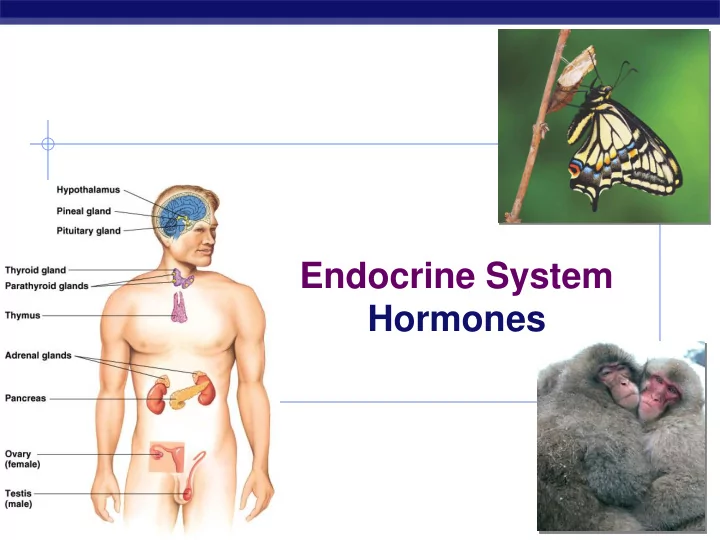
Endocrine System Hormones

slide-2
SLIDE 2

AP Biology

Regulation

  • Why are hormones needed?

 chemical messages from one

body part to another

 communication needed to

coordinate whole body

 homeostasis & regulation

  • metabolism
  • growth
  • development
  • maturation
  • reproduction

growth hormones

slide-3
SLIDE 3

AP Biology

Regulation & Communication

  • Animals rely on 2 systems for regulation

 endocrine system

  • system of ductless glands

 secrete chemical signals directly into blood  chemical travels to target tissue  slow, long-lasting response

 nervous system

  • system of neurons

 transmits “electrical” signal &

release neurotransmitters to target tissue

 fast, short-lasting response

slide-4
SLIDE 4

AP Biology

Regulation by chemical messengers

axon endocrine gland receptor proteins target cell

  • Neurotransmitters released by neurons
  • Hormones release by endocrine glands

receptor proteins hormone carried by blood neurotransmitter

slide-5
SLIDE 5

AP Biology

Classes of Hormones

  • Protein-based hormones

 polypeptides

  • small proteins: insulin, ADH

 glycoproteins

  • large proteins + carbohydrate: FSH, LH

 amines

  • modified amino acids: epinephrine, melatonin
  • Lipid-based hormones

 steroids

  • modified cholesterol: sex hormones, aldosterone

insulin

slide-6
SLIDE 6

AP Biology

How do hormones act on target cells

  • Lipid-based hormones

 hydrophobic & lipid-soluble

  • diffuse across membrane & enter cells
  • bind to receptor proteins in cytoplasm & nucleus
  • bind to DNA as transcription factors
  • Protein-based hormones

 hydrophilic & not lipid soluble

  • can’t diffuse across membrane
  • receptor proteins in cell membrane
  • trigger signal transduction pathway
  • activate internal cellular response

 enzyme action, uptake or secretion of molecules…

slide-7
SLIDE 7

AP Biology

nucleus target cell

plasma membrane DNA mRNA protein steroid hormone

blood

protein carrier

S S S S

Action of lipid (steroid) hormones

receptor protein

cytoplasm

transcription factor

ex: growth factors (hair, bone, muscle, gametes) 1 2 3 4 5

slide-8
SLIDE 8

AP Biology

Action of protein hormones

activates enzyme activates enzyme activates ion channel

  • r enzyme

protein hormone

ATP

produces an action

transduction

P 1 2 3 cytoplasm receptor protein

response signal

Signal transduction pathway

signal-transduction pathway

2° messenger

target cell

plasma membrane

slide-9
SLIDE 9

AP Biology

adrenal gland

Action of epinephrine (adrenalin)

activates protein kinase-A activates glycogen phosphorylase

activates adenylyl cyclase epinephrine

liver cell

released to blood

1 2 4

receptor protein

cytoplasm 5

glycogen

activates phosphorylase kinase

GTP

cAMP 3

activates G protein

GDP

ATP 6

glucose

slide-10
SLIDE 10

AP Biology

Maintaining homeostasis

high low

hormone 1

lowers body condition

hormone 2

gland

specific body condition

raises body condition gland

Negative Feedback Model

slide-11
SLIDE 11

AP Biology

Controlling Body Temperature

high low

nerve signals

sweat

nerve signals

body temperature

(37°C)

shiver dilates surface blood vessels constricts surface blood vessels

Nervous System Control

Feedback

hypothalamus hypothalamus

slide-12
SLIDE 12

AP Biology

liver pancreas liver

Regulation of Blood Sugar

blood sugar level

(90mg/100ml)

insulin

body cells take up sugar from blood liver stores glycogen reduces appetite

glucagon pancreas

liver releases glucose triggers hunger

high low

Feedback

Endocrine System Control

beta islet cells alpha islet cells

slide-13
SLIDE 13

AP Biology

  • smoreceptors in

hypothalamus

nephron nephron

Blood Osmolarity

blood osmolarity

ADH

increased water reabsorption increase thirst

renin

increased water & salt reabsorption

high

Feedback

Endocrine System Control

pituitary

angiotensinogen angiotensin adrenal gland aldosterone

JuxtaGlomerular Apparatus

nephron

(JGA)

low

slide-14
SLIDE 14

AP Biology

Thirst

Drinking reduces blood osmolarity to set point. Osmoreceptors in hypothalamus trigger release of ADH. Increased permeability

Pituitary gland ADH Hypothalamus Distal tubule H2O reab- sorption helps prevent further

  • smolarity

increase. STIMULUS: Increase in blood

  • smolarity

Collecting duct Homeostasis: Blood osmolarity (300 mOsm/L) (a) Exocytosis (b) Aquaporin water channels H2O H2O Storage vesicle

Second messenger signaling molecule

cAMP

INTERSTITIAL FLUID

ADH receptor ADH

COLLECTING DUCT LUMEN

COLLECTING DUCT CELL

slide-15
SLIDE 15

AP Biology

Nervous & Endocrine systems linked

  • Hypothalamus = “master nerve control center”

 nervous system  receives information from nerves around body

about internal conditions

 regulates release of hormones from pituitary

  • Pituitary gland = “master gland”

 endocrine system  secretes broad range

  • f hormones

regulating other glands

hypothalamus pituitary posterior anterior

slide-16
SLIDE 16

AP Biology

Regulating metabolism

  • Hypothalamus

 TRH = TSH-releasing hormone

  • Anterior Pituitary

 TSH = thyroid stimulating hormone

  • Thyroid

 produces thyroxine hormones  metabolism & development

  • bone growth
  • mental development
  • metabolic use of energy
  • blood pressure & heart rate
  • muscle tone
  • digestion
  • reproduction

tyrosine + iodine

thyroxine

slide-17
SLIDE 17

AP Biology

Goiter

Iodine deficiency causes thyroid to enlarge as it tries to produce thyroxine

slide-18
SLIDE 18

AP Biology

Regulation of Blood Calcium

blood calcium level

(10 mg/100mL)

calcitonin parathyroid hormone (PTH)

 Ca++ uptake in intestines

high low

Feedback

Endocrine System Control

 kidney reabsorption

  • f Ca++

bones release Ca++  kidney reabsorption

  • f Ca++

Ca++ deposited in bones

activated Vitamin D

thyroid parathyroid

slide-19
SLIDE 19

AP Biology

corpus luteum

  • vary

Female reproductive cycle

pregnancy

maintains uterus lining

no yes

Feedback

estrogen

egg matures & is released (ovulation) builds up uterus lining

FSH & LH progesterone progesterone

fertilized egg (zygote)

hCG

corpus luteum breaks down progesterone drops menstruation

corpus luteum maintains uterus lining

GnRH

pituitary gland hypothalamus