How does Geosoft use EM & Electrical methods? IP & DC - - PowerPoint PPT Presentation

how does geosoft use em electrical methods
SMART_READER_LITE
LIVE PREVIEW

How does Geosoft use EM & Electrical methods? IP & DC - - PowerPoint PPT Presentation

Geoscience software for: Geophysics Geochemistry Geology GIS How does Geosoft use EM & Electrical methods? IP & DC resistivity QC, processing and 3D pseudosection visualizeation 3D inversion FDEM


slide-1
SLIDE 1

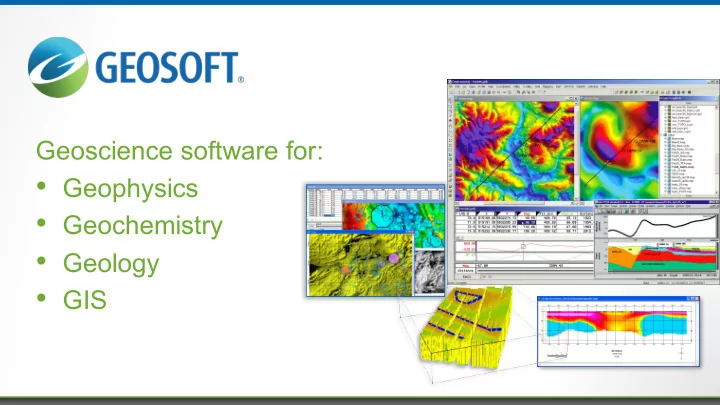
Geoscience software for:

  • Geophysics
  • Geochemistry
  • Geology
  • GIS
slide-2
SLIDE 2

How does Geosoft use EM & Electrical methods?

2

IP & DC resistivity

  • QC, processing and 3D pseudosection visualizeation
  • 3D inversion

FDEM

  • Visualization and basic processing
  • FDEM pseudo 3D inversion

TDEM for UXO –EM61 MK2, (3-4 time gates)

  • Import, processing, target picking, depth estimates 7 forward modelling

TDEM for UXO – Geometrics - Metal Mapper

  • Dynamic surveys for target locating
  • Processing, target picking, depth estimates, high level classification (21 time gates)
  • Static surveys for classification
  • Ordinance classification (122 time gates)
slide-3
SLIDE 3

Conventional EM Sensors

Not usually good for classification

  • Coarse measurement of eddy current decay (four

time windows or gates)

  • Point response measured at series of locations must

be combined to fully interrogate target

  • Small sensor location errors (~1 cm) compromise

ability to estimate polarizability (some simple case exceptions) EM61

slide-4
SLIDE 4

Conventional EM Sensors

Nose Down Horizontal

slide-5
SLIDE 5

Why Do Classification?

Munitions Response Typical Cost Breakout

5 10 15 20 25 30 35 40 45 50

Site Assessment Survey and Mapping Vegetation Removal Scrap Metal Removal UXO Removal & Disposal

Cost - $B

Direct Cost Indirect Cost

Defense Science Board Task Force on UXO

slide-6
SLIDE 6

Advanced EM Sensors

To observe the complete EM response pattern the object must be excited and measured from all directions

  • multi-axis coil sensors or
  • single axis coil arrays

Designed for Classification

Multi-axis coil array Single axis planar array

slide-7
SLIDE 7

Advanced EM Sensors

MetalMapper

  • 3 multi-axis transmitters
  • 7 multi-axis receivers

MetalMapper 2x2

  • 4 coil transmitter array
  • 4 multi-axis receivers

Typical static survey mode, 122 gates over 25ms

slide-8
SLIDE 8

Extracting ‘Intrinsic’ Features

Time (ms) 0.1 1 10 Polarizability

10-3 10-2 10-1 100 101

P1 P2 P3

Dipole Response Model Inverse Operation Plan view of 2x2 sensor Rx Transients from Rx cube

time (ms) voltage

slide-9
SLIDE 9

Polarizability’s

EM response is decomposed into components along three orthogonal principal axis directions

  • Principal axis directions correspond to

fundamental excitation modes of target

  • Magnetic polarizabilities are specific responses

to unit excitation along each of target’s principal axis Principal axis polarizabilities

  • Completely describe EM response of target
  • Intrinsic to the source

The solution for classification – intrinsic features

slide-10
SLIDE 10

Measured Decays Convolve Intrinsic Response with Relative Position and Orientation – Position “A”

R(X) R(Y) R(Z) Rx0 Rx1 Rx2 Rx3 Rx2 Rx3 Rx0 Rx1 R(X) R(Y) R(Z)

Tx2 Tx3

R(X) R(Y) R(Z) Rx0 Rx1 Rx2 Rx3

Tx0

R(X) R(Y) R(Z) Rx2 Rx3 Rx0 Rx1

Tx1

Time (ms) 0.1 1 10 Polarizability

10-3 10-2 10-1 100 101

P1 P2 P3

slide-11
SLIDE 11

Measured Decays Convolve Intrinsic Response with Relative Position and Orientation – Position “B”

R(X) R(Y) R(Z) Rx0 Rx1 Rx2 Rx3 Rx2 Rx3 Rx0 Rx1 R(X) R(Y) R(Z)

Tx2 Tx3

R(X) R(Y) R(Z) Rx0 Rx1 Rx2 Rx3

Tx0

R(X) R(Y) R(Z) Rx2 Rx3 Rx0 Rx1

Tx1

Time (ms) 0.1 1 10 Polarizability

10-3 10-2 10-1 100 101

P1 P2 P3

slide-12
SLIDE 12

Measured Decays Convolve Intrinsic Response with Relative Position and Orientation – Position “C”

R(X) R(Y) R(Z) Rx0 Rx1 Rx2 Rx3 Rx2 Rx3 Rx0 Rx1 R(X) R(Y) R(Z)

Tx2 Tx3

R(X) R(Y) R(Z) Rx0 Rx1 Rx2 Rx3

Tx0

R(X) R(Y) R(Z) Rx2 Rx3 Rx0 Rx1

Tx1

Time (ms) 0.1 1 10 Polarizability

10-3 10-2 10-1 100 101

P1 P2 P3

slide-13
SLIDE 13

Polarizabilities

Principal axis polarizabilities completely describe EM response of target

§ intrinsic to the target § invariant to burial depth or target

  • rientation

Polarizability Property Target Property Decay Rate Wall Thickness Relative Magnitude Shape Total Magnitude Size (volume)

37mm projectile

slide-14
SLIDE 14

Classification

What an unknown target “looks like” in EM sense

  • Compares polarizability against bank of signatures for expected munitions

and other training objects

Signature Matching

slide-15
SLIDE 15

Classification

EM signatures of nominally identical items can differ

  • Different subtypes, damage, inversion errors due to noise

Matching procedures must tolerate some variability

Signature Variability

band at base band missing band in middle e.g. 37mm projectile rotating band effects

slide-16
SLIDE 16

Ranked Source List

Classify and Rank Sources

  • Combine match metric
  • Size and Decay
  • Signal amplitude
  • Source to array distance
slide-17
SLIDE 17

Future plans and challenges?

17

  • Marine EM
  • Develop our current tools for EM61 to be marine

compatible

  • Work with Geometrics to develop an advanced EM

system for classification

  • 3D TDEM inversion
slide-18
SLIDE 18

Please visit Geosoft at Booth G8

  • r visit www.Geosoft.com

18