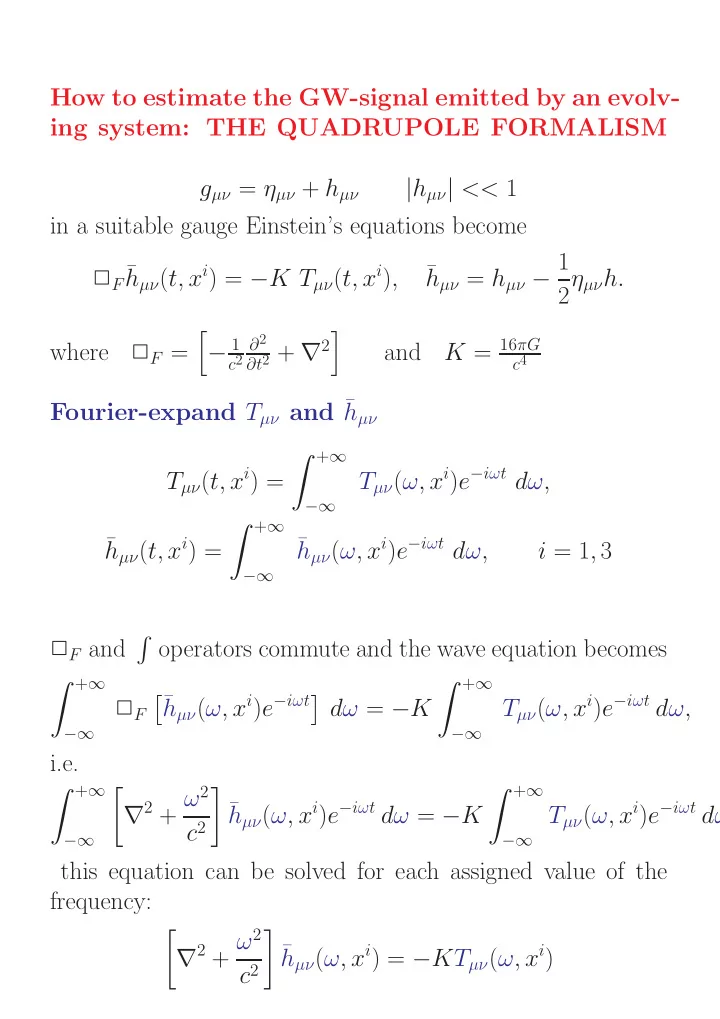
SLIDE 1 How to estimate the GW-signal emitted by an evolv- ing system: THE QUADRUPOLE FORMALISM gµν = ηµν + hµν |hµν| << 1 in a suitable gauge Einstein’s equations become ✷F¯ hµν(t, xi) = −K Tµν(t, xi), ¯ hµν = hµν − 1 2ηµνh. where ✷F =
c2 ∂2 ∂t2 + ∇2
and K = 16πG
c4
Fourier-expand Tµν and ¯ hµν Tµν(t, xi) = +∞
−∞
Tµν(ω, xi)e−iωt dω, ¯ hµν(t, xi) = +∞
−∞
¯ hµν(ω, xi)e−iωt dω, i = 1, 3 ✷F and
- perators commute and the wave equation becomes
+∞
−∞
✷F ¯ hµν(ω, xi)e−iωt dω = −K +∞
−∞
Tµν(ω, xi)e−iωt dω, i.e. +∞
−∞
c2
hµν(ω, xi)e−iωt dω = −K +∞
−∞
Tµν(ω, xi)e−iωt dω this equation can be solved for each assigned value of the frequency:
c2
hµν(ω, xi) = −KTµν(ω, xi)
SLIDE 2 SLOW-MOTION APPROXIMATION We shall solve the wave equation
c2
hµν(ω, xi) = −KTµν(ω, xi) assuming that the region where the source is confined |xi| ≤ ǫ ǫ ǫ, Tµν = 0, is much smaller than the wavelenght of the emitted radiation λGW = 2πc ω 2πc ω >> ǫ ǫ ǫ → ǫ ǫ ǫ ω << c → v << c The wave equation will be solved inside and outside the source, and the two solutions will be matched on the source boundary
SLIDE 3 Let us first integrate the equations OUTSIDE the source
c2
hµν(ω, xi) = 0 In polar coordinates, the Laplacian operator is ∇2 = 1 r2 ∂ ∂r
∂r
1 r2 sen θ ∂ ∂θ
∂θ
1 r2 sen 2θ ∂2 ∂φ2 The simplest solution does not depend on φ and θ ¯ hµν(ω, r) = Aµν(ω) r eiω
c r + Zµν(ω)
r e−iω
c r,
This solution represents a spherical wave, with an ingoing part (∼ e−iω
c r), and an outgoing ( ∼ eiω c r) part.
Since we are interested only in the wave emitted from the source, we set Zµν = 0, and the solution becomes ¯ hµν(ω, r) = Aµν(ω) r eiω
c r
This is the solution outside the source, and on its boundary x = ǫ How do we find Aµν(ω)? To answer this question we need to integrate the equations inside the source
SLIDE 4 INSIDE THE SOURCE
c2
hµν(ω, xi) = −KTµν(ω, xi) This equation can be solved for each assigned value of the in- dices µ, ν. Let us integrate each term over the source volume A)
c2
hµν(ω, xi)d3x = −K
Tµν(ω, xi)d3x 1)
∇2 ¯ hµν d3x =
div[ ∇ ¯ hµν] d3x =
hµν k dSk ≃ 4π ǫ ǫ ǫ2 d dr ¯ hµν
ǫ ǫ = 4π ǫ ǫ ǫ2 d dr Aµν(ω) r eiω
c r
ǫ ǫ = 4π ǫ ǫ ǫ2
r2 eiω
c r + Aµν
r iω c
c r
ǫ ǫ ∼ −4π Aµν(ω) neglecting all terms of order ≥ ǫ ǫ ǫ
∇2 ¯ hµν(ω, xi) d3x ≃ − 4π Aµν(ω)
−4π Aµν(ω)+
ω2 c2 ¯ hµν(ω, xi) d3x = −K
Tµν(ω, xi) d3x
SLIDE 5
ω2 c2 ¯ hµν(ω, xi) d3x ω2 c2 |¯ hµν|max 4 3πǫ ǫ ǫ3 negligible The final solution inside the source gives −4πAµν(ω) = −K
Tµν(ω, xi) d3x K = 16πG c4 Aµν(ω) = K 4π
Tµν(ω, xi) d3x = 4G c4
Tµν(ω, xi) d3x SUMMARIZING: By integrating the wave equation outside the source we find ¯ hµν(ω, r) = Aµν(ω) r eiω
c r
by integrating over the source volume we find Aµν(ω) = 4G c4
Tµν(ω, xi) d3x, therefore ¯ hµν(ω, r) = 4G c4 · eiωr
c
r
Tµν(ω, xi) d3x,
- r, in terms of the outgoing coordinate (t − r
c, xi)
¯ hµν(t, r) = 4G c4r ·
Tµν(t − r c, xi) d3x .
SLIDE 6 ¯ hµν(t, r) = 4G c4r
Tµν(t − r c, xi) d3x, We shall now simplify the integral over Tµν. We are in flat spacetime, therefore ∂ ∂xνT µν = 0, → 1 c ∂ ∂tT µ0 = − ∂ ∂xkT µk, k = 1, 3 Integrate over the source volume:
1 c ∂ ∂tT µ0 d3x = −
∂ ∂xkT µk d3x; Apply Gauss’s theorem to the R.H.S.
∂ ∂xkT µk d3x =
T µk dSk where S is the surface which encloses V. On S, T µν = 0, therefore
T µk dSk = 0, and 1 c ∂ ∂t
T µ0 d3x = 0, i.e.
T µ0 d3x = const, → ¯ hµ0 = const. Since we are interested in the time-dependent part of the field, we put ¯ hµ0(t, r) = ¯ hµ0(t, r) = 0; (this condition is automatically satisfied when transforming to the TT-gauge)
SLIDE 7 To simplify the space components of ¯ hµν: ¯ hik(t, r) = 4G c4r
Tik(t − r c, xi) d3x, i, k = 1, 3 we shall use the Tensor-Virial Theorem Let us consider the space components of the conservation low ∂T µν ∂xν = 0 → 1) 1 c ∂T n0 ∂t + ∂T ni ∂xi = 0, n, i = 1, 3 multiply 1) by xk and integrate over the volume 1 c ∂ ∂t
T n0 xk dx3 = −
∂T ni ∂xi xk dx3 = −
∂
∂xi dx3 −
T ni ∂xk ∂xi dx3
∂xi = δk
i
dSi +
T nk dx3 as before,
dSi = 0, therefore 1 c ∂ ∂t
T n0 xk dx3 =
T nk dx3 Since T nk is symmetric in n and k, 1 c ∂ ∂t
T k0 xn dx3 =
T kn dx3 and adding the two we get
SLIDE 8 1 2c ∂ ∂t
dx3 =
T nk dx3 .
SLIDE 9 We shall now use the 0- component of the conservation low: ∂T 0ν ∂xν = 0 → 2) 1 c ∂T 00 ∂t + ∂T 0i ∂xi = 0 multiply 2) by xkxn and integrate 1 c ∂ ∂t
T 00 xk xn dx3 = −
∂T 0i ∂xi xk xn dx3 = −
∂
∂xi dx3 −
∂xi xn + T 0i xk ∂xn ∂xi
dSi +
dx3 as before, the first integral vanishes, and 1 c ∂ ∂t
T 00 xk xn dx3 =
dx3. Let us differenciate with respect to x0 = ct: 1 c2 ∂2 ∂t2
T 00 xk xn dx3 = 1 c ∂ ∂t
dx3 and since we just found 1 2c ∂ ∂t
dx3 =
T nk dx3, finally ********************************************** 2
c2 ∂2 ∂t2
T 00 xk xn dx3 .
SLIDE 10 2
c2 ∂2 ∂t2
T 00 xk xn dx3 . The quantity 1 c2
T 00xkxndx3 is the Quadrupole Mo- ment Tensor of the system qkn(t) = 1 c2
T 00(t, xi) xk xndx3 , (1) and it is a function of time only. In conclusion
T kn(t, xi) dx3 = 1 2 d2 dt2qkn(t) and since ¯ hkn(t, r) = 4G c4r ·
T kn(t − r c, xi) d3x, we finally find ¯ hµ0 = 0, µ = 0, 3 ¯ hkn(t, r) = 2G c4r · d2 dt2 qkn(t − r c)
k, n = 1, 3 (2) This is the gravitational wave emitted by a mass- energy system evolving in time
SLIDE 11 ¯ hµ0 = 0, µ = 0, 3 ¯ hkn(t, r) = 2G c4r · d2 dt2 qkn(t − r c)
k, n = 1, 3 (3) NOTE THAT 1) G c4 ∼ 8 · 10−50 s/g cm GW are extremely weak! 2) We are not yet in the TT-gauge 3) these equations are derived on very strong assumptions:
i.e. the motion of the bodies is dominated by non-gravitational
- forces. However, and remarkably, the result depends only on
the sources motion and not on the forces acting on them.
SLIDE 12 Gravitational radiation has a quadrupolar nature. A system of accelerated charged particles has a time-varying dipole moment
qi ri and it will emit dipole radiation, the flux of which depends on the second time derivative of dEM. For an isolated system of masses we can define a gravitational dipole moment
mi ri, which satisfies the conservation law of the total momentum of an isolated system d dt
For this reason, gravitational waves do not have a dipole contribution. It should be stressed that for a spherical or axisymmetric dis- tribution of matter (or energy) the quadrupole moment is a constant, even if the body is rotating: thus, a spherical
- r axisymmetric star does not emit gravitational
waves; similarly, a star which collapses in a perfectly spherically sym- metric way has a vanishing qik and does not emit gravitational waves.
SLIDE 13
To produce waves we need a certain degree of asym- metry, as it occurs for instance in the non-radial pulsations of stars, in a non spherical gravitational collapse, in the coalescence of massive bodies etc.
SLIDE 14 HOW TO SWITCH TO THE TT-GAUGE ¯ hµ0 = 0, µ = 0, 3 ¯ hik(t, r) = 2G c4r · d2 dt2 qik(t − r c)
c) = 1 c2
T 00((t − r c), xn) xi xkdx3 we shall make an infinithesimal coordinate transformation x
′µ = xµ + ǫ
ǫ ǫµ such that ✷Fǫ ǫ ǫµ = 0, (so that the harmonic gauge condition is satisfied also in the new gauge), and we shall impose that δik hTT ik = 0, i, k = 1, 3 vanishing trace ni hTT ik = 0 trasverse wave condition where
x r is the unit vector normal to the wavefront. How to do it. As a first thing we define the operator which projects a vector onto the plane orthogonal to the direction of
Pjk ≡ δjk − njnk . (4) Pjk is symmetric, it is a projector, because PjkPkl = Pjl, and it is transverse: njPjk = 0.
SLIDE 15 Next, we define the transverse-traceless projector Pjkmn ≡ PjmPkn − 1
2PjkPmn ,
which “extracts” the transverse-traceless part of a 2
- ten-
- sor. We want to compute
hTT jk = (Ph)jk = Pjklmhlm . It is easy to check that Pjkmn satisfies the following properties
PjkmnPmnrs = Pjkrs ;
njPjkmn = nkPjkmn = nmPjkmn = nnPjkmn = 0 ;
δjkPjkmn = δmnPjkmn = 0 . It is worth mentioning that hTT
jk = Pjkmnhmn = Pjkmn¯
hmn , indeed, since ¯ hµν = hµν − 1 2ηµνh hjk and ¯ hjk differ only by the trace, which is projected out by P.
SLIDE 16 By applying the projector to ¯ hjk hTT
jk = Pjklm¯
hlm, where ¯ hµ0 = 0, µ = 0, 3 ¯ hik(t, r) = 2G c4r · d2 dt2 qik(t − r c)
qik(t − r c) = 1 c2
T 00((t − r c), xn) xi xkdx3 we find the following ¯ hTT µ0 = 0, µ = 0, 3 ¯ hTT ik(t, r) = 2G c4r · d2 dt2 qTT ik(t − r c)
- where qTT ij is the quadrupole moment of the source pro-
jected in the TT-gauge, i.e. it is the Transverse-Traceless quadrupole moment qTT
ij
= Pijlmqlm
SLIDE 17 GW-emission by a binary system in circular orbit (far from coalescence)
r1 r2 m1 m2
x
l0 total mass M ≡ m1 + m2 reduced mass µ ≡ m1m2
M
. Let us consider a coordinate frame with origin coincident with the center of mass l0 = r1 + r2, r1m1 + r2m2 = 0 r1 = m2l0 M , r2 = m1l0 M . The orbital frequency ωK ωK ωK can be found from Kepler’s law: for each mass Gm1m2 l2 = m1 ωK
2 m2l0
M , Gm1m2 l2 = m2 ωK
2 m1l0
M i.e. ωK ωK ωK =
l3
SLIDE 18
r1 r2 m1 m2
x
l0 total mass M ≡ m1 + m2 reduced mass µ ≡ m1m2
M
. r1 = m2l0 M , r2 = m1l0 M The equations of motion are x1 = m2
M l0 cos ωKt
y1 = m2
M l0 sin ωKt
x2 = −m1
M l0 cos ωKt
y2 = −m1
M l0 sin ωKt
The gravitational wave signal emitted by the system is ¯ hµ0 = 0, µ = 0, 3 ¯ hkn(t, r) = 2G c4r · d2 dt2 qkn(t − r c)
k, n = 1, 3 where qij(t − r
c) is the quadrupole moment tensor.
SLIDE 19
r1 r2 m1 m2
x
l0 total mass M ≡ m1 + m2 reduced mass µ ≡ m1m2
M
. r1 = m2l0 M , r2 = m1l0 M The equations of motion are x1 = m2
M l0 cos ωKt
y1 = m2
M l0 sin ωKt
x2 = −m1
M l0 cos ωKt
y2 = −m1
M l0 sin ωKt
We need to compute qik(t) = 1
c2
where T 00 = 2
n=1 mnc2 δ(x − xn) δ(y − yn) δ(z)
SLIDE 20
r1 r2 m1 m2
x
qik(t) = 1
c2
T 00 = 2
n=1 mnc2 δ(x − xn) δ(y − yn) δ(z)
qzz = m1
- δ(x − x1) dx
- δ(y − y1) dy
- z2 δ(z) dz
+ m2
- δ(x − x2) dx
- δ(y − y2) dy
- z2 δ(z) dz
= 0, since
z2 δ(z) dz = 0; Since
- x δ(x) dx = 0, in a similar way it is easy to show
that qzx = qzy = 0 .
SLIDE 21
r1 r2 m1 m2
x
qik(t) = 1
c2
T 00 = 2
n=1 mnc2 δ(x − xn) δ(y − yn) δ(z)
qxx = m1
- x2δ(x − x1) dx
- δ(y − y1) dy
- δ(z) dz
+m2
- x2δ(x − x2) dx
- δ(y − y2) dy
- δ(z) dz
= m1x2
1 + m2x2 2
= m1 m2l0 M 2 cos2 ωKt + m2 m1l0 M 2 cos2 ωKt Since the equations of motion are x1 = m2
M l0 cos ωKt
y1 = m2
M l0 sin ωKt
x2 = −m1
M l0 cos ωKt
y2 = −m1
M l0 sin ωKt
SLIDE 22
r1 r2 m1 m2
x
qik(t) = 1
c2
T 00 = 2
n=1 mnc2 δ(x − xn) δ(y − yn) δ(z)
qxx = m1
- x2δ(x − x1) dx
- δ(y − y1) dy
- δ(z) dz
+m2
- x2δ(x − x2) dx
- δ(y − y2) dy
- δ(z) dz
= m1x2
1 + m2x2 2
= m1 m2l0 M 2 cos2 ωKt + m2 m1l0 M 2 cos2 ωKt = µ l2
0 cos2 ωKt
SLIDE 23
r1 r2 m1 m2
x
qik(t) = 1
c2
T 00 = 2
n=1 mnc2 δ(x − xn) δ(y − yn) δ(z)
qxx = m1
- x2δ(x − x1) dx
- δ(y − y1) dy
- δ(z) dz
+m2
- x2δ(x − x2) dx
- δ(y − y2) dy
- δ(z) dz
= m1x2
1 + m2x2 2
= m1 m2l0 M 2 cos2 ωKt + m2 m1l0 M 2 cos2 ωKt = µ l2
0 cos2 ωKt = µ
2 l2
0 cos 2ωKt + cost
(cos 2α = 2 cos2 α − 1).
SLIDE 24 By Computing the remaining components in a similar way,
r1 r2 m1 m2
x
we find qxx = µ 2 l2
0 cos 2ωKt + cost
qyy = −µ 2 l2
0 cos 2ωKt + cost1
qxy = µ 2 l2
0 sin 2ωKt .
therefore, the time-varying part of qij is: qxx = −qyy = µ 2 l2
0 cos 2ωKt
qxy = µ 2 l2
0 sin 2ωKt
hµ0 = 0, µ = 0, 3 hik(t, r) = 2G c4r · d2 dt2 qik(t − r c)
- Waves are emitted at twice the orbital frequency.
SLIDE 25
r1 r2 m1 m2
x
Let us now compute the wave emerging in the z-direction (TT-gauge):
x r → (0, 0, 1) and
Pjk = δjk − njnk = 1 0 0 0 1 0 0 0 0 hTT µ0 = 0, µ = 0, 3 hTTik(t, z) = 2G c4z · d2 dt2 qTT ik(t − z c)
qTT
jk = Pjkmnqmn =
2PjkPmn
The non-zero components of qij are qxx, qyy and qxy, therefore: qTT
xx =
2PxxPmn
=
2P 2
xx
2PxxPyyqyy = 1 2 (qxx − qyy) qTT
yy =
2PyyPmn
2 (qxx − qyy) qTT
xy =
2PxyPmn
The remaining components vanish.
SLIDE 26
r1 r2 m1 m2
x
Choosing as direction of propagation of the wave that orthogonal to the orbital plane (z-direction), and projecting the quadrupole moment on the plane
- rthogonal to that direction, the non vanishing com-
ponents of the projectd quadrupole moment are: qTT xx = 1
2 (qxx − qyy)
qTT yy = −1
2 (qxx − qyy) = −qTT xx
qTT xy = qxy Therefore the wave in the TT-gauge is: hTT
µ0 = 0,
µ = 0, 3 hTT
ik (t, z) = 2G
c4z · d2 dt2 qTT
ik (t − z
c)
SLIDE 27
The final result for the radiation emerging in the z-direction is hTT
µ0 = 0,
hTT
zi = 0,
hTT
xx = −hTT yy = G
c4z d2 dt2 (qxx − qyy), hTT
xy = 2G
c4z d2 dt2 qxy ; since qxx = −qyy = µ 2 l2
0 cos 2ωKt
qxy = µ 2 l2
0 sin 2ωKt
hTT
xx = −hTT yy = − G
c4 z µ l2
0 (2ωK)2 cos 2ωK(t − z
c) hTT
xy = − G
c4 z µ l2
0 (2ωK)2 sin 2ωK(t − z
c) . In conclusion 1) radiation is emitted at twice the orbital frequency 2) the wave along z has both polarizations 3) since hTT xx = ihTT xy the wave is circularly po- larized
SLIDE 28 A more general expression for the TT-wave. Since
2 l2 0 cos 2ωKt
qxy = µ
2 l2 0 sin 2ωKt
If we define Aij = cos 2ωKt sin 2ωKt 0 sin 2ωKt − cos 2ωKt 0 − → qij = µ 2l2
0 Aij
In the TT-gauge the wave is hTT
ij = 2G
rc4 ¨ qTT
ij
≡ 2G rc4 Pijkl ¨ qkl hTT
ij = 2G
rc4 µ 2 l2
0 (2ωK)2 [Pijkl Akl] ≡ 4µMG2
rl0c4 ATT
kl
where we have used ωK =
0.
Thus, the wave amplitude is (order of magnitude) h0 = 4µMG2 rl0c4 , µ = m1m2 m1 + m2 , M = m1 + m2 . and the general form for the TT-wave is hTT
ij = h0 ATT ij
. (5)
SLIDE 29
y l0 x
if ˆ n = ˆ z → Pij = diag(1, 1, 0) ATT
ij =
cos 2ωKt sin 2ωKt 0 sin 2ωKt −cos 2ωKt 0 the wave is circularly polarized; if ˆ n = ˆ x → Pij = diag(0, 1, 1) ATT
ij =
0 −1
2cos 2ωKt 1 2cos 2ωKt
the wave is linearly polarized; if ˆ n = ˆ y → Pij = diag(1, 0, 1) ATT
ij =
1 2cos 2ωKt 0
0 −1
2cos 2ωKt
the wave is linearly polarized;
SLIDE 30 Binary Pulsar PSR 1913+16
y l0 x
M1 ∼ M2 ∼ 1.4M⊙, l0 = 0.19 · 1012 cm ≃ 2R⊙ T = 7h 45m 7s, νK ∼ 3.58 · 10−5 Hz the orbit is eccentric, (ǫ ≃ 0.62); however, let us assume it is circular; from the observed data we find νGW = 2νK ∼ 7.16 · 10−5 Hz The distance of the system from Earth is r = 5 kpc, 1 pc = 3.08 · 1018 cm, → r = 1.5 · 1022 cm , the wave amplitude is h0 = 4µMG2 rl0c4 ∼ 6 · 10−23 Ground-based and space-based interferometers are sensitive in the frequency regions: LIGO[40 Hz − 1 − 2 kHz] LISA[10−4 − 10−1] Hz VIRGO[10 Hz − 1 − 2 kHz]
SLIDE 31
1e-24 1e-23 1e-22 1e-21 1e-20 0.0001 0.001 0.01 0.1 1 Detection threshold ν [ Hz ] PSR1913+16 LISA 1-yr observation
Waves from PSR 1913+16 cannot be detected di- rectly by current detectors. Let us check whether we are in the condition to apply the quadrupole formalism: λGW = c νGW ∼ 1014 cm λGW >> l0 Yes we are!
SLIDE 32 Circular orbit → GWs are emitted at twice the orbital frequency If the orbit is elliptic, waves are emitted at fre- quencies multiple of the orbital frequency, and the number of equally spaced spectral lines increases with ellipticity.
0.1 0.2 0.3 0.4 0.5 0.6 0.7 0.8 0.9 1 1.1 2 4 6 8 10 12 14 16 18 20
n hc1023 PSR 1913+16 νk=3.6 10-5 Hz
For a detailed description: Michele Maggiore, Gravitational waves, Vol. I: Theory and
- experiments. Oxfor University Press.
SLIDE 33 New Binary Pulsar PSR J0737-3039 discovered in 2003.
r1 r2 m1 m2
x
m1 = 1.337M⊙, m2 ∼ 1.250M⊙, P = 2.4h, e = 0.08 r = 500 pc l0 ∼ 1.2R⊙ the orbit is nearly circular. µ = m1m2 m1 + m2 = 0.646M⊙ h0 = 4µMG2 rl0c4 ∼ 1.1 · 10−21 and waves are emitted at the frequency νGW = 2 νK = 2.3 · 10−4 Hz
SLIDE 34
1e-24 1e-23 1e-22 1e-21 1e-20 0.0001 0.001 0.01 0.1 1 Detection threshold ν [ Hz ] PSRJ0737-3039 PSR1913+16 LISA 1-yr observation
SLIDE 35 There are many other binaries LISA could detect: Cataclismic variables:
semi-detached systems with small orbital period primary star: white dwarf secondary star: star filling the Roche lobe and accreting matter on the companion emission frequency: few digits ·10−4 Hz, h ∼ [10−22 − 10−21]
Double-degenerate binary systems (WD-WD, WD- NS)
Ultra-short period : < 10 minutes, νGW > 10−3 Hz Strong X-ray emitter RXJ1914.4+2457 M1=0.5 M⊙ M2=0.1 M⊙ P=9.5 min
1e-24 1e-23 1e-22 1e-21 1e-20 1e-04 0.001 0.01 0.1 1 Detection threshold ν [ Hz ] PSR1913+16 RXJ1914.4+2457 RXJ0806.3+1527
LISA 1-yr observation
SLIDE 36 Let us consider an emitting source and the associated 3-dimensional coordinate frame O (x, y, z). Be an observer located at P = (x1, y1, z1) at a distance r =
1 + y2 1 + z2 1 from the origin.
The observer detects the wave traveling along the direction identified by the versor n = r
|r|.
y’ x’ x z z’ n P O
Consider a second frame O′ (x′, y′, z′), with origin coincident with O, and having the x′-axis aligned with n. Assuming that the wave traveling along x′ is linearly polarized and has only
- ne polarization, the corresponding metric tensor will be
gµ′ν′ = (t) (x′) (y′) (z′) −1 1 [1 + hTT
+ (t, x′)]
hTT
× (t, x′)
hTT
× (t, x′)
[1 − hTT
+ (t, x′)]
,
SLIDE 37 The observer wants to measure the energy which flows per unit time across the unit surface orthogonal to x′: dEGW dtdS = c3 16πG dhTT
+
dt 2 + dhTT
×
dt 2 = c3 32πG
jk
jk
dt 2 Since in GR the energy of the gravitational field cannot be defined locally, to find the GW-flux we need to average over several wavelenghts, i.e. dEGW dtdS = c3 32πG
jk
dt 2 . We shall now express the energy flux directly in terms of the source quadrupole moment.
SLIDE 38 Since ¯ hTT
µ0 = 0,
µ = 0, 3 ¯ hTT
ik (t, r) = 2G
c4r · d2 dt2 qTT
ik (t − r
c)
- by direct substitution we find
dEGW dtdS = c3 32πG
jk
dt 2 = G 8πc5 r2
... qTT
jk
c 2
G 8πc5 r2
...
qmn
c 2
From this formula we can compute the gravita- tional luminosity LGW = dEGW dt : LGW = dEGW dt = dEGW dtdS dS = dEGW dtdS r2dΩ = G 2c5 1 4π
...
qmn
c 2
SLIDE 39 Gravitational luminosity LGW = G 2c5 1 4π
...
qmn
c 2
To evaluate the integral over the solid angle it is convenient to replace the quadrupole moment qmn with the reduced quadrupole moment Qij = qij − 1 3 δij qk
k ;
we remind that, since its trace is zero by definition, we have Pijlmqlm = PijlmQlm . The GW luminosity becomes LGW = G 2c5 1 4π
...
Qmn
c 2
Let us compute the integral over the solid angle.
SLIDE 40 By using the definitions and and the properties of Pmnjk we find
...
Qmn 2 =
Pjkmn
...
QmnPjkrs
...
Qrs =
- (δmr − nmnr) (δns − nnns)
−1 2 (δmn − nmnn) (δrs − nrns) ... Qmn
...
Qrs. If we expand this expression, and remember that
...
Qmn = δrs
...
Qrs = 0 because the trace of Qij vanishes by definition, and
...
Qmn
...
Qrs = nnnsδmr
...
Qmn
...
Qrs because Qij is symmetric, we find
...
Qmn 2 =
...
Qrn
...
Qrn − 2nmnr
...
Qms
...
Qsr + 1 2nmnnnrns
...
Qmn
...
Qrs . and by replacing in the equation for LGW LGW = G 2c5 1 4π
... Qrn
...
Qrn − 2nmnr
...
Qms
...
Qsr +1 2nmnnnrns
...
Qmn
...
Qrs
SLIDE 41 LGW = G 2c5 1 4π
... Qrn
...
Qrn − 2nmnr
...
Qms
...
Qsr +1 2nmnnnrns
...
Qmn
...
Qrs
- In polar coordinates, the versor n is
ni = (sin ϑ cos ϕ, sin ϑ sin ϕ, cos ϑ). The integrals to be calculated over the solid angle are: 1 4π
and 1 4π
************************************************* It is easy to show that 1 4π
when i = j 1 4π
3 · δij 1 4π
15 (δijδrs + δirδjs + δisδjr) ************************************************* Consequently 1 4π
... Qrn
...
Qrn − 2nm
...
Qms
...
Qsrnr + 1 2nmnnnrns
...
Qmn
...
Qrs
5
...
Qrn
...
Qrn
SLIDE 42 and, finally, the emitted power is LGW = dEGW dt = G 5c5
jk=1,3 ...
Qjk
c ... Qjk
c
- This equation was derived by Einstein.
SLIDE 43 LGW = dEGW dt = G 5c5
jk=1,3 ...
Qjk
c ... Qjk
c
- We shall now compute the GW-luminosity of a bi-
nary system, for which we need the reduced quadrupole moment of the source Qij = qij − 1 3 δij qk
k .
For a circular orbit the time-varying part of qij is: qij(t) = µ 2l2 cos 2ωKt sin 2ωKt 0 sin 2ωKt − cos 2ωKt 0 ωK =
l3 Its trace vanishes, therefore Qij(t) = qij(t) . Therefore
...
Qij = µ 2 l2
0 8 ω3 K
sin 2ωKtret − cos 2ωKtret 0 − cos 2ωKtret − sin 2ωKtret and it is easy to show that
...
Qjk
...
Qjk = 32 µ2 l4
0 ω6 K = 32 µ2 G3 M 3
l5 By direct substitution we finally find
SLIDE 44
LGW ≡ dEGW dt = 32 5 G4 c5 µ2M 3 l5 For the binary pulsar PSR 1913+16 LGW = 0.7 · 1031 erg/s
SLIDE 45 Power radiated in gravitational waves by a binary system in circular orbit: LGW ≡ dEGW dt = 32 5 G4 c5 µ2M 3 l5 . This expression has to be considered as an average
- ver several wavelenghts, or equivalently, over a
sufficiently large number of periods. Adiabatic approximation To be able to define LGW, the system we must be in a regime where the orbital parameters do not change significantly over the time interval taken to perform the average. In the adiabatic regime, the system has the time to adjust the orbit to compensate the energy lost in gravitational waves with a change in the orbital energy, in such a way that dEorb dt + LGW = 0 where Eorb = EK + U , where EK = kinetic energy, and U = potential energy of the system.
SLIDE 46 The kinetic and the gravitational energy are, respectively, EK = 1 2m1ω2
K r2 1 + 1
2m2ω2
K r2 2 = 1
2ω2
K
m1m2
2l2
M 2 + m2m2
1l2
M 2
2ω2
Kµl2 0 = 1
2 GµM l0 and U = −Gm1m2 l0 = −GµM l0 → Eorb = −1 2 GµM l0 ⇓ dEorb dt = 1 2 GµM l0 1 l0 dl0 dt
1 l0 dl0 dt
The term dl0 dt can be expressed in terms of the time derivative
ω2
K = GMl−3
→ 2 ln ωK = ln GM − 3 ln l0 → 1 ωK dωK dt = −3 2 1 l0 dl0 dt consequently dEorb dt = 2 3 Eorb ωK dωK dt
SLIDE 47
dEorb dt = 2 3 Eorb ωK dωK dt Since ωK = 2πP −1 1 ωK dωK dt = − 1 P dP dt and dEorb dt = −2 3 Eorb P dP dt → dP dt = −3 2 P Eorb dEorb dt . Since in the adiabatic regime dEorb dt = −LGW we finally find dP dt = 3 2 P Eorb LGW
SLIDE 48 PSR 1913+16 Assuming the orbit is circular P = 27907 s, Eorb ∼ −1.4·1048 erg, LGW ∼ 0.7·1031 erg/s and dP dt = 3 2 P Eorb LGW → dP dt ∼ −2.2 · 10−13. The orbit of the real system has a quite strong eccentricity ǫ ≃ 0.617. Using the quadrupole formalism wih the appropriate
dP dt = −2.4 · 10−12. Measured value dP dt = − (2.4184 ± 0.0009) · 10−12. (J. M. Wisberg, J.H. Taylor Relativistic Binary Pulsar B1913+16: Thirty Years of Observations and Analysis, in Binary Ra- dio Pulsars, ASP Conference series, 2004, eds. F.AA.Rasio, I.H.Stairs). Residual differences due to Doppler corrections, due to the relative velocity between us and the pulsar induced by the differential rotation of the Galaxy. ˙ Pcorrected ˙ PGR = 1.0013(21)
SLIDE 49
For the recently discovered double pulsar PSR J0737-3039 P = 8640 s, Eorb ∼ −2.55·1048 erg, LGW ∼ 2.24·1032 erg/s and dP dt ∼ −1.2 · 10−12, which also agrees with observations. Thus, this prediction of General Relativity is con- firmed by observations. This result provided the first indirect evidence of the existence of gravita- tional waves and for this discovery R.A. Hulse and J.H. Taylor have been awarded of the Nobel prize in 1993.
SLIDE 50 ORBITAL EVOLUTION Knowing the energy lost by the system, we can also evaluate how the orbital separation l0 changes in time. From the above equations 1 l0 dl0 dt = − 1 Eorb dEorb dt ; Since in the adiabatic approximation dEorb dt = −LGW , and since LGW = 32 5 G4 c5 µ2M 3 l5 , Eorb = −1 2 GµM l0 , we find 1 l0 dl0 dt = LGW Eorb → 1 l0 dl0 dt = − 64 5 G3 c5 µ M 2
l4 Assuming that at some initial time t = 0 the orbital separation is l0(t = 0) = lin
0 , by integrating this equation we easily find
l4
0(t) = (lin 0 )4−256
5 G3 c5 µ M 2 t = (lin
0 )4
5 G3 µ M 2 c5(lin
0 )4
t
If we define tcoal = 5 256 c5 G3
4 µM 2 ,
SLIDE 51 the previous equation becomes l0(t) = lin
t tcoal
1/4
r1 r2 m1 m2
x
The orbital separation decrease with time: the two bodies coalesce due to gravitational wave emission. tcoal gives an order of magnitude of the time the system needs to merge starting from a given initial distance lin
0 .
SLIDE 52 WAVEFORM: AMPLITUDE AND PHASE Since the orbital separation between the two bodies decrases with time as l0(t) = lin
t tcoal 1/4 , the instantaneous amplitude of the emitted signal h0(t) = 4µMG2 rl0(t)c4 increases as the two stars approach each other. At the same time, the Keplerian angular velocity of the sys- tem, ωK =
0,
increases and, being the instanta- neous frequency of the emitted wave equal to twice the orbital frequency, we find νGW(t) = 2 ωK(t) 2π
π
l0(t)3 Thus, also the wave frequency increases with time.
SLIDE 53 The amplitude and the frequency of the gravita- tional signal emitted by a coalescing system in- creases with time. For this reason this peculiar waveform is called chirp, like the chirp of a singing bird
5 10 15 20
chirp retarded time
l0(t) = lin
t tcoal 1/4 , wave amplitude h0(t) = 4µMG2 rl0(t)c4 wave frequency νGW(t) = 1 π
l0(t)3
SLIDE 54 LIGO[40 Hz − 1 − 2 kHz] LISA[10−4 − 10−1] Hz VIRGO[10 Hz − 1 − 2 kHz] Let us consider 3 binary system a) m1 = m2 = 1.4 M⊙ c) m1 = m2 = 106 M⊙ b) m1 = m2 = 10 M⊙ Let us first calculate what is the orbital distance between the two bodies on the Innermost Stable Circular Orbit (ISCO) and the corresponding emis- sion frequency lISCO ∼ 6GM c2 , νISCO
GW
= 1 π
(lISCO )3 (M is the total mass) a) l0ISCO = 24, 8 km νGW = 1570.4 Hz b) l0ISCO = 177, 2 km νGW = 219.8 Hz c) l0ISCO = 17.720.415, 3 km νGW = 2.2 · 10−3 Hz a) and b) are interesting for LIGO and VIRGO, c) will be detected by LISA
SLIDE 55 1e-24 1e-23 1e-22 1e-21 1e-20 100 1000
Sn
1/2, ν1/2 h(ν) [ Hz-1/2 ]
ν [ Hz ]
Chirp at 100 Mpc
Adv Virgo Virgo+ 10-10 MSun BHs 100-100 MSun BHs νISCO νISCO
Planned sensitivity curve for VIRGO+ and ADVANCED VIRGO The plotted signal is the strain amplitude = ν1/2h(ν) , evaluated for the chirp. Source located at a distance of 100 Mpc. The chirp is only a part of the signal emitted during the binary coalescence.
SLIDE 56 Black hole-black hole coalescence
1e-24 1e-23 1e-22 1e-21 1e-20 100 1000
Sn
1/2, ν1/2 h(ν) [ Hz-1/2 ]
ν [ Hz ]
Hybrid waveform at 100 Mpc
Adv Virgo Virgo+ 10-10 MSun BHs 100-100 MSun BHs νISCO νISCO
This hybrid waveform is obtained by matching three signals: 1) chirp waveform for ν < νISCO 2) waveform emitted during the merger phase of two black holes, obtained by numerical integration of Einstein’s equa- tions. 3) waveform emitted after the final black hole is formed, due to ringdown oscillations.
- P. Ajith et al., Phys. Rev. D 77, 104017 2008
SLIDE 57 WHAT ABOUT LISA? LISA [10−4 − 10−1] Hz
1e-21 1e-20 1e-19 1e-18 1e-17 1e-16 1e-15 1e-14 1e-13 1e-05 0.0001 0.001 0.01 0.1 Sn
1/2 , ν1/2 h(ν) [ Hz-1/2 ]
ν [ Hz ]
Chirp at 1 Gpc
10-10 MSun BHs 106-106 MSun BHs LISA
Let us consider 2 BH-BH binary systems a) m1 = m2 = 10 M⊙ b) m1 = m2 = 106 M⊙ lISCO ∼ 6GM c2 , νISCO
GW
= 1 π
(lISCO )3 a) l0ISCO = 177, 2 km νGW = 219.8 Hz b) lISCO = 17.720.415, 3 km νGW = 2.2 10−3 Hz