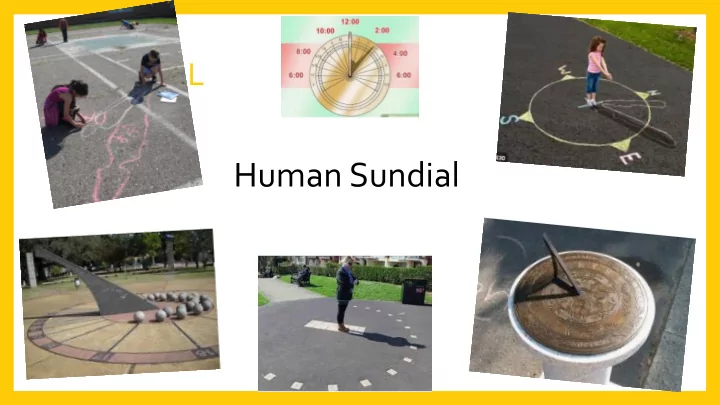
Human Sundial You need a sunny day , someone to help you and time - - PowerPoint PPT Presentation

human sundial you need a sunny day someone to help you
SMART_READER_LITE
LIVE PREVIEW

Human Sundial You need a sunny day , someone to help you and time - - PowerPoint PPT Presentation

SUNDIAL Human Sundial You need a sunny day , someone to help you and time throughout the day to record, for this activity to take place. You will be looking at your shadow at different times of the day and measure differences in its size and


slide-1
SLIDE 1

SUNDIAL

Human Sundial

slide-2
SLIDE 2

You need a sunny day , someone to help you and time throughout the day to record, for this activity to take place. You will be looking at your shadow at different times of the day and measure differences in its size and direction. You can use a compass or an online map to help work out which way is North before measurements begin. Tip: All standard satellite dishes, in the UK, point South Please record your results in a table and in a bar chart or line graph and discuss why they see what they do.

Note: During British Summer Time the clock is set one hour ahead of Greenwich Mean Time, so that, e.g., 12:00 BST (clock time) is 11:00 GMT (real time relating to the position of the Sun overhead).

slide-3
SLIDE 3

You will need:

  • chalk
  • measuring tape
  • table to record (see resources or draw your own)
  • graph to record results (see resources or draw your own)
  • Pencils
  • colouring pencils
slide-4
SLIDE 4
  • Why do we have shadows?
  • Do you have a shadow in the classroom/inside

your home? Why?

  • If you are standing outside and the Sun is behind

you, where will your shadow be?

slide-5
SLIDE 5
  • Why do we have shadows?
  • Answer: A shadow appears when an object blocks a light

source such as the Sun.

  • Do you have a shadow in the classroom/inside your

home? Why?

  • Answer: Yes, anywhere there is a source of light, you will

cast a shadow.

  • If you are standing outside and the Sun is behind you,

where will your shadow be?

  • Answer: In front of you. Shadows always point away

from the source of light which causes them

slide-6
SLIDE 6
  • This sundial was placed here in

2002 to mark Queen Elizabeth II's Golden Jubilee (50 years of reign).

  • If you stand on the line closest to

the correct date your shadow points to the correct time on the circle.

  • You can become a sundial in your

garden.

slide-7
SLIDE 7

You will need someone to help you for this task!

1.

Find a space where you can mark out your shadow – patio, driveway etc and mark the place where you stand with an ‘X’ in chalk.

2.

Ask your partner to draw the outline of your shadow with chalk and write the time next to the shadow.

3.

Write down the direction of your shadow in the table.

4.

Measure the length of your shadow and write it in the table.

5.

Repeat steps 2, 3 and 4 at different times in the day.

slide-8
SLIDE 8

What do you think will happen to your shadow at different times of the day?

slide-9
SLIDE 9
slide-10
SLIDE 10
  • Draw a line graph or bar

chart below showing the length of your shadow at different times of the day.

  • What happened to your

shadow?

slide-11
SLIDE 11
  • What did your results show?
  • Answer: Shadows move regularly from West to East over the day (see

images below). They also get shorter towards the middle of the day before growing in length again.

slide-12
SLIDE 12
  • Why do you think this happens?
  • When was your shadow shortest?
  • Why do you think the Sun moves from east to west

every day?

slide-13
SLIDE 13
  • Why do you think this happens?
  • Answer: The Sun appears to rise in the East, climb upward

through midday, and then set in the West. Shadows always point away from the Sun.

  • When was your shadow shortest?
  • Answer: Midday.
  • Why do you think the Sun moves from east to west every day?
  • Answer: The Earth is spinning on its axis.
slide-14
SLIDE 14
  • Use your sundial to find out the time over the next

few days.

  • When will this clock not work?