
SLIDE 1
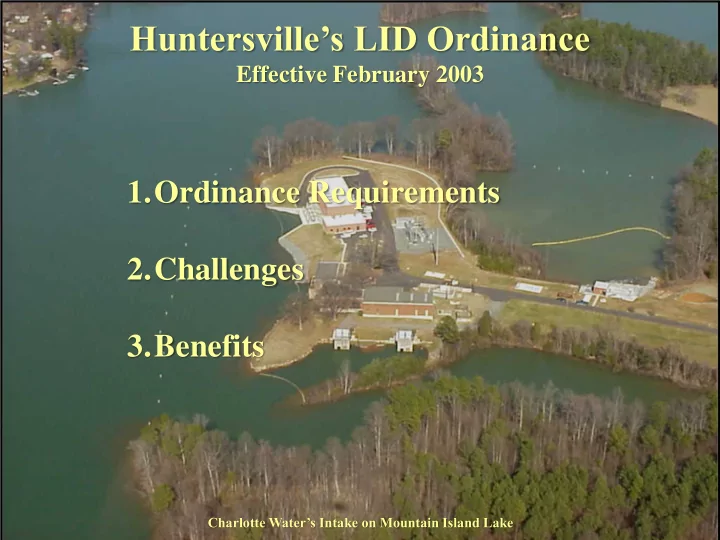
Charlotte Water’s Intake on Mountain Island Lake
Huntersvilles LID Ordinance Effective February 2003 1.Ordinance - - PowerPoint PPT Presentation
Huntersvilles LID Ordinance Effective February 2003 1.Ordinance Requirements 2.Challenges 3.Benefits Charlotte Waters Intake on Mountain Island Lake Restoring water quality in McDowell Creek was the driver for the development of the
Charlotte Water’s Intake on Mountain Island Lake
McDowell Creek McDowell Creek Cove Mountain Island Lake
McDowell Creek McDowell Creek Cove Mountain Island Lake
Quality Degradation
produce over 27,000 gallons of runoff.
Increased stream flows and degraded channel conditions.
Volume + Velocity Change in Natural Stream Hydrology =
Increased stream flows and degraded channel conditions.
Increased stream flows and degraded channel conditions. The Good
Increased stream flows and degraded channel conditions.
Increased pollutants in storm water runoff associated with increased development.
Mayfly
Increased stream flows and storm water pollutants negatively impact aquatic life.
Rain Garden at Shops at Birkdale in Huntersville
Use physical and some biological processes to remove pollutants and detain (slow down) storm water. Use physical, chemical and biological processes to remove pollutants and retain (eliminate) storm water in order to mimic natural site hydrology. Typically more expensive.
versus
Wet Pond Rain Garden (bioretention)
Water Quality:
achieve an average annual 85% TSS removal.
shall be used.
runoff from the one (1) inch storm event must be treated using LID BMPs.
BMPs.
media surface area.
Volume Control
1. LID BMPs or a combination of LID and Conventional BMPs shall be used to treat the increase in storm water runoff volume for the 2-year, 24-hour storm event in the Rural and Transitional Zoning Districts. 2. For all other Zoning Districts, treat the increase in storm water runoff volume for the 1-year, 24-hour storm event.
Peak Control
1. The peak storm water runoff release rates leaving the site during post-construction conditions shall be equal to or less than the pre-development peak storm water runoff release rates for the 2-year and 10-year, 24-hour storm events.
High Density Threshold = >12% Built-Upon-Area
Bioretention at Huntersville Aquatic Center
Table 6.1. Approved LID BMPs for Use in Huntersville (page 54 of Huntersville’s Design Manual)
BMP Applicable Zoning Districts (1) Applicable Performance Criteria (2) Designs & Specifications (3) Function (4) (WQ, VC, PC) Bioretention (Rain Garden) U, T, R 3(a), 3(b) Chapter 12 NCDENR BMP Design Manual (6) WQ, VC, PC Infiltration Trench U, T, R 3(a), 3(b) Chapter 4.6 WQ, VC, PC Enhanced Grass Swale U, T, R 3(a) Chapter 4.4 WQ, VC Grass Channel U, T, R 3(a) Chapter 4.5 WQ Filter Strip/Wooded Buffer Strip U, T, R 3(a) Chapter 4.7 WQ, PC Dry Well, Cistern & Rain barrel U, T, R 3(b) Chapter 19 NCDENR BMP Manual (6) WQ, VC, PC Curb & Gutter Elimination R 3(b) WQ, PC Rooftop Storage U, T, R 3(b) Chapter 19 NCDENR BMP Manual (6) VC, PC Sand Filter (5) U, T, R 3(a), 3(b) Chapter 4.8 WQ, VC, PC
Rural; and U = All other zones EXCEPT transitional and rural.
satisfy.
the specific chapter indicated in the above table unless noted.
Peak Control.
not compacted. A double-ringed infiltrometer test of the bottom must show infiltration capabilities. In addition, the under drain must be designed to create minimum two-foot internal water storage layer above the bottom. Sand filters not meeting these criteria will be considered Conventional Storm Water BMPs.
Guidance for Rainwater Harvesting Systems located at: http://portal.ncdenr.org/web/lr/bmp-manual
0% 5% 10% 15% 20% 25% 30% Existing Future Current Regs Future No Regs
Modeling Results for the Huntersville’s LID Ordinance Stream Instability Analysis
Percent of Stream Feet at Risk
LID Ordinance
Modeling Results for the Huntersville’s LID Ordinance Total Suspended Solids Loading Rates 0.05 0.1 0.15 0.2 0.25 0.3 0.35 0.4 0.45 0.5 Existing Future Current Regs Future No Regs
LID Ordinance
Modeling Results for the Huntersville’s LID Ordinance Total Phosphorus Loading Rates 0.2 0.4 0.6 0.8 1 1.2 Existing Future Current Regs Future No Regs
LID Ordinance
Modeling Results for the Huntersville’s LID Ordinance Total Nitrogen Loading Rates 1 2 3 4 5 6 7 8 Existing Future Current Regs Future No Regs
LID Ordinance
$336,029 $172,280 $0 $50,000 $100,000 $150,000 $200,000 $250,000 $300,000 $350,000 $400,000
Huntersville LID Cornelius Post- Construction Ordinance (51%)
1. Maintaining our current pollutant removal capabilities. 2. Continuing to utilize the LID principle of infiltrating storm water runoff. 3. Continuing to rely on green infrastructure (plants) to the extent practicable.
1. April 10, 2003 – Original Design Manual was based on the LID Manual from Prince George’s County, Maryland 2. December 1, 2005 – Adapted LID BMPs to local needs 3. April 5, 2006 – Significant enhancements to rain garden designs 4. September 13, 2006 – Further adaption and changes in plantings 5. July 26, 2007 – Allowed < 6% BUA with grass channels 6. January 1, 2008 – Allowed a combination of LID and conventional BMPs 7. July 6, 2012 – Allowed sand filters as LID technique 8. June 3, 2013 – Major Modifications
Money to be used for stream restoration.
Stormwater BMP Manual in lieu of the current Charlotte-Mecklenburg standard.
constructed above ground with a native soil bottom that has been scarified and not compacted to maximize infiltration. A double-ringed infiltrometer test of the bottom must show infiltration capabilities. In addition, the under drain must be designed to create a one-foot internal water storage layer above the bottom. Sand filters not meeting these criteria will be considered Conventional and not LID Storm Water BMPs.
costs by spreading the costs over a longer time period; and
5,000 square feet and remove the ordinance requirement that restricts the area draining to any one BMP to no more than 5 acres.
$336,029 $217,997 $172,280 $0 $50,000 $100,000 $150,000 $200,000 $250,000 $300,000 $350,000 $400,000
Huntersville LID with Modifications (65%) Huntersville LID Cornelius Post- Construction Ordinance (51%)
McDowell Creek Mountain Island Lake
In McDowell Creek, total suspended solid loads have decreased by 50% and total nitrogen and total phosphorus concentrations have decreased by 25% resulting in improved water quality conditions.
McDowell Creek Cove
Water and sewer capacities are adequate to meet future growth demands.
Mountain Island Lake Drinking Water Intake McDowell Creek Wastewater Treatment Plant Sewer Line Projects