Imbeddings of Free Actions on Handlebodies 1 handlebody = - - PDF document

imbeddings of free actions on handlebodies
SMART_READER_LITE
LIVE PREVIEW

Imbeddings of Free Actions on Handlebodies 1 handlebody = - - PDF document

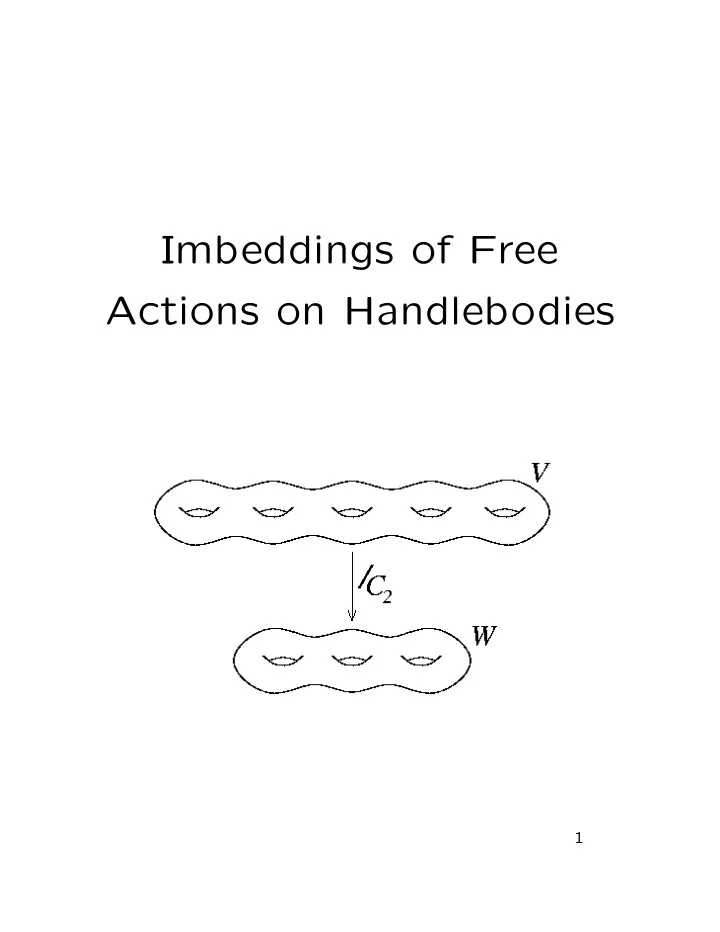
Imbeddings of Free Actions on Handlebodies 1 handlebody = (compact) 3-dimensional orientable handlebody action = effective action of a finite group G on a handlebody, by orientation-preserving (smooth- or PL-) homeomorphisms Actions on


slide-1
SLIDE 1

Imbeddings of Free Actions on Handlebodies

1
slide-2
SLIDE 2

handlebody = (compact) 3-dimensional

  • rientable handlebody

action = effective action of a finite group G on a handlebody, by

  • rientation-preserving (smooth-
  • r PL-) homeomorphisms

Actions on handlebodies have been extensively

  • studied. See articles by various combinations
  • f:

Bruno Zimmermann, Andy Miller, John Kalliongis, McC. Free actions on handlebodies have been stud- ied by J. Przytycki, and more recently by McC and M. Wanderley of Universidade Federal de Pernambuco, Brazil.

2

slide-3
SLIDE 3

Elementary Observation: Every finite group acts freely on a handlebody. Proof: Let W be a handlebody of genus g, where g is at least as large as µ(G), the min- imum number of elements in a generating set for G. Since π1(W) is free of rank g, there is a sur- jective homomorphism ψ : π1(W) → G. The covering of W corresponding to the kernel

  • f ψ is a handlebody (since its fundamental

group is free), and it admits an action of G as covering transformations, with quotient W. But how many different actions are there?

3

slide-4
SLIDE 4

Two actions α: G → Homeo(V1) and β : G → Homeo(V2) are equivalent if V1 and V2 are equivariantly homeomorphic, that is, there is a homeomorphism h: V1 → V2 so that α(γ) = h ◦ β(γ) ◦ h−1 for all γ ∈ G. The actions are weakly equivalent when they are equivalent after changing one of them by an automorphism of G. McC-Wanderley proved, among other results, that for every N, there exists a solvable G and a genus g such that G has at least N weak equivalence classes of free actions on the han- dlebody of genus g (the hard part of this is an algebraic result of M. Dunwoody). But there is no known counterexample to the following: If G is finite, and g is greater than the minimum genus∗ of handlebody on which G can act freely, then all free actions of G on the genus g handlebody are equivalent.

∗The minimum genus is 1 + |G| (µ(G) − 1).

4

slide-5
SLIDE 5

A weaker relation than equivalence is that one free G-action imbeds equivariantly in another. This turns out to be a very weak equivalence relation: Theorem 1 Let G be a finite group acting freely and preserving orientation on two han- dlebodies V1 and V2, not necessarily of the same genus. Then there is a G-equivariant imbedding of V1 into V2. In fact, imbedding free actions of handlebodies is ridiculously easy: Theorem 2 Let G be a finite group acting freely and preserving orientation on a handle- body V and on a connected 3-manifold X. Then there is a G-equivariant imbedding of V into X.

5

slide-6
SLIDE 6
  • 1. Since the actions are free and orientation-

preserving, V/G is an orientable handle- body W, and X/G is a connected orientable 3-manifold Y .

  • 2. By elementary covering space theory, there

are group extensions 1 − → π1(V ) − → π1(W)

ψ

− → G − → 1 and 1 − → π1(X) − → π1(Y )

Ψ

− → G − → 1.

  • 3. Regarding W as a regular neighborhood of

a graph Γ, choose an imbedding j of Γ into Y so that Ψ ◦ j#: π1(W) = π1(Γ) → π1(Y ) → G equals ψ. Since both W and Y are orientable, j extends to an imbedding J of W into Y .

  • 4. The data that Ψ ◦ j = ψ

translates into the fact that J lifts to a G-equivariant imbedding of V into X. V − → X

   /G    /G

W − → Y

6

slide-7
SLIDE 7

One might ask whether, given an action on V , there exists an X for which there is a more “natural” kind of equivariant imbedding— one for which for which V is one of the handlebod- ies in a G-invariant Heegaard splitting of X. Simply by forming the double of V and taking an identical action on the second copy of V ,

  • ne obtains such an extension with X a con-

nected sum of S2 × S1’s. A better question is whether V imbeds as an invariant Heegaard handlebody for a free ac- tion on some irreducible 3-manifold. Our main result answers this question affirmatively. Theorem 3 Any orientation-preserving free G- action on a handlebody V imbeds equivariantly as a Heegaard handlebody in a free G-action

  • n some closed irreducible 3-manifold. This 3-

manifold may be chosen to be Seifert-fibered. Provided that V has genus greater than 1, it may be chosen to be hyperbolic.

7

slide-8
SLIDE 8

Here is a sketch of the proof. Again, let W = V/G, and ψ : π1(W) → G. We will find

  • 1. an imbedding J of W as a Heegaard han-

dlebody in some closed 3-manifold Y , and

  • 2. a homomorphism Ψ: π1(Y ) → G with Ψ ◦

J# = ψ. For the lifted imbedding of V into the covering space X of Y , X − V is a handlebody, since it covers the handlebody Y − W. So V imbeds equivariantly as a Heegaard handlebody in X. To construct Y , we will add g (= genus(W)) 2-handles to W along attaching curves in ∂W, so that

  • 1. The complement in ∂W of the attaching

circles is connected. This ensures that the union of W with the 2-handles can be filled in with a 3-ball to make a closed Y that contains W as a Heegaard handlebody.

  • 2. Each 2-handle is attached along a loop in

the kernel of ψ. This ensures that ψ : π1(W) → G extends to Ψ: π1(Y ) → G.

8

slide-9
SLIDE 9

The Seifert-fibered case: Let n be the order of

  • G. Consider the following loops in ∂W, where

each Ci goes n times around one of the handles

  • f W.

Let C′

i be the images of the Ci under the nth

power of a Dehn twist of ∂W about C. These C′

i are the attaching curves for the 2-handles.

The complement of ∪Ci is connected, so the complement of ∪C′

i is also connected.

If x1, . . . , xg are a standard set of generators

  • f π1(W), where xi goes once around the ith

1-handle of W, then Ci represents xn

i (up to

conjugacy), and C′

i represents xn i (x1 · · · xg)−n.

So ψ carries each C′

i to the trivial element of

G, and ψ induces Ψ: π1(Y ) → G.

9

slide-10
SLIDE 10

By a construction that goes back (at least) to Lickorish’s proof that all closed orientable 3- manifolds are cobordant to the 3-sphere, we may change the attaching map of a Heegard splitting, at the expense of introducing Dehn surgeries on solid tori imbedded in one of the Heegard handlebodies. We do this to the previous Heegaard descrip- tion, to move the C′

i to a standard set of at-

taching curves for S3. This yields the following surgery description of Y : The complement of this link in S3 is just a g-times punctured disc times S1, which has a product S1-fibering. The core circles of the filled-in solid tori become exceptional Seifert

  • fibers. The Seifert invariants of Y work out to

be {−1; (o1, 0); (n, 1), . . . , (n, 1), (n, n − 1)}.

10

slide-11
SLIDE 11

The hyperbolic case: Suppose for now that the genus of W is 2. Take the same curves C1 and C2 as before, but instead of the curve C used before, use the curve shown here: It turns out that the resulting surgery descrip- tion for Y is: The link complement is a 2-fold cover of the Whitehead link complement, so is hyperbolic. Conceivably, this Dehn filling does not produce a hyperbolic 3-manifold, but n can be any in- teger divisible by the order of G, and all but finitely many choices yield a hyperbolic Y .

11

slide-12
SLIDE 12

If the genus of W is g, then in place of C we use the following collection of curves: The resulting surgery description of Y is simi- lar, but instead of a two-component chain link- ing the loop L, we obtain a (2g−2)-component

  • chain. The complement is a (2g−2)-fold cover
  • f the Whitehead link, so is hyperbolic.

Again, the surgery coefficients are simple ex- pressions in n, and all but finitely many choices for n must yield a hyperbolic Y .

12