V4 11 Aug 2015 Statistics for Managers V4 2015 ASA 1 V4 2015 - - PDF document

v4 11 aug 2015 statistics for managers
SMART_READER_LITE
LIVE PREVIEW

V4 11 Aug 2015 Statistics for Managers V4 2015 ASA 1 V4 2015 - - PDF document

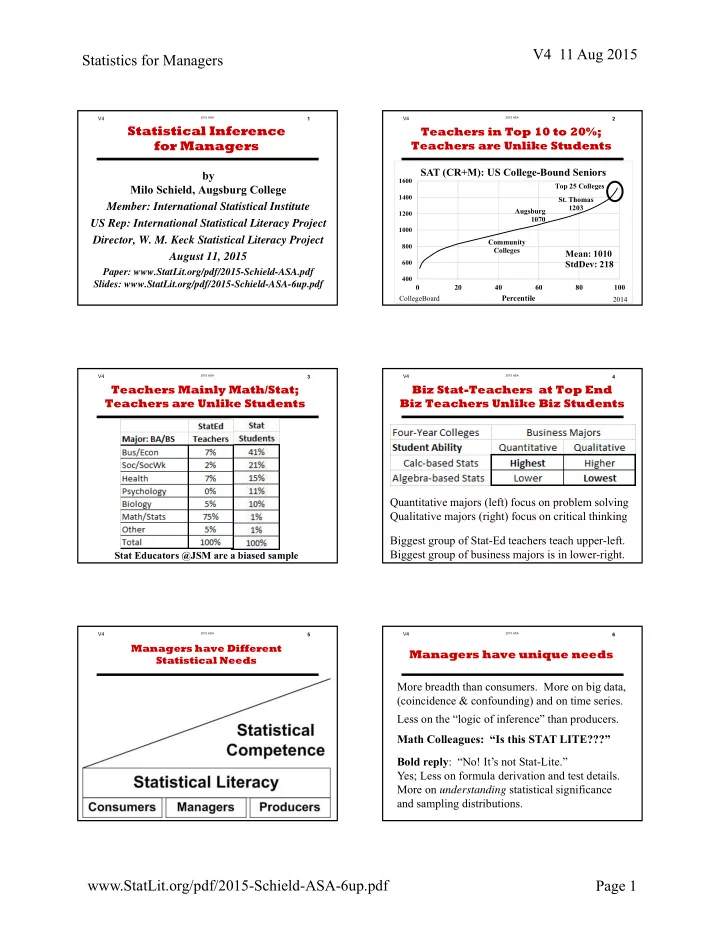
V4 11 Aug 2015 Statistics for Managers V4 2015 ASA 1 V4 2015 ASA 2 Statistical Inference Teachers in Top 10 to 20%; for Managers Teachers are Unlike Students . SAT (CR+M): US College-Bound Seniors by 1600 Top 25 Colleges Milo


slide-1
SLIDE 1

Statistics for Managers V4 11 Aug 2015 www.StatLit.org/pdf/2015-Schield-ASA-6up.pdf Page 1

2015 ASA

V4 1

by Milo Schield, Augsburg College Member: International Statistical Institute US Rep: International Statistical Literacy Project Director, W. M. Keck Statistical Literacy Project August 11, 2015

Paper: www.StatLit.org/pdf/2015-Schield-ASA.pdf Slides: www.StatLit.org/pdf/2015-Schield-ASA-6up.pdf

Statistical Inference for Managers

V4

2015 ASA

2

Teachers in Top 10 to 20%; Teachers are Unlike Students

.

400 600 800 1000 1200 1400 1600

20 40 60 80 100

Percentile

SAT (CR+M): US College-Bound Seniors

CollegeBoard

Mean: 1010 StdDev: 218

2014 Top 25 Colleges Community Colleges

  • St. Thomas

1203 Augsburg 1070

V4

2015 ASA

3

Teachers Mainly Math/Stat; Teachers are Unlike Students

Stat Educators @JSM are a biased sample

V4

2015 ASA

4

Biz Stat-Teachers at Top End Biz Teachers Unlike Biz Students Quantitative majors (left) focus on problem solving Qualitative majors (right) focus on critical thinking Biggest group of Stat-Ed teachers teach upper-left. Biggest group of business majors is in lower-right.

V4

2015 ASA

5

Managers have Different Statistical Needs

.

V4

2015 ASA

6

Managers have unique needs More breadth than consumers. More on big data, (coincidence & confounding) and on time series. Less on the “logic of inference” than producers. Bold reply: “No! It’s not Stat-Lite.” Yes; Less on formula derivation and test details. More on understanding statistical significance and sampling distributions. Math Colleagues: “Is this STAT LITE???”

slide-2
SLIDE 2

Statistics for Managers V4 11 Aug 2015 www.StatLit.org/pdf/2015-Schield-ASA-6up.pdf Page 2

V4

2015 ASA

7

R-sq = 0.49; N = 9. Is this statistically significant?

Yes! R > 2/Sqrt(n) is sufficient. Schield (2014b)

V4

2015 ASA

8

Correlation = 93.6%. Is this statistically significant?

www.tylervigen.com

No! Normal statistical-significance minimums don’t apply to time-based correlations.

V4

2015 ASA

9

Chi-sq = 12.5; Six bins. Is this statistically significant?

YES! χ2 > 2*#bins is sufficient. Schield (2014c)

V4

2015 ASA

10

Is Statistical Significance Necessary for Causation? Of the millions of users, ~ten lost their sense of smell Zicam defense; Ten is not statistically significant. ZICAM: homeopathic remedy clinically proven to reduce symptoms of common cold US Supreme Court: Lack of statistical significance is not an acceptable defense. See Schield (2011).

V4

2015 ASA

11

Influence of Bias & Confounding

  • n Statistical Significance

Bias: Subject bias, measurement bias and sampling bias See Schield (2013). Confounder: A factor related to the predictor and to the outcome in an association that (1) has a causal influence on the outcome and (2) is not causally influenced by the predictor. See Schield (2006 and 2014a)

11 V4

2015 ASA

12

Influence of Bias on Significance Response bias: Men likely to overstate income Sample bias: Rich less likely to do surveys

slide-3
SLIDE 3

Statistics for Managers V4 11 Aug 2015 www.StatLit.org/pdf/2015-Schield-ASA-6up.pdf Page 3

V4

2015 ASA

13

Control for Mom’s Age

V4

2015 ASA

14

Controlling for a Confounder Can Change Statistical Significance

V4

2015 ASA

15

Understanding the “Logic of Statistical Inference” McKenzie (2004) asked statistical educators to pick the top-three core concepts in intro statistics: 75% Variation 31% Association vs. causation 25% Hypothesis tests and 24% Sampling distribution 22% Confidence intervals 14% Randomness and statistical significance %: Percentage of votes by Statistical Educators Sample size: 56; 95% ME = 12 percentage points

15 V4

2015 ASA

16

Understanding the “Logic of Statistical Inference” Teaching randomness and statistical significance is necessary but not sufficient. Students need to understand and appreciate the sampling distribution. But deriving the sampling distribution takes time. Randomization takes time and a computer. What to do with minimal time & no computer? See the final paper for more on this topic.

16 V4

2015 ASA

17

Conclusion Managers need a statistics curriculum that is better aligned with their work.

  • Less on the derivation of sampling error;

More on understanding sampling distributions

  • Less on p-value;

More on statistical significance

17 V4

2015 ASA

18

References

Schield, M. (2015). Statistically-Significant Shortcuts. Statchat, Macalester. www.statlit.org/pdf/2015-Schield-StatChat-Slides.pdf Schield, M. (2014c). Chi‐Squared Cutoffs for Statistical Significance. NNN www.statlit.org/pdf/2014-Schield-SS-Shortcut-Chi-Square.pdf Schield, M. (2014b). Statistically-Significant Correlations. NNN Carleton. www.statlit.org/pdf/2014-Schield-NNN4-Slides.pdf Schield, M. (2014a). Two Big Ideas for Teaching Big Data: ECOTS. www.statlit.org/pdf/2014-Schield-ECOTS.pdf Schield, M. (2011). Zicam and the US Supreme Course. www.statlit.org/pdf/2011Schield-ASA-Zicam6up.pdf Schield, M. (2006). Presenting Confounding & Standardization Graphically. STATS Magazine. www.StatLit.org/pdf/2006SchieldSTATS.pdf McKenzie, John, Jr. (2004) . Teaching the Core Concepts. ASA www.statlit.org/pdf/2004McKenzieASA.pdf

18

slide-4
SLIDE 4

2015 ASA

V4

by Milo Schield, Augsburg College Member: International Statistical Institute US Rep: International Statistical Literacy Project Director, W. M. Keck Statistical Literacy Project August 11, 2015

Paper: www.StatLit.org/pdf/2015-Schield-ASA.pdf Slides: www.StatLit.org/pdf/2015-Schield-ASA-6up.pdf

Statistical Inference for Managers

1

slide-5
SLIDE 5

V4

2015 ASA

Teachers in Top 10 to 20%; Teachers are Unlike Students

.

400 600 800 1000 1200 1400 1600

20 40 60 80 100

Percentile

SAT (CR+M): US College-Bound Seniors

CollegeBoard

Mean: 1010 StdDev: 218

2014 Top 25 Colleges Community Colleges

  • St. Thomas

1203 Augsburg 1070

2

slide-6
SLIDE 6

V4

2015 ASA

Teachers Mainly Math/Stat; Teachers are Unlike Students

Stat Educators @JSM are a biased sample

3

slide-7
SLIDE 7

V4

2015 ASA

Biz Stat-Teachers at Top End Biz Teachers Unlike Biz Students Quantitative majors (left) focus on problem solving Qualitative majors (right) focus on critical thinking Biggest group of Stat-Ed teachers teach upper-left. Biggest group of business majors is in lower-right.

4

slide-8
SLIDE 8

V4

2015 ASA

Managers have Different Statistical Needs

.

5

slide-9
SLIDE 9

V4

2015 ASA

Managers have unique needs More breadth than consumers. More on big data, (coincidence & confounding) and on time series. Less on the “logic of inference” than producers. Bold reply: “No! It’s not Stat-Lite.” Yes; Less on formula derivation and test details. More on understanding statistical significance and sampling distributions. Math Colleagues: “Is this STAT LITE???”

6

slide-10
SLIDE 10

V4

2015 ASA

R-sq = 0.49; N = 9. Is this statistically significant?

Yes! R > 2/Sqrt(n) is sufficient. Schield (2014b)

7

slide-11
SLIDE 11

V4

2015 ASA

Correlation = 93.6%. Is this statistically significant?

www.tylervigen.com

No! Normal statistical-significance minimums don’t apply to time-based correlations.

8

slide-12
SLIDE 12

V4

2015 ASA

Chi-sq = 12.5; Six bins. Is this statistically significant?

YES! χ2 > 2*#bins is sufficient. Schield (2014c)

9

slide-13
SLIDE 13

V4

2015 ASA

Is Statistical Significance Necessary for Causation? Of the millions of users, ~ten lost their sense of smell Zicam defense; Ten is not statistically significant. ZICAM: homeopathic remedy clinically proven to reduce symptoms of common cold US Supreme Court: Lack of statistical significance is not an acceptable defense. See Schield (2011).

10

slide-14
SLIDE 14

V4

2015 ASA

11

Influence of Bias & Confounding

  • n Statistical Significance

Bias: Subject bias, measurement bias and sampling bias See Schield (2013). Confounder: A factor related to the predictor and to the outcome in an association that (1) has a causal influence on the outcome and (2) is not causally influenced by the predictor. See Schield (2006 and 2014a)

11

slide-15
SLIDE 15

V4

2015 ASA

12

Influence of Bias on Significance Response bias: Men likely to overstate income Sample bias: Rich less likely to do surveys

slide-16
SLIDE 16

V4

2015 ASA

13

Control for Mom’s Age

slide-17
SLIDE 17

V4

2015 ASA

14

Controlling for a Confounder Can Change Statistical Significance

slide-18
SLIDE 18

V4

2015 ASA

15

Understanding the “Logic of Statistical Inference” McKenzie (2004) asked statistical educators to pick the top-three core concepts in intro statistics: 75% Variation 31% Association vs. causation 25% Hypothesis tests and 24% Sampling distribution 22% Confidence intervals 14% Randomness and statistical significance %: Percentage of votes by Statistical Educators Sample size: 56; 95% ME = 12 percentage points

15

slide-19
SLIDE 19

V4

2015 ASA

16

Understanding the “Logic of Statistical Inference” Teaching randomness and statistical significance is necessary but not sufficient. Students need to understand and appreciate the sampling distribution. But deriving the sampling distribution takes time. Randomization takes time and a computer. What to do with minimal time & no computer? See the final paper for more on this topic.

16

slide-20
SLIDE 20

V4

2015 ASA

17

Conclusion Managers need a statistics curriculum that is better aligned with their work.

  • Less on the derivation of sampling error;

More on understanding sampling distributions

  • Less on p-value;

More on statistical significance

17

slide-21
SLIDE 21

V4

2015 ASA

18

References

Schield, M. (2015). Statistically-Significant Shortcuts. Statchat, Macalester. www.statlit.org/pdf/2015-Schield-StatChat-Slides.pdf Schield, M. (2014c). Chi‐Squared Cutoffs for Statistical Significance. NNN www.statlit.org/pdf/2014-Schield-SS-Shortcut-Chi-Square.pdf Schield, M. (2014b). Statistically-Significant Correlations. NNN Carleton. www.statlit.org/pdf/2014-Schield-NNN4-Slides.pdf Schield, M. (2014a). Two Big Ideas for Teaching Big Data: ECOTS. www.statlit.org/pdf/2014-Schield-ECOTS.pdf Schield, M. (2011). Zicam and the US Supreme Course. www.statlit.org/pdf/2011Schield-ASA-Zicam6up.pdf Schield, M. (2006). Presenting Confounding & Standardization Graphically. STATS Magazine. www.StatLit.org/pdf/2006SchieldSTATS.pdf McKenzie, John, Jr. (2004) . Teaching the Core Concepts. ASA www.statlit.org/pdf/2004McKenzieASA.pdf

18