Incident Response: Goals of Incident Management Steps to - - PDF document

incident response goals of incident management steps to
SMART_READER_LITE
LIVE PREVIEW

Incident Response: Goals of Incident Management Steps to - - PDF document

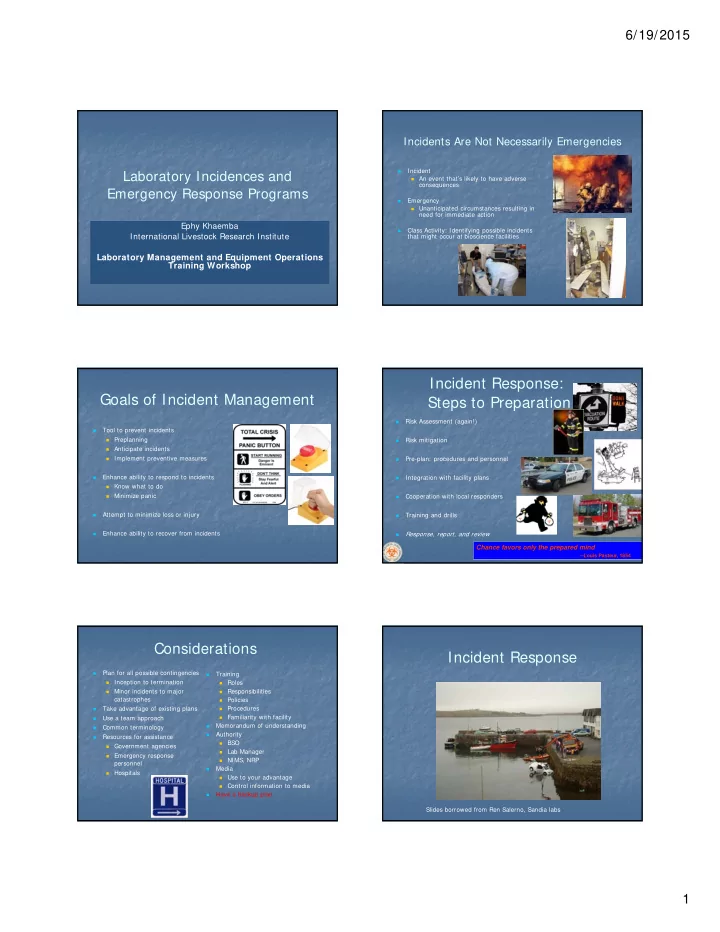
6/19/2015 Incidents Are Not Necessarily Emergencies Incident Laboratory Incidences and An event thats likely to have adverse consequences Emergency Response Programs Emergency Unanticipated circumstances resulting in


slide-1
SLIDE 1

6/19/2015 1 Laboratory Incidences and Emergency Response Programs

Ephy Khaemba International Livestock Research Institute Laboratory Management and Equipment Operations Training Workshop

Incidents Are Not Necessarily Emergencies

  • Incident
  • An event that’s likely to have adverse

consequences

  • Emergency
  • Unanticipated circumstances resulting in

need for immediate action

  • Class Activity: Identifying possible incidents

that might occur at bioscience facilities

Goals of Incident Management

  • Tool to prevent incidents
  • Preplanning
  • Anticipate incidents
  • Implement preventive measures
  • Enhance ability to respond to incidents
  • Know what to do
  • Minimize panic
  • Attempt to minimize loss or injury
  • Enhance ability to recover from incidents

Incident Response: Steps to Preparation

  • Risk Assessment (again!)
  • Risk mitigation
  • Pre-plan: procedures and personnel
  • Integration with facility plans
  • Cooperation with local responders
  • Training and drills
  • Response, report, and review

Chance favors only the prepared mind

  • -Louis Pasteur, 1854

Considerations

  • Plan for all possible contingencies
  • Inception to termination
  • Minor incidents to major

catastrophes

  • Take advantage of existing plans
  • Use a team approach
  • Common terminology
  • Resources for assistance
  • Government agencies
  • Emergency response

personnel

  • Hospitals
  • Training
  • Roles
  • Responsibilities
  • Policies
  • Procedures
  • Familiarity with facility
  • Memorandum of understanding
  • Authority
  • BSO
  • Lab Manager
  • NIMS, NRP
  • Media
  • Use to your advantage
  • Control information to media
  • Have a backup plan

Incident Response

Slides borrowed from Ren Salerno, Sandia labs

slide-2
SLIDE 2

6/19/2015 2

Don’t make it worse!

slide-3
SLIDE 3

6/19/2015 3

Learn from past incidents to improve your response SOPs

Emergency Responses

Front line response begins at the local level

KEY CONCEPTS

Pre-Planning Establishing Procedures Practicing Established Procedures Risk Mitigation Training Procedural Review

Emergency Pre-Planning

Determine the level of required preparation

through the risk assessment

The risk assessment indicates the breadth of

hazardous materials that could be spilled or released into the environment

Establish the response parameters. Determine who is required to respond and when

and how they must respond

Risk Mitigation: Emergency Planning

Utilizing the results of the risk assessment, determine the critical points where an emergency may

  • ccur
slide-4
SLIDE 4

6/19/2015 4 Establishing Procedures

Enlist the input of

lab manager/director, local emergency response team, representation from interested parties

Use your Risk Assessment to mitigate the

highest probability

  • Review literature, best practices

Emergency Response

Develop plan before the emergency Include all appropriate parties in planning Inform and involve community-based

responders

Conduct drills & after-incident reviews Emergency Response

Integrate throughout the Organization

Cover all contingencies Medical Emergencies Spills Breaches in containment Physical events (fire, utility outage, …) Natural events (storms, earthquakes, …) Integrate throughout the Organization

Personnel Involved in a Potential Exposure

Personnel Involved in a Potential Exposure

Should report to a health clinic as soon as possible

First aid

  • Prophylaxis

The Lab Chief should be contacted immediately,

  • r if unavailable, the lab manager
  • The Lab Chief should then contact safety

personnel or the Biosafety Committee

Training

Train and re-train

  • Repetition creates a stronger

training memory = Reaffirmation

  • Provides another opportunity to refine procedures
  • Establish a regular drill schedule
  • Vary HOW training is done

Procedural Review

Annually and after every “event” Ask yourself

Where did the “Plan go wrong”? What went as planned? What can be enhanced? Where is training lacking?

slide-5
SLIDE 5

6/19/2015 5

Questions??