INF3130: Dynamic Programming 12 sept. 2019 In the textbook: Ch. 9, - - PowerPoint PPT Presentation

inf3130 dynamic programming
SMART_READER_LITE
LIVE PREVIEW

INF3130: Dynamic Programming 12 sept. 2019 In the textbook: Ch. 9, - - PowerPoint PPT Presentation

INF3130: Dynamic Programming 12 sept. 2019 In the textbook: Ch. 9, and Section 20.5 The slides presented here have a different introduction to this topic than the textbook This is done because the introduction in the textbook seems


slide-1
SLIDE 1

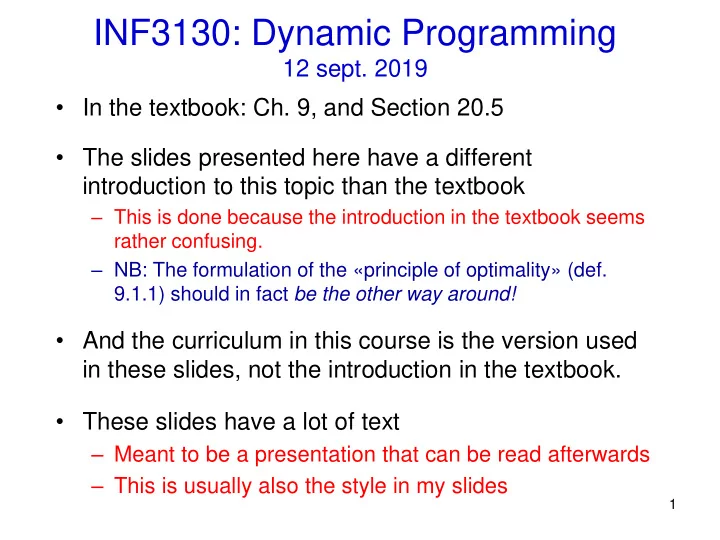
INF3130: Dynamic Programming

12 sept. 2019

  • In the textbook: Ch. 9, and Section 20.5
  • The slides presented here have a different

introduction to this topic than the textbook

– This is done because the introduction in the textbook seems rather confusing. – NB: The formulation of the «principle of optimality» (def. 9.1.1) should in fact be the other way around!

  • And the curriculum in this course is the version used

in these slides, not the introduction in the textbook.

  • These slides have a lot of text

– Meant to be a presentation that can be read afterwards – This is usually also the style in my slides

1

slide-2
SLIDE 2

Dynamic programming

Dynamic programming was formalised by Richard Bellmann (RAND Corporation) in the 1950’es.

– «programming» should here be understood as planning, or making decisions. It has nothing to do with writing code. – ”Dynamic” should indicate that it is a stepwise process.

2

But was that the real background for the name??

slide-3
SLIDE 3

A simple example

We are given a matrix W with positive «weights» in each cell:

12 5 35 7 21 4 29 8 19 14 8 3 19 20 24 37 84 78 15 62 26 13 40 33 12 21 60 27 18 17 12 17 52 59 80 16 45 53 72 86 24 27 46 66 90 61

111 124 81 143 87 100 140 114 126 108 160 167 132 143

W:

P (initialization in black) Problem: Find the «best» path (lowest sum of weights) from upper left to lower right corner. NB: The shown red path is radomly chosen, and is probably not the best path (has weight = 255) We use a new matrix P to store intermediate results: P[i,j] = The weight of the best path from the start (upper left) to cell [i,j]. The «recurrence relation» will be: P[i, j] = min(P[i-1, j], P[i, j-1]) + W[i,j]

  • We can initialialize by filling in the leftmost column and

topmost row, as shown to the left.

  • We can the fill in P according to the formula above

Questions (exercises for next week):

  • In which order should P be filled out?
  • How can we find the shortest path itself?
  • What is the complexity of this algorithm?

3

slide-4
SLIDE 4

Another problem (Ch. 9.4)

Find the «Longest Common Subsequence» of two strings: P (pattern) and T (text)

T P

e

f h k p p g

g e h p f p

The Longest Common Subsequence is here «e, h, p, p» «Length of Longest Commom Subsequence» (LCS) is 4.

1 2 3 4 5 6 1 2 3 4 5 6 7

4

slide-5
SLIDE 5

An idea for finding LCS

We will use an interger matrix L[0:m, 0:n] as shown below, where we imagine that the string P = P[1:m] is placed downwords along the left side of L, and T = T[1:n] is placed above D from left to right (at corresponding indices). (NB: This is a slightly different use of indices than in Sectons 9.4 and 20.5). Our plan is then to systematically fill in this table so that L[i, j] = LSC( P[1:i], T[1:j] ) We will do this from «smaller» to «larger» index pairs (i, j), by taking column after column from left to right (but row after row from top to bottom would also work). The value we are looking for, LSC(P, T), will then occur in L[m, n] when all entries are filled.

1 … j -1 j n 1 ... i -1 i

?

m

P

The matrix L:

T

5

slide-6
SLIDE 6

Example: P = «gehpfp» and T = «efhkppg»

We initialize the leftmost column and the topmost row as below

  • Why is it correct with zeroes here?
  • Note that these celles correspond to the empty prefix of P and/or the

empty prefix of T.

e f h k p p g

1 2 3 4 5 6 7

g

1

1 e

2

1 1 1 h

3

1 1 2 p

4

1 f

5

p

6

4?

T P j i L

We have filled in a few more entries of L by intuition We hope to get 4 here!

6

slide-7
SLIDE 7

The general formula for filling L

e f h k p p g

1 2 3 4 5 6 7

g

1

1 e

2

1 1 1 h

3

1 1 2 p

4

1 f

5

p

6

4?

T P L

We want to find: L[i,j] and assume we have already computed: L[i-1,j-1] L[i-1,j] L[i,j-1] (Find: L[i,j])

Case 1: If Pi = Tj then L[i,j] = L[i-1,j-1] +1 WHY? Case 2: If Pi ≠ Tj then L[i,j] = max( L[i,j-1], L[i-1,j] ) WHY?

7

slide-8
SLIDE 8

8

L[i-1,j-1] L[i-1,j] L[i,j-1] (Find: L[i,j])

T[1:j-1] P[1:i-1] T[1:j-1] P[1:i-1] T[1:j-1] P[1:i-1] T[1:j-1] P[1:i-1]

T[j] P[i] Case 1: If Pi = Tj then L[i,j] = L[i-1,j-1] +1 Case 2: If Pi ≠ Tj then L[i,j] = max( L[i,j-1], L[i-1,j] ) T[j] P[i]

slide-9
SLIDE 9

Using the formula for filling L

e f h k p p g

1 2 3 4 5 6 7

g

1

1 e

2

1 1 1 1 1 1 1 h

3

1 1 2 2 2 2 2 p

4

1 1 2 2 3 3 3 f

5

1 2 2 2 3 3 3 p

6

1 2 2 2 3 4

4

T P L

We want to find: L[i,j] and assume we have already computed: L[i-1,j-1] L[i-1,j] L[i,j-1] (Find: L[i,j])

Case 1: If Pi = Tj then L[i,j] = L[i-1,j-1] +1 Case 2: If Pi ≠ Tj then L[i,j] = max( L[i,j-1], L[i-1,j] ) Hurrah!

9

slide-10
SLIDE 10

Finding the

Longest Common Subsequence itself

e f h k p p g

1 2 3 4 5 6 7

g

1

1 e

2

1

1

1 1 1 1 1 h

3

1 1

2 2

2 2 2 p

4

1 1 2 2

3

3 3 u

5

1 1 2 2

3

3 3 p

6

1 2 2 2 3

4

4

T P L

Case 1 If Pi = Tj then L[i,j] = L[i-1,j-1] +1 Case 2 If Pi ≠ Tj then L[i,j] = max( L[i,j-1], L[i-1,j] )

  • 2. The red arrows indicate

the letters included in the Longest Common Subsequence

  • 1. To find the actual Longest Common

Subsequence we highlight entries, backwards from lower right, what «caused» each value (green numbers)

10

slide-11
SLIDE 11

We’ll now look at the problem discussed in Chapter 20.5:

«Approximate String Matching»:

Given: A long string T and a shorter string P Problem: Find strings «similar» to P in T

P: u t t x v T: b s u t t v r t o x i g u t t v x l b t s k u t t z x v k l v h u u t t x v n x u t z t x v w

Questions:

  • What do we mean by a «similar string»?
  • Can we quantify the degree of simularity?

We’ll first look at how to define and find:

The Edit Distance between P and T

11

slide-12
SLIDE 12

The «edit distance» between two strings

We observe that any string P can be converted to another string T by some sequence of the following opertions (usally by many different such sequences): Substitution: One symbol in P is changed to another symbol. Addition: A new symbol is inserted somwhere in P. Removing: One symbol is removed from P.

The «Edit Distance», ED(P,T), between two strings P and T is: The smallest number of such operations needed to convert P to T (or T to P! Note that the definition is symmetric in P and T!)

Example. logarithm  alogarithm  algarithm  algorithm (Steps: +a, -o, a->o)

P T Thus ED(”logarithm”, ”algorithm”) = 3 (as there are no shorter ways!)

12

slide-13
SLIDE 13

To find ED(P,T) we use a similar setup as for LCS

We use an interger matrix D[0:m, 0:n], where P = P[1:m] is placed downwords along the left side of D, and T = T[1:n] is placed above D Our plan is again to systematically fill in this table, but so that D[i, j] = Edit Distance between the strings P[1:i] and T[1:j] Like before we will do this e.g. by taking column after column from left to

  • right. The value we are looking for, ED(P, T), will then occur in D[m, n]

when all entries are filled in.

1 … j -1 j n 1 ... i -1 i

?

m

P The matrix D: T

13

slide-14
SLIDE 14

Example: P = «anne» and T = «ane»

  • We initialize the leftmost column and the topmost row as below
  • Why is this correct?
  • Note that these celles correspond to the empty prefix of P and/or the

empty prefix of T.

a n e

1 2 3

1 2 3 a

1

1 n

2

2 n

3

3 e

4

4

T P

j i

D

14

slide-15
SLIDE 15

More of P = «anne» and T = «ane»

We’ll look a general cell D[i,j], and try to find how the value here can be computed from the values in the tree cells over and to the left. We first assume that P[i]= T[j](as below). We know that P[1: i-1] can be converted to T[1:j-1] in D[i-1, j-1] steps, and thus «T[1:j-1]‘n’» can also be transformed into «D[i-1, j-1] ‘n’» in D[i-1, j-1] steps.

a n e

1 2 3

1 2 3 a

1

1 n

2

2 D[i-1,j-1] D[i-1, j] . n

3

3 D[i, j-1]. D[i, j] . e

4

4 . . T P

j i

D

Thus:

if P[i] = T[j], then D[i,j] = D[i-1, j-1]

15

slide-16
SLIDE 16

16

L[i-1,j-1] L[i-1,j] L[i,j-1] (Find: L[i,j])

T[1:j-1] P[1:i-1] T[1:j-1] P[1:i-1] T[1:j-1] P[1:i-1] T[1:j-1] P[1:i-1]

T[j] P[i] Case 1: If Pi = Tj then D[i,j] = D[i-1, j-1] T[j] P[i]

Equal

slide-17
SLIDE 17

More of P = «anne» and T = «ane»

We again look a general cell D[i,j], but we now assume that P[i] ≠ T[j] . We know that: P[1: i-1] can be transformed to T[1: j-1] in D[i-1, j-1] steps, and we can thus transform «T[1: j-1]‘x’» to «P[1: j-1]‘y’» in D[i-1, j-1] +1 steps.

a x e

1 2 3

1 2 3 a

1

1 n

2

2 D[i-1,j-1] D[i-1, j] . y

3

3 D[i, j-1] D[i, j] . e

4

4 . . T P

j i

D

Likewise we get:

We can transform «T[1: j-1]» into «P[1: i-1]‘y’» in D[i, j-1] +1 steps. «T[1: j-1]» into «P[1: i-1] ‘y’» in D[i-1, j] +1 steps.

Thus we can do the transformation from «T[1: j-1]‘x’» into «P[1: i-1] ‘y’» in the minimum number of steps used in these three

  • scenarios. We therefore obtain

the formula on next page.

17

slide-18
SLIDE 18

18

L[i-1,j-1] L[i-1,j] L[i,j-1] (Find: L[i,j])

T[1:j-1] P[1:i-1] T[1:j-1] P[1:i-1] T[1:j-1] P[1:i-1] T[1:j-1] P[1:i-1]

T[j] P[i] Case 2: If Pi ≠ Tj then D[i,j] = min( D[i-1,j-1], D[i,j-1], D[i-1,j] ) + 1 T[j] P[i]

Different

slide-19
SLIDE 19

The general recurrence relation becomes

To fill in this matrix D we in fact used the relation indicated below (from Ch 20.5) The equalities at the last line can be used to initialize the matrix (shown in red).

1 … j -1 j n

1 j -1 j n

1

1

... i -1

i -1

i

i ?

m

m

P The matrix D: T

19

slide-20
SLIDE 20

Example: P = «anne» and T = «ane»

  • Using the rules
  • The answer ED(P, T) will appear in D[4, 3] (lower right)

a n e

1 2 3

1 2 3 a

1

1 1 2 n

2

2 1 1 n

3

3 2 1 1 e

4

4 3 2

1 T P

j i

The matrix D

20

slide-21
SLIDE 21

A program for computing the edit distance

function EditDistance ( P [1:m ], T [1:n ] ) for i ← 0 to m do D[ i, 0 ] ← i endfor // Initialize row zero for j ← 1 to n do D[ 0, j ] ← j endfor // Initialize column zero for i ← 1 to m do for j ← 1 to n do If P [ i ] = T [ j ] then D[ i, j ] ← D[ i -1, j - 1 ] else D[ i, j ] ← min(D[i -1, j - 1] +1, D[i -1, j ] +1, D[i, j - 1] +1 ) endif endfor endfor return( D[ m, n ] ) end EditDistance Note that, after the initialization, we look at the pairs (i, j) in the following order (line after line): (1,1) (1,2) … (1,n) (2,1) (2,2) … (2,n) … (m,1) … (m,n) This is OK as this order ensures that the smaller instances are solved before they are needed to solve a larger instance. That is: D[i-1, j-1], D[i-1, j] and D[i, j-1] are always computed before D[i, j ]

21

slide-22
SLIDE 22

Our old example: ED(«anne», «ane»)

a n e

1 2 3

1 2 3 a

1

1 1 2 n

2

2 1 1 n

3

3 2 1 1 e

4

4 3 2 1

T: P:

j i

The matrix D

The value used in each entry is given by an arrow into that entry.

22

slide-23
SLIDE 23

Finding the edit steps:

a n e

1 2 3

1 2 3 a

1

1 1 2 n

2

2 1 1 n

3

3 2 1 1 e

4

4 3 2 1

T P

j i

D Diagonally, and P[i] = T[j]:

  • No edit was needed.

Occurred e.g.for D[3, 2]. Diagonally, and P[i] ≠ T[j]:

  • Substitution Occured

e.g. for D[3, 3] (not used in the current final edit path) Upwards (and thus P[i] ≠ T[j] ):

  • A letter is deleted from P

Occur e.g.for D[2, 1] Towards the left (and thus P[i] ≠ T[j] ): A letter is added to P Occur e.g. for D[1, 3] (not used in the current final edit path)

Follow the «path» used from the final entry backwards to [0,0]. The meaning of each step is given to the right, assuming that P is transformed to T.

a n n e

a . n e

The result can be visualized as follows:

23

( ) ( )

slide-24
SLIDE 24

Until now we have computed the edit distance between two strings P and T

a n e

K-1 k k+1 k+2 k+3

? ? ? a … 1 1 2 n

2 1 1 n

3 2 1 1 e

4 3 2 1

T P

j

But what about searching for substrings U of a long string T so that ED(P,U) is small, e.g, smaller than a given value? … … … … … … …

k+4 24

This problem will be an exercise next week!

slide-25
SLIDE 25

Relevance for research in genetics

Then T may be the full «genome» of one organism, and P a part of the genome of another. Question: Does a sequence similar to P occur in T? A chimpanzee gene (probably much longer):

u t t x v

The human genome (around 3 x 10⁹ letters):

b s u t t v r t o f i g u t t v x l b s k u t t z x v k l h u u t t x v n x u t z t x v w

  • Does the chimpanzee gene occur here, may be with a little

change?

  • Hopefully, Torbjørn Rognes from Bioinformatics will tell us

more about such problems in a guest lecture (one hour) later this semester.

25

slide-26
SLIDE 26

About Dynamic Programming in general

  • Dynamic programming is typically used to solve optimazation problems.
  • The instances of the problem must be handeled from smaller to larger
  • nes, and the smallest (or simplest) instances can usually easily be

solved directly (and be used for initialization of a program)

  • For each problem instance I there is a set of instances I1, I2, … ,Ik, all

smaller than I, so that we can find an (optimal) solution to I if we know the (optimal) solution of all the problems I1, I2 , …, Ik

1 … j -1 j

1 j -1 j

1

1

... i -1

i -1

i

i

The values of the

yellow area are all computed when the gray value is to be computed. Usually only a few is used for computing each new entry

26

slide-27
SLIDE 27

When should we use dynamic programming?

  • Dynamic programming is useful if the total number of smaller

instances needed to solve an instance I is so small that

– The answer to all of them can be stored in a suitable table – They can be computed within reasonable time

  • The main trick is to store the solutions in the table for later use. The

real gain comes when each «smaller» table entry is used a number of times for later computations.

1 … j -1 j

1 j -1 j

1

1

... i -1

i -1

i

i

27

slide-28
SLIDE 28

Another (slightly abstract) example

28

  • As indicated on the previous slide, Dynamic Programming is more useful if

the solution to a certain instance is used in the solution of many (larger) instances (assumeing that the size of an instanstance C(i, j) is j – i)

  • In the problem C below, an instance is given by some data (e.g two strings)

and by two intergers i and j. Assume the corresponding instances are written C(i, j). Thus the solutions to the instances can be stored in a two-dimentional table with dimensions i and j. (The size of an instanstance C(i, j) is here j – i).

  • Below, the children of a node N indicate the instances that we need the

solution of, to compute the solution to instance N. We would therefore get this tree if we use recursion without remembering computed values at all.

  • Note that the solution to many instances, e.g. C(3,3), is used multiple times.

Thus, DP can be a preferable alternative here!

slide-29
SLIDE 29

A rather formal basis for Dynamic Programming

You don’t need to learn this formalism and terminology Assume we have a problem P with instances I1, I2, I3 , ...

Dynamic programming might be useful for solving P, if:

  • Each instance has a «size», where the «simplest» instances have small sizes,

usually 0 or 1. (In our last example we can choose m+n as the size)

  • The (optimal) solution to instance I is written s(I)
  • For each I there is a set of instances { J1, … , Jk } called the base of I, written

B(I)={ J1, J2, … , Jk } (where k may vary with I), and every Jk is smaller than I.

  • We have a process/function Combine that takes as input an instance I, and the

solutions s(Ji) to all Ji in B(I), so that s(I) = Combine( I, s(J1), s(J2), … , s(Jk ) ) This is called the «recurrence relation» of the problem.

  • For an instance I, we can set up a sequence of instances < L0, L1,… , Lm> with

growing sizes, and where Lm is the problem we want to solve, and so that for all p ≤ m, all instances in B(Lp) occur in the sequence before Lp.

  • The solutions of the instances L0, L1,… , Lm can be stored in a table of

reasonable size compared to the size of the instance I.

29

slide-30
SLIDE 30

Two variants of dynamic programming:

Bottom up (traditional) and top down (memoization)

  • 1. Traditional Dynamic Programming (bottom up)
  • DP is traditionally performed bottom-up. All relevant smaller instances

are solved first (independantly of whether they will be used later!), and their solutions are stored in the table.

  • This usually leads to very simple and often rapid programs.
  • 2. «Top-Down» Dynamic Programming

A drawback with traditional dynamic programming is that one usually solves a number of smaller instances that turn out not to be needeed for the actual (larger) instance that we are really interested in.

  • We can instead start at the (large) instance we want to solve, and do the

computation recursively top-down. Also here we put computed solutions in the table as soon as they are computed.

  • Each time we need to find the answer to an instance we first check in the

table whether it is already solved, and if so we only use the stored

  • solution. Otherwise we do recursive calls, and store the solution
  • The table entries then need a special marker «not computed», which also

should be the initial value of the entries.

30

slide-31
SLIDE 31

«Top-Down» dynamic programming: ”Memoization”

1. Start at the instance you want to solve, and ask recursively for the solution to the instances needed. The recursion will follow the red arrows in the figure below

  • 2. As soon as you have an answer, fill it into the table, and take it

from there when the answer to the same instance is later needed.

a n e

1 2 3

1 2 3 a

1

1 1 2 n

2

2 1 1 n

3

3 2 1 1 e

4

4 3 2 1

T P

j i

D

Benefit:

You only have to compute the needed table entries (those colored to the left)

But:

Managing the recursive calls take some extra time, so it does not always execute fastest.

31

slide-32
SLIDE 32

A type of problems typically solved by DP

Both the «optimal matrix multiplication» and «optimal search tree» problem is of this type with only small madification!

  • Assume we have a sequence of elements that should be turned into

an optimal binary tree according to some criterium.

  • Assume the sequence occur in an array E[1:n], and are < e1, e2, …,

en >

  • We assume:
  • 1. What is an optimal subtree containing the interval of elements <ei, …

ej>, written E[i, j], depends only on the values of ei, …, ej themselves (and maybe of some «static» global information or table)

  • 2. The optimal subtree of E[i, j] will have one of the elements in E[i, j] as

root, say ek, and have the optimal subtrees of the intervals E[i, k-1] and E[k+1,j] as subtrees

  • 3. The «quality» of an optimal subtree for E[i, j] is written Q(i, j).
  • 4. There is also a formula Q’(i,k,j) that computes the quality of the tree

formed by using the element ek as root. This should only depend on Q(i,k-1], Q(k+1, j) and the value of ek.

  • 5. That the quality of an empty tree and a tree with one element can be
  • computed. This will make up the initialization of the malgorithm below. 32
slide-33
SLIDE 33

Typical DP problem 2

We can then use DP to compute Q(1,n) (and the optimal tree for E[1, n]) by computing the Q(i, j) for the smallest intervals first, by the following recurrence formula: Q(i, j) = max over k = i, i+1, …, j of Q’(i, k, j)

33

EE EE

Try each of these as root for this interval (try all k = i … j). Find the best k (that is, largest Q’(i,k,j)), and choose this as

  • root. You will all the time know the answer for the shorter

intervals ( [i, k-1] and [k+1, j] ) during this computation.

1 n i E E k k EE EE E E

Result:

j

slide-34
SLIDE 34
  • Ch. 9.2. Optimal Matrix Multiplication Order

Given the sequence M0, M1, …, Mn -1 of matrices. We want to compute the product: M0 · M1 · … · Mn -1. Note that, for this multiplication to be meaningful, the length of the rows in Mi must be equal to the length of the columns Mi+1 for i = 0, 1, …, n-2 Matrix multiplication is associative: (A · B) · C = A · (B · C) But it is not symmetric, since A · B generally is different from B · A Thus, one can do the multiplications in different orders. E.g., with four matrices it can be done in the following five ways (where only those corresponding to binary trees are allowed): (M0 · (M1 · (M2 · M3))) (M0 · ((M1 · M2) · M3)) ((M0 · M1) · (M2 · M3)) ((M0 · (M1 · M2)) · M3) (((M0 · M1) · M2) · M3) The cost (the number of simple (scalar) multiplications) for these will usually vary a lot between the differnt alternatives. We want to find the one with as few scalar multiplications as possible.

34

slide-35
SLIDE 35

Optimal matrix multiplication order, 2

Given two matrices A and B with dimentions: A is a p × q matrix, B is a q × r matrix. The cost of computing A · B is p · q · r , and the result is a p × r matrix

Example showing that the muitiplication order has significans: Compute A · B · C, where A is a 10 × 100 matrix, B is a 100 × 5 matrix, and C is a 5 × 50 matrix. Computing D = (A · B) costs 5,000 and gives a 10 × 5 matrix. Computing D · C costs 2,500. Total cost for (A · B) · C is thus 7,500. Computing E = (B · C) costs 25,000 and gives a 100 × 50 matrix. Computing A · E costs 50,000. Total cost for A · (B · C) is thus 75,000.

We would indeed prefer to do it the first way!

35

slide-36
SLIDE 36

Optimal matrix multiplication order, 3

Given a sequence of matrices M0, M1, …, Mn -1. We want to find the cheapest way to do this multiplication (that is, an «optimal paranthesization»). From the outermost level, the first step in a parenthesizaton is a partition into two parts: (M0 · M1 · … · Mk) · (Mk + 1 · Mk + 2 · … · Mn-1) If we know the best parenthesizaton of the two parts, we can sum their cost and add the pqr-cost for the last multiplication, and thereby get the smallest cost, given that we have to use this outermost partititon. Thus, to find the best outermost parenthesizaton of M0, M1, …, Mn -1, we can simply look at all the n-1 possible outermost partitions (k = 0, 1, n-2), and choose the best. But we will then need the cost of the optimal parenthesizaton of a lot of instances of smaller sizes. And we shall say that the size of the instance Mi, Mi+1, …, Mj is j - i. We therefore generally have to look at the best parenthesizaton of all intervals Mi, Mi+1, …, Mj , in the order of growing sizes. We will refer to the lowest possible cost for the multiplication Mi · Mi+1 · … · Mj as mi,j

36

slide-37
SLIDE 37

Optimal matrix multiplication order, 4

Let d0, d1, …, dn be the dimensiones of the matrices M0, M1, …,Mn-1, so that matrix Mi has dimension di × di+1 As on the previous slide: Let mi,j be the cost of an optimal parenthesizaton of Mi, Mi+1, …, Mj. Thus the value we are interested in is m0,n-1 The recurrence relation for mi,j will be:

1 all for ,

,

    n i m i

i

 

1 all for , min

1 1 , 1 , ,

      

    

n j i d d d m m m

j k i j k k i j k i j i

when

when

i j

n-1 n-1

Here, importantly, the values mk,l that we need for computing mi,j are all for smaller

  • instances. With usual indexing this means

we shall fill the green area from the diagonal towards the upper right corner, as shown by the red arrow. In the next slide this green triangle is turned 45 degrees against the clock.

37

slide-38
SLIDE 38

30 35 5 15 10 20 25 d 5 4 3 2 1 1 2 3 4 5 15,750 2,625 750 1,000 5,000 7,875 4,375 2,500 3,500 9,375 5,375 7,125 11,875 10,500 15,125

Example:

m1,4 = min(d1d2d5 + m(1,1) + m(2,4), d1d3d5 + m(1,2) + m(3,4), d1d4d5 + m(1,3) + m(4,4)) = min(35 · 15 · 20 + 0 + 2,500, 35 · 5 · 20 + 2,625 + 1,000, 35 · 10 · 20 + 4,375 + 0) = min(13000, 7125, 11375) =7125

The table: Optimal matrix multiplication order

Second index: j First index: i

The values mi,j:

Size is 0 Size is 1 Size is 5 Definition: Size of the instance covering the interval from pos. i to pos. j is j - i

38

slide-39
SLIDE 39

Program: Optimal matrix multiplication order

function OptimalParenth( d[0 : n – 1] ) for i ← 0 to n-1 do m[i, i] ← 0 for diag ← 1 to n – 1 do for i ← 0 to n – 1 – diag do j ← i + diag m[i, j] ← ∞ // Relative to the scalar values that can occur for k ← i to j – 1 do q ← m[i, k] + m[k + 1, j] + d[i] · d[k + 1] · d[j + 1] if q < m[i, j] then m[i, j] ← q c[i,j] ← k endif return m[0, n – 1] end OptimalParenth

39

slide-40
SLIDE 40
  • Ch. 9.3. Optimal search trees
  • To get a managable problem that still catches the essence of the general

problem, we shall assume that all q-es are zero (that is, we never search for values not in the tree)

  • A key to a solution is that a subtree in a search tree will always represent an

interval of the values in the tree in sorted order (and that such an interval can be seen as an optimal seach instance in itself)

  • Thus, we can use the same type of table as in the matrix multiplication

case, where the value of the optimal tree over the values from intex i to index j is stored in A[i, j], and the size of such an instance is j - i

  • Then, for finding the optimal tree for an interval with values Ki, …, Kj we can

simply try with each of the values Ki, …, Kj as root, and use the best subtrees in each of these cases (whose optimal values are already found).

  • To compute the cost of the subtrees is slightly more complicated than in the

matrix case, but is no problem.

Kk Ki , …, Kk -1 Kk+1 , …, Kj

Try with k= i, i+1, …, j The optimal values and form for these subtrees are already computed, when we here try with different values Kk at the root

40

slide-41
SLIDE 41

Dynamic programming in general:

We fill in differnt types of tables «bottom up» (smallet instances first)

41

slide-42
SLIDE 42

Dynamic programming

Filling in the tables

  • It is always safe to solve all the smaller instances before any larger
  • nes, using the defined size of the instances.
  • However, if we know what smaller instances are needed to solve a

larger instance, we can deviate from the above. The important thing is that the smaller instances needed to solve a certain instance J is computed before we solve J.

  • Thus, if we know the «dependency graph» of the problem (which

must be cycle-free, see examples below), the important thing is to look at the instances in an order that conforms with this dependency. This freedom is often utilized to get a simple computation.

42