Merge Sort 5/6/2003 1:27 PM Outline and Reading The General - - PDF document

merge sort 5 6 2003 1 27 pm
SMART_READER_LITE
LIVE PREVIEW

Merge Sort 5/6/2003 1:27 PM Outline and Reading The General - - PDF document

Merge Sort 5/6/2003 1:27 PM Outline and Reading The General Technique (5.3.2) Dynamic Programming 0-1 Knapsack Problem (5.3.3) Matrix Chain-Product (5.3.1) Dynamic Programming version 1.4 1 Dynamic Programming version 1.4 2 Dynamic


slide-1
SLIDE 1

Merge Sort 5/6/2003 1:27 PM 1

Dynamic Programming version 1.4 1

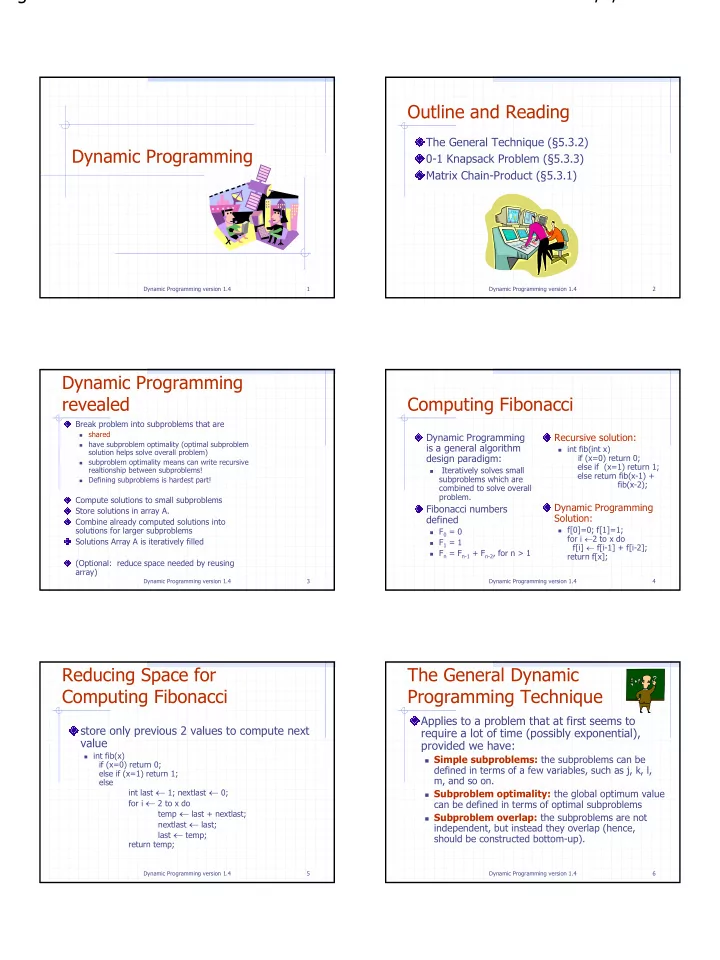
Dynamic Programming

Dynamic Programming version 1.4 2

Outline and Reading

The General Technique (§5.3.2) 0-1 Knapsack Problem (§5.3.3) Matrix Chain-Product (§5.3.1)

Dynamic Programming version 1.4 3

Dynamic Programming revealed

Break problem into subproblems that are

  • shared
  • have subproblem optimality (optimal subproblem

solution helps solve overall problem)

  • subproblem optimality means can write recursive

realtionship between subproblems!

  • Defining subproblems is hardest part!

Compute solutions to small subproblems Store solutions in array A. Combine already computed solutions into solutions for larger subproblems Solutions Array A is iteratively filled (Optional: reduce space needed by reusing array)

Dynamic Programming version 1.4 4

Computing Fibonacci

Dynamic Programming is a general algorithm design paradigm:

  • Iteratively solves small

subproblems which are combined to solve overall problem.

Fibonacci numbers defined

F0 = 0 F1 = 1 Fn = Fn-1 + Fn-2, for n > 1

Recursive solution:

int fib(int x)

if (x=0) return 0; else if (x=1) return 1; else return fib(x-1) + fib(x-2);

Dynamic Programming Solution:

f[0]=0; f[1]=1;

for i ←2 to x do f[i] ← f[i-1] + f[i-2]; return f[x];

Dynamic Programming version 1.4 5

Reducing Space for Computing Fibonacci

store only previous 2 values to compute next value

int fib(x)

if (x=0) return 0; else if (x=1) return 1; else int last ← 1; nextlast ← 0; for i ← 2 to x do temp ← last + nextlast; nextlast ← last; last ← temp; return temp;

Dynamic Programming version 1.4 6

The General Dynamic Programming Technique

Applies to a problem that at first seems to require a lot of time (possibly exponential), provided we have:

Simple subproblems: the subproblems can be

defined in terms of a few variables, such as j, k, l, m, and so on.

Subproblem optimality: the global optimum value

can be defined in terms of optimal subproblems

Subproblem overlap: the subproblems are not

independent, but instead they overlap (hence, should be constructed bottom-up).

slide-2
SLIDE 2

Merge Sort 5/6/2003 1:27 PM 2

Dynamic Programming version 1.4 7

The 0/1 Knapsack Problem

Given: A set S of n items, with each item i having

bi - a positive benefit wi - a positive weight

Goal: Choose items with maximum total benefit but with weight at most W. If we are not allowed to take fractional amounts, then this is the 0/1 knapsack problem.

In this case, we let T denote the set of items we take Objective: maximize Constraint:

∈T i i

b

T i i

W w

Dynamic Programming version 1.4 8

Given: A set S of n items, with each item i having

bi - a positive benefit wi - a positive weight

Goal: Choose items with maximum total benefit but with weight at most W.

Example

Weight: Benefit:

1 2 3 4 5

4 in 2 in 2 in 6 in 2 in $20 $3 $6 $25 $80

Items:

9 in

Solution:

  • 5 (2 in)
  • 3 (2 in)
  • 1 (4 in)

“knapsack”

Dynamic Programming version 1.4 9

A 0/1 Knapsack Algorithm, First Attempt

Sk: Set of items numbered 1 to k. Define B[k] = best selection from Sk. Problem: does not have subproblem optimality:

Consider S={(3,2),(5,4),(8,5),(4,3),(10,9)} benefit-weight pairs

Best for S4: Best for S5:

Dynamic Programming version 1.4 10

A 0/1 Knapsack Algorithm, Second Attempt

Sk: Set of items numbered 1 to k. Define B[k,w] = best selection from Sk with weight exactly equal to w Good news: this does have subproblem

  • ptimality:

I.e., best subset of Sk with weight limit exactly w is either the best subset of Sk-1 w/ weight w or the best subset of Sk-1 w/ weight w-wk plus benefit of item k.

   + − − − > − = else } ] , 1 [ ], , 1 [ max{ if ] , 1 [ ] , [

k k k

b w w k B w k B w w w k B w k B

Dynamic Programming version 1.4 11

Towards the 0/1 Knapsack Algorithm

Sk: Set of items numbered 1 to k = {(b1,w1), (b2,w2), …, (bk,wk)} Define B[k,j] = maximum benefit of optimal subset from Sk with total weight at most j Recursive definition of B[k,j]:

     + − − − > = − =

  • therwise

} ] , 1 [ ], , 1 [ max{ if if ] , 1 [ ] , [

k k k

b w j k B j k B j w k j k B j k B

Dynamic Programming version 1.4 12

Towards the 0/1 Knapsack Algorithm

B[k,j] = maximum benefit

  • f optimal subset from Sk

with total weight at most j Recursive version of algorithm based on recursive subproblem relationship. Not a dynamic programming version.

Algorithm rec01Knap(S, W): Input: set S of k items w/ benefit b1, b2, … bk,; weights w1, w2, … wkj and max. weight W Output: benefit of best subset with weight at most W if k=0 then {S = emptyset} return 0 remove item k (benefit-weight (bk,wk)) from S if wk > W then {item k does not fit} return rec01Knap(S,W) return max(rec01Knap(S,W), rec01Knap(S,W-wk) + bk)      + − − − > = − =

  • therwise

} ] , 1 [ ], , 1 [ max{ if if ] , 1 [ ] , [

k k k

b w j k B j k B j w k j k B j k B

slide-3
SLIDE 3

Merge Sort 5/6/2003 1:27 PM 3

Dynamic Programming version 1.4 13

Towards the 0/1 Knapsack Algorithm

Modified recursive version that stores subproblem solutions

  • First allocate global array

B of size n+1 by W

  • Then initialize all entries
  • f B[i,j] to –1
  • B stores results of

recursive calls

  • Entries in B are

computed when necessary

This is considered a dynamic programming version.

Algorithm rec01Knap(S, W): Input: set S of k items w/ benefit b1, b2, …,bk,; weights w1, w2, … wkj and max. weight W Output: benefit of best subset with weight at most W if k=0 then return 0 remove item k (benefit-weight (bk,wk)) from S if B[k-1, W]= –1 then B[k-1,W]=rec01Knap(S,W) if wk > W then return B[k-1, W] if B[k-1, W- wk]= –1 then B[k-1,W - wk]=rec01Knap(S,W -wk) return max(B[k-1, W], B[k-1,W - wk]+bk)      + − − − > = − =

  • therwise

} ] , 1 [ ], , 1 [ max{ if if ] , 1 [ ] , [

k k k

b w j k B j k B j w k j k B j k B

Dynamic Programming version 1.4 14

The 0/1 Knapsack Algorithm- Iterative

Algorithm 01Knapsack(S, W): Input: set S of n items w/ benefit bi and weight wi; max. weight W Output: benefit of best subset with weight at most W for w ← 0 to W do {base case} B[0,w] ← 0 for k ← 1 to n do for j ← 1 to W do if wk > j then B[k,j] ← B[k-1,j] else B[k,j] ← max(B[k-1,j], B[k-1,j-wk]+bk)      + − − − > = − =

  • therwise

} ] , 1 [ ], , 1 [ max{ if if ] , 1 [ ] , [

k k k

b w j k B j k B j w k j k B j k B

Recursive computation not necessary Compute iteratively, bottom-up All B[k-1,*] must be computed before B[k,*] because of subproblem dependencies This is also dynamic programming.

Dynamic Programming version 1.4 15

The 0/1 Knapsack Algorithm- Iterative

Algorithm 01Knapsack(S, W): Input: set S of n items w/ benefit bi and weight wi; max. weight W Output: benefit of best subset with weight at most W for w ← 0 to W do {base case} B[0, w] ← 0 for k ← 1 to n do for j ← W downto 1 do if wk > j then B[k, j] ← B[k-1, j] else B[k, j] ← max(B[k-1, j], B[k-1, j-wk]+bk)      + − − − > = − =

  • therwise

} ] , 1 [ ], , 1 [ max{ if if ] , 1 [ ] , [

k k k

b w j k B j k B j w k j k B j k B

Not necessary to use all the space Keep track of one row at a time Overwrite results from previous row as new values computed Must compute right to left (W downto 1) so that the next row (B[k,*]) uses results from the previous row (B[k-1,*]). Simplify this to get version in book.

Dynamic Programming version 1.4 16

The 0/1 Knapsack Algorithm- Iterative

Algorithm 01Knapsack(S, W): Input: set S of n items w/ benefit bi and weight wi; max. weight W Output: benefit of best subset with weight at most W for w ← 0 to W do {base case} B[w] ← 0 for k ← 1 to n do for j ← W downto 1 do if wk > j then B[ j] ← B[ j] else B[ j] ← max(B[ j], B[ j-wk]+bk)      + − − − > = − =

  • therwise

} ] , 1 [ ], , 1 [ max{ if if ] , 1 [ ] , [

k k k

b w j k B j k B j w k j k B j k B

Not necessary to use all the space Keep track of one row at a time Overwrite results from previous row as new values computed Must compute right to left (W downto 1) so that the next row (B[k,*]) uses results from the previous row (B[k-1,*]). Simplify this to get version in book.

Dynamic Programming version 1.4 17

The 0/1 Knapsack Algorithm

The book version:

When value does not change

from one row to the next, then no need to assign same value.

Running time: O(nW). Not a polynomial-time algorithm if W is large This is a pseudo-polynomial time algorithm

Algorithm 01Knapsack(S, W): Input: set S of n items w/ benefit bi and weight wi; max. weight W Output: benefit of best subset with weight at most W

for w ← 0 to W do B[w] ← 0 for k ← 1 to n do for w ← W downto wk do if B[w-wk]+bk > B[w] then B[w] ← B[w-wk]+bk

   + − − − > − = else } ] , 1 [ ], , 1 [ max{ if ] , 1 [ ] , [

k k k

b w w k B w k B w w w k B w k B

Dynamic Programming version 1.4 18

line-breaking problem

Given sequence of words from one paragraph Return where line-breaks should occur Minimize empty space on each line (except for last line of paragraph)

slide-4
SLIDE 4

Merge Sort 5/6/2003 1:27 PM 4

Dynamic Programming version 1.4 19

A simple version:

letters and spaces have equal width input is set of n word lengths, w1, w2, … wn also given line width limit L. each length wi includes one space Placing words i up to j on one line means Penalty for extra spaces

is X3

Minimize sum of penalties from each line (no last

line penalty)

line-breaking problem

L w

j i k i ≤

=

=

− =

j i k i

w L X

Dynamic Programming version 1.4 20

Example problem

Paragraph is: Those who cannot remember the past are condemned to repeat it. Word lengths are 6,4,7,9,4,5,4,10,3,7,4. Suppose line width L = 17. Find an optimal way of separating words into lines that minimizes penalty.

Dynamic Programming version 1.4 21

linebreak DP

for i ← n-1 downto 0 do if (w[i] + w[i+1] + … + w[n-1] < L) lineB[i] ← 0; else mincost ← Infinity; k ← 1; while (k words starting from w[i] fit on a line) // meaning (w[i] + w[i+1] + … + w[i+k-1] <= L) linecost ← penalty from placing words w[i] to w[i+k-1]

  • n one line.

totalcost ← linecost + lineB[i+k]; mincost ← min(totalcost, mincost) // track min. so far k++; lineB[i]=mincost;

Dynamic Programming version 1.4 22

linebreak DP cost

O(nL); L is maximum width Linear if L is considered constant Space O(n).

Dynamic Programming version 1.4 23

Matrix Chain-Products

Review: Matrix Multiplication.

C = A*B A is d × e and B is e × f

O(def ) time (def multiplications)

A C B d d f e f e i j i,j

− =

=

1

] , [ * ] , [ ] , [

e k

j k B k i A j i C

Dynamic Programming version 1.4 24

Matrix Chain-Products

Matrix Chain-Product:

Compute A=A0*A1*…*An-1 Ai is di × di+1 Problem: How to parenthesize? [for

minimizing ops]

Example

B is 3 × 100 C is 100 × 5 D is 5 × 5 (B*C)*D takes 1500 + 75 = 1575 ops B*(C*D) takes 1500 + 2500 = 4000 ops

slide-5
SLIDE 5

Merge Sort 5/6/2003 1:27 PM 5

Dynamic Programming version 1.4 25

An Enumeration Approach

Matrix Chain-Product Alg.:

Try all possible ways to parenthesize

A=A0*A1*…*An-1

Calculate number of ops for each one Pick the one that is best

Running time:

The number of paranethesizations is equal

to the number of binary trees with n nodes

This is exponential! It is called the Catalan number, and it is

almost 4n.

This is a terrible algorithm! Dynamic Programming version 1.4 26

A Greedy Approach

Idea #1: repeatedly select the product that uses (up) the most operations. Counter-example:

A is 10 × 5 B is 5 × 10 C is 10 × 5 D is 5 × 10 Greedy idea #1 gives (A*B)*(C*D), which takes

500+1000+500 = 2000 ops

A*((B*C)*D) takes 500+250+250 = 1000 ops Dynamic Programming version 1.4 27

Another Greedy Approach

Idea #2: repeatedly select the product that uses the fewest operations. Counter-example:

A is 101 × 11 B is 11 × 9 C is 9 × 100 D is 100 × 99 Greedy idea #2 gives A*((B*C)*D)), which takes

109989+9900+108900=228789 ops

(A*B)*(C*D) takes 9999+89991+89100=189090 ops

The greedy approach is not giving us the

  • ptimal value.

Dynamic Programming version 1.4 28

A “Recursive” Approach

Define subproblems:

Find the best parenthesization of Ai*Ai+1*…*Aj. Let Ni,j denote the number of operations done by this

subproblem.

The optimal solution for the whole problem is N0,n-1.

Subproblem optimality: The optimal solution can be defined in terms of optimal subproblems

There has to be a final multiplication (root of the expression

tree) for the optimal solution.

Say, the final multiply is at index i: (A0*…*Ai)*(Ai+1*…*An-1). Then the optimal solution N0,n-1 is the sum of two optimal

subproblems, N0,i and Ni+1,n-1 plus the time for the last multiply.

If subproblems were not optimal, neither is global solution.

Dynamic Programming version 1.4 29

A Characterizing Equation

Define global optimal in terms of optimal subproblems, by checking all possible locations for final multiply.

Recall that Ai is a di × di+1 dimensional matrix. So, a characterizing equation for Ni,j is the following:

Note that subproblems are not independent--the subproblems overlap (are shared)

} { min

1 1 , 1 , , + + + < ≤

+ + =

j k i j k k i j k i j i

d d d N N N

Dynamic Programming version 1.4 30

A Dynamic Programming Algorithm

Construct optimal subproblems “bottom-up.” Ni,i’s are easy, so start with them Then do length 2,3,… subproblems, and so on. Array Ni,j stores solutions Running time: O(n3) Algorithm matrixChain(S): Input: sequence S of n matrices to be multiplied Output: number of operations in an optimal paranthesization of S for i ← 1 to n-1 do Ni,i ← 0 for b ← 1 to n-1 do for i ← 0 to n-b-1 do j ← i+b Ni,j ← +infinity for k ← i to j-1 do Ni,j ← min{Ni,j , Ni,k +Nk+1,j +di dk+1 dj+1}

slide-6
SLIDE 6

Merge Sort 5/6/2003 1:27 PM 6

Dynamic Programming version 1.4 31

answer N

1 1 2 … n-1 … n-1 j i

A Dynamic Programming Algorithm Visualization

The bottom-up construction fills in the N array by diagonals Ni,j gets values from pervious entries in i-th row and j-th column Filling in each entry in the N table takes O(n) time. Total run time: O(n3) Getting actual parenthesization can be done by remembering “k” for each N entry

} { min

1 1 , 1 , , + + + < ≤

+ + =

j k i j k k i j k i j i

d d d N N N