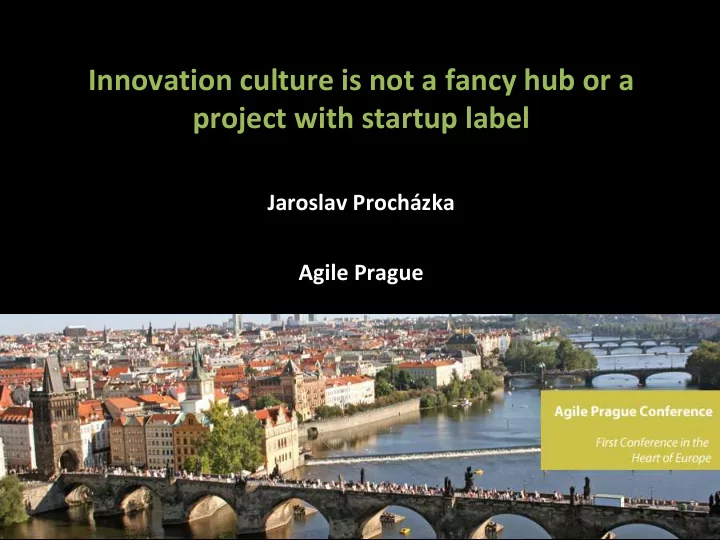
SLIDE 1
Innovation culture is not a fancy hub or a project with startup label
Jaroslav Procházka Agile Prague
SLIDE 2 About me
- Agile coach and mentor
- Innovation mentor
- (e-)book author
- Co-founder of QuickJOBS and
SimplyIT.cloud
- Co-founder of Viva incubator
- Mentor in JIC, GreenLight, iKid
Blog: www.differ.cz Twitter: @JarekProchazka
https://twitter.com/JarekProchazka
SLIDE 3
Agile is not a SW development approach … … it is a company organizational and cultural change
… and innovation culture and management is its part
SLIDE 4
Therefore need to be … supported by business driven by business done together with business … … and with people (employees, customers)
SLIDE 5 Software development and Agile approaches (50+ years) Engineering disciplines (5000+ years)
SLIDE 6
Still evolving …
SLIDE 7
Phase 1: internal cleaning (behind the wall)…
(Guerrilla) Agile implementation only in IT teams Iterations, engineering practices (pair working, code review, automation, UC/US, TC, CI) Be more efficient, quick, have better quality, predictability and internal visibility
SLIDE 8 Phase 2: Dismantling the wall…
US with clear business value/benefit Early and frequent customer involvement
Contract updates Regular Demo
Measuring the success and visibility for the business/customer
SLIDE 9
Phase 3: IT part of the business…
Tight cooperation between IT and business (cross teams, Agile business teams) Agile contracts
Measuring the success
(company boards) Discovery process / dual track Agile (here the business innovations appear!)
SLIDE 10
SLIDE 11
Phase 4 Driving the business… (Strategic/Business Agile):
Managers as organizational coaches Hiring based on values (HR) Management as one team Agile procurement à vendor ecosystem (Agile RFP) Incremental innovations part of daily business Future horizon: Internal startups, LABS, new markets, products/services
SLIDE 12
- Unknown Business Model
- Different mindset needed
(startup, R&D)
Ideally 70-20-10% spread
- Existing core products/services
(key business)
- Focus on defend and optimise
- Incremental changes
- Verified new products
- Emerging, core product complement
- Incremental / verified disruption
McK: 3 Horizons
SLIDE 13
Simon Wardley: 3 party system
SLIDE 14 Takes time to create the organizational innovation skills
(start now, experiment)
Also fail is a success, learning
(we DON’T do what nobody would buy)
Internal start-ups change mindset of
Bias, bureaucracy, no time and uniformity as biggest innovation blockers
SLIDE 15 What type of company is yours?
Source: https://marketoonist.com/2007/02/new-product-adoption.html
SLIDE 16 Initial experiments to take
- Deliver incremental innovations
- Conduct regular demos
- Run FedEx day
- Measure and visualize E2E
(NPS, product usage!)
- Invite startups (talks, presentations)
- Conduct internal innovation conference
- Share user feedback and NPS results
- SM: shift from team coach to organization
& mgmt. coach
- PO: experiment, verify, prototype
- Visualize what you know now
(data, facts, not assumptions)
SLIDE 17
Anti-pattern - possible steps
SLIDE 18
SLIDE 19 “Show me your business case” even before small experiment Do it as part of your daily (overwhelming) operations! Steps:
- Grant people limited time for
experiments
(e.g. 10%, FedEx days, hackathons)
- (Partly) Fully dedicated teams
- Innovation process to gather ideas
- Organize hackaton, FedEx day or
Design Sprint
Explicit „NO“ and lacking focus
SLIDE 20 I know what they want! I think/assume/like ... We have this market research… Steps:
- Clarify and visualize product/
service vision (LC/BMC/Product
vision board)
- Start to say NO as PO
- Conduct small internal
experiments
(NPS, product usage, heat maps, word clouds from feedback)
HIPPO / confirmation bias
SLIDE 21 They do not innovate, they just do their daily operations... Wrong assumptions behind:
- All people are the same
- All teams have the same goal and
context (product, dev, maintenance, support, …) Steps:
- Explain 3 horizons of business and
different types of innovations
- Explain and respect people typology
(only few like changes)
- Demonstrate your (personal, team)
specific value and skills
- Don’t forget to focus on H1!
This is your core business
Everybody innovative!
SLIDE 22 They will create the innovation for us (as this is granted and less risky) We will hire external people to do innovations Steps:
- Build internal competence
- Involve internal employees in
innovation agency projects (to change their mind & teach them the techniques, tools)
- Mix internal & new hires
- Question status quo
(processes, handovers, roles, …)
External innovation agencies
SLIDE 23 This technology is great! Let’s release it, we will think about money later Consider Twitter, Tesla, Google Glass Steps:
- Think about all 3 parts: customer
needs – solution – BM
- Verify also/mostly BM
- Monetize since the first MVP
Innovation without (working/
verified) Business Model
SLIDE 24 “We-them” culture
These old style folks! Those innovation junkies have always some benefits (better rooms, free snacks, …) Steps:
- Realize that your company is also
your customer!
(blogs, video, internal magazine)
(personas, needs, feedback, figures)
SLIDE 25 Blog: www.differ.cz Twitter: @JarekProchazka
https://twitter.com/JarekProchazka
LinkedIn:
https://www.linkedin.com/in/jaroslav- procházka-6a65b14/
e-book on internal startups (50 pages, 8 MB): goo.gl/4hZzxZ