SLIDE 1 The Center for Tropical Conservation & Ecology
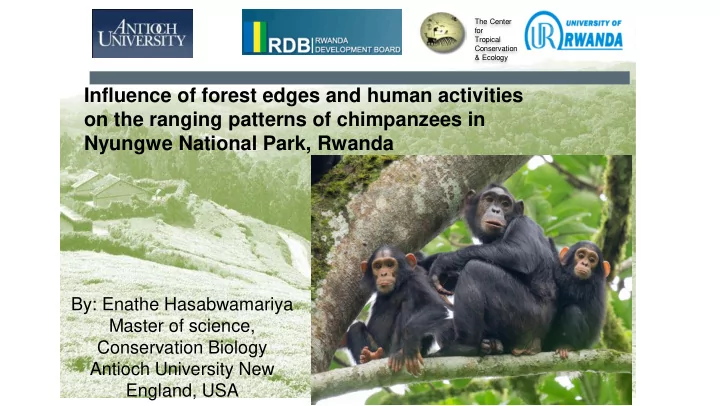
Influence of forest edges and human activities
- n the ranging patterns of chimpanzees in
Nyungwe National Park, Rwanda
By: Enathe Hasabwamariya Master of science, Conservation Biology Antioch University New England, USA
SLIDE 2
Nyungwe National Park
………………………….
Surface area: 1,015 sqkm
SLIDE 3 Rich Biodiversity
- 13 species of Primates
- 280 species of birds
- 100 species Reptile
- Small mammals
- Source of Nile River (70%of Rwanda’s water comes from Nyungwe)
SLIDE 4 Why Chimpanzees?
- Closest-relatives
- Endangered
species( IUCN)
importance through ecotourism.
importance through seed dispersal capacity and forest regeneration
SLIDE 5
The conservation challenge
SLIDE 6
Why forest edges?
Attractions: Diversity of food species, nutritious food, food from from agriculture (agroforestry, beekeeping, etc..). Threats: Disease transmission, illegal activities, human and wildlife conflicts.
SLIDE 7
Abiotic factors: Temperature, Wind penetration, soil moisture, fire frequency and intensity. Biotic factors: species composition, invasive species, etc..
Edge effect?
Changes or disturbances at the boundary between two habitats.
SLIDE 8
Type of edges around Nyungwe 1.Soft edges
Eucalyptus Plantations Pine Plantations
SLIDE 10
Previous Research: Mapping edge effect around Nyungwe
SLIDE 11 Research Objectives
- Assess chimpanzee use of forest edges.
- Document ecological factors influencing
chimpanzee ranging patterns.
- Document the influence of human activities on
the ranging patterns of chimpanzees.
SLIDE 12 Study site
Map by JGI
SLIDE 13
Methods – Inside the forest Edge to Interior
Systematically walked 5 1-km transects perpendicular to the forest edge (edge to interior) for 3 consecutive months. Signs of chimpanzee recorded and located with GPS along transects 0-1km (i.e. observations of
chimpanzee, chimpanzee vocalizations, feeding signs, feces, nests).
SLIDE 14
SLIDE 15
Methods – Outside of the forest along human activities
Systematically walked 5-1 km transects parallel to the forest edge for 3 consecutive months. Recorded all signs of chimpanzees and type of matrix and human activity.
SLIDE 16 0 m 1000m 50 m 950m
circular sample plots
30 m
Vegetation Sampling
- Edges were defined at 0-50 meters inside the
forest just along the edge.
- Ten circular plots of 5meters radius were
randomly located at forest edges and interior between 0-50 m, where I recorded tree species, diameter at breast height (DBH) and basal area at forest edges in the plots to compare vegetation.
SLIDE 17
Results
SLIDE 18 Chimpanzee distribution in relation to distance from edge
50 100 150 200 250 300 350 400 Edge Interior
Frequency of Distribution
Location Distance (m) Frequency Mean Distance Edge 0-500 371 199.03 Interior 500-1000 59 692.8
(binom. test (100, 0.6, p=0.01))
SLIDE 19
SLIDE 20
Beehives destroyed by chimpanzees
SLIDE 21 Conclusion
- Chimpanzees were mostly found using forest edges compared to
forest interior
- I found a significant positive relationship between fruits
availability and chimpanzee's distribution at the forest edges
- Beekeeping was the main attraction of chimpanzees outside the
park
SLIDE 22
More research are needed to better understand the socio-ecological behaviors of chimpanzees and their interactions with humans. Collaboration between researchers, local communities, and policy makers is needed to reduce human- chimpanzee conflicts. Modern beekeeping practices are needed to support communities in Gisovu and reduce human-chimpanzee conflicts
Recommendations
SLIDE 23
THANK YOU!!