
SLIDE 1
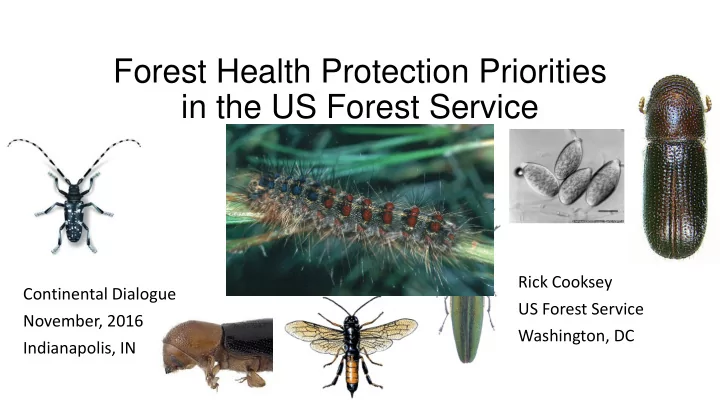
Forest Health Protection Priorities in the US Forest Service Rick - - PowerPoint PPT Presentation
Forest Health Protection Priorities in the US Forest Service Rick Cooksey Continental Dialogue US Forest Service November, 2016 Washington, DC Indianapolis, IN Forest Health Protection Outline -> Forest Service -> Fire -> FHP
Outline -> Forest Service -> Fire -> FHP Program -> Updates -> Done
$0 $5,000,000 $10,000,000 $15,000,000 $20,000,000 $25,000,000 FY 2004 FY 2005 FY 2006 FY 2007 FY 2008 FY 2009 FY 2010 FY 2011 FY 2012 FY 2013 FY 2014 FY 2015 FY 2016 Western Bark Beetles Southern Pine Beetle Hemlock Woolly Adelgid Gypsy Moth Total
Pre 1990’s: Gypsy moth Western bark beetles Southern pine beetle 1990’s: Asian longhorned beetle Hemlock woolly adelgid Sudden oak death 2000’s: Emerald ash borer Laurel wilt Thousand cankers disease Gold-spotted oak borer Sirex wood wasp Winter moth Shot-hole borers Coconut rhinoceros beetle Rapid ohia death ...
Asia, first found in Michigan in 2002
28 states, and killed tens
assisted APHIS and states in developing tools to help detect and manage infestations
challenging and damaging pest we are dealing with
provided technical assistance to states to help communities manage infestations
insect from Japan. In the US since 1950’s
and discoloration, then eventual tree mortality
ecological function of hemlocks, an important stream-side species
state partners have released hundreds of thousands of biocontrol agents to help control the adelgid
beetles and their associated fungi are causing significant impacts; one in the southeastern US and one in California.
that causes laurel wilt is found from North Carolina to Texas, and have impacted Lauraceae hosts including red bay, sassafras and avocado.
(Euwallacea spp.) and a Fusarium fungus have killed many species of trees in the Los Angeles and San Diego areas.
shothole borer in China and Vietnam to look at its biology, flight period and test lures.
Mexico on identification, biology, impacts and management of these ambrosia beetle species.
9
Red bay ambrosia beetle Polyphagous shothole borer
10
racemosa)
10.Chinese holly (Ilex cornuta) 11.Japanese maple (Acer palmatum) 12.Black bean (Castanospermum australe) 13.Palo verde (Parkinsonia aculeata) 14.Blue palo verde (Cercidium floridium) 15.Liquidambar (Liquidambar styraciflua) 16.Red Willow (Salix laevigata) 17.Weeping willow (Salix babylonica) 18.Trident maple (Acer nuergerianum) 19.Tortusa (Salix matsudana)
found from Maryland south to Texas and Florida
recently been found in New Jersey, New York and Connecticut
large areas of mature, dense pine forests
partners have preventatively thinned more than 1 million acres to improve tree health and make forests more resistant to beetle attacks
North America 1898 & 1910.
pines are increasingly being impacted by this fungus in addition to damage from mountain pine beetle and stress of long-term drought.
five-needle pines for WPBR resistance for restoration to these fragile ecosystems.
Conservation program and working with our partners, High Elevation Pine may yet be preserved.
introduced into Massachusetts in 1869
and many other hardwoods eventually causing tree mortality
states work to suppress infestations in infested areas, eradicate infestations in the uninfested area, and slow- the-spread along the 1,000 mile advancing front.
species of bark beetles in the west that impact forests
beetle, spruce beetle and Douglas-fir beetle have had the most significant impact in the past few decades
native beetles killed nearly 50 million acres since 2000
to protect human safety in areas with hazardous trees, and reduce fire risk in high value areas.