Advances in Understanding Ambrosia Beetle Chemical Ecology and - - PowerPoint PPT Presentation

advances in understanding ambrosia beetle chemical
SMART_READER_LITE
LIVE PREVIEW

Advances in Understanding Ambrosia Beetle Chemical Ecology and - - PowerPoint PPT Presentation

Advances in Understanding Ambrosia Beetle Chemical Ecology and Utilizing the Findings to Improve Insecticide Management Jason Oliver 1 , Chris Ranger 2 , Mike Reding 2 , and Pete Schultz 3 1 Tennessee State University, School of Agriculture and


slide-1
SLIDE 1

Jason Oliver1, Chris Ranger2, Mike Reding2, and Pete Schultz3

1 Tennessee State University, School of Agriculture and Consumer Sciences,

Otis L. Floyd Nursery Research Center, McMinnville, TN

2 USDA-ARS, Horticultural Insects Research Laboratory, Wooster, OH 3 Virginia Tech, Hampton Roads Center, Virginia Beach, VA

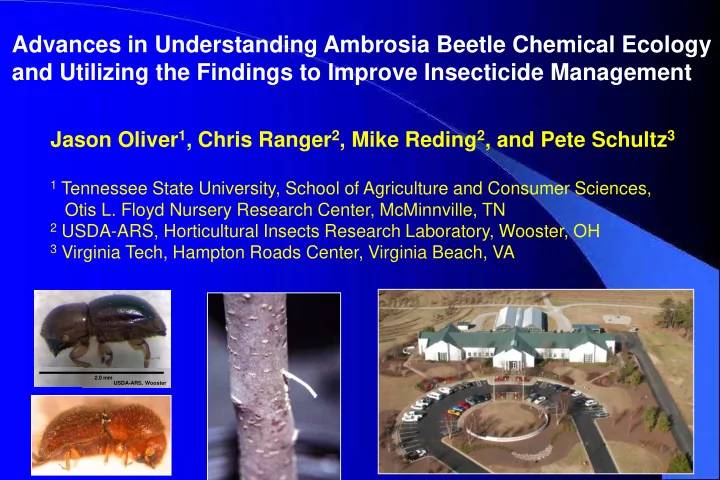
Advances in Understanding Ambrosia Beetle Chemical Ecology and Utilizing the Findings to Improve Insecticide Management

2.0 mm USDA-ARS, Wooster
slide-2
SLIDE 2

Outline

1) General Biology and Information 2) Research 3) Management Issues / Options Trapping Inducing Tree Attacks Insecticide Studies Plant Stress Studies

slide-3
SLIDE 3

Subfamily Scolytinae

Ambrosia, Bark Beetles, and Engravers ~ 5,812 species worldwide

slide-4
SLIDE 4
  • Many are attracted to volatiles probably related to

plant stress (e.g., ethanol)

Ethanol Lure Pack

Theysohn (“slot”) Lindgren Funnel Vane Panel

  • Dark silhouettes

Ambrosia Beetles

slide-5
SLIDE 5
slide-6
SLIDE 6

24 Species Trapped at Tennessee Nursery Center (1998 / 1999)

slide-7
SLIDE 7

Granulated (Asian) Ambrosia Beetle (Xylosandrus crassiusculus [Motschulsky])

Actual Size

Lesser Shothole Borer, Fruit-Tree Pinhole Borer (Xyleborinus saxeseni Ratzeburg) Black Stem Borer, Smaller Alnus Beetle, Tea Root Borer (Xylosandrus germanus Blandford)

Species Attacking Nursery Stock in Tennessee

Thysanoes fimbricornis LeConte

2.0 mm USDA-ARS, Wooster
slide-8
SLIDE 8
  • Numerous reports of damage across eastern U.S.
  • Introduced to South Carolina in 1974
  • Now widely distributed

Granulated Ambrosia Beetle (“Asian AB”)

5 – 10 GAB will kill most trees under 3 inch caliper (Mizell and Riddle 2004)

slide-9
SLIDE 9
  • Seems to be more problematic in northern states
  • Introduced at Long Island New York about 1932
  • Now widely distributed

Black Stem Borer

  • Multiple reports of being problematic in walnut production
2.0 mm USDA-ARS, Wooster
slide-10
SLIDE 10

Cherry Chestnut Elm Maple Oak Persimmon Sweetgum Buckeye Crape myrtle Dogwood Fig Golden raintree Magnolia Peach Pear Pecan Persimmon Plum Redbud Styrax Sweetgum

Major Hosts

Cherry Chestnut Elm Maple Oak Persimmon Sweetgum Alder Apple Beech Cypress Grape Hickory Hornbeam Mulberry Pine Rhododendron Spruce Tulip poplar Tupelo Walnut

Major Hosts Over 100 known hosts Over 34 plant genera hosts

Walnut???

2.0 mm USDA-ARS, Wooster
slide-11
SLIDE 11

Lesser Shothole Borer, Fruit-Tree Pinhole Borer (Xyleborinus saxeseni Ratzeburg) Black Stem Borer, Smaller Alnus Beetle, Tea Root Borer (Xylosandrus germanus Blandford) Ambrosia Beetles Reported as Problematic on Walnut Pear Blight Beetle, European Shot-Hole Borer (Xyleborus dispar [Fab.]) Cosmopolitan Ambrosia Beetle, Black Twig Borer (Xyleborus ferrugineus [Fab.]) Oak Timber Beetle (Xyleborus xylographus [Say])

J.R. Baker & S.B. Bambara, NCSU, Bugwood.org Pest & Disease Image Library, Australia, Bugwood.org Pest & Disease Image Library, Australia, Bugwood.org

(Solomon 1995)

slide-12
SLIDE 12

Importance: Most have broad host ranges, primarily preferring hardwoods Range: Most introduced from Asia or Europe and occur over most of U.S. Habits: Adults usually over-winter in galleries Females mate before leaving galleries. Males do not fly. Bore into sapwood, usually not the heartwood. Galleries consist of branches or enlarged brood chambers Larvae and adults feed on symbiotic ambrosia fungus Adults “culture” fungi along gallery walls Some continue to extend galleries over time Some begin galleries and are then joined by others of their species Some have one generation per year and others have multiple Peak Activity: Emerge as early as February (X. saxeseni), but usually peak emergence is March through May Host Preference: Unthrifty, injured, and dying trees. Moisture content

  • important. Attracted to stressed trees.

Generalities Among Walnut Attacking Ambrosia Beetles

slide-13
SLIDE 13

Damage: Prefer to attack before “bud-break” Wilting, flagging, branch dieback, basal sprouts, tree death Lumber staining and reduced quality from galleries Possible vectors of other pathogenic fungi Generalities Among Walnut Attacking Ambrosia Beetles Control: Natural enemies (predaceous beetles / true bugs) Cultural practices promoting healthy trees Prompt harvest and use of timber Seed sources listed as important for X. germanus (Weber) Plantings near water sources may be more susceptible Traps to time judicious insecticide treatments

slide-14
SLIDE 14

Shot holes

  • Adult boring produces “shot holes”
  • Boring activities can result in “sawdust” or “toothpick” like particles
slide-15
SLIDE 15
  • Tunnels (galleries) generally made deep into sapwood

1 inch

Granulated Ambrosia Beetle Gallery

slide-16
SLIDE 16
  • Adults carry species-specific symbiotic “ambrosia” fungus in mycangia

Doug Stone, Miss. St. Univ.,

Bugwood.org

Jack C. Nord, USDA For.Serv.

www.forestryimages.org

  • Larvae and adults eat ambrosia fungus

Doug Stone, Miss. St. Univ., Bugwood.org

slide-17
SLIDE 17
  • Female progeny emerge from host trees and fly to new host trees
  • Males do not fly, but will exit trees
  • Ambrosia beetles are more serious nursery and landscape pests

than other scolytids

slide-18
SLIDE 18
  • Attack living, recently killed trees, or dead trees (high moisture content)

Dead tree in river under attack

slide-19
SLIDE 19

Research

Trap Studies

slide-20
SLIDE 20

1) Used to direct scouting activities (esp. when sprays not made) 2) Used to direct timing of spray treatments

Value of Traps

Ambrosia beetles: Over-winter as adults No temperature dependent larval development period in spring Remain inactive until conditions favorable Emerge suddenly in large numbers Generally attack before bud break However, emergence can vary widely between years and locations

slide-21
SLIDE 21

Beetles Captured Per Day

10 20 30 40 50 60 70 80

60 80 100 120 140 160 180 200

Site-1 Site-2 2007 1 2 3 4 60 80 100 120 140 160 180 200 Site-1 Site-2 2006 Apr May Jun Jul Mar 0.2 0.4 0.6 0.8 1 1.2 1.4 60 70 80 90 100 110 120 130 140 150 160 170 180 Site-1 Site-2 2 4 6 8 10 12 60 70 80 90 100 110 120 130 140 150 160 170 180 Site-1 Site-2 2007 2006 Apr May Jun Mar

2006 2006 2007 2007

Site 1 Site 2

  • Peaks at different times in different years
  • Within years, similar between sites and X. crass and X. germ

Xylosandrus crassiusculus Xylosandrus germanus

slide-22
SLIDE 22

3) Extension assistance

Widely-spaced Contiguous Procoxae Xylosandrus Other

Identifying the Granulated (Asian) Ambrosia Beetle

1) Color – Reddish-brown to orange-brown (may appear two toned) 2) Non-shiny patch on abdomen tip (visible with 10x hand lens)

slide-23
SLIDE 23

Lindgren Trap Chestnut Trees with Gallery Cages Trapping / Tree Attack Study (1999)

slide-24
SLIDE 24

Jan Feb Mar Apr May Jun Jul Aug Sep Oct Nov Dec Jan

Total Number

25 50 75 100 500 550 600

Tree Attacks Trap Collections

slide-25
SLIDE 25

Other Findings During Study

  • More galleries on southwest side of tree
  • X. germanus

– 195.2 + 13.1

  • X. crassiusculus – 238.6 + 22.0
  • Females vs. Males emerging
  • X. germanus

– 16 : 1

  • X. crassiusculus – 15 : 1

Males did emerge

  • Mixed species emergence from same gallery
  • Emergence occurred in spurts
  • X. germanus

– Up to 7 events from 54 to 89 days

  • X. crassiusculus – Up to 4 events from 55 to 94 days
  • Greater progeny production by X. crassiusculus
  • X. germanus

– 4.4 + 0.5 per gallery

  • X. crassiusculus – 9.9 + 4.0 per gallery
slide-26
SLIDE 26

Trap Features Evaluated: Trap type Lure type Killing agents Cost Ease of use Ambrosia Beetle Trap Comparisons (2003)

slide-27
SLIDE 27

X.crass X.germ X.sax Species

Traps With Greater Collections Than a Non-Baited Lindgren Trap

All baited with pill bottle ethanol lure

slide-28
SLIDE 28
  • Traps with highest

capture rates

  • Bottle trap was best all around trap
  • Cheapest to make
  • Easiest to operate
  • Effective on problem ambrosia beetles

Improved

  • Best lure (pill bottle with wick)

had highest ethanol release rate)

slide-29
SLIDE 29

Trap Height Study – Bottle Trap (2006 - 2008)

3 m (9.8 ft) 1.7 m (5.6 ft) 0.5 m (1.6 ft)

TN

slide-30
SLIDE 30 100 200 300 400 500

A B C

OH

Height

Average Cumulative Trap Captures (+ SE)

Xylosandrus germanus

F = 544.64, df = 2, 14, P < 0.0001

5 10 15 20 25

A B B

TN

Height (m)

Average Cumulative Trap Captures (+ SE)

F = 21.57, df = 2, 14, P = 0.0001

10 20 30 40 50 60 70

A B B

VA

Height (m)

Average Cumulative Trap Captures (+ SE)

F = 50.48, df = 2, 46, P < 0.0001

2.0 mm USDA-ARS, Wooster
slide-31
SLIDE 31 10 20 30 40

A B AB

Height

20 40 60 80

A B A

Height

VA (2006) VA (2007)

2 4 6 8 10 12 14

A B C

Height

TN (2006)

40 80 120 160

A B A

Height

TN (2007)

Average Cumulative Trap Captures (+ SE) Average Cumulative Trap Captures (+ SE)

Xylosandrus crassiusculus

F = 34.47, df = 2, 14, P < 0.0001 F = 21.36, df = 2, 14, P = 0.0001 F = 8.61, df = 2, 14, P = 0.004 F = 3.93, df = 2, 14, P = 0.044

slide-32
SLIDE 32

Ohio Virginia Tennessee Total

1000 2000 3000 4000

Ohio Virginia Tennessee

1000 2000 3000 4000

Total Captures in Three States During 2007

2.0 mm USDA-ARS, Wooster
slide-33
SLIDE 33

Research

Inducing Tree Attacks

slide-34
SLIDE 34

Injecting Trees With Ethanol

slide-35
SLIDE 35
slide-36
SLIDE 36

After Ethanol Injection

Attacks Induced on Previously Healthy Trees (Trunk Size ~ 4 Inches)

slide-37
SLIDE 37

Attacks on Adjacent Tree Shoots Attacks High in Tree

After Ethanol Injection

Injection Point

slide-38
SLIDE 38

After Ethanol Injection

Beetle Attempting to Enter Tree Checkered Beetle Attacking Ambrosia Beetle Boring Into the Tree

slide-39
SLIDE 39

Ethanol-Baited Trap Versus Trap with Ethanol-Injected Bolt

slide-40
SLIDE 40

Research

Insecticide Studies

slide-41
SLIDE 41

Insecticide / Biopesticide Sprays Injecting Trees With Ethanol Using an Arbojet Ambrosia Beetle Attacks Triggered

slide-42
SLIDE 42

Insecticide Test – April 24 to May 22, 2009

  • I. Trees Treated:
  • A. Systemic Soil Drenches Rate / 100 gallons
  • Acelepryn 32 floz
  • Safari 24 oz
  • B. Systemic Trunk Sprays
  • Safari 8 oz
  • Safari + PentraBark (wetting agent) 8 oz
  • C. Contact Pyrethroid Trunk Sprays
  • Onyx Pro Insecticide 32 floz
  • Perm-Up 3.2 EC 160 floz
  • Scimitar CS 5 floz
  • II. Trees Injected With Ethanol

(75 ml of 50% ETOH)

  • 34 days after systemic drenches
  • 1 day after trunk sprays
  • III. Trees Monitored for New

Attacks (~ 1 month)

  • IV. Attacked Trees Then Held

in Lab to Rear Beetles

slide-43
SLIDE 43

Apr24 Apr27 Apr30 May5 May11 May15 May22 3 6 9 12

Acelepryn Drench Total hits = 75

Apr24 Apr27 Apr30 May5 May11 May15 May22 3 6 9 12

Safari Drench

*

Total hits = 94 Mean New Ambrosia Beetle Attacks (+ SEM)

Systemic Soil Drenches

Apr24 Apr27 Apr30 May5 May11 May15 May22 3 6 9 12

Control (Ethanol Injected) Total hits = 70

Indicates significant difference from control (P < 0.05)

*

(chlorantraniliprole) (dinotefuran)

slide-44
SLIDE 44

Mean New Ambrosia Beetle Attacks (+ SEM)

Apr24 Apr27 Apr30 May5 May11 May15 May22 3 6 9 12

Control (Ethanol Injected) Total hits = 70

Systemic Trunk Sprays

Indicates significant difference from control (P < 0.05)

*

Apr24 Apr27 Apr30 May5 May11 May15 May22 3 6 9 12

Safari Trunk Spray + Pentra Bark Total hits = 49

(dinotefuran)

Apr24 Apr27 Apr30 May5 May11 May15 May22 3 6 9 12

Safari Trunk Spray

*

Total hits = 59

(dinotefuran)

slide-45
SLIDE 45

Mean New Ambrosia Beetle Attacks (+ SEM)

Apr24 Apr27 Apr30 May5 May11 May15 May22 3 6 9 12

Control (Ethanol Injected) Total hits = 70

Contact Pyrethroid Trunk Sprays

Indicates significant difference from control (P < 0.05)

*

Apr24 Apr27 Apr30 May5 May11 May15 May22 3 6 9 12

Perm Up Trunk Spray

* *

Total hits = 5

(permethrin)

Apr24 Apr27 Apr30 May5 May11 May15 May22 3 6 9 12

Onyx Trunk Spray

*

Total hits = 42

(bifenthrin)

Apr24 Apr27 Apr30 May5 May11 May15 May22 3 6 9 12

Scimitar Trunk Spray Total hits = 59

(lambda-cyhalothrin)

slide-46
SLIDE 46

Biopesticide / Insecticide Test – June 24 to July 16, 2009

  • I. Trees Treated:
  • A. Contact Pyrethroid Trunk Sprays (160 ml / 100 gal)
  • Perm-Up 3.2 EC
  • Perm-Up 3.2 EC + PentraBark
  • B. Biopesticides (421 ml / gallon ~ 10% )
  • Cinnacure (30% cinnamaldehyde)
  • Cinnacure + PentraBark
  • EcoTrol (10% rosemary oil; 2% peppermint oil)
  • II. Trees Injected With Ethanol

(75 ml of 10% ETOH)

  • 1 day after trunk sprays
  • III. Trees Monitored for New

Attacks (~ 1 month)

  • IV. Attacked Trees Then Held

in Lab to Rear Beetles Most antennally active on X. germanus

slide-47
SLIDE 47

Mean New Ambrosia Beetle Attacks (+ SEM)

Biopesticide Trunk Sprays

Indicates significant difference from control (P < 0.05)

*

Cinnacure

Jun24 Jun25 Jun26 Jun29 Jun30 Jul1 Jul2 Jul9 Jul16 2 4 6

Total hits = 11 EcoTrol

Jun24 Jun25 Jun26 Jun29 Jun30 Jul1 Jul2 Jul9 Jul16 2 4 6

Total hits = 29 Cinnacure + PentraBark

Jun24 Jun25 Jun26 Jun29 Jun30 Jul1 Jul2 Jul9 Jul16 2 4 6

Total hits = 14 Control (No Injection)

Jun24 Jun25 Jun26 Jun29 Jun30 Jul1 Jul2 Jul9 Jul16 2 4 6

Control (Ethanol Injected)

Jun24 Jun25 Jun26 Jun29 Jun30 Jul1 Jul2 Jul9 Jul16 2 4 6

Total hits = 34 Total hits = 13

slide-48
SLIDE 48

Pyrethroid Trunk Sprays

Control (No Injection)

Jun24 Jun25 Jun26 Jun29 Jun30 Jul1 Jul2 Jul9 Jul16 2 4 6

Control (Ethanol Injected)

Jun24 Jun25 Jun26 Jun29 Jun30 Jul1 Jul2 Jul9 Jul16 2 4 6

Total hits = 34 Total hits = 13 Permethrin

Jun24 Jun25 Jun26 Jun29 Jun30 Jul1 Jul2 Jul9 Jul16 2 4 6

Total hits = 9 Permethrin + PentraBark

Jun24 Jun25 Jun26 Jun29 Jun30 Jul1 Jul2 Jul9 Jul16 2 4 6

Total hits = 18 Mean New Ambrosia Beetle Attacks (+ SEM)

slide-49
SLIDE 49

Biopesticide ambrosia beetle test - 2009 Total Average Attacks

Permethrin

  • Cinn. + Pentra

Cinnacure Water Permethrin + Pentra Ethanol Injected Ecotrol

Mean + SEM

2 4 6 8 10

slide-50
SLIDE 50

Research

Plant Stress Studies

slide-51
SLIDE 51

Ambrosia Beetle Tree Stress Test Stress Treatments: 1) Planting to deep 2) Root drowning 3) Delayed dormancy break 4) Defoliation 5) Drought stress Data Collected: 1) Number of new galleries (3 times / week) 2) Sticky trap catches 3) Species reared from trees Drought stress treatment

slide-52
SLIDE 52

Average Attacks + Standard Error

4 8 12 16 20 Delay May Drought Delay April Defoliation Plant Depth Root Drowning Control

Average Attacks + Standard Error

4 8 12 16 20 Delay May Plant Depth Drought Delay April Root Drowning Defoliation Control

Redbud Tulip Poplar Stress Treatments – Average Total Attacks (April 24 to May 15, 2009) No significant differences between treatments (P < 0.05)

Thysanoes fimbricornis Asian or Granulated Ambrosia Beetle

Average Attacks (+ SEM) Average Attacks (+ SEM)

slide-53
SLIDE 53

Average Sticky Trap Captures (+ SEM)

20 40 60 80 Defoliation Delay April Plant Depth Delay May Root Drowning Drought Control

Average Attacks (+ SEM)

4 8 12 16 20 Delay May Drought Delay April Defoliation Plant Depth Root Drowning Control

Stress Treatments – Redbud Trees (Apr. 24 to May 15, 2009) No significant differences between treatments (P < 0.05) Tree Attacks

(Thysanoes fimbricornis)

Sticky Trap Captures

(all Scolytids)

slide-54
SLIDE 54

Management Plan

Preventing Damage

slide-55
SLIDE 55

Factors Increasing Attack Risk

1) Plants still dormant, but beetles being trapped 7) Planting near water sites (high humidity) 6) Time of year (March to May) 5) Fertilization terminated after July 4) Last pyrethroid spray over 4 weeks ago 3) Stressed crop

(New transplant, drought, disease, freeze, poor drainage, trunk injury, etc.)

2) Susceptible species

(Cherry, chestnut, dogwood, golden rain tree, lilac, maple, hydrangea, redbud, weeping mulberry, yellowwood, or others with past problems)

Ethanol release

slide-56
SLIDE 56

Use Traps for Early Detection of Activity

Look for Key Indicator Species

2.0 mm USDA-ARS, Wooster
slide-57
SLIDE 57
  • Thorough spray coverage
  • Use effective insecticides:

Permethrin: Perm-Up 3.2 EC Biopesticides ???? (Future)

Insecticide Management

Management too late if toothpick strands are present Not labeled for ambrosia beetles in walnut Label Site: http://www.cdms.net/manuf/default.asp

slide-58
SLIDE 58

Some Conclusions

  • 3 species problematic in Tennessee nurseries (Xcrass, Xgerm, Xsax)
  • Ethanol-baited traps catch large variety of ambrosia beetles
  • Different species have different activity periods
  • Within species peak captures varies by year (value of traps)
  • Trapping Xcrass, Xgerm, and Xsax coincides with tree attacks
  • Bottle trap was cheap and effective
  • Low height settings are best
  • Ethanol injections induce Xylosandrus attacks - Value:
  • Trap trees ????
  • Timing insecticide sprays
  • Facilitate insecticide studies
  • Attacks were induced in summer with ethanol
  • Most induced attacks occurred during first week and then declined:
  • Change in host suitability ?????
  • Drop in ethanol release ????
slide-59
SLIDE 59

Some Conclusions

  • Need more work to understand relationship between:
  • Types of plant damage and associated stress signals
  • Ambrosia beetle host selection factors
  • Host quality factors for the ambrosia fungus
slide-60
SLIDE 60

Acknowledgments

USDA-ARS, Wooster, OH James Moyseenko Alane Robinson Betsy Anderson Abby Hart Gerald Hammel Leona Horst Multiple Commercial Nurseries Funding USDA-ARS Floriculture and Nursery Research Initiative USDA-ARS Specialty Crop Block Grant Horticultural Research Institute and American Nursery & Landscape Association USDA-APHIS Middle Tennessee Nursery Association Virginia Tech Carmella Whitaker Tennessee State University Nadeer Youssef Joshua Basham Joshua Medley Samuel Patton