Information Extraction and Question-Answering Systems Foundations - - PDF document

information extraction and question answering systems
SMART_READER_LITE
LIVE PREVIEW

Information Extraction and Question-Answering Systems Foundations - - PDF document

Information Extraction and Question-Answering Systems Foundations and methods Dr. Gnter Neumann LT-Lab, DFKI neumann@dfki.de 22/02/2002 1 What the lecture will cover Lexical processing Machine Learning for IE Basic Terms &


slide-1
SLIDE 1

1

22/02/2002 1

Information Extraction and Question-Answering Systems

Foundations and methods

  • Dr. Günter Neumann

LT-Lab, DFKI neumann@dfki.de

22/02/2002 2
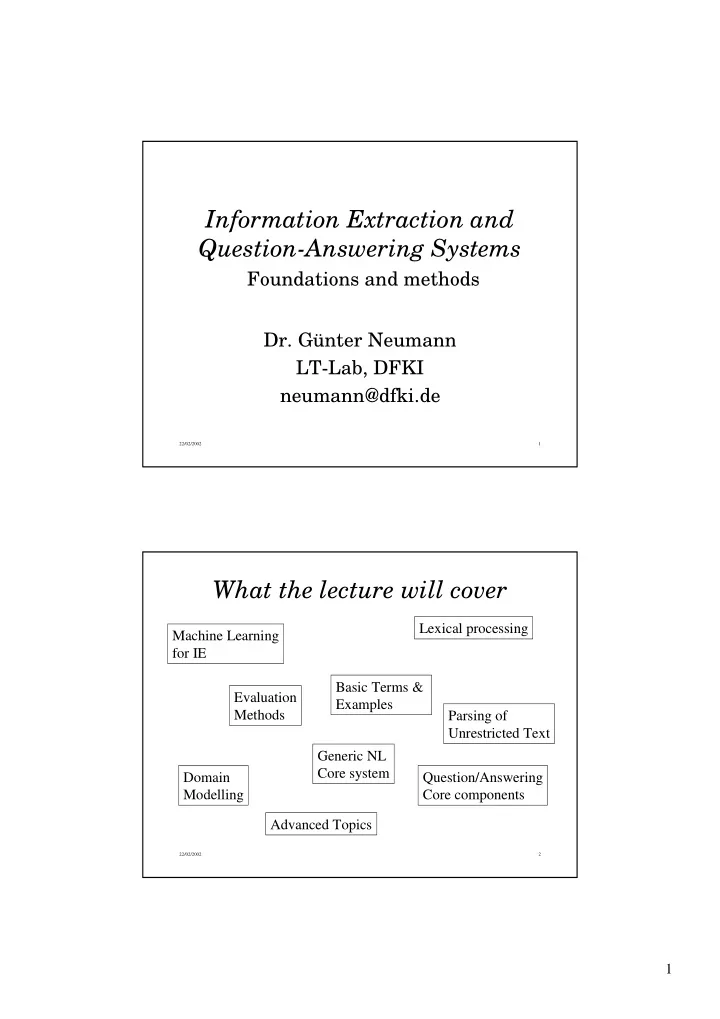
What the lecture will cover

Basic Terms & Examples Evaluation Methods Generic NL Core system Lexical processing Machine Learning for IE Parsing of Unrestricted Text Domain Modelling Question/Answering Core components Advanced Topics

slide-2
SLIDE 2

2

22/02/2002 3

Contents

  • Task & Motivation, example
  • Hand-crafted approach

TBL (Alembic workbench) DFKI´s SMES technology

  • Automated (ML) approaches

Hidden Markov Models Decision Trees Maximum Entropy Models

  • Hand-crafted vs. automated
  • Increasing performance

22/02/2002 4

The who, where, when & how much in a sentence

  • The task: identify lexical and phrasal information in

text which express references to named entities NE, e.g.,

person names company/organization names locations dates&times percentages monetary amounts

  • Determination of an NE‘s

Specific type according to some taxonomy Canonical representation (template structure)

slide-3
SLIDE 3

3

22/02/2002 5

Example from MUC-7

Delimit the named entities in a text and tag them with NE types:

<ENAMEX TYPE=„LOCATION“>Italy</ENAMEX>‘s business world was rocked by the announcement <TIMEX TYPE=„DATE“>last Thursday</TIMEX> that Mr. <ENAMEX TYPE=„PERSON“>Verdi</ENAMEX> would leave his job as vice-president

  • f <ENAMEX TYPE=„ORGANIZATION“>Music Masters of Milan, Inc</ENAMEX>

to become operations director of <ENAMEX TYPE=„ORGANIZATION“>Arthur Andersen</ENAMEX>.

  • „Milan“ is part of organization name
  • „Arthur Andersen“ is a company
  • „Italy“ is sentence-initial => capitalization useless

22/02/2002 6

Difficulties

  • too numerous to include in dictionaries
  • changing constantly
  • appear in many variant forms
  • subsequent occurrences might be

abbreviated ⇒ list search/matching doesn‘t perform well ⇒ context based pattern matching needed

slide-4
SLIDE 4

4

22/02/2002 7

Difficulties

Whether a phrase is a proper name, and what name class it has, depends on

Internal structure: „Mr. Brandon“ Context: „The new company, SafeTek, will make air bags.“

22/02/2002 8

NE and chunk parsing

  • POS tagging plus generic chunk parsing

alone does not solve the NE problem

Complex modification; target structure

[[1 Komma 2] Mio Euro] CARD NN CARD NN NN

POS tagging and chunk parsing would construct following syntactical possible but wrong structure

[1 Komma] [2 Mio] [Euro]

slide-5
SLIDE 5

5

22/02/2002 9

NE and chunk parsing

  • Postmodification

Date expression with target structure

Am [3. Januar 1967] CARD NN CARD

Wrong structure when generic chunk parsing

Am [3. Januar] [1967] CARD NN CARD

22/02/2002 10

NE and chunk parsing

  • Coordination of unit measures

target structure

[6 Euro und 50 Cents] CARD NN KON CARD NN

Generic chunk analysis

[6 Euro] und [50 Cents] CARD NN KON CARD NN

slide-6
SLIDE 6

6

22/02/2002 11

NE and chunk parsing

  • Person names

Target structure

[John F. Kennedy] NE NE NE

Generic chunk parsing

[John F.] [Kennedy] NE NE NE

22/02/2002 12

NE ambiguities and NE reference resolution

Norman Augustine ist im Grunde seines Herzens ein friedlicher Mensch."Ich könnte niemals auf irgend etwas schiessen", versichert der57jährige Chef des US-Rüstungskonzerns Martin Marietta Corp. (MM). ... Die Idee zu diesem Milliardendeal stammt eigentlich von GE-Chef JohnF. Welch jr. Er schlug Augustine bei einem Treffen am

  • 8. Oktober den Zusammenschluss beider Unternehmen vor. Aber

Augustine zeigte wenig Interesse, Martin Marietta von einem zehnfach grösseren Partner schlucken zu lassen.

  • Martin Marietta can be a person name or a

reference to a company

  • If MM is not part of an abreviation lexicon, how to

we recognize it? Also by taking into account NE reference resolution.

slide-7
SLIDE 7

7

22/02/2002 13

NER and answer extraction

  • Often, the expected answer type of a

question is an NE

What was the name of the first Russian astronaut to do a spacewalk?

Expected answer type is PERSON NAME

Who was the first astronaut to do a spacewalk?

Expected answer type either PERSON NATION or PERSON NAME

Where is the Völklinger Hütte?

Expected answer type is LOCATION

When will be the next talk?

Expected answer type is DATE

22/02/2002 14

NE is an interesting problem

  • Productivity of name creation requieres

lexicon free recognition

  • NE ambiguity require resolution methods
  • Depending on the application fine-grained

NE classification is needed which needs fined-grained decision making methods

  • Multilinguality

A text might contain NE expressions from different languages (e.g., name expression) Example output of IdentiFinder™

slide-8
SLIDE 8

8

22/02/2002 15

Two principle ways of specifying NE

  • Hand-craft rule writing

still the best performance when fined-grained classification is needed Hard to adapt to new domains

  • Machine learning

System-based adaptation two new domains Very good for coarse-grained classification Still requiere large annotated corpora

22/02/2002 16

The hand-crafted approach

  • Uses hand-written context-sensitive

reduction rules:

1) title capitalized word => title person_name compare „Mr. Jones“ vs. „Mr. Ten-Percent“ => no rule without exceptions 2) person_name, „the“ adj* „CEO of“

  • rganization

„Fred Smith, the young dynamic CEO of BlubbCo“ => ability to grasp non-local patterns 3) plus help from databases of known named entities

slide-9
SLIDE 9

9

22/02/2002 17

Example of a rule based system

  • Alembic system developed at MITRE (

http://www.mitre.org )

  • IE core system for English (MUC

participant)

  • MUC-6 Alembic version

Transformation based rule sequence method (following Brill) on all level of processing POS tagging, syntactic analysis, inference, template filling

22/02/2002 18

Architecture

Unix pre-process:

  • Zoning
  • Pre-tagging
  • POS tagging

Phraser:

  • 1. NE rules
  • 2. TE rules
  • 3. CorpNP rules
  • 4. ST rules

Inference:

  • Axioms, rules,

sequences

  • Facts, equalities

Template printing:

  • gazetter

TE processing:

  • Acronyms
  • aliases

templates

slide-10
SLIDE 10

10

22/02/2002 19

Phrase recognition

  • Phraser processes in several steps

1. Initial phrasing functions are applied to all of the sentences to be analyzed

  • Driven by Word lists, POS, pre-tagging

2. Sequence of phrase-finding rules

1. Each individual rule is applied on whole text before next rule is called 2. If antecedents of the rules are satisfied by a phrase then action indicated by the rule is executed 3. Possible actions: change label, grow boundary, create new phrases 4. Next rules are sensitive to previous rules results 5. No re-analysis of a rules action is possible (no backtracking)

22/02/2002 20

Simple form of rules

  • Rules can test lexems to the left/right
  • Look at the lexemes in the phrase
  • Tests can be POS, literal match, or

generic predicates on phrase structure

(def-phraser

Label none Left-1 phrase ttl Label action person)

slide-11
SLIDE 11

11

22/02/2002 21

Example

... Widely anticipated: <ttl>Mr.</ttl> <none>James</none>, <num>57</num> years old, is stepping ... ... Widely anticipated: <ttl>Mr.</ttl> <person>James</person>, <num>57</num> years old, is stepping ...

(def-phraser Label none Left-1 phrase ttl Label action person)

22/02/2002 22

Learning rules using Brill‘s TBL approach

  • Learning of rules for ENAMEX
  • Evaluation result (6 fewer points for P&R

compared to hand-crafted rules)

16 33 19 2 68 82 2 25 18 91 134 111 Locati 17 24 3 6 80 78 21 12 60 292 364 373 Person 7 26 15 7 80 86 34 73 28 392 493 454 Organi SUB ERR OVG UND PRE REC NON MIS SPU INC PAR COR ACT POS SLOT

slide-12
SLIDE 12

12

22/02/2002 23

NE recognition of German DFKI`s SMES technology

  • Based an two primary data structures

Weighted finite state Machines Dynamic tries for lexical & morphological processing

recursive traversal (e.g., for compound & derivation analysis) robust retrieval (e.g., shortest/longest suffix/prefix)

  • Parameterizable XML-output interface
  • Both tools are portable across different

platforms (Unix & Windows NT)

22/02/2002 24

Generic Dynamic Tries

  • parameterized tree-based data structure for efficiently storing sequences of

elements of any type, where each sequence is associated with an object of some other type (GDT)

  • efficient deletion function is provided

(self-organizing lexica)

  • variety of complex functions relevant to

linguistic processing supporting recognition

  • f longest and shortest prefix/suffix
  • f a given sequence in the trie
  • example: Trie for storing verb

phrases and their frequencies, where each component of the phrase is represented as a pair <POS,STRING>

slide-13
SLIDE 13

13

22/02/2002 25

Tokenizer

  • The goal of the TOKENIZER is to:
  • map sequences of consecutive characters into word-like units (tokens)
  • identify the type of each token disregarding the context

(LOWER_CASE_WORD, TWO_DIGIT_NUMBER, NUMBER_PERCENT_COMPOUND, etc.)

  • represented as single WFSA (easily updatable or extendable)
  • generic vs. specific token classes:
  • „13:15“ (number-colon-compound)
  • „neumann@dfki.de“ (email-adress)
  • complex token classes:
  • ABBREVIATION (CANDIDATE_FOR_ABBREVIATION),
  • COMPLEX_COMPOUND_FIRST_CAPITAL („AT&T-Chief“)
  • COMPLEX_COMPOUND_FIRST_LOWER_DASH („d‘Italia-Chefs-“)
  • verall more than 50 classes (proved to simplify processing on higher stages)
  • word-segmentation: „(first,second)“ => „(„ + „first“ + „,“ + „second“ + „)“

22/02/2002 26

Lexical Processor (1)

  • Tasks of the LEXICAL PROCESSOR:
  • retrieval of lexical information
  • recognition of compounds
  • hyphen coordination
  • sole storage: dynamic tries
  • currently more than 700 000 German full-form words, generated from Morphix
  • each reading represented as triple <STEM,INFLECTION,POS>

example: „wagen“ (to dare vs. a car)

STEM: „wagen“ INFL: (GENDER: m,CASE: nom, NUMBER: sg) (GENDER: m,CASE: akk, NUMBER: sg) (GENDER: m,CASE: dat, NUMBER: sg) (GENDER: m,CASE: nom, NUMBER: pl) (GENDER: m,CASE: akk, NUMBER: pl) (GENDER: m,CASE: dat, NUMBER: pl) (GENDER: m,CASE: gen, NUMBER: pl) POS: noun STEM: „wag“ INFL: (FORM: infin) (TENSE: pres, PERSON: anrede, NUMBER: sg) (TENSE: pres, PERSON: anrede, NUMBER: pl) (TENSE: pres, PERSON: 1, NUMBER: pl) (TENSE: pres, PERSON: 3, NUMBER: pl) (TENSE: subjunct-1, PERSON: anrede, NUMBER: sg) (TENSE: subjunct-1, PERSON: anrede, NUMBER: pl) (TENSE: subjunct-1, PERSON: 1, NUMBER: pl) (TENSE: subjunct-1, PERSON: 3, NUMBER: pl) (FORM: imp, PERSON: anrede) POS: verb

slide-14
SLIDE 14

14

22/02/2002 27

Lexical Processor (2)

  • Compound analysis
  • crucial since compounding is very productive process of German
  • realized by means of recursive trie traversal
  • often more than one decomposition: rules for validating compound morphemes

example: „Autoradiozubehör“ (car-radio equipment) (1) „Autor“ + „adio“ + „zubehör“ (2) „Auto“ + „radio“ + „zubehör“ example: „Weinsorten“ (1) „Wein“ + „sorten“ (wine types) (2) „Weins“ + „orten“ (wine places)

  • Hyphen coordination
  • in some cases conjuncts are not compounds:

(1) „Leder-, Glas-, Holz- und Kunstoffbranche“ leather, glass, wooden and synthetic materials industry (2) „An- und Verkauf“ purchase and sale

22/02/2002 28

POS-Filter (1)

  • The task of POS FILTER is to filter out unplausible readings of ambiguous word

forms

  • large amount of German word forms are ambiguous
  • more than 20% ambiguous word forms in test corpus
  • ca. 30% of the ambiguous word forms have verb reading
  • case-sensitive rules
  • „das Unternehmen“ - the enterprise vs. „wir unternehmen“ - we undertake
  • problems at the beginning of the sentence
  • contextual filtering rules
  • example: „Sie bekannten, die bekannten Bilder gestohlen zu haben“

They confessed they have stolen the famous pictures „bekannten“ - to confess vs. famous

  • FILTERING RULE:

if the previous word form is determiner and the next word form is a noun then filter out the verb reading of the current word form

slide-15
SLIDE 15

15

22/02/2002 29

POS-Filter (2)

  • filtering out rare readings
  • example: „recht“ right vs. to rake (3rd person,sg)
  • supplementary rules determined by Brill‘s tagger in order to achieve broader

coverage

  • rules may be compiled into single FST:
  • single rules expressed as nondeterministic FSTs
  • use local extension to turn the FSTs to operate globally
  • compose FSTs into single FST
  • determininze & minimize the FST

22/02/2002 30

Named Entity Finder

  • The task of the NAMED ENTITY FINDER is the identification of:
  • entities: organizations, persons, locations
  • temporal expressions: time, date
  • quantities: monetary values, percentages, numbers
  • Identification in two steps:
  • recognition patterns expressed as WFSA are used to identify phrases containing

potential candidates for named entities

  • additional constraints (depending on the type of a candidate) are used for

validating the candidates and an appropriate extraction rule is applied in order to recover the named entity example: „von knapp neun Milliarden auf über 43 Milliarden Spanische Pesetas“ from almost nine billions to more than 43 billions spanish pesetas TYPE: monetary SUBTYPE: monetary-prepositional-phrase

  • Longest match strategy
slide-16
SLIDE 16

16

22/02/2002 31

Named Entity Finder (cont.)

  • Arcs of the WFSAs are predicates on lexical items:

(a) STRING: s, holds if the surface string mapped by current lexical item is of the form s (b) STEM: s, holds if: the current lexical item has a prefered reading with stem s or the current lexical item does not have prefered reading, but at least one reading with stem s (c) TOKEN: x, holds if the token type of the surface string mapped by current lexical ´ item is x

  • Example: simple automaton for recognition of company names

additional constraint: disallow determiner reading for the first word candidate: „Die Braun GmbH & Co.“ extracted: „Braun GmbH & Co.“

SPPC - 27

22/02/2002 32

Named Entity Finder (cont.)

  • Additional lexica for geographical names, first names (persons) and company

names compiled as WFSA (new token classes)

  • Named entities may appear without designators (companies, persons)
  • Dynamic lexicon for storing named entities without designators
  • Candidates for named entities, example:

Da flüchten sich die einen ins Ausland, wie etwa der Münchner Strickwarenhersteller März GmbH oder der badische Strumpffabrikant Arlington Socks, GmbH. Ab kommendem Jahr strickt März knapp drei Viertel seiner Produktion in Ungarn.

  • Resolution of type ambiguity using the dynamic lexicon:

if an expression can be a person name or company name (Martin Marietta Corp.) then use type of last entry inserted into dynamic lexicon for making decision

slide-17
SLIDE 17

17

22/02/2002 33

Evaluation

  • Basis

corpus of German business magazine „Wirtschaftswoche“ (1,2MB, 197118 tokens)

  • Performance

~10sec. ( ~12000wrds/sec; PentiumIII, 700MHz, 256Ram)

  • Evaluation (20.000 tokens)

Recall Precision compound analysis: 98.53 % 99.29 % part-of-speech-filterung: 74.50 % 96.36 % Named entity (including NE reference resolution) 85 % 95.77 % person names: 81.27% 95.92% companies: 67.34% 96.69% locations: 75.11% 88.20% total: 73.94% 94.10%