
SLIDE 1
1
22/02/2002 1
Information Extraction and Question-Answering Systems
Foundations and methods
- Dr. Günter Neumann
LT-Lab, DFKI neumann@dfki.de
22/02/2002 2
Information Extraction and Question-Answering Systems Foundations - - PDF document
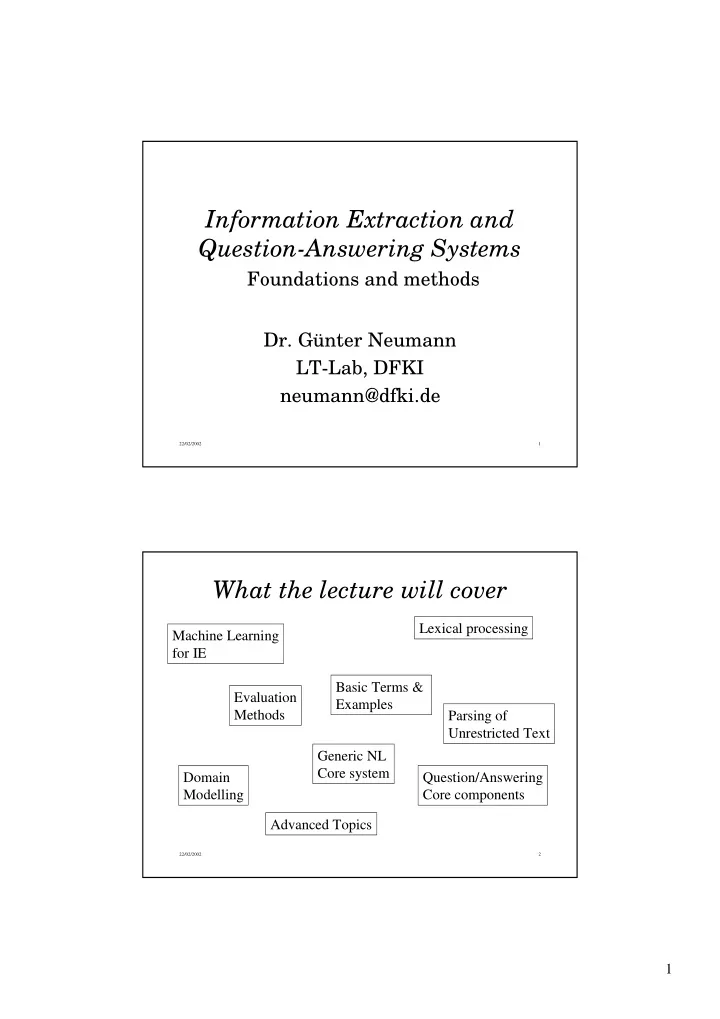
Information Extraction and Question-Answering Systems Foundations and methods Dr. Gnter Neumann LT-Lab, DFKI neumann@dfki.de 22/02/2002 1 What the lecture will cover Lexical processing Machine Learning for IE Basic Terms &
22/02/2002 1
22/02/2002 2
22/02/2002 3
22/02/2002 4
Major steps lexical processing including morphological analysis, POS-tagging, Named Entity recognition phrase recognition general nominal & prepositional phrases, verb groups clause recognition via domain-specific templates templates triggered by domain-specific predicates attached to relevant verbs; expressing domain-specific selectional restrictions for possible argument fillers Bottom-up chunk parsing perform clause recognition after phrase recognition is completed
22/02/2002 5
Crucial properties of German highly ambiguous morphology (e.g., case for nouns, tense for verbs); free word/phrase order; splitting of verb groups into separated parts into which arbitrary phrases and clauses can be spliced in (e.g., Der Termin findet morgen statt. The date takes place tomorrow.) Main problem in case of a bottom-up parsing approach even recognition of simple sentence structure depends heavily on performance of phrase recognition [NPDie vom Bundesgerichtshof und den Wettbewerbern als Verstoß gegen das Kartellverbot gegeisselte zentrale TV-Vermarktung] ist gängige Praxis. [Central television marketing censured by the German Federal High Court and the guards against unfair competition as an infringement of anti-cartel legislation] is common practice.
22/02/2002 6
Text Tokenization Lexical processor
Chunk Parser
> 120.000 main stems; > 12.000 verb frames; special name lexica; tagging rules; general (NPs, PPs, VG); special (lexicon-poor, Time/Date/Names); general sentence patterns; Lexical DB Grammars (FST)
Set of Underspecified
Shallow Text Processor
22/02/2002 7
[PNDie Siemens GmbH] [Vhat] [year1988][NPeinen Gewinn] [PPvon 150 Millionen DM], [Compweil] [NPdie Auftraege] [PPim Vergleich] [PPzum Vorjahr] [Cardum 13%] [Vgestiegen sind]. “The siemens company has made a revenue of 150 million marks in 1988, since the orders increased by 13% compared to last year.”
hat Obj Gewinn weil steigen Auftrag PPs {1988, von(150M)} Subj UFD: flat dependency-based structure, only upper bounds for attachment and scoping Subj Siemens {im(Vergleich), zum(Vorjahr), um(13%) } PPs SC Comp
22/02/2002 8
Divide-and-conquer strategy
(fields) of sentence domain-independently; FrontField LeftVerb MiddleField RightVerb RestField
grammars to the identified fields of the main and sub- clauses [CoordS [CSent Diese Angaben konnte der Bundesgrenzschutz aber nicht bestätigen], [CSent Kinkel sprach von Horrorzahlen, [Relcl denen er keinen Glauben schenke]]]. This information couldn‘t be verified by the Border Police, Kinkel spoke of horrible figures that he didn‘t believe. Field Recognizer Phrase Recognizer Gramm. Functions Text (morph. analysed) topological structure
sentence structures
22/02/2002 9
Improved robustness topological sentence structure determined on basis of simple indicators like verbgroups and conjunctions and their interplay; phrases need not be recognized completely Resolution of some ambiguities relative pronouns vs. determiners subjunction vs. preposition clause vs. NP coordination Modularity easy exchange/extension of (domain-specific) phrase grammars Some more examples (source text) topological structure plus expanded phrase structure
22/02/2002 10
The lexical processor is realized on basis of state-of-the-art finite state technology, however taking care of German language specificities.
rund 60 bis 70 Prozent: percentage-NP bis: adv Steigerungsrate: steigerung+[s]+rate bis: prep|adv 52 classes 150.000 stems
hyphen coordination Over 100 Rules, Roche&Schabes approach 12 subgrammars dynamic lexicon reference resolution ASCII Documents
Tokenizer Morphology POS-Filtering Named Entity Finder
rund: low-w 60: 2int EXAMPLE: rund 60 bis 70 Prozent der Steigerungsrate (about 60 to 70 percent increase)
Stream of morph-syn. words & Named Entities
22/02/2002 11
Stream of morph-syn. words & Named Entities
Verb Groups Base Clauses Clause Combination Main Clauses Topological Structure Phrase Recognition Underspecified dependency trees
Weil die Siemens GmbH, die vom Export lebt, Verluste erlitt, mußte sie Aktien verkaufen.
Because the Siemens Corp which strongly depends on exports suffered from losses they had to sell some shares.
Weil die Siemens GmbH, die vom Export Verb-FIN, Verluste Verb- FIN, Modv-FIN sie Aktien FV-Inf. Weil die Siemens GmbH, Rel-Clause Verluste Verb-FIN, Modv-FIN sie Aktien FV-Inf. Subconj-Clause, Modv-FIN sie Aktien FV-Inf. Clause
22/02/2002 12
Modularity: each subcomponent can be used in isolation; Declarativity: lexicon and grammar specification tools; High coverage: more than 93 % lexical coverage of unseen text; high degree of subgrammars Efficiency: finite state technology in all components; specialized constrained solvers (e.g. agreement checks & grammatical functions); Run-time: 4.5 msec real time per token (Standard PC environment) Available for research: http://www.dfki.de/~neumann/pd-smes/pd-smes.html
22/02/2002 13
22/02/2002 14
H E O E S L := N T N := N P . . .
22/02/2002 15
Prefix: (complex) verb prefix or GE- Lemma: possible lexical stem, where possible umlauts are reduced (e.g., Mädchen vs. Häusern) Suffix: longest matching inflection ending (using a inflection lexicon)
22/02/2002 16
22/02/2002 17
Compute DNF for the compactly represented disjunctive morpho-syntactic
disjunctive output for the form “die Häuser” (“the houses”) (“haus” (cat noun) (flexion ((ntr ((pl (nom gen acc))))))) as symbol list (e.g., used in case of lexical tagging) (“haus” (ntr-pl-nom ntr-pl-gen ntr-pl-acc) . :n) as feature term (e.g., used in case of shallow parsing) (“haus” (((:tense . :no) (:person . :no) (:gender . :ntr) (:number . :pl) (:case . :nom)) ((:tense . :no) (:person . :no) (:gender . :ntr) (:number . :pl) (:case . :gen)) ((:tense . :no) (:person . :no) (:gender . :ntr) (:number . :pl) (:case . :acc))) . :n)
22/02/2002 18
DNF computation can be done off-line and on-line using memorization techniques
set {:cat :mact :sym :comp :comp-f :det :tense :form :person :gender
:number :case}
e.g.
(“haus”
(((:number . :pl) (:case . :nom)) ((:number . :pl) (:case . :gen)) ((:number . :pl) (:case . :acc))) . :n) supports lexical tagging (use of different tag sets) supports feature relaxation (ignore uninteresting features)
22/02/2002 19
agreement
Feature vector representation Special symbol :no used as anonymous variable Example s1=(((:TENSE . :NO) (:FORM . :NO) (:NUMBER . :S) (:CASE . :N))
((:TENSE . :NO) (:FORM . :NO) (:NUMBER . :S) (:CASE . :A)) ((:TENSE . :NO) (:FORM . :NO) (:NUMBER . :P) (:CASE . :N)) ((:TENSE . :NO) (:FORM . :NO) (:NUMBER . :P) (:CASE . :A)))) s2=(((:TENSE . :NO) (:FORM . :XX) (:NUMBER . :S) (:CASE . :N)) ((:TENSE . :NO) (:FORM . :NO) (:NUMBER . :S) (:CASE . :G)) ((:TENSE . :NO) (:FORM . :NO) (:NUMBER . :S) (:CASE . :D))) unify(s1,s2)= (((:TENSE . :NO) (:FORM . :XX) (:NUMBER . :S) (:CASE . :N)))
22/02/2002 20
Predicate or a specific class of tokens, e.g. (:morphix-cat partikel pre) :morphix-cat is a predicate which checks whether the current token‘s POS equals partikel, and if so, bound the token to the variable pre
22/02/2002 21
22/02/2002 22
(compile-regexp '(:conc (:current-pos start) (:alt (:star<=n (:morphix-unify :indef NIL agr det) 1) (:star<=n (:morphix-unify :def NIL agr det) 1)) (:star<=n (:morphix-unify :a agr agr adj) 1) (:morphix-unify :n agr agr noun) (:current-pos end)) :output-desc '(:lisp (build-item :type :np :start start :end end :agr agr :det det :adj adj :noun noun)) :name 'small-np)
Empty feature vector Special basic edge Output description (typed based)
22/02/2002 23
22/02/2002 24
Frau mit dem Fernrohr. The man sees the woman with the telescope.
((:SEM (:HEAD "mann") (:QUANTIFIER "d-det")) (:AGR ((:TENSE . :NO) ... (:CASE . :NOM))) (:END . 2) (:START . 0) (:TYPE . :NP)) ((:SEM (:HEAD "frau") (:QUANTIFIER "d-det")) (:AGR ((:TENSE . :NO) ... (:GENDER . :F) (:NUMBER . :S) (:CASE . :NOM)) ((:TENSE . :NO) ... (:GENDER . :F) (:NUMBER . :S) (:CASE . :AKK))) (:END . 5) (:START . 3) (:TYPE . :NP)) ((:SEM (:HEAD "mit") (:COMP (:QUANTIFIER "d-det") (:HEAD "fernrohr"))) (:AGR ((:TENSE . :NO) ... (:GENDER . :NT) (:NUMBER . :S) (:CASE . :DAT))) (:END . 8) (:START . 5) (:TYPE . :PP)))
22/02/2002 25
Stream of morph-syn. words & Named Entities
Verb Groups Base Clauses Clause Combination Main Clauses Topological Structure Phrase Recognition Underspecified dependency trees
Weil die Siemens GmbH, die vom Export lebt, Verluste erlitt, mußte sie Aktien verkaufen.
Because the Siemens Corp which strongly depends on exports suffered from losses they had to sell some shares.
Weil die Siemens GmbH, die vom Export Verb-FIN, Verluste Verb- FIN, Modv-FIN sie Aktien FV-Inf. Weil die Siemens GmbH, Rel-Clause Verluste Verb-FIN, Modv-FIN sie Aktien FV-Inf. Subconj-Clause, Modv-FIN sie Aktien FV-Inf. Clause
22/02/2002 26
22/02/2002 27
22/02/2002 28
... Agree T Neg nicht gelobt haben kann Form Lob Stem Koenn Modal-stem Mod-Perf-Ak Subtype VG-final Type
22/02/2002 29
22/02/2002 30
22/02/2002 31
Middle-field recursion embedded base clause is located in the middle field of the embedding sentence ..., weil die Firma, nachdem sie expandiert hatte, größere Kosten hatte.
(*..., because the company, after it expanded had, increased costs had.) ➸ ➸ ➸ ➸ ..., weil die Firma [Subclause], größere Kosten hatte. ➸ ➸ ➸ ➸ ... [Subclause].
Rest-field recursion embedded clause follows the right verb part of the embedding sentence ..., weil die Firma größere Kosten hatte, nachdem sie expandiert hatte.
(*..., because the company increased costs had, after it expanded had.) ➸ ➸ ➸ ➸ ... [Subclause] [Subclause]. ➸ ➸ ➸ ➸ ... [Subclause].
22/02/2002 32
Base clause recognition Morphological analysed stream of sentence Change? Base clause combination New base clauses found base clause structure of sentence MF-recursion inside-out Handle NF-recursion ...*[daß das Glück [, das Jochen Kröhne empfunden haben soll Rel-
Cl][,als ihm jüngst sein Großaktionär
die Übertragungsrechte bescherte
Subj-Cl], nicht mehr so recht erwärmt Subj-Cl].
22/02/2002 33
22/02/2002 34
Csent ::= ... LVP ... [RVP] ... Ssent ::= LVP [RVP] ... CoordS ::= CSent ( , CSent)* Coord CSent | CSent (, SSent)* Coord SSent AsyndSent ::= CSent {,} CSent ComplexCSent :: = CSent {,} SSent | CSent , CSent AsyndCond ::= SSent {,} SSent
22/02/2002 35
Lexical pre-processor (20.000 tokens) Recall % Precision % compound analysis 99.01 99.29 part-of-speech-filtering 74.50 97.90 named entity (incl. dynamic lexicon) 85.00 95.77 fragments (NPs, PPs): 76.11 91.94 Divide-and-conquer parser (400 sentences, 6306 words) verb module 98.10 98.43 base-clause module 93.08 (94.61) 93.80 (93.89) main-clause module 89.00 (93.00) 94.42 (95.62) complete analysis 84.75 89.68 F=87.14
22/02/2002 36
Divide-and-conquer parsing strategy free German text processing suited for free worder languages high modularity Main experience full text processing necessary even if only some parts of a text are of interest; application-oriented depth of text understanding; the difference between shallow and deep NLP seen as a continuum
22/02/2002 37
the elements of the identified fields
collecting the elements from the verb groups which define the head
all NPs directly governed by the head into a set NP modifiers all PPs directly governed by the head into a set PP modifiers
bounds for attachment are defined
22/02/2002 38
Der Mann sieht die Frau mit dem Fernrohr.
(((:PPS ((:SEM (:HEAD "mit") (:COMP (:QUANTIFIER "d-det") (:HEAD "fernrohr"))) (:AGR ((:TENSE . :NO) ... (:CASE . :DAT))) (:END . 8) (:START . 5) (:TYPE . :PP))) (:NPS ((:SEM (:HEAD "mann") (:QUANTIFIER "d-det")) (:AGR ((:TENSE . :NO) ... (:CASE . :NOM))) (:END . 2) (:START . 0) (:TYPE . :NP)) ((:SEM (:HEAD "frau") (:QUANTIFIER "d-det")) (:AGR ((:TENSE . :NO) ... (:CASE . :NOM)) ((:TENSE . :NO) ... (:CASE . :AKK))) (:END . 5) (:START . 3) (:TYPE . :NP))) (:VERB (:COMPACT-MORPH ((:TEMPUS . :PRAES) ... (:PERSON . 3) (:GENUS . :AKTIV))) (:MORPH-INFO ((:TENSE . :PRES) (:FORM . :FIN) ... (:CASE . :NO))) (:ART . :FIN) (:STEM . "seh") (:FORM . "sieht") (:C-END . 3) (:C-START . 2) (:TYPE . :VERBCOMPLEX)) (:END . 8) (:START . 0) (:TYPE . :VERB-NODE)))
sieht {der Mann, die Frau} {mit dem Fernrohr}
NPs PPs
22/02/2002 39
22/02/2002 40
in other words, their dependency relation to the head counts as an upper border rather than an attachment
22/02/2002 41
Der Mann sieht die Frau mit dem Fernrohr.
(((:SYN (:SUBJ (:RANGE (:SEM (:HEAD "mann") (:QUANTIFIER "d-det")) (:AGR ((:PERSON . 3) (:GENDER . :M) (:NUMBER . :S) (:CASE . :NOM))) (:END . 2) (:START . 0) (:TYPE . :NP))) (:OBJ (:RANGE (:SEM (:HEAD "frau") (:QUANTIFIER "d-det")) (:AGR ((:PERSON . 3) (:GENDER . :F) (:NUMBER . :S) (:CASE . :NOM)) ((:PERSON . 3) (:GENDER . :F) (:NUMBER . :S) (:CASE . :AKK))) (:END . 5) (:START . 3) (:TYPE . :NP))) (:NP-MODS) (:PP-MODS ((:SEM (:HEAD "mit") (:COMP (:QUANTIFIER "d-det") (:HEAD "fernrohr"))) (:AGR ((:PERSON . 3) (:GENDER . :NT) (:NUMBER . :S) (:CASE . :DAT))) (:END . 8) (:START . 5) (:TYPE . :PP))) (:PROCESS (:COMPACT-MORPH ((:TEMPUS . :PRAES) ... (:GENUS . :AKTIV))) (:MORPH-INFO ((:TENSE . :PRES) ... (:NUMBER . :S) (:CASE . :NO))) (:ART . :FIN) (:STEM . "seh") (:FORM . "sieht") (:TYPE . :VERBCOMPLEX)) (:SC-FRAME ((:NP . :NOM) (:NP . :AKK))) (:START . 0) (:END . 8) (:TYPE . :SUBJ-OBJ))))
sieht der Mann {mit dem Fernrohr}
Subj PPs
die Frau
Obj
22/02/2002 42
1. {<np,nom>} 2. {<np,nom>, <pp, dat, mit>} 3. {<np,nom>, <np,acc>}
22/02/2002 43
22/02/2002 44
elements; but only used for assigning a deep case label)
SUBJ: deep subject; OBJ: deep object; OBJ1: indirect object; P-OBJ: prepositional object; XCOMP: subcategorized subclause
subject and direct object in the sentence, e.g., in case of passivization
22/02/2002 45
1. Retrieve the subcategorization frames for the verbal head of the root node of the input dependency tree; 2. Apply lexical rules in order to determine deep case information depending on the verb diathesis; since frames are expressed for active sentences only, a passivation rule exists which transforms NP-nominative to NP-accusative, and NP-nominative to PP-accusative with preposition von and durch 3. For each subcat frame sc do: 1. match sc with the dependent elements; if matching succeeds, then call sc a valid subcat frame; otherwise sc is discarded; 2. if sc is a valid subcat frame and scp is the current active subcat frame compute in the previous step of the loop, then if |sc| > | scp| select sc as the current active subcat frame; 3. insert the domain-specific information found for the verbal head of the root (if available); this information can be retrieved from the domain lexicon using the stem entry of the head verb (template triggering) 4. the same method is recursively applied on all sub-clauses 5. finally return the new dependency tree marked for deep grammatical functions; we call such dependency tree an underspecified functional description
22/02/2002 46
and unify it with the feature structure found for verbal head
subcat frame for seh (to see): {<np,nom>, <np,acc>}. Fvect from input: ((:tense . :pres) (:form . :fin) (:person . 3) (:gender . :no)(:number . :s) (:case . :no)) Expanded and unified fvec: {((:tense . :pres) (:form . :fin) (:person . 3) (:gender . :no) (:number . :s) (:case . :nom)), ((:tense . :no) (:form . :no) (:person . :no) (:gender . :no) (:number . :no) (:case . :acc))}
assign subject and object.
22/02/2002 47
are considered as adjuncts
into disjunctive subsets (actually based on NE recognition): {LOC-PP, LOC-NP, RANGE-LOC-PP} maps to LOC-MODS {DATE-PP, DATE-NP} maps to DATE-MODS
NPS PPS SClause
22/02/2002 48
22/02/2002 49
(check http://www.dfki.de/~neumann/publications/neumann-ref.html)
Shallow Parsing of German Free Texts. In proceedings of ANLP-2000, Seattle, Washington, April, 2000.
Technical Report, 1999. A detailed description of SMES, especially
for HPSG but in SMES used for domain modelling)
Computerlinguistik, Universität des Saarlandes, Oktober, 1999.
Extraction Core System for Real World German Text Processing. In Proceedings of 5th ANLP, Washington, March, 1997.