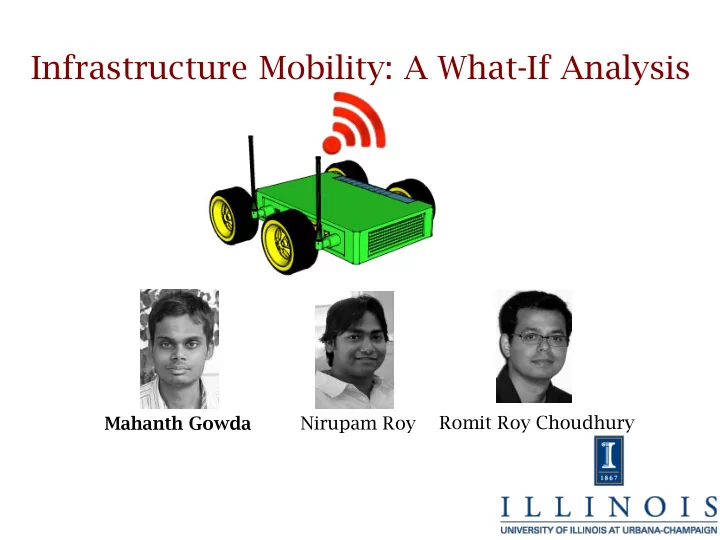
SLIDE 1
Infrastructure Mobility: A What-If Analysis
Mahanth Gowda Nirupam Roy Romit Roy Choudhury
SLIDE 2
Wireless Network Capacity
Revolutionary work in the last 30 years
Beamforming, MIMO, power-control, channel assignment, coding …
SLIDE 3
Wireless Network Capacity
Capacity is reaching Shannon's limit, but the demand is still increasing Revolutionary work in the last 30 years
Beamforming, MIMO, power-control, channel assignment, coding …
SLIDE 4
Wireless Network Capacity
Growing agreement in the community that we have reached saturation at the PHY Layer …
SLIDE 5
Wireless Network Capacity
Growing agreement in the community that we have reached saturation at the PHY Layer … Next jump perhaps from new networking architectures.
SLIDE 6
Static Infrastructure, Mobile Clients
SLIDE 7
Static Infrastructure, Mobile Clients
SLIDE 8
Static Infrastructure, Mobile Clients
SLIDE 9
What if Infrastructure is Mobile
SLIDE 10
What if Infrastructure is Mobile
SLIDE 11
What if Infrastructure is Mobile
SLIDE 12
Regimes of Infrastructure Mobility
Mobility Range
SLIDE 13
Regimes of Infrastructure Mobility
Mobility Range
Tethered Mobility (feet)
SLIDE 14
Regimes of Infrastructure Mobility
Mobility Range
Tethered Mobility (feet) Ceiling Track Mobility (meter)
SLIDE 15
Regimes of Infrastructure Mobility
Mobility Range
Tethered Mobility (feet) Ceiling Track Mobility (meter) Cell Tower Relays (km)
SLIDE 16
Regimes of Infrastructure Mobility
Mobility Range
Tethered Mobility (feet) Ceiling Track Mobility (meter) Cell Tower Relays (km) Three main sources of gains
SLIDE 17
Indoor Multipath
SLIDE 18
Indoor Multipath
SLIDE 19
Indoor Multipath
SLIDE 20
Indoor Multipath
SLIDE 21
Multipath can Add up Destructively
SLIDE 22
Multipath can Add up Destructively
SLIDE 23
Multipath can Add up Destructively
SLIDE 24
Multipath can Add up Destructively
Out of phase components
SLIDE 25
Multipath can Add up Destructively
Destructive multipath – nullified signal
Out of phase components
SLIDE 26
Small Mobility Facilitates Constructive Multipath
SLIDE 27
Small Mobility Facilitates Constructive Multipath
SLIDE 28
Small Mobility Facilitates Constructive Multipath
SLIDE 29
Small Mobility Facilitates Constructive Multipath
SLIDE 30
Small Mobility Facilitates Constructive Multipath
In Phase alignment with small AP motion
SLIDE 31
Small Mobility Facilitates Constructive Multipath
Constructive multipath – amplified signal
In Phase alignment with small AP motion
SLIDE 32
Shadowing
SLIDE 33
Shadowing
SLIDE 34
Shadowing
SLIDE 35
LoS Path blocked by wall Shadowing
SLIDE 36
Shadowing
SLIDE 37
Shadowing
SLIDE 38
Shadowing
SLIDE 39
Shadowing
SLIDE 40
LoS opportunity by evading shadow Shadowing
SLIDE 41
Regimes of Infrastructure Mobility
Mobility Range
Tethered Mobility (feet) Ceiling Track Mobility (meter) Cell Tower Relays (km)
SLIDE 42
Time
Traffic Changes Channel Variation Topology Faults User Location
Timescales
SLIDE 43 Opportunities are many:
- Better capacity
- Localization
- Improved energy
- Security
- Fault management
- QoS, reliability, prioritization,
- Software defined mobility … scalable
Not entirely sure about killer app
- Treating this as a bottom-up research
- 1. What’s the Killer App?
SLIDE 44 Robots permeating life … design, cost, reliability, safety not major issues
Robotic Camera Package Delivery Virtual Presence
- 2. Is this Really Practical?
Robotic Feet Robotic Vacuum
SLIDE 45
- 2. Is this Really Practical?
Today’s home
SLIDE 46
- 2. Is this Really Practical?
Smart homes!
SLIDE 47
- 2. Is this Really Practical?
Smart homes!
SLIDE 48
- 2. Is this Really Practical?
Smart homes!
SLIDE 49
- 2. Is this Really Practical?
Smart homes!
SLIDE 50
- 2. Is this Really Practical?
Smart homes!
SLIDE 51
- 2. Is this Really Practical?
Smart homes!
SLIDE 52
- 3. How Compelling are the Gains?
SLIDE 53
- Mobility can be only in small spatial scale (< 1 sq ft)
- Exploit multipath opportunities
- Constructive multipath - To increase signal strength of clients
Single-AP Mobility
- 3. How Compelling are the Gains?
SLIDE 54
- Mobility can be only in small spatial scale (< 1 sq ft)
- Exploit multipath opportunities
- Constructive multipath - To increase signal strength of clients
Single-AP Mobility
- 3. How Compelling are the Gains?
SLIDE 55
- Mobility can be only in small spatial scale (< 1 sq ft)
- Exploit multipath opportunities
- Constructive multipath - To increase signal strength of clients
- Destructive multipath - To decrease interference from interferers
Single-AP Mobility
- 3. How Compelling are the Gains?
SLIDE 56
- Mobility can be only in small spatial scale (< 1 sq ft)
- Exploit multipath opportunities
- Constructive multipath - To increase signal strength of clients
- Destructive multipath - To decrease interference from interferers
- Upper bounds on throughput gain ~ 2x
Single-AP Mobility
- 3. How Compelling are the Gains?
SLIDE 57
- Mobility can be only in small spatial scale (< 1 sq ft)
- Exploit multipath opportunities
- Constructive multipath - To increase signal strength of clients
- Destructive multipath - To decrease interference from interferers
- Upper bounds on throughput gain ~ 2x
- Long Range Macro-mobility can offer upto 3x gains
Single-AP Mobility
- 3. How Compelling are the Gains?
SLIDE 58
- 3. How Compelling are the Gains?
Multiple-AP Coordinated Mobility
SLIDE 59
- 3. How Compelling are the Gains?
Multiple-AP Coordinated Mobility
Joint Mobility Control over Cloud
SLIDE 60
- 3. How Compelling are the Gains?
Multiple-AP Coordinated Mobility
Joint Mobility Control over Cloud Upto 1.8x gains (based
simulations
SLIDE 61 Robotic WiFi APs can be plug and play backward compatible Moreover, multiple APs can together be mobile additional gains
- 4. Why not Overprovision?
Yes, that’s possible. However,
- re-wiring + Ethernet costly
- new protocols, eco-system
- backward compatibility
SLIDE 62
Platform: USRPs and off-the-shelf laptops
Measurements
SLIDE 63 Methodology
AP Mobility Area
Client Client Client Client
SLIDE 64 Methodology
AP Mobility Area
Client Client Client Client
SLIDE 65 Spot 1 foot
Methodology
AP Mobility Area
Client Client Client Client
SLIDE 66 Spot 1 foot Pixels
Methodology
AP Mobility Area
Client Client Client Client
SLIDE 67 Spot 1 foot Pixels
Methodology
AP Mobility Area
Client Client Client Client
Three Regimes
SLIDE 68 Spot 1 foot Pixels
Methodology
1) MicroMobility AP Mobility Area
Client Client Client Client
Three Regimes
SLIDE 69 Spot 1 foot Pixels 2) MiniMobility
Methodology
1) MicroMobility AP Mobility Area
Client Client Client Client
Three Regimes
SLIDE 70 Spot 1 foot Pixels 2) MiniMobility 3) MacroMobility
Methodology
1) MicroMobility AP Mobility Area
Client Client Client Client
Three Regimes
SLIDE 71
MicroMobility
Client
SLIDE 72
MicroMobility
Your AP Client
SLIDE 73
MicroMobility
Good SNR Your AP Client
SLIDE 74
MicroMobility
Good SNR Your AP Interfering (Neighbor) AP Client
SLIDE 75
MicroMobility
Good SNR Weak Interference Your AP Interfering (Neighbor) AP Client
SLIDE 76
SNR Variation within a Spot
SLIDE 77
CDF of (max – median) SNR.
SNR Variation within a Spot
SLIDE 78
CDF of (max – median) SNR. CDF of (median - min) SNR.
SNR Variation within a Spot
SLIDE 79
MicroMobility: Upper bound on Throughput Gain with Interference
SLIDE 80
MiniMobility: SNR Variation over 6 Spots
SLIDE 81
Without interference With interference
MiniMobility: Upper bound on Throughput Gain
SLIDE 82
MacroMobility: Upper bound on Throughput Gain
SLIDE 83
Cloud Controlled Mobility
Coordinated Mobility
SLIDE 84
Cloud Controlled Mobility
Coordinated Mobility
SLIDE 85
Cloud Controlled Mobility
Coordinated Mobility
SLIDE 86
Coordinated Mobility Gains
30 Node, 6 AP testbed with measurement based simulation
SLIDE 87
Need not Move too much
SLIDE 88
Client
Need not Move too much
SLIDE 89
Client Close by AP
Need not Move too much
SLIDE 90
Client Close by AP
Need not Move too much
SLIDE 91
Client Close by AP
Need not Move too much
SLIDE 92
Client Close by AP
Need not Move too much
SLIDE 93
Client Close by AP
Need not Move too much
SLIDE 94
Client Close by AP
Need not Move too much
SLIDE 95
Client Close by AP
Need not Move too much
SLIDE 96
Pixels of comparable SNRs connected with a line. Far away pixels, chosen carefully, offer strong SNRs
Need not Move too much
SLIDE 97
- Energy savings
- Due to greater data rates, fewer re-transmissions
- Range finding possible via careful antenna motion
- Averages out multi-path
- More bits of secret keys from the channel
- Through frequent antenna mobility
- Quadcopter based cell tower extension
- Possible to avoid shadow regions
- Channel quality at heights different from ground
Many More Opportunities
SLIDE 98
- How to relocate to the right pixel for improved SNR?
- When to relocate?
- Joint mobility and power control, channel management
- Optimizing for multiple clients. New scheduling schemes
- Mobility planning in between protocol idle periods
- Leverage overheard transmissions for mobility decisions
- Improved multi-AP coordination
- Many others …
Many Challenges too
SLIDE 99 Power Control Channel Selection Coding Beamforming MIMO
Take Away
99
Scheduling
SLIDE 100 Power Control Channel Selection Coding Beamforming MIMO
Take Away
100
Scheduling Infrastructure Mobility
SLIDE 101
Thank You!
Questions?
Mahanth Gowda
gowda2@illinois.edu
Systems and Networking Research Group (SyNRG)
http://www.synrg.csl.illinois.edu