Instruction Set Architecture Assembly Language View Computer - - PDF document

instruction set architecture
SMART_READER_LITE
LIVE PREVIEW

Instruction Set Architecture Assembly Language View Computer - - PDF document

Instruction Set Architecture Assembly Language View Computer Architecture: Instruction Set Processor state Application Program Registers, memory, Architecture Instructions Compiler OS addq , pushq , ret , How


slide-1
SLIDE 1

– 1 – CS:APP3e

Computer Architecture: Instruction Set Architecture

CSci 2021: Machine Architecture and Organization March 18th-20th, 2018 Your instructor: Stephen McCamant Based on slides originally by: Randy Bryant, Dave O’Hallaron

– 2 – CS:APP3e

Instruction Set Architecture

Assembly Language View

◼ Processor state ⚫ Registers, memory, … ◼ Instructions ⚫ addq, pushq, ret, … ⚫ How instructions are encoded

as bytes

Layer of Abstraction

◼ Above: how to program machine ⚫ Processor executes instructions

in a sequence

◼ Below: what needs to be built ⚫ Use variety of tricks to make it

run fast ⚫ E.g., execute multiple instructions simultaneously ISA Compiler OS CPU Design Circuit Design Chip Layout Application Program

– 3 – CS:APP3e

ZF SF OF

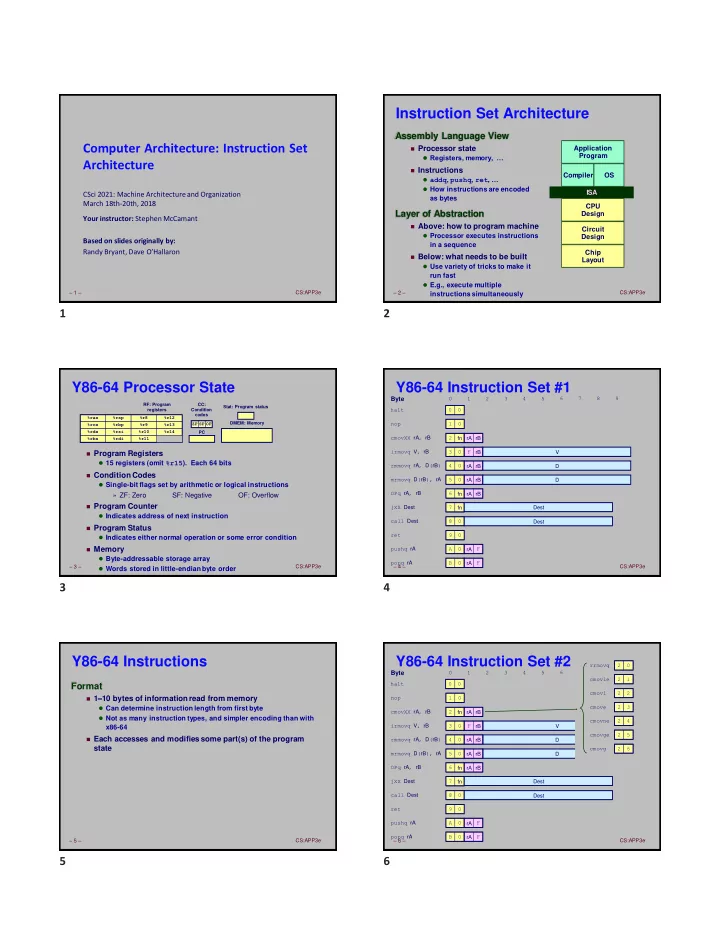
Y86-64 Processor State

◼ Program Registers ⚫ 15 registers (omit %r15). Each 64 bits ◼ Condition Codes ⚫ Single-bit flags set by arithmetic or logical instructions

» ZF: Zero SF: Negative OF: Overflow

◼ Program Counter ⚫ Indicates address of next instruction ◼ Program Status ⚫ Indicates either normal operation or some error condition ◼ Memory ⚫ Byte-addressable storage array ⚫ Words stored in little-endian byte order

RF: Program registers CC: Condition codes PC DMEM: Memory Stat: Program status %r8 %r9 %r10 %r11 %r12 %r13 %r14 %rax %rcx %rdx %rbx %rsp %rbp %rsi %rdi

– 4 – CS:APP3e

Y86-64 Instruction Set #1

Byte

pushq rA A rA F jXX Dest 7 fn Dest popq rA B rA F call Dest 8 Dest cmovXX rA, rB 2 fn rA rB irmovq V, rB 3 F rB V rmmovq rA, D(rB) 4 rA rB D mrmovq D(rB), rA 5 rA rB D OPq rA, rB 6 fn rA rB ret 9 nop 1 halt 1 2 3 4 5 6 7 8 9 – 5 – CS:APP3e

Y86-64 Instructions

Format

◼ 1–10 bytes of information read from memory ⚫ Can determine instruction length from first byte ⚫ Not as many instruction types, and simpler encoding than with

x86-64

◼ Each accesses and modifies some part(s) of the program

state

– 6 – CS:APP3e 1 2 3 4 5 6 7 8 9 V D D

Y86-64 Instruction Set #2

Byte

pushq rA A rA F jXX Dest 7 fn Dest popq rA B rA F call Dest 8 Dest cmovXX rA, rB 2 fn rA rB irmovq V, rB 3 F rB rmmovq rA, D(rB) 4 rA rB mrmovq D(rB), rA 5 rA rB OPq rA, rB 6 fn rA rB ret 9 nop 1 halt rrmovq 2 cmovle 2 1 cmovl 2 2 cmove 2 3 cmovne 2 4 cmovge 2 5 cmovg 2 6

1 2 3 4 5 6

slide-2
SLIDE 2

– 7 – CS:APP3e

Y86-64 Instruction Set #3

Byte

pushq rA A rA F jXX Dest 7 fn Dest popq rA B rA F call Dest 8 Dest cmovXX rA, rB 2 fn rA rB irmovq V, rB 3 F rB V rmmovq rA, D(rB) 4 rA rB D mrmovq D(rB), rA 5 rA rB D OPq rA, rB 6 fn rA rB ret 9 nop 1 halt 1 2 3 4 5 6 7 8 9 addq 6 subq 6 1 andq 6 2 xorq 6 3 – 8 – CS:APP3e

Y86-64 Instruction Set #4

Byte

pushq rA A rA F jXX Dest 7 fn Dest popq rA B rA F call Dest 8 Dest cmovXX rA, rB 2 fn rA rB irmovq V, rB 3 F rB V rmmovq rA, D(rB) 4 rA rB D mrmovq D(rB), rA 5 rA rB D OPq rA, rB 6 fn rA rB ret 9 nop 1 halt 1 2 3 4 5 6 7 8 9 jmp 7 jle 7 1 jl 7 2 je 7 3 jne 7 4 jge 7 5 jg 7 6 – 9 – CS:APP3e

Encoding Registers

Each register has a 4-bit ID

◼ Same encoding as in x86-64

Register ID 15 (0xF) indicates “no register”

◼ Will use this in our hardware design in multiple places

%rax %rcx %rdx %rbx 1 2 3 %rsp %rbp %rsi %rdi 4 5 6 7 %r8 %r9 %r10 %r11 8 9 A B %r12 %r13 %r14 No Register C D E F

– 10 – CS:APP3e

Instruction Example

Addition Instruction

◼ Add value in register rA to that in register rB ⚫ Store result in register rB ⚫ Note that Y86-64 only allows addition to be applied to register

data

◼ Set condition codes based on result ◼ e.g., addq %rax,%rsi Encoding: 60 06 ◼ Two-byte encoding ⚫ First indicates instruction type ⚫ Second gives source and destination registers addq rA, rB 6 0 rA rB

Encoded Representation Generic Form

– 11 – CS:APP3e

Arithmetic and Logical Operations

◼ Refer to generically as

“OPq”

◼ Encodings differ only by

“function code”

⚫ Low-order 4 bits in first instruction word ◼ Set condition codes as

side effect

addq rA, rB 6 0 rA rB subq rA, rB 6 1 rA rB andq rA, rB 6 2 rA rB xorq rA, rB 6 3 rA rB Add Subtract (rA from rB) And Exclusive-Or Instruction Code Function Code

– 12 – CS:APP3e

Move Operations

◼ Like the x86-64 movq instruction ◼ Simpler format for memory addresses ◼ Give different names to keep them distinct rrmovq rA, rB 2

Register ➔ Register Immediate ➔ Register irmovq V, rB F rB 3 0 V Register ➔ Memory rmmovq rA, D(rB) 4 0 rA rB D Memory ➔ Register mrmovq D(rB), rA 5 0 rA rB D

7 8 9 10 11 12

slide-3
SLIDE 3

– 13 – CS:APP3e

Move Instruction Examples

irmovq $0xabcd, %rdx movq $0xabcd, %rdx 30 82 cd ab 00 00 00 00 00 00 X86-64 Y86-64 Encoding: rrmovq %rsp, %rbx movq %rsp, %rbx 20 43 mrmovq -12(%rbp),%rcx movq -12(%rbp),%rcx 50 15 f4 ff ff ff ff ff ff ff rmmovq %rsi,0x41c(%rsp) movq %rsi,0x41c(%rsp) 40 64 1c 04 00 00 00 00 00 00 Encoding: Encoding: Encoding:

– 14 – CS:APP3e

Conditional Move Instructions

◼ Refer to generically as

“cmovXX”

◼ Encodings differ only by

“function code”

◼ Based on values of

condition codes

◼ Variants of rrmovq

instruction

⚫ (Conditionally) copy value from source to destination register rrmovq rA, rB Move Unconditionally cmovle rA, rB Move When Less or Equal cmovl rA, rB Move When Less cmove rA, rB Move When Equal cmovne rA, rB Move When Not Equal cmovge rA, rB Move When Greater or Equal cmovg rA, rB Move When Greater 2 0 rA rB 2 1 rA rB 2 2 rA rB 2 3 rA rB 2 4 rA rB 2 5 rA rB 2 6 rA rB

– 15 – CS:APP3e

Jump Instructions

◼ Refer to generically as “jXX” ◼ Encodings differ only by “function code” fn ◼ Based on values of condition codes ◼ Same as x86-64 counterparts ◼ Encode full destination address ⚫ Unlike PC-relative addressing seen in x86-64 jXX Dest 7 fn Jump (Conditionally) Dest – 16 – CS:APP3e

Jump Instructions

jmp Dest 7 Jump Unconditionally

Dest

jle Dest 7 1 Jump When Less or Equal

Dest

jl Dest 7 2 Jump When Less

Dest

je Dest 7 3 Jump When Equal

Dest

jne Dest 7 4 Jump When Not Equal

Dest

jge Dest 7 5 Jump When Greater or Equal

Dest

jg Dest 7 6 Jump When Greater

Dest – 17 – CS:APP3e

Y86-64 Program Stack

◼ Region of memory holding

program data

◼ Used in Y86-64 (and x86-64) for

supporting procedure calls

◼ Stack top indicated by %rsp ⚫ Address of top stack element ◼ Stack grows toward lower

addresses

⚫ Top element is at highest address in the stack ⚫ When pushing, must first decrement stack pointer ⚫ After popping, increment stack pointer %rsp

  • Increasing

Addresses Stack “Top” Stack “Bottom”

– 18 – CS:APP3e

Stack Operations

◼ Decrement %rsp by 8 ◼ Store word from rA to memory at %rsp ◼ Like x86-64 ◼ Read word from memory at %rsp ◼ Save in rA ◼ Increment %rsp by 8 ◼ Like x86-64 pushq rA A 0 rA F popq rA B 0 rA F

13 14 15 16 17 18

slide-4
SLIDE 4

– 19 – CS:APP3e

Subroutine Call and Return

◼ Push address of next instruction onto stack ◼ Start executing instructions at Dest ◼ Like x86-64 ◼ Pop value from stack ◼ Use as address for next instruction ◼ Like x86-64 call Dest 8 Dest ret 9 – 20 – CS:APP3e

Miscellaneous Instructions

◼ Don’t do anything ◼ Stop executing instructions ◼ x86-64 has comparable instruction, but can’t execute it

in user mode

◼ We will use it to stop the simulator ◼ Encoding ensures that program hitting memory

initialized to zero will halt

nop 1 halt

– 21 – CS:APP3e

Status Conditions

Mnemonic Code ADR 3 Mnemonic Code INS 4 Mnemonic Code HLT 2 Mnemonic Code AOK 1

◼ Normal operation ◼ Halt instruction encountered ◼ Bad address (either instruction or data)

encountered

◼ Invalid instruction encountered

Desired Behavior

◼ If AOK, keep going ◼ Otherwise, stop program execution – 22 – CS:APP3e

Writing Y86-64 Code

Try to Use C Compiler as Much as Possible

◼ Write code in C ◼ Compile for x86-64 with gcc –Og –S ◼ Transliterate into Y86-64 ◼ Modern compilers make this more difficult, alas

Coding Example

◼ Find number of elements in null-terminated list

long len1(long a[]); 5043 6125 7395 a  3

– 23 – CS:APP3e

Y86-64 Code Generation Example

First Try

◼ Write typical array code ◼ Compile with gcc -Og -S

Problem

◼ Hard to do array indexing on

Y86-64

⚫ Since don’t have scaled addressing modes

/* Find number of elements in null-terminated list */ long len(long a[]) { long len; for (len = 0; a[len]; len++) ; return len; } L3: addq $1,%rax cmpq $0, (%rdi,%rax,8) jne L3

– 24 – CS:APP3e

Y86-64 Code Generation Example #2

Second Try

◼ Write C code that mimics

expected Y86-64 code

Result

◼ Compiler generates exact

same code as before!

◼ Compiler converts both

versions into same intermediate form long len2(long *a) { long ip = (long) a; long val = *(long *) ip; long len = 0; while (val) { ip += sizeof(long); len++; val = *(long *) ip; } return len; }

19 20 21 22 23 24

slide-5
SLIDE 5

– 25 – CS:APP3e

Y86-64 Code Generation Example #3

len: irmovq $1, %r8 # Constant 1 irmovq $8, %r9 # Constant 8 irmovq $0, %rax # len = 0 mrmovq (%rdi), %rdx # val = *a andq %rdx, %rdx # Test val je Done # If zero, goto Done Loop: addq %r8, %rax # len++ addq %r9, %rdi # a++ mrmovq (%rdi), %rdx # val = *a andq %rdx, %rdx # Test val jne Loop # If !0, goto Loop Done: ret Register Use %rdi a %rax len %rdx val %r8 1 %r9 8

– 26 – CS:APP3e

Y86-64 Sample Program Structure #1

◼ Program starts at

address 0

◼ Must set up stack ⚫ Where located ⚫ Pointer values ⚫ Make sure don’t

  • verwrite code!

◼ Must initialize data

init: # Initialization . . . call Main halt .align 8 # Program data array: . . . Main: # Main function . . . call len . . . len: # Length function . . . .pos 0x100 # Placement of stack Stack:

– 27 – CS:APP3e

Y86-64 Program Structure #2

◼ Program starts at

address 0

◼ Must set up stack ◼ Must initialize data ◼ Can use symbolic

names

init: # Set up stack pointer irmovq Stack, %rsp # Execute main program call Main # Terminate halt # Array of 4 elements + terminating 0 .align 8 Array: .quad 0x000d000d000d000d .quad 0x00c000c000c000c0 .quad 0x0b000b000b000b00 .quad 0xa000a000a000a000 .quad 0

– 28 – CS:APP3e

Y86-64 Program Structure #3

Set up call to len

◼ Follow x86-64 procedure conventions ◼ Push array address as argument

Main: irmovq array,%rdi # call len(array) call len ret

– 29 – CS:APP3e

Assembling Y86-64 Program

◼ Generates “object code” file len.yo ⚫ Actually looks like disassembler output

unix> yas len.ys

0x054: | len: 0x054: 30f80100000000000000 | irmovq $1, %r8 # Constant 1 0x05e: 30f90800000000000000 | irmovq $8, %r9 # Constant 8 0x068: 30f00000000000000000 | irmovq $0, %rax # len = 0 0x072: 50270000000000000000 | mrmovq (%rdi), %rdx # val = *a 0x07c: 6222 | andq %rdx, %rdx # Test val 0x07e: 73a000000000000000 | je Done # If zero, goto Done 0x087: | Loop: 0x087: 6080 | addq %r8, %rax # len++ 0x089: 6097 | addq %r9, %rdi # a++ 0x08b: 50270000000000000000 | mrmovq (%rdi), %rdx # val = *a 0x095: 6222 | andq %rdx, %rdx # Test val 0x097: 748700000000000000 | jne Loop # If !0, goto Loop 0x0a0: | Done: 0x0a0: 90 | ret – 30 – CS:APP3e

Simulating Y86-64 Program

◼ Instruction set simulator ⚫ Computes effect of each instruction on processor state ⚫ Prints changes in state from original

unix> yis len.yo

Stopped in 33 steps at PC = 0x13. Status 'HLT', CC Z=1 S=0 O=0 Changes to registers: %rax: 0x0000000000000000 0x0000000000000004 %rsp: 0x0000000000000000 0x0000000000000100 %rdi: 0x0000000000000000 0x0000000000000038 %r8: 0x0000000000000000 0x0000000000000001 %r9: 0x0000000000000000 0x0000000000000008 Changes to memory: 0x00f0: 0x0000000000000000 0x0000000000000053 0x00f8: 0x0000000000000000 0x0000000000000013

25 26 27 28 29 30

slide-6
SLIDE 6

– 31 – CS:APP3e

Think & chat break: missing in Y86-64

The following x86-64 instructions don’t exist in Y86-64. Which one would be hardest to replace with a sequence

  • f Y86-64 instructions?
  • notq
  • negq
  • testq
  • jae
  • shlq
  • shrq
  • leaq
  • jmp *%rax

https://chimein.cla.umn.edu/course/view/2021

– 32 – CS:APP3e

Break: missing in Y86-64

The following x86-64 instructions don’t exist in Y86-64. Which one would be hardest to replace with a sequence

  • f Y86-64 instructions?
  • notq → XOR with -1
  • negq → subtract from 0
  • testq → AND to scratch register
  • jae → subtract TMin from both sides, then cmp/jge
  • shlq → add to itself = left shift by one
  • shrq → via rotate-left, or by-byte table lookup
  • leaq → combination of shl (above) and addition
  • jmp *%rax → push and then return

– 33 – CS:APP3e

CISC Instruction Sets

◼ Complex Instruction Set Computer ◼ IA32 is example

Stack-oriented instruction set

◼ Use stack to pass arguments, save program counter ◼ Explicit push and pop instructions

Arithmetic instructions can access memory

◼ addq %rax, 12(%rbx,%rcx,8) ⚫ requires memory read and write ⚫ Complex address calculation

Condition codes

◼ Set as side effect of arithmetic and logical instructions

Philosophy

◼ Add instructions to perform “typical” programming tasks – 34 – CS:APP3e

RISC Instruction Sets

◼ Reduced Instruction Set Computer ◼ Internal project at IBM, later popularized by Hennessy

(Stanford) and Patterson (Berkeley)

Fewer, simpler instructions

◼ Might take more to get given task done ◼ Can execute them with small and fast hardware

Register-oriented instruction set

◼ Many more (typically 32) registers ◼ Use for arguments, return pointer, temporaries

Only load and store instructions can access memory

◼ Similar to Y86-64 mrmovq and rmmovq

No Condition codes

◼ Test instructions return 0/1 in register – 35 – CS:APP3e

MIPS Registers

$0 $1 $2 $3 $4 $5 $6 $7 $8 $9 $10 $11 $12 $13 $14 $15 $0 $at $v0 $v1 $a0 $a1 $a2 $a3 $t0 $t1 $t2 $t3 $t4 $t5 $t6 $t7 Constant 0 Reserved Temp. Return Values Procedure arguments Caller Save Temporaries: May be overwritten by called procedures $16 $17 $18 $19 $20 $21 $22 $23 $24 $25 $26 $27 $28 $29 $30 $31 $s0 $s1 $s2 $s3 $s4 $s5 $s6 $s7 $t8 $t9 $k0 $k1 $gp $sp $s8 $ra Reserved for Operating Sys Caller Save Temp Global Pointer Callee Save Temporaries: May not be

  • verwritten by

called procedures Stack Pointer Callee Save Temp Return Address – 36 – CS:APP3e

MIPS Instruction Examples

Op Ra Rb Offset Op Ra Rb Rd Fn 00000 R-R Op Ra Rb Immediate R-I Load/Store addu $3,$2,$1 # Register add: $3 = $2+$1 addu $3,$2, 3145 # Immediate add: $3 = $2+3145 sll $3,$2,2 # Shift left: $3 = $2 << 2 lw $3,16($2) # Load Word: $3 = M[$2+16] sw $3,16($2) # Store Word: M[$2+16] = $3 Op Ra Rb Offset Branch beq $3,$2,dest # Branch when $3 = $2

31 32 33 34 35 36

slide-7
SLIDE 7

– 37 – CS:APP3e

CISC vs. RISC

Original Debate

◼ Strong opinions! ◼ CISC proponents---easy for compiler, fewer code bytes ◼ RISC proponents---better for optimizing compilers, can make

run fast with simple chip design

Current Status

◼ For desktop processors, choice of ISA not a technical issue ⚫ With enough hardware, can make anything run fast

⚫ Code compatibility more important

◼ x86-64 adopted many RISC features ⚫ More registers; use them for argument passing ◼ For embedded processors, RISC makes sense ⚫ Smaller, cheaper, less power ⚫ Most cell phones use ARM processors – 38 – CS:APP3e

Summary

Y86-64 Instruction Set Architecture

◼ Similar state and instructions as x86-64 ◼ Simpler encodings ◼ Somewhere between CISC and RISC

How Important is ISA Design?

◼ Less now than before ⚫ With enough hardware, can make almost anything go fast

37 38