Integral Bases for P-Recursive Sequences Lixin Du Chinese Academy - - PowerPoint PPT Presentation

integral bases for p recursive sequences
SMART_READER_LITE
LIVE PREVIEW

Integral Bases for P-Recursive Sequences Lixin Du Chinese Academy - - PowerPoint PPT Presentation

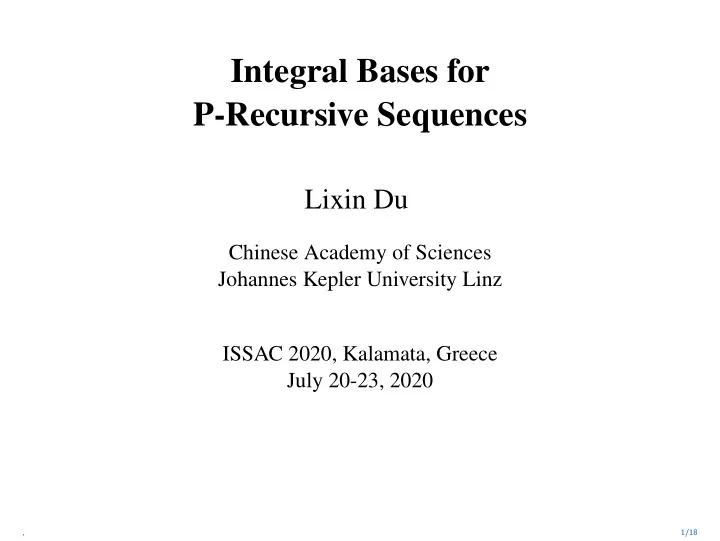
Integral Bases for P-Recursive Sequences Lixin Du Chinese Academy of Sciences Johannes Kepler University Linz ISSAC 2020, Kalamata, Greece July 20-23, 2020 , 1/18 Integral Bases for P-Recursive Sequences Lixin Du Chinese Academy of

slide-1
SLIDE 1

Integral Bases for P-Recursive Sequences

Lixin Du

Chinese Academy of Sciences Johannes Kepler University Linz ISSAC 2020, Kalamata, Greece July 20-23, 2020

, 1/18

slide-2
SLIDE 2

Integral Bases for P-Recursive Sequences

Lixin Du

Chinese Academy of Sciences Johannes Kepler University Linz ISSAC 2020, Kalamata, Greece July 20-23, 2020

joint work with S. Chen, M. Kauers, and T. Verron

, 1/18

slide-3
SLIDE 3

Integral functions: algebraic case

Notation. C: a field of characteristic zero (e.g. Q, C). C(x): the field of rational functions in x. M ∈ C[x,y]: irreducible over C(x) with r = degy(M). K = C(x)[y]/M ∼ = C(x)(β): the algebraic function field. K =

  • a0 +a1β +···+ar−1β r−1 | ai ∈ C(x)
  • ,

2/18

slide-4
SLIDE 4

Integral functions: algebraic case

Notation. C: a field of characteristic zero (e.g. Q, C). C(x): the field of rational functions in x. M ∈ C[x,y]: irreducible over C(x) with r = degy(M). K = C(x)[y]/M ∼ = C(x)(β): the algebraic function field. K =

  • a0 +a1β +···+ar−1β r−1 | ai ∈ C(x)
  • Definition. A function f ∈ K is called integral over C[x] if

f d +pd−1 f d−1 +···+p0 = 0 with pi ∈ C[x].

, 2/18

slide-5
SLIDE 5

Integral bases: algebraic case

  • Definition. The integral closure of C[x] in K is defined as

OK := { f ∈ K | f is integral over C[x] }.

, 3/18

slide-6
SLIDE 6

Integral bases: algebraic case

  • Definition. The integral closure of C[x] in K is defined as

OK := { f ∈ K | f is integral over C[x] }.

  • Theorem. OK is a free C[x]-module of rank r = [K : C(x)].

, 3/18

slide-7
SLIDE 7

Integral bases: algebraic case

  • Definition. The integral closure of C[x] in K is defined as

OK := { f ∈ K | f is integral over C[x] }.

  • Theorem. OK is a free C[x]-module of rank r = [K : C(x)].
  • Definition. An integral basis is a basis for OK as a C[x]-module.

, 3/18

slide-8
SLIDE 8

Integral bases: algebraic case

  • Definition. The integral closure of C[x] in K is defined as

OK := { f ∈ K | f is integral over C[x] }.

  • Theorem. OK is a free C[x]-module of rank r = [K : C(x)].
  • Definition. An integral basis is a basis for OK as a C[x]-module.

Example. K = C(x)(β) with β =

3

√ x2.

  • 1,β, 1

xβ 2

is an integral basis.

, 3/18

slide-9
SLIDE 9

Integral bases: algebraic case

  • Definition. The integral closure of C[x] in K is defined as

OK := { f ∈ K | f is integral over C[x] }.

  • Theorem. OK is a free C[x]-module of rank r = [K : C(x)].
  • Definition. An integral basis is a basis for OK as a C[x]-module.
  • Question. Given an irreducible polynomial M ∈ C(x)[y], how to find

an integral basis for K = C(x)[y]/M?

, 3/18

slide-10
SLIDE 10

Integral bases: algebraic case

  • Definition. The integral closure of C[x] in K is defined as

OK := { f ∈ K | f is integral over C[x] }.

  • Theorem. OK is a free C[x]-module of rank r = [K : C(x)].
  • Definition. An integral basis is a basis for OK as a C[x]-module.
  • Question. Given an irreducible polynomial M ∈ C(x)[y], how to find

an integral basis for K = C(x)[y]/M?

  • Answer. van Hoeij’s algorithm, etc.

, 3/18

slide-11
SLIDE 11

Computation of integral bases: van Hoeij’s algorithm

  • Input. M ∈ C[x,y] monic irreducible over C(x) with r = degy(M);
  • utput. an integral basis {B0,··· ,Br−1}.
  • 1. Start with (B0,...,Br−1) := (1,β,...,β r−1).
  • 2. For d ∈ {0,1,...,r −1}

3. While there exist a0,...,ad−1 ∈ C[x] such that A = a0B0 +···+ad−1Bd−1 +Bd p(x) is integral and p(x) ∈ C[x]\C; replace Bd by A.

  • 4. Return B0,...,Br−1.

, 4/18

slide-12
SLIDE 12

Computation of integral bases: van Hoeij’s algorithm

  • Example. M = (25

16x3 +2x4)−x3y−(2x+1)y2 +y3.

slide-13
SLIDE 13

Computation of integral bases: van Hoeij’s algorithm

  • Example. M = (25

16x3 +2x4)−x3y−(2x+1)y2 +y3.

integral closure OK

slide-14
SLIDE 14

Computation of integral bases: van Hoeij’s algorithm

  • Example. M = (25

16x3 +2x4)−x3y−(2x+1)y2 +y3.

integral closure OK O0 C[x]+C[x]β +C[x]β 2

slide-15
SLIDE 15

Computation of integral bases: van Hoeij’s algorithm

  • Example. M = (25

16x3 +2x4)−x3y−(2x+1)y2 +y3.

integral closure OK O0 C[x]+C[x]β +C[x]β 2 α = 0, B2 := −β+β 2 x O1

slide-16
SLIDE 16

Computation of integral bases: van Hoeij’s algorithm

  • Example. M = (25

16x3 +2x4)−x3y−(2x+1)y2 +y3.

integral closure OK O0 C[x]+C[x]β +C[x]β 2 α = 0, B2 := −β+β 2 x O1 α ∈ C, Bd := a0B0+···ad−1Bd−1+Bd x−α On ···

, 5/18

slide-17
SLIDE 17

Computation of integral bases: van Hoeij’s algorithm

  • Example. M = (25

16x3 +2x4)−x3y−(2x+1)y2 +y3.

integral closure OK O0 C[x]+C[x]β +C[x]β 2 α = 0, B2 := −β+β 2 x O1 α ∈ C, Bd := a0B0+···ad−1Bd−1+Bd x−α On ··· {1,β, 1

x(−β +β 2)} is an integral basis of C(x)[y]/M.

, 5/18

slide-18
SLIDE 18

Integral bases: general framework

  • Definition. Let k be a field. The map ν : k → Z∪{∞} is called a

valuation if for all a,b ∈ k ν(a) = ∞ iff a = 0; ν(ab) = ν(a)+ν(b); ν(a+b) ≥ min{ν(a),ν(b)}.

, 6/18

slide-19
SLIDE 19

Integral bases: general framework

  • Definition. Let k be a field. The map ν : k → Z∪{∞} is called a

valuation if for all a,b ∈ k ν(a) = ∞ iff a = 0; ν(ab) = ν(a)+ν(b); ν(a+b) ≥ min{ν(a),ν(b)}. The pair (k,ν) is called a valued field.

, 6/18

slide-20
SLIDE 20

Integral bases: general framework

  • Definition. Let k be a field. The map ν : k → Z∪{∞} is called a

valuation if for all a,b ∈ k ν(a) = ∞ iff a = 0; ν(ab) = ν(a)+ν(b); ν(a+b) ≥ min{ν(a),ν(b)}. The pair (k,ν) is called a valued field. The valuation ring O(k,ν) of k is defined as O(k,ν) = {a ∈ k | ν(a) ≥ 0}.

, 6/18

slide-21
SLIDE 21

Integral bases: general framework

  • Definition. Let k be a field. The map ν : k → Z∪{∞} is called a

valuation if for all a,b ∈ k ν(a) = ∞ iff a = 0; ν(ab) = ν(a)+ν(b); ν(a+b) ≥ min{ν(a),ν(b)}. The pair (k,ν) is called a valued field. The valuation ring O(k,ν) of k is defined as O(k,ν) = {a ∈ k | ν(a) ≥ 0}.

  • Example. For a nonzero f ∈ C(x), define νz(f) = m if

f = (x−z)m a b where (x−z) ∤ a,b.

, 6/18

slide-22
SLIDE 22

Integral bases: general framework

  • Definition. Let k be a field. The map ν : k → Z∪{∞} is called a

valuation if for all a,b ∈ k ν(a) = ∞ iff a = 0; ν(ab) = ν(a)+ν(b); ν(a+b) ≥ min{ν(a),ν(b)}. The pair (k,ν) is called a valued field. The valuation ring O(k,ν) of k is defined as O(k,ν) = {a ∈ k | ν(a) ≥ 0}.

  • Example. (C(x),νz) is a valued field.

, 6/18

slide-23
SLIDE 23

Integral bases: general framework

  • Definition. Let k be a field. The map ν : k → Z∪{∞} is called a

valuation if for all a,b ∈ k ν(a) = ∞ iff a = 0; ν(ab) = ν(a)+ν(b); ν(a+b) ≥ min{ν(a),ν(b)}. The pair (k,ν) is called a valued field. The valuation ring O(k,ν) of k is defined as O(k,ν) = {a ∈ k | ν(a) ≥ 0}.

  • Example. (C(x),νz) is a valued field.

The corresponding valuation ring is C[x]x−z = a b ∈ C(x)

  • (x−z) ∤ b
  • .

, 6/18

slide-24
SLIDE 24

Integral bases: general framework

  • Definition. Let k be a field. The map ν : k → Z∪{∞} is called a

valuation if for all a,b ∈ k ν(a) = ∞ iff a = 0; ν(ab) = ν(a)+ν(b); ν(a+b) ≥ min{ν(a),ν(b)}. The pair (k,ν) is called a valued field. The valuation ring O(k,ν) of k is defined as O(k,ν) = {a ∈ k | ν(a) ≥ 0}.

  • Example. (C(x),νz) is a valued field.
  • Fact. The valuation ring is integrally closed.

, 6/18

slide-25
SLIDE 25

Integral Bases: general framework

  • Definition. Let V be a vector space over (k,ν). The map

val : V → Z∪{∞} is called a value function if for all B,B1,B2 ∈ V and u ∈ k val(B) = ∞ iff B = 0; val(u·B) = ν(u)+val(B); val(B1 +B2) ≥ min{val(B1),val(B2)}.

, 7/18

slide-26
SLIDE 26

Integral Bases: general framework

  • Definition. Let V be a vector space over (k,ν). The map

val : V → Z∪{∞} is called a value function if for all B,B1,B2 ∈ V and u ∈ k val(B) = ∞ iff B = 0; val(u·B) = ν(u)+val(B); val(B1 +B2) ≥ min{val(B1),val(B2)}. The pair (V,val) is called a valued vector space.

, 7/18

slide-27
SLIDE 27

Integral Bases: general framework

  • Definition. Let V be a vector space over (k,ν). The map

val : V → Z∪{∞} is called a value function if for all B,B1,B2 ∈ V and u ∈ k val(B) = ∞ iff B = 0; val(u·B) = ν(u)+val(B); val(B1 +B2) ≥ min{val(B1),val(B2)}. The pair (V,val) is called a valued vector space. An element B of V is called integral if val(B) ≥ 0.

, 7/18

slide-28
SLIDE 28

Integral Bases: general framework

  • Definition. Let V be a vector space over (k,ν). The map

val : V → Z∪{∞} is called a value function if for all B,B1,B2 ∈ V and u ∈ k val(B) = ∞ iff B = 0; val(u·B) = ν(u)+val(B); val(B1 +B2) ≥ min{val(B1),val(B2)}. The pair (V,val) is called a valued vector space. An element B of V is called integral if val(B) ≥ 0.

  • Fact. The integral elements of V form a O(k,v)-module.

, 7/18

slide-29
SLIDE 29

Integral Bases: general framework

  • Definition. Let V be a vector space over (k,ν). The map

val : V → Z∪{∞} is called a value function if for all B,B1,B2 ∈ V and u ∈ k val(B) = ∞ iff B = 0; val(u·B) = ν(u)+val(B); val(B1 +B2) ≥ min{val(B1),val(B2)}. The pair (V,val) is called a valued vector space. An element B of V is called integral if val(B) ≥ 0.

  • Fact. The integral elements of V form a O(k,v)-module.

Problem 1. When is this module free, i.e., when does there exist an integral basis?

, 7/18

slide-30
SLIDE 30

Integral Bases: general framework

  • Definition. Let V be a vector space over (k,ν). The map

val : V → Z∪{∞} is called a value function if for all B,B1,B2 ∈ V and u ∈ k val(B) = ∞ iff B = 0; val(u·B) = ν(u)+val(B); val(B1 +B2) ≥ min{val(B1),val(B2)}. The pair (V,val) is called a valued vector space. An element B of V is called integral if val(B) ≥ 0.

  • Fact. The integral elements of V form a O(k,v)-module.

Problem 1. When is this module free, i.e., when does there exist an integral basis? Problem 2. How to compute a basis if it exists?

, 7/18

slide-31
SLIDE 31

Computation of integral bases: general case

  • Input. a vector space basis {B1,...,Br} of (V,val) over (C(x),νz).
  • utput. an integral basis.
  • 1. For d ∈ {1,...,r} do:

2. Replace Bd by (x−z)−val(Bd)Bd. 3. While there exist a1,...,ad−1 ∈ C[x] such that A = a1B1 +···+ad−1Bd−1 +Bd x−z is integral; replace Bd by A.

  • 4. Return B1,...,Br.

, 8/18

slide-32
SLIDE 32

Existence of integral bases: general case

Theorem. Let (V,val) be a valued vector space over (C(x),ν). TFAE. (a) There is an integral basis of (V,val). (b) There is a discriminant function Disc : BV → Z, where BV is the set of all bases of V. (c) The algorithm terminates. (d) The completion of V w.r.t ν is of dimension r = dimk(V).

, 9/18

slide-33
SLIDE 33

Existence of integral bases: general case

Theorem. Let (V,val) be a valued vector space over (C(x),ν). TFAE. (a) There is an integral basis of (V,val). (b) There is a discriminant function Disc : BV → Z, where BV is the set of all bases of V. (c) The algorithm terminates. (d) The completion of V w.r.t ν is of dimension r = dimk(V).

integral bases

slide-34
SLIDE 34

Existence of integral bases: general case

Theorem. Let (V,val) be a valued vector space over (C(x),ν). TFAE. (a) There is an integral basis of (V,val). (b) There is a discriminant function Disc : BV → Z, where BV is the set of all bases of V. (c) The algorithm terminates. (d) The completion of V w.r.t ν is of dimension r = dimk(V).

integral bases termination

  • f Alg.

discriminant functions topological assumption

, 9/18

slide-35
SLIDE 35

Integral Bases: three cases

Algebraic case K = C(x)[y]/M, where M ∈ C(x)[y] irreducible The integral elements of K form a free C[x]-module. Computation: van Hoeij’s algorithm 1994, etc.

, 10/18

slide-36
SLIDE 36

Integral Bases: three cases

Algebraic case K = C(x)[y]/M, where M ∈ C(x)[y] irreducible The integral elements of K form a free C[x]-module. Computation: van Hoeij’s algorithm 1994, etc. D-finite case V = C(x)[D]/L, Dx = xD+1, where L ∈ C(x)[D] admits a fundamental system of solutions in C[[[x−z]]]. The integral elements of V form a free C[x]-left module. Computation: Kauers-Koutschan’s algorithm 2015.

, 10/18

slide-37
SLIDE 37

Integral Bases: three cases

Algebraic case K = C(x)[y]/M, where M ∈ C(x)[y] irreducible The integral elements of K form a free C[x]-module. Computation: van Hoeij’s algorithm 1994, etc. D-finite case V = C(x)[D]/L, Dx = xD+1, where L ∈ C(x)[D] admits a fundamental system of solutions in C[[[x−z]]]. The integral elements of V form a free C[x]-left module. Computation: Kauers-Koutschan’s algorithm 2015. P-recursive case

  • Question. What are integral elements?

, 10/18

slide-38
SLIDE 38

P-recursive sequences

  • Definition. A sequence f : Z → C is called P-recursive if

p0(n)f(n)+p1(n)f(n+1)+···+pr(n)f(n+r) = 0 for pi ∈ C[x].

, 11/18

slide-39
SLIDE 39

P-recursive sequences

  • Definition. A sequence f : Z → C is called P-recursive if

p0(n)f(n)+p1(n)f(n+1)+···+pr(n)f(n+r) = 0 for pi ∈ C[x].

  • Example. The Harmonic sequence f(n) = n

k=1 1 k satisfies

(n+1)f(n)−(2n+3)f(n+1)+(n+2)f(n+2) = 0.

, 11/18

slide-40
SLIDE 40

P-recursive sequences: solution space

Setting. L = p0(n)+p1(n)S+···+pr(n)Sr ∈ C[n][S] with p0,pr = 0. V = C(n)[S]/L, Sn = (n+1)S

, 12/18

slide-41
SLIDE 41

P-recursive sequences: solution space

Setting. L = p0(n)+p1(n)S+···+pr(n)Sr ∈ C[n][S] with p0,pr = 0. V = C(n)[S]/L, Sn = (n+1)S Let α ∈ C. For a sequence f ∈ Cα+Z := { u : α +Z → C }, Operator action: L·f = p0(n)f(n)+p1(n)f(n+1)+···+pr(n)f(n+r).

, 12/18

slide-42
SLIDE 42

P-recursive sequences: solution space

Setting. L = p0(n)+p1(n)S+···+pr(n)Sr ∈ C[n][S] with p0,pr = 0. V = C(n)[S]/L, Sn = (n+1)S Let α ∈ C. For a sequence f ∈ Cα+Z := { u : α +Z → C }, Operator action: L·f = p0(n)f(n)+p1(n)f(n+1)+···+pr(n)f(n+r). Solution space: Sol(L) := { f : α +Z → C | L·f = 0}.

, 12/18

slide-43
SLIDE 43

P-recursive sequences: solution space

Setting. L = p0(n)+p1(n)S+···+pr(n)Sr ∈ C[n][S] with p0,pr = 0. V = C(n)[S]/L, Sn = (n+1)S Let α ∈ C. For a sequence f ∈ Cα+Z := { u : α +Z → C }, Operator action: L·f = p0(n)f(n)+p1(n)f(n+1)+···+pr(n)f(n+r). Solution space: Sol(L) := { f : α +Z → C | L·f = 0}.

  • Question. How to decide the solution space Sol(L)?

, 12/18

slide-44
SLIDE 44

P-recursive sequences: solution space

Example 1. f(n+1)+f(n)−f(n+2) = 0

, 13/18

slide-45
SLIDE 45

P-recursive sequences: solution space

Example 1. f(n+1)+f(n)−f(n+2) = 0 α = 0 ··· −2 −1 ··· 1st sol ··· 1 2nd sol ··· 1

, 13/18

slide-46
SLIDE 46

P-recursive sequences: solution space

Example 1. f(n+1)+f(n)−f(n+2) = 0 α = 0 ··· −2 −1 1 2 3 ··· 1st sol ··· 1 1 1 2 3 ··· 2nd sol ··· 1 1 2 3 5 ···

, 13/18

slide-47
SLIDE 47

P-recursive sequences: solution space

Example 1. f(n+1)+f(n)−f(n+2) = 0 α = 0 ··· −2 −1 1 2 3 ··· 1st sol ··· 1 1 1 2 3 ··· 2nd sol ··· 1 1 2 3 5 ··· Example 2. nf(n)+2n2f(n+1)+(n+1)2f(n+3) = 0

, 13/18

slide-48
SLIDE 48

P-recursive sequences: solution space

Example 1. f(n+1)+f(n)−f(n+2) = 0 α = 0 ··· −2 −1 1 2 3 ··· 1st sol ··· 1 1 1 2 3 ··· 2nd sol ··· 1 1 2 3 5 ··· Example 2. nf(n)+2n2f(n+1)+(n+1)2f(n+3) = 0 α = 0 ··· −2 −1 ··· sol ··· 1

, 13/18

slide-49
SLIDE 49

P-recursive sequences: solution space

Example 1. f(n+1)+f(n)−f(n+2) = 0 α = 0 ··· −2 −1 1 2 3 ··· 1st sol ··· 1 1 1 2 3 ··· 2nd sol ··· 1 1 2 3 5 ··· Example 2. nf(n)+2n2f(n+1)+(n+1)2f(n+3) = 0 α = 0 ··· −2 −1 1 2 ··· sol ··· 1 ? ···

, 13/18

slide-50
SLIDE 50

P-recursive sequences: solution space

Example 1. f(n+1)+f(n)−f(n+2) = 0 α = 0 ··· −2 −1 1 2 3 ··· 1st sol ··· 1 1 1 2 3 ··· 2nd sol ··· 1 1 2 3 5 ··· Example 2. nf(n)+2n2f(n+1)+(n+1)2f(n+3) = 0 α = 0 ··· −2 −1 1 2 ··· sol ··· 1 ? ··· f(−1)+2·f(0)+0·f(2) = 0

, 13/18

slide-51
SLIDE 51

P-recursive sequences: solution space

Example 1. f(n+1)+f(n)−f(n+2) = 0 α = 0 ··· −2 −1 1 2 3 ··· 1st sol ··· 1 1 1 2 3 ··· 2nd sol ··· 1 1 2 3 5 ··· Example 2. nf(n)+2n2f(n+1)+(n+1)2f(n+3) = 0 α = 0 ··· −2 −1 1 2 ··· sol ··· 1 ? ··· f(−1)+2·f(0)+0·f(2) = 0 Contradiction!

, 13/18

slide-52
SLIDE 52

Deformed P-recursive sequences

Setting [van Hoeij1999]. L = p0(n)+p1(n)S+···+pr(n)Sr ∈ C[n][S] with p0,pr = 0. Let q be a new parameter. For a sequence f ∈ Cα+Z := {u : α +Z → C((q))},

, 14/18

slide-53
SLIDE 53

Deformed P-recursive sequences

Setting [van Hoeij1999]. L = p0(n)+p1(n)S+···+pr(n)Sr ∈ C[n][S] with p0,pr = 0. Let q be a new parameter. For a sequence f ∈ Cα+Z := {u : α +Z → C((q))}, Operator action: L·f = p0(n+q)f(n)+p1(n+q)f(n+1)+···+pr(n+q)f(n+r).

, 14/18

slide-54
SLIDE 54

Deformed P-recursive sequences

Setting [van Hoeij1999]. L = p0(n)+p1(n)S+···+pr(n)Sr ∈ C[n][S] with p0,pr = 0. Let q be a new parameter. For a sequence f ∈ Cα+Z := {u : α +Z → C((q))}, Operator action: L·f = p0(n+q)f(n)+p1(n+q)f(n+1)+···+pr(n+q)f(n+r). Solution space: Sol(L) := { f : α +Z → C((q)) | L·f = 0}.

, 14/18

slide-55
SLIDE 55

Deformed P-recursive sequences: solution space

  • Example. L = n+2n2S+(n+1)2S3.

, 15/18

slide-56
SLIDE 56

Deformed P-recursive sequences: solution space

  • Example. L = n+2n2S+(n+1)2S3.

α = 0 ··· −2 −1 1st sol ··· 1 2nd sol ··· 1 3rd sol ··· 1

, 15/18

slide-57
SLIDE 57

Deformed P-recursive sequences: solution space

  • Example. L = n+2n2S+(n+1)2S3.

α = 0 ··· −2 −1 1 2 3 ··· 1st sol ··· 1

−q+2 (q−1)2 2q−4 q2 −4q+8 (q+1)2

··· 2nd sol ··· 1

−q+1 q2 2q−2 (q+1)2

··· 3rd sol ··· 1

−2q2+8q−8 (q−1)2 4q2−16q+16 q2 −8q2+31q−32 (q+1)2

···

  • Fact. Sol(L) is a C((q))-vector space of dimension r = ord(L).

, 15/18

slide-58
SLIDE 58

Deformed P-recursive sequences: solution space

  • Example. L = n+2n2S+(n+1)2S3.

α = 0 ··· −2 −1 1 2 3 ··· 1st sol ··· 1 2+··· −4q−2 +2q−1 8+20q+··· ··· 2nd sol ··· 1 q−2 −q−1 −1+6q+··· ··· 3rd sol ··· 1 −8+··· 16q−2 −16q−1 +··· −32+95q+··· ···

  • Question. How to define a value function on V = C(x)[S]/L?

, 15/18

slide-59
SLIDE 59

Value functions: P-recursive case

  • Definition. For an operator B ∈ V = C(n)[S]/L, we define

valz : V → Z∪{∞} by valz(B) := min

b∈Sol(L)

  • νq((B·b)(z))−liminf

n→∞ νq(b(z−n))

  • for any z ∈ α +Z.

, 16/18

slide-60
SLIDE 60

Value functions: P-recursive case

  • Definition. For an operator B ∈ V = C(n)[S]/L, we define

valz : V → Z∪{∞} by valz(B) := min

b∈Sol(L)

  • νq((B·b)(z))−liminf

n→∞ νq(b(z−n))

  • for any z ∈ α +Z.
  • Remark. For a normalized basis {b1,··· ,br} of Sol(L), we have

valz(B) =

r

min

j=1

  • νq
  • (B·bj)(z)
  • .

, 16/18

slide-61
SLIDE 61

Value functions: P-recursive case

  • Definition. For an operator B ∈ V = C(n)[S]/L, we define

valz : V → Z∪{∞} by valz(B) := min

b∈Sol(L)

  • νq((B·b)(z))−liminf

n→∞ νq(b(z−n))

  • for any z ∈ α +Z.
  • Theorem. valz is indeed a value function on V.

, 16/18

slide-62
SLIDE 62

Value functions: P-recursive case

  • Definition. For an operator B ∈ V = C(n)[S]/L, we define

valz : V → Z∪{∞} by valz(B) := min

b∈Sol(L)

  • νq((B·b)(z))−liminf

n→∞ νq(b(z−n))

  • for any z ∈ α +Z.
  • Theorem. valz is indeed a value function on V.
  • Definition. An operator B of V is called integral at z if valz(B) ≥ 0.

, 16/18

slide-63
SLIDE 63

Value functions: P-recursive case

  • Definition. For an operator B ∈ V = C(n)[S]/L, we define

valz : V → Z∪{∞} by valz(B) := min

b∈Sol(L)

  • νq((B·b)(z))−liminf

n→∞ νq(b(z−n))

  • for any z ∈ α +Z.
  • Theorem. valz is indeed a value function on V.
  • Definition. An operator B of V is called integral at z if valz(B) ≥ 0.
  • Theorem. The integral elements of V form a free C[n]n−z-module.

Discz(B1,··· ,Br) := νq

  • det(((Bi ·bj)(z))r

i,j=1)

  • ,

16/18

slide-64
SLIDE 64

Integral bases: P-recursive case

  • Example. L = n+2n2S+(n+1)2S3

, 17/18

slide-65
SLIDE 65

Integral bases: P-recursive case

  • Example. L = n+2n2S+(n+1)2S3

α = 0 ··· −2 −1 1 2 3 ··· 1st sol ··· 1 2+··· −4q−2 +2q−1 8+20q+··· ··· 2nd sol ··· 1 q−2 −q−1 −1+6q+··· ··· 3rd sol ··· 1 −8+··· 16q−2 −16q−1 +··· −32+95q+··· ···

, 17/18

slide-66
SLIDE 66

Integral bases: P-recursive case

  • Example. L = n+2n2S+(n+1)2S3

n = 1 1 1st sol 2+··· 2nd sol 3rd sol −8+···

, 17/18

slide-67
SLIDE 67

Integral bases: P-recursive case

  • Example. L = n+2n2S+(n+1)2S3

n = 1 1 S 1st sol 2+··· −4q−2 +2q−1 2nd sol q−2 −q−1 3rd sol −8+··· 16q−2 −16q−1 +··· 1 is an integral element of C(n)[S]/L, but S not.

, 17/18

slide-68
SLIDE 68

Integral bases: P-recursive case

  • Example. L = n+2n2S+(n+1)2S3

n = 1 1 (n−1)2S 1st sol 2+··· −4+2q 2nd sol 1−q 3rd sol −8+··· 16−16q+···

, 17/18

slide-69
SLIDE 69

Integral bases: P-recursive case

  • Example. L = n+2n2S+(n+1)2S3

n = 1 1 (n−1)2S S2 1st sol 2+··· −4+2q 8+20q+··· 2nd sol 1−q −2+6q+··· 3rd sol −8+··· 16−16q+··· −32+95q+···

, 17/18

slide-70
SLIDE 70

Integral bases: P-recursive case

  • Example. L = n+2n2S+(n+1)2S3

n = 1 1 (n−1)2S S2 1st sol 2+··· −4+2q 8+20q+··· 2nd sol 1−q −2+6q+··· 3rd sol −8+··· 16−16q+··· −32+95q+···

, 17/18

slide-71
SLIDE 71

Integral bases: P-recursive case

  • Example. L = n+2n2S+(n+1)2S3

n = 1 1 (n−1)2S S2 S2 −2(n−1)2S 1st sol 2+··· −4+2q 8+20q+··· 24q+··· 2nd sol 1−q −2+6q+··· 4q+··· 3rd sol −8+··· 16−16q+··· −32+95q+··· 63q+···

, 17/18

slide-72
SLIDE 72

Integral bases: P-recursive case

  • Example. L = n+2n2S+(n+1)2S3

n = 1 1 (n−1)2S S2 −2(n−1)S+

1 n−1S2

1st sol 2+··· −4+2q 8+20q+··· 24+··· 2nd sol 1−q −2+6q+··· 4+··· 3rd sol −8+··· 16−16q+··· −32+95q+··· 63+··· integral closure B2 :=

1 n−1((n−1)2S+S2)

C[n]n−1 +C[n]n−1(n−1)2S+C[n]n−1S2

, 17/18

slide-73
SLIDE 73

Integral bases: P-recursive case

  • Example. L = n+2n2S+(n+1)2S3

n = 1 1 (n−1)2S S2 −2(n−1)S+

1 n−1S2

1st sol 2+··· −4+2q 8+20q+··· 24+··· 2nd sol 1−q −2+6q+··· 4+··· 3rd sol −8+··· 16−16q+··· −32+95q+··· 63+···

  • 1, (n−1)2S, −2(n−1)S+

1 n−1S2

is an integral basis

  • f C(n)[S]/L at z = 1.

, 17/18

slide-74
SLIDE 74

Summary

Main results. Extend van Hoeij’s algorithm to valued vector spaces. Construct integral bases for P-recursive sequences.

, 18/18

slide-75
SLIDE 75

Summary

Main results. Extend van Hoeij’s algorithm to valued vector spaces. Construct integral bases for P-recursive sequences. Future work. Applications to symbolic summation.

, 18/18

slide-76
SLIDE 76

Summary

Main results. Extend van Hoeij’s algorithm to valued vector spaces. Construct integral bases for P-recursive sequences. Future work. Applications to symbolic summation.

Thank you!

, 18/18

slide-77
SLIDE 77

Summary

Main results. Extend van Hoeij’s algorithm to valued vector spaces. Construct integral bases for P-recursive sequences. Future work. Applications to symbolic summation.

Thank you!

See you on Monday, July 20, 2020, during the on-line session for questions and discussions!

, 18/18