International Society of Neuroscience 2018 Annual Meeting Grand - - PDF document

international society of neuroscience 2018 annual meeting
SMART_READER_LITE
LIVE PREVIEW

International Society of Neuroscience 2018 Annual Meeting Grand - - PDF document

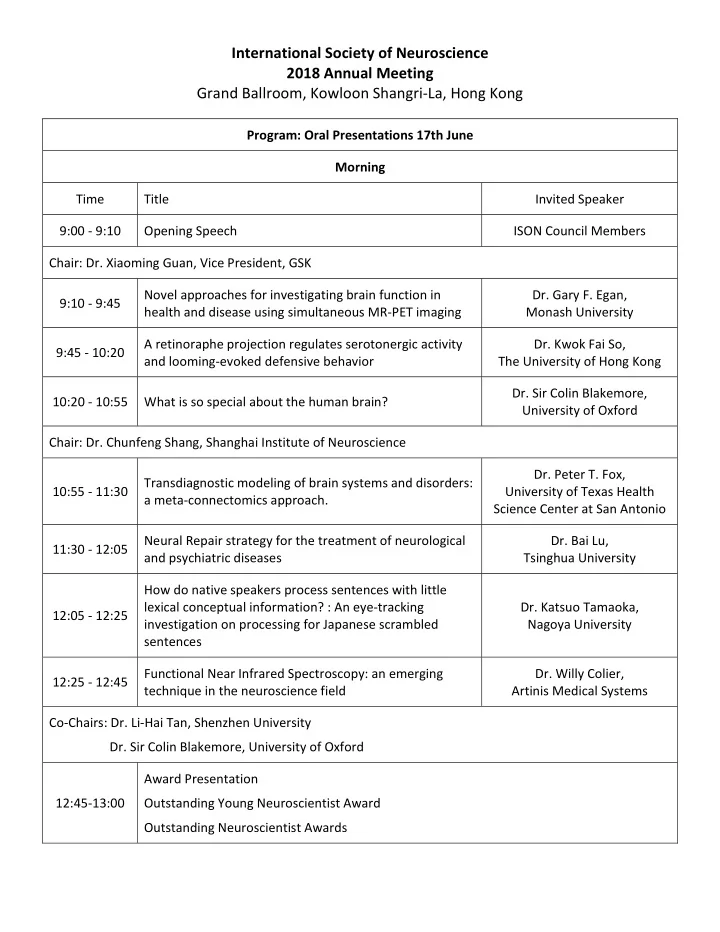
International Society of Neuroscience 2018 Annual Meeting Grand Ballroom, Kowloon ShangriLa, Hong Kong Program: Oral Presentations 17th June Morning Time Title Invited Speaker 9:00 9:10 Opening Speech ISON Council Members Chair: Dr.


slide-1
SLIDE 1

International Society of Neuroscience 2018 Annual Meeting Grand Ballroom, Kowloon Shangri‐La, Hong Kong

Program: Oral Presentations 17th June Morning Time Title Invited Speaker 9:00 ‐ 9:10 Opening Speech ISON Council Members Chair: Dr. Xiaoming Guan, Vice President, GSK 9:10 ‐ 9:45 Novel approaches for investigating brain function in health and disease using simultaneous MR‐PET imaging

  • Dr. Gary F. Egan,

Monash University 9:45 ‐ 10:20 A retinoraphe projection regulates serotonergic activity and looming‐evoked defensive behavior

  • Dr. Kwok Fai So,

The University of Hong Kong 10:20 ‐ 10:55 What is so special about the human brain?

  • Dr. Sir Colin Blakemore,

University of Oxford Chair: Dr. Chunfeng Shang, Shanghai Institute of Neuroscience 10:55 ‐ 11:30 Transdiagnostic modeling of brain systems and disorders: a meta‐connectomics approach.

  • Dr. Peter T. Fox,

University of Texas Health Science Center at San Antonio 11:30 ‐ 12:05 Neural Repair strategy for the treatment of neurological and psychiatric diseases

  • Dr. Bai Lu,

Tsinghua University 12:05 ‐ 12:25 How do native speakers process sentences with little lexical conceptual information? : An eye‐tracking investigation on processing for Japanese scrambled sentences

  • Dr. Katsuo Tamaoka,

Nagoya University 12:25 ‐ 12:45 Functional Near Infrared Spectroscopy: an emerging technique in the neuroscience field

  • Dr. Willy Colier,

Artinis Medical Systems Co‐Chairs: Dr. Li‐Hai Tan, Shenzhen University

  • Dr. Sir Colin Blakemore, University of Oxford

12:45‐13:00 Award Presentation Outstanding Young Neuroscientist Award Outstanding Neuroscientist Awards

slide-2
SLIDE 2

Afternoon Time Title Speaker Chair: Dr. Sir Colin Blakemore, University of Oxford 14:00 ‐ 14:20 How do the Hierarchical Levels of Premises Affect Category‐based Induction: Diverging Effects from the P300 and N400

  • Dr. Yi Lei,

Shenzhen University 14:20 ‐ 14:40 The role of sentence‐final particle ‐ne in Japanese for constructing interpersonal relations

  • Dr. Sachiko Kiyama,

Tohoku University 14:40 ‐ 15:00 TMC proteins modulate membrane excitability through a background sodium‐leak conductance

  • Dr. Xiaomin Yue,

Zhejiang University Chair: Dr. Gui Xue, Beijing Normal University 15:00 ‐ 15:15 The effects of apolipoprotein E on default mode network in Alzheimer’s disease spectrum

  • Dr. Yao Zhu,

Southeast University 15:15 ‐ 15:30 Disrupted functional connectivity patterns of insula subregions in major depressive disorder

  • Dr. Chao Wang,

Shenzhen University 15:30 ‐ 15:45 A Word That Matters: Distinctive Neural Responses of Affirmative and Negative Sentences across Two Languages

  • Dr. Hao Yan,

Xidian University 15:45 ‐ 16:00 Anxious Brain Networks: A Coordinate‐Based Meta‐ analysis of Resting‐State Functional Connectivity Studies in Anxiety Disorders

  • Dr. Pengfei Xu,

Shenzhen Institute of Neuroscience Chair: Dr. Ping Li, Penn State University 16:00 ‐ 16:15 Decoding the intensity of sensory input by one C. elegans interneuron to regulate two types of behavioral outputs

  • Dr. Wenjuan Zou,

Zhejiang University 16:15 ‐ 16:30 Alleviation of Mechanical Allodynia Produced by 14,15‐ epoxyeicosatrienoic Acid in a Central Post‐stroke Pain Model: Possible Role of Allopregnanolone and δGABAARs

  • Dr. Xuhui Chen,

Huazhong University of Science and Technology 16:30 ‐ 16:45 Brain activation and functional connectivity underlying Chinese writing: an fMRI study

  • Dr. Yang Yang,

Chinese Academy of Sciences 16:45 ‐ 17:00 Closing remarks

slide-3
SLIDE 3

Oral Presentation Guidelines

Equipment provided:

  • Podium with microphone
  • Wireless presenter
  • A computer equipped with Windows

(If you are a Macintosh user, please test your presentation on a PC to verify it converts to Windows format accurately) **To eliminate any delays to the start of the session, you are NOT recommended to use your own laptop for presentation. ** Please store your files into an USB, there will be a technician to assist you for setting up. You are highly recommended to give us your USB during registration on 16th June for testing. Preferred format:

  • In English
  • PowerPoint in 4:3 ratio
  • Use standard fonts, such as Times New Roman or Arial
  • Avoid using small fonts that will be illegible from the back of the

room, and break up a complex slide into a series of slides

  • Presentations are most readable on a dark background and bright

lettering

  • Regarding the stability, do not rely on internet access
  • If your presentation contains any video or audio, please try it on
  • ur computer during registration on 16th June

Allocated time: Please refer to the program rundown, there will be Q&A session after each presentation