Janice Walker Janice Walker is a licensed Occupational Therapist - - PDF document

janice walker
SMART_READER_LITE
LIVE PREVIEW

Janice Walker Janice Walker is a licensed Occupational Therapist - - PDF document

02/11/2016 Janice Walker Janice Walker is a licensed Occupational Therapist with over 26 years of therapy experience in rehabilitation hospitals, long term care facilities and home health Janice has had an integral part in the development of the


slide-1
SLIDE 1

02/11/2016

Janice Walker

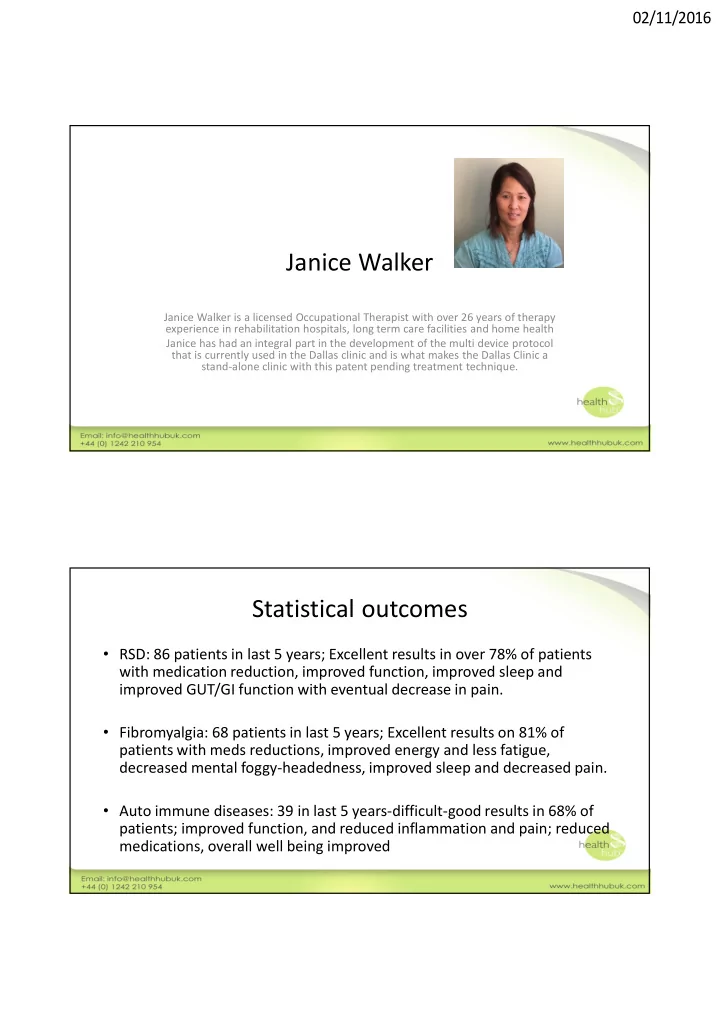
Janice Walker is a licensed Occupational Therapist with over 26 years of therapy experience in rehabilitation hospitals, long term care facilities and home health Janice has had an integral part in the development of the multi device protocol that is currently used in the Dallas clinic and is what makes the Dallas Clinic a stand-alone clinic with this patent pending treatment technique.

Statistical outcomes

  • RSD: 86 patients in last 5 years; Excellent results in over 78% of patients

with medication reduction, improved function, improved sleep and improved GUT/GI function with eventual decrease in pain.

  • Fibromyalgia: 68 patients in last 5 years; Excellent results on 81% of

patients with meds reductions, improved energy and less fatigue, decreased mental foggy-headedness, improved sleep and decreased pain.

  • Auto immune diseases: 39 in last 5 years-difficult-good results in 68% of

patients; improved function, and reduced inflammation and pain; reduced medications, overall well being improved

slide-2
SLIDE 2

02/11/2016

Changes Observed

  • Gut/GI after first 6-10 visits; longer if greater than 4 years of RSD or other conditions
  • More consistent sleep improvement in the first 4-6 visits, but this waxes and wanes

depending on patient lifestyle

  • Functional changes of improved Range, decreased swelling in limb, slight improvement in

energy levels in first 14 treatments

  • Diminished pain over time, gradually lessening in intensity and area in 2nd set of treatments
  • Eventual reduction of pain/narcotics and anti seizure medications and sleep aides
  • Patient receives a Home InterX Kit in the first 14 treatments with this diagnosis
  • During second set of visits (ten), patients level of pain reduces and recovery from activity is

improved at a faster rate. Well being is definitely changed as patient begins to have more HOPE

  • May take 4 series with first-14 visits with break of 7 days; second-10 visits with break of 14;

third-6 visits with a break following of 21; fourth-3 visits with break of a month…Maintenance thereafter

Therapeutic Outcomes InterX

  • Primary Headaches/Migraines: 48 in last 5 years; Great results with

98% pain meds reduction, improved sleep and energy, improved function as pain lessens. May take 6 visits and up to 24 to resolve. Recommended that patient has a home unit in first week of treatment

  • Back and Neck Pain: 198 in last 5 years: Superb results in 90% of
  • patients. Recommend patient take a home unit in first 2 weeks but

a lot of these patients would rather come in. May take 6 to 30 visits depending on the severity of the problem and how many medications the patient is on.

slide-3
SLIDE 3

02/11/2016

Other conditions

  • We see many other complex patients:
  • Some mixed in with RSD. For example, Ehlers Danlos

Syndrome or EDS is difficult. Usually this turns into RSD and then there are much more complicated symptoms associated with the two.

Protocol for Complex Pain

  • use at least 4 InterX devices, this counts for 2 on the body and

2 in my hand for face, and as many as 18 InterX devices…

  • Reciprocals with the flexible array
  • 12 Neuropathic Points
  • Source points
  • Abdomen
  • Six Trigeminal Points/ Cranial Therapy
  • Never place the electrodes on Allodynia site
slide-4
SLIDE 4

02/11/2016

  • Internal functions are coordinated through multiple neurological

relationships

  • Relationships are “reflex” meaning automatic or involuntary
  • InterX uses a category of Reflex Relationships called “reciprocal

correspondences” in its methodologies

Reflex Relationships

  • Reflexes embedded in organism at early stages of

embryo

  • Left/right, front/back, top/bottom seen in first stages
  • f cell development in fertilized ovum

BACK FRONT LEFT RIGHT BOTTOM TOP

Embryological Relationships

slide-5
SLIDE 5

02/11/2016

  • Left/Right

Mirror correspondence is most frequently used

Reflex Relationships: Mirror

  • Left/Right + Top/Bottom

Right shoulder and Left hip Example of a Reciprocal relationship

  • Upright walking and

cross-crawling are evidence of a Reciprocal reflex

Reflex Relationships: Reciprocal

slide-6
SLIDE 6

02/11/2016

  • Left/Right + Top/Bottom +

Front/Back 3-D Reciprocal relationships also extend basic protocols

  • ‘Back of left elbow’ and ‘front of

right knee’ is example of a 3-D Reciprocal relationship.

Reflex Relationships: 3D Reciprocal

4 5 6 1 2 3 7 8 9 1 1 1 1 2

12 Neuropathic Points

  • Before treating with the InterX palpate

every point as you go to have an idea which one is sensitive

  • Select a CHRONIC preset . Choose

60PPS (or 15PPS for hypersensitive) adjust the level of intensity to comfortable ‘vibration’; ‘tingling’

  • Apply InterX to 12 Nerve Points in

sequence starting from 1 to 12, left and right, once a patient feels a pleasant comfortable buzzing sensation, treat by waiting for the Point Stim.

  • If necessary, you can treat longer until a

proper spreading sensation is felt. Always use a very comfortable level of intensity

Ma, Ma, Cho, “Biomedical Acupuncture for Pain Management” Elsevier 2005

slide-7
SLIDE 7

02/11/2016

Source Points Protocol

1 2 3 4 5 6 7 11 12 8 9 10

Chronic Preset 60PPS Intensity to comfortable ‘tingling’ buzzing around sensation Apply stimulation to the points as numbered until ‘Point Stim’

Parasympathetic relaxation

Using flexible array, Preset Cycle 3, on comfortable tingling sensation treat front of the abdomen for 10 minutes follow by the sacral area for another 10 minutes

Abdomen treatment

slide-8
SLIDE 8

02/11/2016

Parasympathetic relaxation

  • When sympathetic overdrive
  • Neuropathic long term pain
  • Overly sensitive
  • Prone to insomnia

6 trigeminal points Using ‘classic’ or small circular’ electrode, Preset 15 PPS for 2 minutes on each point on vibration intensity settings Scalp Using ‘comb’, Preset 15 – 60PPS for 10 minutes on pleasant comfortable intensity settings

Multi-device use

slide-9
SLIDE 9

02/11/2016

Face stimulation CRPS – case study

slide-10
SLIDE 10

02/11/2016

CRPS Case Study Reciprocals

slide-11
SLIDE 11

02/11/2016

Recovered! 16 devices use

slide-12
SLIDE 12

02/11/2016

16 devices use - All limbs Comb technique

slide-13
SLIDE 13

02/11/2016

Source Point protocol Thank you!

www.interx.com janicew@interxtherapycenter.com