Interpre'ng and Compiling Intex Intex programs are simple arithme'c - - PowerPoint PPT Presentation

interpre ng and compiling intex
SMART_READER_LITE
LIVE PREVIEW

Interpre'ng and Compiling Intex Intex programs are simple arithme'c - - PowerPoint PPT Presentation

A New Mini-Language: Intex Interpre'ng and Compiling Intex Intex programs are simple arithme'c expressions on integers that can refer to integer arguments. Intex is the first in a sequence of mini-languages that can be extended to culminate in


slide-1
SLIDE 1

Interpre'ng and Compiling Intex

CS251 Programming Languages

Fall 2017, Lyn Turbak

Department of Computer Science Wellesley College

A New Mini-Language: Intex

Intex programs are simple arithme'c expressions on integers that can refer to integer arguments. Intex is the first in a sequence of mini-languages that can be extended to culminate in something that is similar to Racket. At each step along the way, we can add features that allow us to study different programming language dimensions.

Intex 2

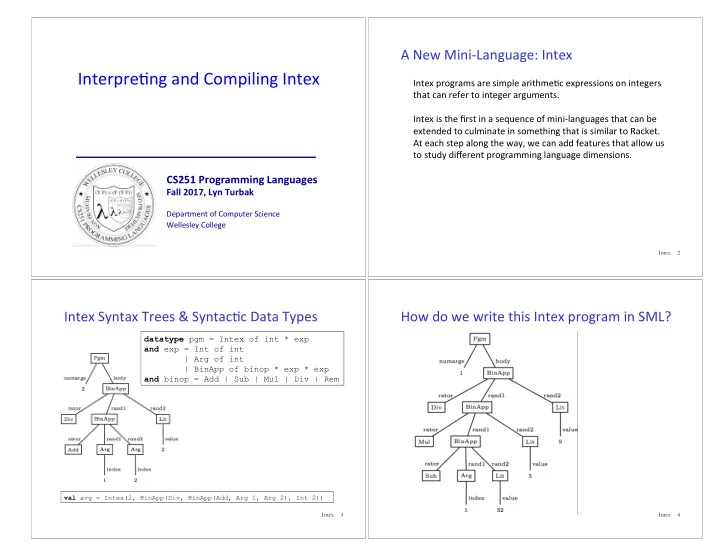
Intex Syntax Trees & Syntac'c Data Types

datatype pgm = Intex of int * exp and exp = Int of int | Arg of int | BinApp of binop * exp * exp and binop = Add | Sub | Mul | Div | Rem

val avg = Intex(2, BinApp(Div, BinApp(Add, Arg 1, Arg 2), Int 2))

Intex 3

How do we write this Intex program in SML?

Intex 4

slide-2
SLIDE 2

Intex Implementa'on #1: Intex Interpreter in SML

Intex 5

avg machine (I) q avg-in-Intex program q Intex interpreter machine (I) ² Intex-in-SML-interpreter program ² SML interpreter machine in wx VM (ignore details) Given an avg-in-Intex program, how can we execute it?

Intex Interpreter Without Error Checking: Skeleton

(* Intex.pgm -> int list -> int *) fun run (Intex(numargs, exp)) args = ?? (* Intex.exp -> int list -> int *) and eval (Int i) args = ?? | eval (Arg index) args = ?? | eval (BinApp(binop, exp1, exp2)) args = ?? (* Intex.binop -> int * int -> int *) and binopToFun Add = op+ | binopToFun Mul = op* | binopToFun Sub = op- | binopToFun Div = (fn(x,y) => x div y) | binopToFun Rem = (fn(x,y) => x mod y)

Intex 6

Intex Interpreter Without Error Checking: Solu'ons

(* Intex.pgm -> int list -> int *) fun run (Intex(numargs, exp)) args = eval exp args (* Intex.exp -> int list -> int *) and eval (Int i) args = i | eval (Arg index) args = List.nth(args, index-1) | eval (BinApp(binop, exp1, exp2)) args = (binopToFun binop)(eval exp1 args, eval exp2 args) (* Intex.binop -> int * int -> int *) and binopToFun Add = op+ | binopToFun Mul = op* | binopToFun Sub = op- | binopToFun Div = (fn(x,y) => x div y) | binopToFun Rem = (fn(x,y) => x mod y)

Intex 7

Intex Interpreter With Error Checking

exception EvalError of string (* Intex.pgm -> int list -> int *) fun run (Intex(numargs, exp)) args = if numargs <> length args then raise EvalError "Mismatch between expected and actual number of args" else eval exp args (* Intex.exp -> int list -> int *) and eval (Int i) args = i | eval (Arg index) args = if (index <= 0) orelse (index > length args) then raise EvalError "Arg index out of bounds" else List.nth(args, index-1) | eval (BinApp(binop, exp1, exp2)) args = let val i1 = eval exp1 args val i2 = eval exp2 args in (case (binop, i2) of (Div, 0) => raise EvalError "Division by 0" | (Rem,0) => raise EvalError "Remainder by 0" | _ => (binopToFun binop)(i1, i2)) end

Intex 8

slide-3
SLIDE 3

Try it out

  • run (Intex(1, BinApp(Mul, Arg 1, Arg 1))) [5];

val it = 25 : int

  • run (Intex(1, BinApp(Div, Arg 1, Arg 1))) [5];

val it = 1 : int

  • run (Intex(1, BinApp(Div, Arg 1, Arg 1))) [0];

uncaught exception EvalError

  • run avg [5,15];

val it = 10 : int

  • map (run f2c) [[~40], [0], [32], [98], [212]];

val it = [~40,~18,0,36,100] : int list

Intex 9

Handling Errors

(* Intex.pgm -> int list -> string *) fun testRun pgm args = Int.toString (run pgm args) (* Convert to string so same type as error messages below *) handle EvalError msg => "EvalError: " ^ msg | other => "Unknown exception: " ^ (exnMessage other)

Intex 10

  • testRun (Intex(1, BinApp(Div, Arg 1, Arg 1))) [5];

val it = "1" : string

  • testRun (Intex(1, BinApp(Div, Arg 1, Arg 1))) [0];

val it = "EvalError: Division by 0" : string

  • map (testRun f2c) [[~40], [0], [32], [98], [212]];

val it = ["~40","~18","0","36","100"] : string list

Intex programs as S-expression strings

Intex(1, BinApp(Mul, Arg 1, Arg 1)

Intex 11

"(intex 1 (* ($ 1) ($ 1))" Intex(2, BinApp(Div, BinApp(Add, Arg 1, Arg 2), Int 2)) "(intex 2 (/ (+ ($ 1) ($ 2)) 2))" Intex(1, BinApp(Div, BinApp(Mul, BinApp(Sub, Arg 1, Int 32), Int 5), Int 9)) "(intex 1 (/ (* (- ($ 1) 32) 5) 9))"

Running Intex programs as S-expression strings

Intex 12

(* string -> string -> string *) fun testRun' pgmSexpString argsSexpString = testRun (stringToPgm pgmSexpString) (sexpStringToIntList argsSexpString) handle SexpError (msg, sexp) => ("SexpError: " ^ msg ^ " " ^ (Sexp.sexpToString sexp)) | Sexp.IllFormedSexp msg => ("SexpError: Ill-formed sexp " ^ msg) | other => "Unknown exception: " ^ (exnMessage other)

  • testRun' "(intex 2 (/ (+ ($ 1) ($ 2)) 2))" "(5 15)";

val it = "10" : string

  • map (testRun' "(intex 1 (/ (* (- ($ 1) 32) 5) 9))")

= ["(-40)", "(0)", "(32)", "(98)", "(212)"]; val it = ["~40","~18","0","36","100"] : string list

  • map (testRun' "(intex 1 (/ ($ 1) ($ 1)))")=

= ["(-17)", "(0)", "(42)"]; val it = ["1”,"EvalError: Division by 0","1"] : string list
slide-4
SLIDE 4

A Read-Eval-Print Loop (REPL) in Intex

Intex 13

  • repl();

intex> (+ 1 2) 3 intex> (#args 6 7) intex> ( * ($ 1) ($ 2)) 42 intex> (#run (intex 2 (/ (+ ($ 1) ($ 2)) 2)) 5 15) 10 intex> (#run "avg.itx" 5 15) 10 intex> (#run avg.itx 5 15) 10 intex> (#quit) Moriturus te saluto!

What do we know about this program?

Intex 14

val test = Intex(2, BinApp(Sub, BinApp(Mul, Arg 1, Arg 3), Arg 2))

| eval (Arg index) args = if (index <= 0) orelse (index > length args) then raise EvalError "Arg index out of bounds" else List.nth(args, index-1)

Dynamic check (at runAme) : StaAc check (at compile Ame or checking Ame, before runAme) :

Idea: We know numargs from program, so can use this to check all argument references without running the program. Such checks are done by examining thee program syntax tree. OXen there is a choice between a bo)om-up and top-down approach to processing the tree. You will do both approaches for Arg index checking in PS9.

Dynamic vs. Sta'c Checking: Arg Indices

Intex 15

Sta'c Arg Index Checking: Top Down

2 2 2 2 2

In top-down phase, pass numargs to every subexpression in program. Check against every arg Index. Return true for Arg indices that pass test and subexps Without arg indices Return false if any Arg index fails test.

Intex 16

slide-5
SLIDE 5

Sta'c Arg Index Checking: Bo\om Up

(1,1) (2,2) (1,2) (∞, -∞) (1,2)

  • 2. Check if in

inclusive range (1, numargs)

  • 1. Calculate (min,max)

Index value for every Subexpression in tree In boQom-up fashion

Intex 17

Intex Implementa'on #2: Intex-to-Pos_ix-compiler in SML

Intex 18

avg machine (I) q avg-in-PostFix program ² avg-in-Intex program ² Intex-to-PostFix-compiler machine

  • Intex-to-PostFix-compiler-in-SML program
  • SML interpreter machine in wx VM (ignore details)

q PostFix interpreter machine (I) ² PostFix-in-SML-interpreter program ² SML interpreter machine in wx VM (ignore details) Given an avg-in-Intex program, how can we execute it?

Hand-Compiling Intex to PostFix

val intexP1 = Intex(0, BinApp(Mul, BinApp(Sub, Int 7, Int 4), BinApp(Div, Int 8, Int 2))) val intexP2 = Intex(4, BinApp(Mul, BinApp(Sub, Arg 1, Arg 2), BinApp(Div, Arg 3, Arg 4)))

Manually translate the following Intex programs to Equivalent PostFix programs ReflecAon: How did you figure out how to translate Intex Arg indices into PostFix Nget indices?

Intex 19

Can we automate this process?

  • translateString "(intex 1 (* ($ 1) ($ 1)))";

val it = "(postfix 1 1 nget 2 nget mul)" : string

  • translateString "(intex 2 (/ (+ ($ 1) ($ 2)) 2))";

val it = "(postfix 2 1 nget 3 nget add 2 div)" : string

  • translateString "(intex 4 (* (- ($ 1) ($ 2)) (/ ($ 3) ($ 4))))";

val it = "(postfix 4 1 nget 3 nget sub 4 nget 6 nget div mul)" : string

Yes! We can define an intexToPostFix func'on with type Intex.pgm -> PostFix.pgm and then use it like this:

Intex 20

fun translateString intexPgmString = PostFix.pgmToString (intexToPostFix (Intex.stringToPgm intexPgmString))

slide-6
SLIDE 6

How to define intexToPostFix? Skeleton

fun intexToPostFix (Intex.Intex(numargs, exp)) = PostFix.PostFix(numargs, expToCmds exp 0???) (* 0 is a depth argument that statically tracks how many values are on stack above the arguments *) and expToCmds (Intex.Int i) depth = ??? | expToCmds (Intex.Arg index) depth = ??? [PostFix.Int (index + depth), PostFix.Nget] (* specified argument is on stack at index + depth *) | expToCmds (Intex.BinApp(binop,exp1,exp2)) depth = ??? (expToCmds exp1 depth) (* 1st rand is at same depth as whole binapp *) @ (expToCmds exp2 (depth + 1)) (* for 2nd rand, add 1 to depth to account for 1st rand *) @ [PostFix.Arithop (binopToArithop binop)] and binopToArithop Intex.Add = PostFix.Add | binopToArithop Intex.Sub = PostFix.Sub | binopToArithop Intex.Mul = PostFix.Mul | binopToArithop Intex.Div = PostFix.Div | binopToArithop Intex.Rem = PostFix.Rem

Intex 21

How to define intexToPostFix? Solu'on

fun intexToPostFix (Intex.Intex(numargs, exp)) = PostFix.PostFix(numargs, expToCmds exp 0) (* 0 is a depth argument that statically tracks how many values are on stack above the arguments *) and expToCmds (Intex.Int i) depth = [PostFix.Int i] | expToCmds (Intex.Arg index) depth = [PostFix.Int (index + depth), PostFix.Nget] (* specified argument is on stack at index + depth *) | expToCmds (Intex.BinApp(binop,exp1,exp2)) depth = (expToCmds exp1 depth) (* 1st rand is at same depth as whole binapp *) @ (expToCmds exp2 (depth + 1)) (* for 2nd rand, add 1 to depth to account for 1st rand *) @ [PostFix.Arithop (binopToArithop binop)] and binopToArithop Intex.Add = PostFix.Add | binopToArithop Intex.Sub = PostFix.Sub | binopToArithop Intex.Mul = PostFix.Mul | binopToArithop Intex.Div = PostFix.Div | binopToArithop Intex.Rem = PostFix.Rem

Intex 22