Introduction Copy Raising: Copy raising is a fascinating phenomenon - - PowerPoint PPT Presentation

introduction copy raising
SMART_READER_LITE
LIVE PREVIEW

Introduction Copy Raising: Copy raising is a fascinating phenomenon - - PowerPoint PPT Presentation

Introduction Copy Raising: Copy raising is a fascinating phenomenon that tests the limits of our current understanding of syntax and how it interacts with other parts of the language system (Rogers 1973, Postal 1974, At the Limits of


slide-1
SLIDE 1

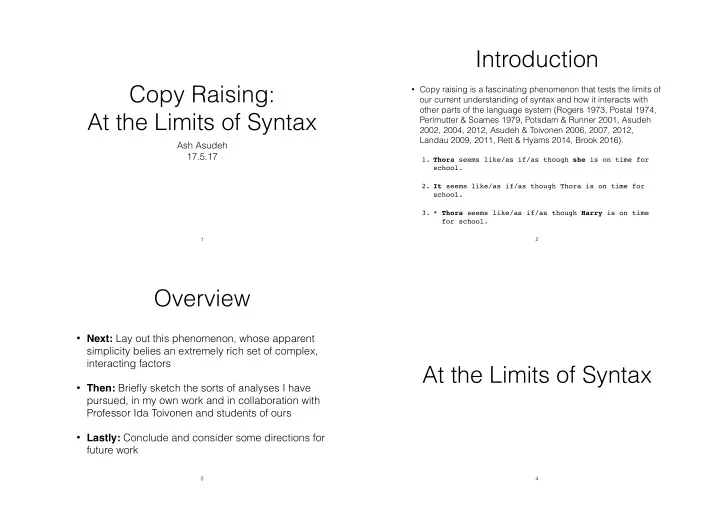
Copy Raising: 
 At the Limits of Syntax

Ash Asudeh
 17.5.17

1

Introduction

  • Copy raising is a fascinating phenomenon that tests the limits of
  • ur current understanding of syntax and how it interacts with
  • ther parts of the language system (Rogers 1973, Postal 1974,

Perlmutter & Soames 1979, Potsdam & Runner 2001, Asudeh 2002, 2004, 2012, Asudeh & Toivonen 2006, 2007, 2012, Landau 2009, 2011, Rett & Hyams 2014, Brook 2016).

  • 1. Thora seems like/as if/as though she is on time for

school.

  • 2. It seems like/as if/as though Thora is on time for

school.

  • 3. * Thora seems like/as if/as though Harry is on time

for school.

2

Overview

  • Next: Lay out this phenomenon, whose apparent

simplicity belies an extremely rich set of complex, interacting factors

  • Then: Briefly sketch the sorts of analyses I have

pursued, in my own work and in collaboration with Professor Ida Toivonen and students of ours

  • Lastly: Conclude and consider some directions for

future work

3

At the Limits of Syntax

4

slide-2
SLIDE 2

Copy Pronouns and Expletives

  • There is an obligatory (for most speakers) “copy” pronoun when the matrix subject

is a non-expletive.

  • Yet, like other raising verbs, the subject can be an expletive, in which case the

expletive must be the expletive it (in English):

  • 4. * There seems like/as if/as though Thora is on time for

school.

  • Unless an expletive there is copied in the subordinate finite clause:
  • 5. There seems like there is a party downstairs.
  • This raises the question of whether a matrix it expletive is independently

generated or “copied” when there is a subordinate it expletive (Horn 1981, Asudeh 2012):

  • 6. It seems like it is raining.

5

The Finite Subordinate Clause

  • The finite subordinate clause is introduced by an obligatory like
  • r as if or as though, not the standard finite that complementizer,

and it also cannot be a bare finite clause:

  • 7. * Thora seems that she is on time for

school.

  • 8. * Thora seems she is on time for school.
  • Contrast:
  • 9. It seems that Thora is on time for school.
  • 10. It seems Thora is on time for school.

6

A Complementizer?

  • Based largely on superficial similarities with the version of

seem with a bare or that finite complement, the complement of copy raising has sometimes been assumed to be a finite clause introduced by a “comparative complementizer”, like/as if/as

  • though. (Rooryck 2000, López-Couso & Méndez-Naya, 2012)
  • However, this misses another obvious point of comparison,

which is with predicative complements of seem, as in:

  • 11. Kim seems sick.
  • 12. Kim seems under the weather.
  • 13. Kim seems like a nice person.

7

A Complementizer?

  • An alternative, then, is that the complement of copy

raising is in fact a predicative phrase of some kind (both PP and AP have been suggested in the literature), headed by a predicative head that takes a finite clause as a complement, which is independently possible:

  • 14. Kim seems proud that Robin scored

a goal.

8

slide-3
SLIDE 3

The Nature of the Comparison

  • The head of the complement in copy raising, like or as,

is an element that is independently used in comparatives:

  • 15. Kim is as tall as Robin.
  • 16. Kim is more like Robin than like

Sandy.

  • 17. Kim greeted Robin very much like/as

if/as though they had not seen each

  • ther in a very long time.

9

The Nature of the Comparison

  • It would seem to miss a generalization to treat these occurrences of

these comparative phrases substantially differently than the

  • ccurrences in copy raising, but what prospect is there for a unified

syntactic treatment across the cases, especially as some are predicative arguments and others are adjuncts?

  • Additionally, what is the semantic basis of the comparison?
  • In copy raising, the comparison seems to be between an

individual and a clause, but this does not make much sense: What is the actual standard of comparison?

  • This could reveal something important about the syntax and

semantics of comparatives and the relationship between syntax and semantics, more broadly.

10

The Syntax of Perception

  • There is a parallel paradigm of perceptual

resemblance verbs (Asudeh 2004, 2012, Asudeh & Toivonen 2012):

  • 18. These fries look/sound/smell/taste/feel

like/as if/as though they have been quadruple deep-fried.

  • 19. It looks/sounds/smells/tastes/feels

like/as if/as though these fries have been quadruple deep-fried.

11

The Syntax of Perception

  • These verbs systematically occur in a number of paradigms,

though (Rogers 1973, Viberg 1983, 2001, Gisborne 2010):


  • Copy raising is therefore part of a larger enquiry into the syntax of

perception.

Modality Percept SUBJ Agentive SUBJ Experiencer SUBJ

Vision look look (at)/watch see Hearing sound listen (to) hear Smell smell smell smell Taste taste taste taste Touch feel feel/touch feel

12

slide-4
SLIDE 4

Perceptual Entailments

  • Moreover, it is well-know that perception verbs have different entailments

depending on the structure of their complements (Barwise 1981, Barwise & Perry 1983):

  • 20. Kim heard that Robin crashed the car. 


⇏ Kim heard the accident

  • 21. Kim heard Robin crash the car.


⇒ Kim heard the accident
 ⇏ Kim heard Robin

  • 22. Kim heard Robin.


⇒ Kim heard Robin

  • There is therefore a very interesting relationship between the syntax and

semantics of perception, which copy raising could shed further light on.

13

The Syntax of Evidentiality

  • Copy raising and perceptual resemblance seem to involve syntactic/

constructional encoding of evidentiality (Aikhenvald 2004, Faller 2002, Garrett 2002, Murray 2010, 2017).

  • This has sometimes been claimed to be direct evidentiality (Rett & Hyams

2014)

  • However, perhaps it is in fact indirect evidentiality (Asudeh, Sullivan & Toivonen

2017)

  • Asudeh & Toivonen (in prep):
  • Argue contra Aikhenvald that evidentiality is necessarily

morphosyntactically marked (‘grammaticalized evidentiality’)

  • Argue instead that we need a common semantic vocabulary for capturing

grammaticalized evidentiality and non-grammaticalized evidentiality

14

The Argument Structure of Copy Raising

  • It might be tempting to assume that the alternation

between copy raising and its expletive-subject variant enjoys the same long-established semantic equivalence as between subject-to-subject raising and its finite variant:

  • 23. Thora seems to be tired.
  • 24. = It seems that Thora is tired.

15

Passive

  • 25. The doctor seemed to examine the patient.
  • 26. = The patient seemed to be examined by the doctor.


  • 27. The doctor seemed like she examined the patient.
  • 28. ≠ The patient seemed like he was examined by the

doctor.

Asudeh & Toivonen (2012) Rosenbaum (1967), Postal (1974)

16

slide-5
SLIDE 5

The Puzzle of the Absent Cook

  • Context: Kim and Robin walk into

Tom’s kitchen. Tom is at the stove doing something, but exactly what is

  • unclear. Kim says:
  • 29. It seems that Tom is

cooking.

  • 30. Tom seems to be cooking.
  • 31. It seems like Tom is

cooking.

  • 32. Tom seems like he is

cooking.

  • Context: Kim and Robin walk into

Tom’s kitchen. There’s no sign of Tom, but there are various things bubbling away on the stove and there are several ingredients on the counter, apparently waiting to be used. Kim says:

  • 33. It seems that Tom is

cooking.

  • 34. Tom seems to be cooking.
  • 35. It seems like Tom is

cooking.

  • 36. * Tom seems like he is

cooking. Asudeh & Toivonen (2012)

17

Control or Raising?

  • The non-equivalence under passive and the puzzle of the absent cook

indicate that perhaps the subject of copy raising is somehow thematic.

  • This means that copy raising is in some sense like a control

construction.

  • Problems:
  • Why, then, do we see an alternation with an expletive subject?
  • What would seem mean as a control predicate?
  • What kind of role would the non-expletive subject play in argument

structure, given that it is a subject, but neither an agent nor an experiencer?

18

Control and Raising

Asudeh & Toivonen (2012: 357)

19

Microvariation: English

Asudeh (2012: 328)

20

slide-6
SLIDE 6

Microvariation: English

Asudeh (2012: 328)

21

Copy Raising in Other Languages

  • Swedish (Asudeh & Toivonen 2012)
  • 37. Han verkar som om han är lugnare nu. 


he seems as if he is calmer now 
 ‘He seems like he is calmer now.’

  • 38. Det verkar på honom som om han är lugnare nu. 


it seems on him as if he is calmer now 
 ‘He seems like he is calmer now.’

  • 39. Det verkar som om han är lugnare nu. 


it seems as if he is calmer now 
 ‘It seems like he is calmer now.’

22

Copy Raising in Other Languages

  • Greek (Joseph 1976, Perlmutter & Soames 1979)
  • 40. Fenete oti i kopeles θa fevgun.


seem.3SG COMP the girls.NOM FUT leave
 ‘It seems that the girls will be leaving.’

  • 41. I kopeles fenonde na fevgun.


the girls.NOM seem.3PL SUBJUNC. leave
 ‘The girls seem to be leaving.’

  • Persian (Darzi 1996)
  • 42. Benæzær miad (ke) bæcheha khæste hæstænd. 

  • pinion PRES.come.3SG (COMP) children tired be.3PL


‘It seems that the children are tired.’

  • 43. % Bæcheha benæzær miand (ke) khæste hæstænd. 


children opinion PRES.come.3PL (COMP) tired be.3PL
 ‘The children seem to be tired.’

23

Hyperraising

  • Apparent raising from a finite clause: 


Bantu (Harford Perez 1985, Carstens 2011, Carstens & Diercks 2013), Brazilian Portuguese (Martins & Nunes 2005), …

  • 44. Lubukusu (Carstens & Diercks 2013)

a. Ka-lolekhana (mbo) babaandu ba-kwa 
 6SA-seem (that) 2people 2SA.PST-fall1 
 ‘It seems that the people fell.’ b. babaandu ba-lolekhana (mbo) ba-kwa
 2people 2SA-seem (that) 2SA.PST-fall
 ‘The people seem like they fell/
 The people seem to have fallen.’

24

slide-7
SLIDE 7

Hyperraising

  • Apparent raising from a finite clause: 


Brazilian Portuguese, Bantu, …

  • 45. Lusaamia (Carstens & Diercks 2013)

a. Bi-bonekhana koti Ouma a-kusa enyumba eyaye 
 8SA-appear that O. 1SA-sell 9house 9POSS 
 ‘It appears that Ouma is selling his house.’ b. Ouma a-bonekhana (koti) a-kusa enyumba eyaye 


  • O. 1SA-appear (that) 1SA-sell 9house 9POSS 


‘Ouma appears as if he’s selling his house/
 Ouma appears to be selling his house.’

25

Analysis

26

Asudeh (2012: 345)

27

Asudeh (2012: 345)

28

slide-8
SLIDE 8

Asudeh (2012: 349)

29

Asudeh (2012: 349)

30

Asudeh (2012: 355)

31

Copy Pronouns:
 The True Limits of Syntax

  • Asudeh (2004,2012): 


Copy pronouns are to raising (a local dependency) as resumptive pronouns are to constituent questions and relative clauses (unbounded dependencies)

  • McCloskey’s Generalization (Asudeh 2011: 122):


Resumptive pronouns are ordinary pronouns.

32

slide-9
SLIDE 9

Copy Pronouns:
 The True Limits of Syntax

  • Given McCloskey’s Generalization and given that copy raising is a

lexically controlled dependency, it follows that the copy pronoun must be a) a morphosyntactically ordinary pronoun that is b) licensed by the copy raising verb.

  • Therefore the licensing mechanism must ultimately not be a special

morphosyntactic mechanism (which would be contra McCloskey’s Generalization), but rather a mechanism about the mapping from syntax to semantics (Asudeh 2004, 2011, 2012).

  • The copy pronoun truly is at the limits of syntax: 


A morphosyntactically ordinary pronoun that behaves exceptionally at the syntax–semantics interface, due to a mechanism associated with a lexical predicate (resource management)

33

Conclusion

  • Copy raising is an apparently simple but actually complex

phenomenon.

  • It reveals much about the nature of the syntactic system.
  • It reveals yet more about the limits of pursuing narrowly

syntactocentric explanations.

  • In order to solve the many puzzles of copy raising, we

need to look carefully at the interactions between syntax and semantics, both compositional and lexical, between syntax and pragmatics, and between syntax and morphology.

34

Future Work

  • A better typological understanding
  • A better understanding of the relationship between

copy raising and hyperraising

  • The nature of the comparison in copy raising
  • The syntax and semantics of perception
  • The syntax and semantics of evidentiality

35

Collaborators Professor Ida Toivonen

  • Dr. Siavash Rafiee Rad

Lisa Sullivan Students

  • Dr. Marie-Elaine van Egmond
  • Dr. Nalini Ramlakhan

Marjolein Poortvliet Claire Lesage Lisa Sullivan Chris Wildman Logic, Language & Information Lab Support Social Sciences and Humanities Research Council of Canada Natural Sciences and Engineering Research Council

  • f Canada

Ministry of Research and Innovation (Ontario)

36

slide-10
SLIDE 10

References

Aikhenvald, Alexandra Y. 2004. Evidentiality. Oxford: Oxford University Press. Asudeh, Ash. 2002. Richard III. In Mary Andronis, Erin Debenport, Anne Pycha, and Keiko Yoshimura, eds., CLS 38: The Main Session, vol. 1, 31–46. Chicago, IL: Chicago Linguistic Society. —. 2004. Resumption as Resource Management. Ph.D. thesis, Stanford University. —. 2011. Towards a Unified Theory of Resumption. In Alain Rouveret, ed., Resumptive Pronouns at the Interfaces, 121–187. Amsterdam: John Benjamins. —. 2012. The Logic of Pronominal Resumption. Oxford: Oxford University Press. Asudeh, Ash, Lisa Sullivan, and Ida Toivonen. 2017. Evidentiality and Reliability in English Copy Raising. Presented at The Annual Meeting of the Linguistic Society of America, Austin, TX. Asudeh, Ash, and Ida Toivonen. 2006. Expletives and the Syntax and Semantics of Copy Raising. In Miriam Butt and Tracy Holloway King, eds., Proceedings of the LFG06 Conference, 14–29. Stanford, CA: CSLI Publications. —. 2007. Copy Raising and Its Consequences for Perception Reports. In Annie Zaenen, Jane Simpson, Tracy Holloway King, Jane Grimshaw, Joan Maling, and Christopher Manning, eds., Architectures, Rules, and Preferences: Variations on Themes by Joan W. Bresnan, 49–67. Stanford, CA: CSLI Publi- cations. —. 2012. Copy Raising and Perception. Natural Language and Linguistic Theory. 30(2): 321–380. —. 2017. A Modular Approach to Evidentiality. To be presented at LFG17, Konstanz. Barwise, Jon. 1981. Scenes and Other Situations. Journal of Philosophy 78: 369–97. Barwise, Jon, and John Perry. 1983. Situations and Attitudes. Cambridge, MA: MIT Press. Brook, Marisa. 2016. Syntactic Categories Informing Variationist Analysis: The Case of English Copy-

  • Raising. Ph.D. thesis, University of Toronto.

Carstens, Vicki. 2011. Hyperactivity and Hyperagreement in Bantu. Lingua 121: 721–741. Carstens, Vicki, and Michael Diercks. 2013. Parametrizing Case and Activity: Hyper-Raising in Bantu. In Seda Kan, Claire Moore-Cantwell, and Robert Staubs, eds., Proceedgins of the 40th Annual Meeting of the North East Linguistics Society, 99–118. Amherst, MA: GLSA. Darzi, Ali. 1996. Word Order, NP-Movements, and Opacity Conditions in Persian. Ph.D. thesis, University

  • f Illinois at Urbana-Champaign.

Faller, Martina. 2002. Semantics and Pragmatics of Evidentials in Cuzco Quechua. Ph.D. thesis, Stanford University. Garrett, Edward. 2002. Evidentiality and Assertion in Tibetan. Ph.D. thesis, UCLA. Harford Perez, Carolyn. 1985. Aspects of Complementation in Three Bantu Languages. Ph.D. thesis, University of Wisconsin, Madison. Horn, Laurence R. 1981. A Pragmatic Approach to Certain Ambiguities. Linguistics and Philosophy 4: 321–358. Joseph, Brian D. 1976. Raising in Modern Greek: A Copying Process. In Jorge Hankamer and Judith Aissen, eds., Harvard Studies in Syntax and Semantics, vol. 2, 241–281. Cambridge, MA: Harvard University, Department of Linguistics. Landau, Idan. 2009. This Construction Looks Like a Copy is Optional. Linguistic Inquiry 40(2): 343–346. —. 2011. Predication Versus Aboutness in Copy-Raising. Natural Language and Linguistic Theory 29: 779–813. López-Couso, María José, and Belén Méndez-Naya. 2012. On the Use of As If, As Though, and Like in Present-Day English Complementation Structures. Journal of English Linguistics 40: 172–195. Martins, Ana Maria, and Jairo Nunes. 2005. Raising Issues in Brazilian and European Portuguese. Journal

  • f Portuguese Linguistics 4: 53–77.

Murray, Sarah E. 2010. Evidentiality and the Structure of Speech Acts. Ph.D. thesis, Rutgers. —. 2017. The Semantics of Evidentials. Oxford: Oxford University Press. Perlmutter, David M., and Scott Soames. 1979. Syntactic Argumentation and the Structure of English. Berkeley, CA: University of California Press. Postal, Paul M. 1974. On Raising: One Rule of English Grammar and its Theoretical Implications. Cam- bridge, MA: MIT Press. Potsdam, Eric, and Jeffrey T. Runner. 2001. Richard Returns: Copy Raising and its Implications. In Mary Andronis, Chris Ball, Heidi Elston, and Sylvain Neuvel, eds., CLS 37: The main session, vol. 1, 453–468. Chicago, IL: Chicago Linguistic Society. Rett, Jessica, and Nina Hyams. 2014. The Acquisition of Syntactically Encoded Evidentiality. Language Acquisition 21(2): 173–198. Rogers, Andy. 1973. Physical Perception Verbs in English: A Study in Lexical Relatedness. Ph.D. thesis, UCLA. Rooryck, Johan. 2000. Configurations of Sentential Complementation: Perspectives from Romance Lan-

  • guages. London: Routledge.

Rosenbaum, Peter S. 1967. The Grammar of English Predicate Complement Constructions. Cambridge, MA: MIT Press. Viberg, Åke. 1983. The Verbs of Perception: A Typological Study. Linguistics 21(1): 123–162. —. 2001. The Verbs of Perception. In Martin Haspelmath, Ekkehard König, Wulf Oesterreicher, and Wolf- gang Raible, eds., Language Typology and Language Universals. An International Handbook. Berlin: de Gruyter.