Introduction I Introduction I Introduction II Introduction II - - PowerPoint PPT Presentation

introduction i introduction i introduction ii
SMART_READER_LITE
LIVE PREVIEW

Introduction I Introduction I Introduction II Introduction II - - PowerPoint PPT Presentation

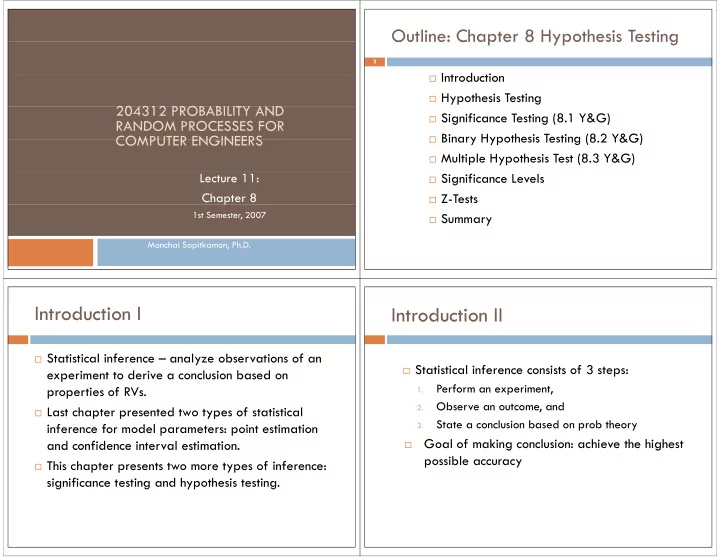
Outline: Chapter 8 Hypothesis Testing Outline: Chapter 8 Hypothesis Testing 2 Introduction I d i Hypothesis Testing 204312 PROBABILITY AND 204312 PROBABILITY AND Significance Testing (8.1 Y&G) RANDOM PROCESSES FOR Binary


slide-1
SLIDE 1

204312 PROBABILITY AND 204312 PROBABILITY AND RANDOM PROCESSES FOR COMPUTER ENGINEERS COMPUTER ENGINEERS

Lecture 11: Chapter 8 p

1st Semester, 2007 Monchai Sopitkamon, Ph.D.

Outline: Chapter 8 Hypothesis Testing Outline: Chapter 8 Hypothesis Testing

I d i

2

Introduction Hypothesis Testing Significance Testing (8.1 Y&G) Binary Hypothesis Testing (8 2 Y&G) Binary Hypothesis Testing (8.2 Y&G) Multiple Hypothesis Test (8.3 Y&G) Significance Levels Z-Tests Summary

Introduction I Introduction I

Statistical inference – analyze observations of an

experiment to derive a conclusion based on properties of RVs.

Last chapter presented two types of statistical

p p yp inference for model parameters: point estimation and confidence interval estimation. and confidence interval estimation.

This chapter presents two more types of inference:

significance testing and hypothesis testing significance testing and hypothesis testing.

Introduction II Introduction II

Statistical inference consists of 3 steps:

f

1.

Perform an experiment,

2.

Observe an outcome, and

3.

State a conclusion based on prob theory

  • Goal of making conclusion: achieve the highest

g g possible accuracy

slide-2
SLIDE 2

Hypothesis Testing : Hypotheses I (8 2 1) (8.2.1)

Allows assessing of the plausibility or credibility of

a specific statement or hypothesis.

Hypothesis Tests of a Population Mean

A null hypothesis H0 for a population mean µ is a A null hypothesis H0 for a population mean µ is a statement that designates possible values for the population mean. p p The alternative hypothesis HA is the “opposite” of the null hypothesis. yp

Hypothesis Testing : Hypotheses II (8.2.1)

A two-sided set of hypothesis is

H0 : µ = µ0 versus HA : µ ≠ µ0 For a specified value of µ0, and a one-sided set of hypothesis is either H0 : µ ≤ µ0 versus HA : µ > µ0

  • r
  • r

H0 : µ ≥ µ0 versus HA : µ < µ0

Hypothesis Testing : Hypotheses III (8.2.1)

Ex.14 pg.342: Metal Cylinder Production

The two-sided hypotheses are H0 : µ = 50 versus HA : µ ≠ 50 The null hypothesis states that the machine produces cylinders with the mean diameter of 50 mm, and the cylinders with the mean diameter of 50 mm, and the alternative hypothesis states that the mean diameter is not equal to 50 mm. q

Hypothesis Testing: Hypotheses IV (8.2.1)

Ex.48 pg.343: Car Fuel Efficiency

The one-sided hypotheses are H0 : µ ≥ 35 versus HA : µ < 35 The null hypothesis states that the manufacturer’s claim regarding the fuel efficiency of its cars is correct, and regarding the fuel efficiency of its cars is correct, and the alternative hypothesis states that the opposite.

slide-3
SLIDE 3

Hypothesis Testing: Interpretation of p- Values (8.2.2)

p-Values

A data set can be used to measure the plausibility of a null hypothesis H0 through the construction of a p-value. The smaller the p-value, the less plausible is the null hypothesis. The p-value can also be called level of significance.

Hypothesis Testing: Interpretation of p- Values II (8.2.2)

P-value construction

Hypothesis Testing: Interpretation of p- Values III (8.2.2)

P-value interpretation P-value interpretation

Rejection of the Null Hypothesis Rejection of the Null Hypothesis

A p-value smaller than 0.01 indicates that the null h th i H i t l ibl t t t hypothesis H0 is not a plausible statement. The null hypothesis H0 is then rejected in favor of th lt ti h th i H the alternative hypothesis HA.

Hypothesis Testing: Interpretation of p- Values IV (8.2.2)

P-value interpretation P-value interpretation

Acceptance of the Null Hypothesis

A p-value larger than 0.1 indicates that the null hypothesis H0 is a plausible statement. The null hypothesis H0 is then accepted. However, H0 has not been proven to be true either.

slide-4
SLIDE 4

Hypothesis Testing: Interpretation of p- Values V (8.2.2)

P-value interpretation P-value interpretation

Intermediate p-Values

A p-value ranges 1% - 10% indicates that data analysis is inconclusive. There is some evidence that the null hypothesis is not plausible, but the evidence is not overwhelming. A larger data set or a cutoff value of 0 05 may be A larger data set or a cutoff value of 0.05 may be used to provide better conclusion.

Hypothesis Testing : Interpretation of p- Values VI (8.2.2)

Ex.14 pg.342: Metal Cylinder Production

The two-sided hypotheses are H0 : µ = 50 versus HA : µ ≠ 50 With a small p-value, the null hypothesis is rejected and the machine is shown to be miscalibrated. With a large p-value, the null hypothesis is accepted and it can be concluded that there is no evidence that the machine is calibrated incorrectly.

Hypothesis Testing: Interpretation of p- Values VII (8.2.2)

Ex.48 pg.343: Car Fuel Efficiency

The one-sided hypotheses are H0 : µ ≥ 35 versus HA : µ < 35 If a small p-value is obtained, the null hypothesis is rejected and the manufacturer’s claim is incorrect. A large p-value indicates that there is not enough evidence to conclude that the manufacturer’s claim is correct.

Hypothesis Testing: Calculation of p-

T id d t T

Values I (8.2.3)

Two-sided t-Test

The p-value for the two-sided hypothesis testing bl problem H0 : µ = µ0 versus HA : µ ≠ µ0 b d d t t f b ti / based on a data set of n observations w/ a sample mean and a sample SD s is p value = 2 x P(X ≥ |t|)

x

p-value = 2 x P(X ≥ |t|) where the RV X has a t-distribution w/ n – 1 degrees of freedom, and degrees of freedom, and hi h i k th t t ti ti

( )

s x n t μ − =

which is known as the t-statistic.

slide-5
SLIDE 5

Hypothesis Testing: Calculation of p- Values II (8.2.3)

P-value for tw o-sided t-test

Hypothesis Testing: Calculation of p- Values III (8.2.3)

Ex Consider the hypothesis

  • Ex. Consider the hypothesis

H0 : µ = 10.0 versus HA : µ ≠ 10.0 suppose that a data set has n = 15, = 10.6, and s = 1.61. The t-statistic is x

( ) ( )

10 6 10 15

The p-value = 2 x P(X ≥ 1.44)

( ) ( )

44 . 1 61 . 1 . 10 6 . 10 15 = − = − = s x n t μ

where the RV X has a t-distribution w/ n – 1 = 14 degrees of freedom g p-value = 2 x 0.086 = 0.172 Since p-value = 0 172 > 0 1 then the null Since p value 0.172 > 0.1, then the null hypothesis that µ = 10.0 should be accepted.

Excel sheet

Hypothesis Testing: Calculation of p- Values IV (8.2.3)

Tw o-sided p-value calculation

Hypothesis Testing: Calculation of p-

One-sided t-Test

Values V (8.2.3)

O

Based on a data set of n observations w/ a sample mean and a sample SD s, the p-value

x

for the one-sided hypothesis testing problem H0 : µ ≤ µ0 versus HA : µ > µ0 is p-value = P(X ≥ t) and p-value for the one-sided hypothesis testing problem H0 : µ ≥ µ0 versus HA : µ < µ0 is p-value = P(X ≤ t) where the RV X has a t-distribution w/ n – 1 d f f d d

( )

degrees of freedom, and

( )

s x n t μ − =

slide-6
SLIDE 6

Hypothesis Testing: Calculation of p- Values VI (8.2.3)

P-value calculation for a id d bl P-value larger than 0 .5 0 f

  • ne-sided problem

for a one-sided t-test

Hypothesis Testing: Calculation of p- Values VII (8.2.3)

E C id th h th i

  • Ex. Consider the hypothesis

H0 : µ ≤ 125.0 VS HA : µ > 125.0 Suppose that a sample mean = 122.3 is

  • bserved. What’s the p-value?

x

p Since the sample mean corresponds to population mean µ contained within the null

x

population mean µ contained within the null hypothesis, the p-value must be > 0.5, and therefore the null hypothesis that µ ≤ 125 0 therefore, the null hypothesis that µ ≤ 125.0 should be accepted.

Hypothesis Testing: Calculation of p- Values VIII (8.2.3)

P-value larger than 0 .5 0 for a one- sided t-test

Hypothesis Testing: Calculation of p- Values VIII (8.2.3)

Suppose instead that a sample mean =

x

Suppose instead that a sample mean =

128.4 is observed, with n = 20 and s = 16.9. S 128 4 125 h

x

Since = 128.4 > µ0 = 125, this suggest that the null hypothesis H0 is false. How ? x plausible is H0? The t-statistic is

( ) ( )

9 . 9 16 125 4 . 128 20 = − = − = s x n t μ

The p-value = P(X ≥ 0.9) = 0.19 Since p value = 0 19 > 0 1 the null

9 . 16 s

Since p-value = 0.19 > 0.1, the null hypothesis is accepted.

Excel sheet

slide-7
SLIDE 7

Significance Testing I (8.1) Significance Testing I (8.1)

Start with the null hypothesis H0 that a certain prob

model describe the observations of an experiment, e.g., μ = μ0.

Two possible answers: accept or reject H0

p p j

Significance level, α, is prob that H0 is rejected

when it is true when it is true

α = P(H0 is rejected)

H0 is rejected when the observation s falls

within the rejection region.

Significance Testing II Significance Testing II

E 8 2 N f ll tt t N t h it hi

Ex.8.2: No. of call attempts N at a phone switching

  • ffice is Poisson RV w/ E(N) = 1000 during 9:00-

9 30PM Th d Th P id ill i 9:30PM every Thursday. The President will give a speech at 9:00 next Thursday to be broadcasted by all radio and TV channels. The null hypothesis, H0, is that the speech does not affect the prob model of phone calls (H0: μ = 1000), or H0 states that on the speech night, N is a Poisson RV w/ E(N) = 1000. Design a significance test for H0 at a significance level of α = 0.05.

Significance Testing III Significance Testing III

27

The experiment involves counting the call requests, N, between 9-9:30pm on the speech night. To design the test, we need to specify a rejection region such that P(N ∈ R) = 0.05. g ( ) Since the no. of calls may be increased or decreased, we choose R to be a symmetrical set {n: |n – 1000| ≥ we choose R to be a symmetrical set {n: |n – 1000| ≥ c}. S d l f h i fi

P(H i

So we need to solve for c that satisfies α = P(H0 is

rejected).

Significance Testing IV Significance Testing IV

28

Since N is Poisson E(N) = Var(N) = 1000 The significance Since N is Poisson, E(N) = Var(N) = 1000. The significance level is

( ) (| 1000 | ) N E N c P N c P α ⎛ ⎞ − = − ≥ = ≥ ⎜ ⎟ ⎜ ⎟

x z μ σ − =

Since E(N) is large, (N-E(N))/σN can be approximated by h d d l RV Z h

(| | )

N N

σ σ ⎜ ⎟ ⎜ ⎟ ⎝ ⎠

σ

the standard normal RV Z so that

2 1 0.05 1000 1000 c c P Z α ⎛ ⎞ ⎛ ⎞ ⎛ ⎞ ≈ ≥ = − Φ = ⎜ ⎟ ⎜ ⎟ ⎜ ⎟ ⎝ ⎠ ⎝ ⎠ ⎝ ⎠

Look up Table 3.1 (pg.123), we

1000 1000 ⎜ ⎟ ⎜ ⎟ ⎝ ⎠ ⎝ ⎠ ⎝ ⎠

0.975 31.623 c ⎛ ⎞ Φ = ⎜ ⎟ ⎝ ⎠

have Φ(1.96) = 0.975. Therefore, c/31.623 = 1.96, or c = 61.98. In conclusion, if h 1000 61 1000 61 ll j we see more than 1000+61 or 1000-61 calls, we reject the null hypothesis at significance level 0.05.

slide-8
SLIDE 8

Significance Testing V Significance Testing V

29

In a significance test, two types of errors are

possible.

Type I Error – False Rejection: Reject H0 when H0 is true Type II Error – False Acceptance: Accept H0 when H0 is

yp p p false

Significance Testing VI Significance Testing VI

30

Therefore, significance level

α = P(H0 is rejected) = P(Type I Error)

( j )

( yp )

To compute P(Type II Error), we need an alternative

hypothesis H defined in the next section hypothesis, H1, defined in the next section.

Significance Testing VII Significance Testing VII

31

Ex.8.3: A drug company runs a test on a group of 64

people before selling its diet pills. The prob model for the weight of the people measured in lbs, is a Gaussian (190, 24) RV W. design a test based on the sample mean of the weight of the population to determine if the pill has a significant effect. The significance level is α = 0.01.

Define null hypothesis H0 as the weight of people after taking the diet pills remain the same, Gaussian(190, 24). If we reject H0, we will decide that the pill works and sell it to the public. So the significance test necessary is to find the rejection region where P( ∈ Rejection Region) = 0.01

X

Significance Testing VIII Significance Testing VIII

32

The sample mean is a Gaussian RV w/ E(X) = 190 and SD = σ/√n = 24/√64 = 3.

X

Since we want to proof if the pill will reduce weight, we choose the rejection region to consist entirely of weights b l h i i l d l R { } below the original expected value: R = { ≤ r0}. We choose r0 so that the prob that we reject H0 is 0.01:

X

⎛ ⎞ 190 ( ) 0.01 3 r P X r − ⎛ ⎞ ≤ = Φ = ⎜ ⎟ ⎝ ⎠ Since Φ(2.33)=0.99, 0.01=1 – Φ(2.33) = Φ(-2.33) 190 2 33 r − − = 2.33 3 190 6.99 183.01 r = = − =

slide-9
SLIDE 9

Significance Testing IX Significance Testing IX

33

Therefore, we will reject the null hypothesis and accept that the diet pill works at significance level 0.01 if the l f h i h d 183 01 lb l sample mean of the weight drops to 183.01 lbs or less.

Note that we selected the rejection region based on

the application of the results of the test.

Ex.8.2 was an example of two-tail significance test,

p g , while Ex.8.3 was one-sided rejection or one-tail significance test. g

Binary Hypothesis Testing I (8.2) Binary Hypothesis Testing I (8.2)

There are two hypothetical prob models, H0, and H1

and two possible conclusions: accept H0 and accept

  • H1. H0

H1

A1 = A0

C

S

A0 A1 A0

P(H0) + P(H1) = 1

If outcome s ∈ A accept H If outcome s ∈ A0 accept H0 If outcome s ∉ A0 accept H1 P(A |H ) = P(Type I Error) P(A1|H0) = P(Type I Error) P(A0|H1) = P(Type II Error)

Binary Hypothesis Testing II Binary Hypothesis Testing II

35

Radar system

Transmitter Target Receiver Type I Error Type II Error

Decision

Type I Error (False Alarm) Type II Error (Miss) H0 = no target H1 = presence of target PFA = P(A1|H0) PMISS = P(A0|H1)

Binary Hypothesis Testing III Binary Hypothesis Testing III

36

A0 = S A1 = φ A0 = S A = φ | A0 S, A1 φ A0 S, A1 φ PMISS = P(A0|H1) PFA = P(A1|H0) A = φ A = S A0 = φ, A1 = S

Figure 8.1 (p. 303)

Continuous and discrete example of a receiver operating curve (ROC).

slide-10
SLIDE 10

Binary Hypothesis Testing IV Binary Hypothesis Testing IV

37

Ex.8.4: Noise voltage in radar system is a Gaussian

(0, 1) RV N. When target is present, received signal is X = v + N volts with v ≥ 0. Otherwise received signal X = N volts. Detector performs binary hypothesis test with H0 as the hypothesis no target and H1 as the hypothesis target present. Acceptance

1

sets for the test are A0 = {X ≤ x0} and A1 = {X > x0}. Draw ROC of radar system for three target

0}

y g voltages v = 0, 1, 2 volts.

Binary Hypothesis Testing V Binary Hypothesis Testing V

38

To draw ROC, need to find PMISS and PFA as functions of

  • x0. From PMISS = P(A0|H1) = P(X ≤ x0|H1) = Φ(x0 – v)

i d h h i H X + N since under hypothesis H1, X = v + N, From PFA = P(A1|H0) = P(X > x0|H0) = 1 – Φ(x0) since under hypothesis H0, X = N.

PMISS = 1 – PFA

Binary Hypothesis Testing VI Binary Hypothesis Testing VI

39

In the previous example, the cost of miss (ignoring

a threatening target) could be far higher than the cost of a false alarm.

This means that the radar system should operate at

y p low value of x0 to produce a low PMISS although this will generate a quite high PFA. will generate a quite high PFA.

Multiple Hypothesis Test I (8.3) Multiple Hypothesis Test I (8.3)

40

f

For experiments that can conform to more than two

known prob models, all with the same sample space S.

MHT is a generalization of binary hypothesis test. M hypothesis prob models, H0, H1, …, HM-1. So we perform an experiment and conclude that a

certain Hm is the true prob model, based on the

  • utcome.

Experimental design starts with dividing S into M

mutually exclusive, collectively exhaustive sets, A0, A1, …, AM-1, such that the conclusion is accept Hi if s ∈ Ai.

slide-11
SLIDE 11

Outline Outline

Significance Levels (8.2.4) Significance Levels (8.2.4) z-Tests (8.2.5) Summary (8.3)

Significance Levels I (8.2.4) Significance Levels I (8.2.4)

The null hypothesis H0 is rejected if the p-value is

smaller than size α (significance level), and H0 is accepted if the p-value is larger than α.

Significance Levels II (8.2.4) Significance Levels II (8.2.4)

Error classification for hypothesis tests

Two-Sided Hypothesis Test for a P l M Population Mean

Because p-value = 2xP(X ≥ |t|)

( )

s x n t μ − =

Critical-point tα/2, n-1 has property: P(X ≥ tα/2 n 1) = α/2

s

(

α/2, n-1)

/ p-value > α if |t| ≤ t /2 1 and p-value > α if |t| ≤ tα/2, n-1 and p-value < α if |t| > tα/2, n-1

Size α tw o- sided t-test

slide-12
SLIDE 12

Two-Sided Hypothesis Test for a P l M E l Population Mean: Example

Sample size n = 18 observations Sample size n

18 observations

Table III provides critical points as in the left Table.

Consider the test statistics |t| = 3 24 1 625

α t

Consider the test statistics |t| = 3.24, 1.625, and 1.74≤|t|≤2.898

α tα/2,17 0.10 1.740 0 05 2 110 0.05 2.110 0.01 2.898

Excel sheet

Relationship Between Confidence Intervals & H h i T I & Hypothesis Tests I

The value µ0 is contained within a 1 - α level

two-sided CI two-sided CI

⎟ ⎟ ⎠ ⎞ ⎜ ⎜ ⎝ ⎛ + −

− −

s t x s t x

n n 1 , 2 / 1 , 2 /

,

α α

if the p-value for the two-sided hypothesis test H0 µ = µ H µ ≠ µ

⎟ ⎠ ⎜ ⎝ n n

: µ = µ0 versus HA : µ ≠ µ0 is larger than α. So, if µ0 is contained within the 1

  • α level CI the hypothesis test with size α
  • α level CI, the hypothesis test with size α

accepts the null hypothesis, and if µ0 is contained

  • utside the 1 - α level CI, the hypothesis test

rejects H0

Relationship Between Confidence Intervals & H h i T II & Hypothesis Tests II

Relationship betw een hypothesis testing and confidence intervals for tw o testing and confidence intervals for tw o- sided problem s

Relationship Between Confidence Intervals & Hypothesis T t III E 47 363 Tests III: Ex.47 pg.363

With t

= 2 756 (from Table III) a 99%

With t0.005, 29 = 2.756 (from Table III), a 99%

two-sided t-interval for the mean tensile strength is strength is

299 . 2 756 . 2 518 . 38 , 299 . 2 756 . 2 518 . 38 ,

1 , 2 / 1 , 2 /

⎟ ⎠ ⎞ ⎜ ⎝ ⎛ × + × − = ⎟ ⎟ ⎞ ⎜ ⎜ ⎛ + −

− −

s t x s t x

n n α α

( )

67 . 39 , 36 . 37 30 , 30 , = ⎟ ⎠ ⎜ ⎝ ⎟ ⎟ ⎠ ⎜ ⎜ ⎝ n n

Since µ0 = 40.0 is not contained within this CI, which is consistent with the hypothesis test H0 : µ 40 0 H 40 0 h i l = 40.0 versus HA : µ ≠ 40.0 having a p-value

  • f 0.0014, so that the null hypothesis is rejected

at size α = 0 01 at size α = 0.01.

Excel sheet

slide-13
SLIDE 13

Relationship Between Confidence Intervals & Hypothesis T t III E 14 363 Tests III: Ex.14 pg.363

With t

= 1 671 a 90% two sided t

With t0.05, 59 = 1.671, a 90% two-sided t-

interval for the mean cylinder diameter is

⎞ ⎛ ⎞ ⎛

( )

028 9 0 49 60 134 . 671 . 1 999 . 49 , 60 134 . 671 . 1 999 . 49 ,

1 , 2 / 1 , 2 /

⎟ ⎠ ⎞ ⎜ ⎝ ⎛ × + × − = ⎟ ⎟ ⎠ ⎞ ⎜ ⎜ ⎝ ⎛ + −

− −

n s t x n s t x

n n α α

Since µ0 = 50.0 is contained within this CI, which is ( )

028 . 50 , 970 . 49 =

consistent with the hypothesis test H0 : µ = 50.0 versus HA : µ ≠ 50.0 having a p-value of 0 954 th t th ll h th i i t d t 0.954, so that the null hypothesis is accepted at size α = 0.1.

Excel sheet

One-Sided Hypothesis Test for a P l M I Population Mean I

( )

s x n t μ − = s

Size α one- sided t-test

One-Sided Hypothesis Test for a P l M II Population Mean II

( )

s x n t μ − = s

Size α one- sided t-test

Relationship Between Confidence Intervals & H h i T I & Hypothesis Tests I

Relationship betw een hypothesis

  • p

ypo testing and confidence intervals for one- sided problem s

slide-14
SLIDE 14

Relationship Between Confidence Intervals & H h i T II & Hypothesis Tests II

Relationship betw een hypothesis Relationship betw een hypothesis testing and confidence intervals for one- sided problem s

Summarization of relationships between CIs, p-values, and significance levels (α) for two-sided and one- a d s g ca ce eve s (α) o wo s ded a d o e sided problems One-Sided Problem Example: Ex.48 pg.366: Car Fuel Effi i Efficiency

The one sided hypothesis are The one-sided hypothesis are

H0 : µ ≥ 35.0 versus HA : µ < 35.0 Si th t t ti ti = 1 119 > t iti l t = Since the t-statistic = -1.119 > t-critical, -t0.01, 19 = - 1.328, a size α = 0.10 hypothesis test accepts the null hypothesis. null hypothesis. This is also consistent w/ the previous analysis where the p-value = 0.1386 > α = 0.10. p Besides, the one-sided 90% t-interval

915 2 328 1

1

⎟ ⎞ ⎜ ⎛ × ⎟ ⎞ ⎜ ⎛ s t

( )

14 35 20 915 . 2 328 . 1 271 . 34 , ,

1 ,

∞ − = ⎟ ⎠ ⎞ ⎜ ⎝ ⎛ × + ∞ − = ⎟ ⎟ ⎠ ⎞ ⎜ ⎜ ⎝ ⎛ + ∞ − ∈

n s t x

n α

μ

contains the value µ0 = 35.0, as expected.

( )

14 . 35 , ∞ =

Excel sheet

Power Levels Power Levels

Significance level α prob that null

h th i i j t d h it i t (T I hypothesis is rejected when it is true (Type I error)

Small significance levels are employed in

hypothesis tests so that the prob of Type I error is small.

Type II error (prob that null hypothesis is

yp (p yp accepted when it is false) should also be minimized, thus the introduction of the “Power minimized, thus the introduction of the Power

  • f a Hypothesis Test” concept.
slide-15
SLIDE 15

Power of a Hypothesis Test Power of a Hypothesis Test

Power = 1 – (prob of Type II error)

= prob that the null hypothesis is rejected when it is p yp j false.

  • The larger the power value the better the
  • The larger the power value, the better the

experiment F fi d i ifi l l th f

  • For a fixed significance level α, the power of a

hypothesis test increases as the sample size n increases.

z-Tests (8.2.5) z Tests (8.2.5)

Used when the population SD σ is known, rather

than the sample SD s.

Uses z-statistic:

( )

μ0 − x n(

)

σ μ0 = x n z

which has standard normal dist when µ = µ0

Two-Sided z-Test I Two Sided z Test I

The p-value for the two-sided hypothesis testing problem H0 : µ = µ0 versus HA : µ ≠ µ0 based on a data set of n observations w/ a sample mean and a population SD σ is p-value = 2 x Φ(-|z|)

x

where the Φ(x) is standard normal CDF and

( )

μ0 − x n

which is known as the z-statistic.

( )

σ μ0 = z

which is known as the z statistic.

Two-Sided z-Test II Two Sided z Test II

A size α test rejects the null hypothesis H0 if the test A size α test rejects the null hypothesis H0 if the test

statistic |z| falls in the rejection region |z| > zα/2 | |

α/2

and accepts the null hypothesis H0 if the test statistic |z| falls in the acceptance region |z| ≤ zα/2 the 1 - α level two-sided CI

⎟ ⎠ ⎞ ⎜ ⎝ ⎛ + − ∈ n z x n z x σ σ μ

α α 2 / 2 /

,

consists of the values µ0 for which this hypothesis testing problem has a p-value > α, or the values g p p µ0 for which the size α hypothesis test accepts the null hypothesis.

slide-16
SLIDE 16

One-Sided z-Test I (H0: µ≤µ0) One Sided z Test I (H0: µ≤µ0)

The p-value for the two-sided hypothesis testing problem p yp g p H0 : µ ≤ µ0 versus HA : µ > µ0 based on a data set of n observations w/ a sample mean and a population SD σ is p-value = 1 – Φ(z)

A i α t t j t th ll h th i wh

x

A size α test rejects the null hypothesis when z > zα and accepts the null hypothesis when and accepts the null hypothesis when z ≤ zα the 1 - α level one-sided CI

⎟ ⎠ ⎞ ⎜ ⎝ ⎛ ∞ − ∈ , z x σ μ

α

α v C consists of the values µ0 for which this hypothesis testing bl h l > α th l µ f whi h

⎠ ⎝ , n μ

problem has a p-value > α, or the values µ0 for which the size α hypothesis test accepts the null hypothesis

One-Sided z-Test II (H0: µ≥µ0) One Sided z Test II (H0: µ≥µ0)

The p-value for the two-sided hypothesis testing problem p yp g p H0 : µ ≥ µ0 versus HA : µ < µ0 based on a data set of n observations w/ a sample mean and a population SD σ is p-value = Φ(z)

A i α t t j t th ll h th i wh

x

A size α test rejects the null hypothesis when z < -zα and accepts the null hypothesis when and accepts the null hypothesis when z ≥ -zα the 1 - α level one-sided CI

⎟ ⎠ ⎞ ⎜ ⎝ ⎛ + ∞ − ∈ z x σ μ

α

,

α v C consists of the values µ0 for which this hypothesis testing bl h l > α th l µ f whi h

⎠ ⎝ n μ ,

problem has a p-value > α, or the values µ0 for which the size α hypothesis test accepts the null hypothesis

Summary I (8.3) Summary I (8.3)

Decision process for inferences on a population m ean

Summary II (8.3) Summary II (8.3)

Sum m ary of the t-procedure

slide-17
SLIDE 17

Summary III (8.3) Summary III (8.3)

Sum m ary of the z-procedure

HW 8 HW 8

66

Problem 8.1.4 8 1 5 8.1.5 8.2.8, 8.2.12 ,

(Hayter pg.372)