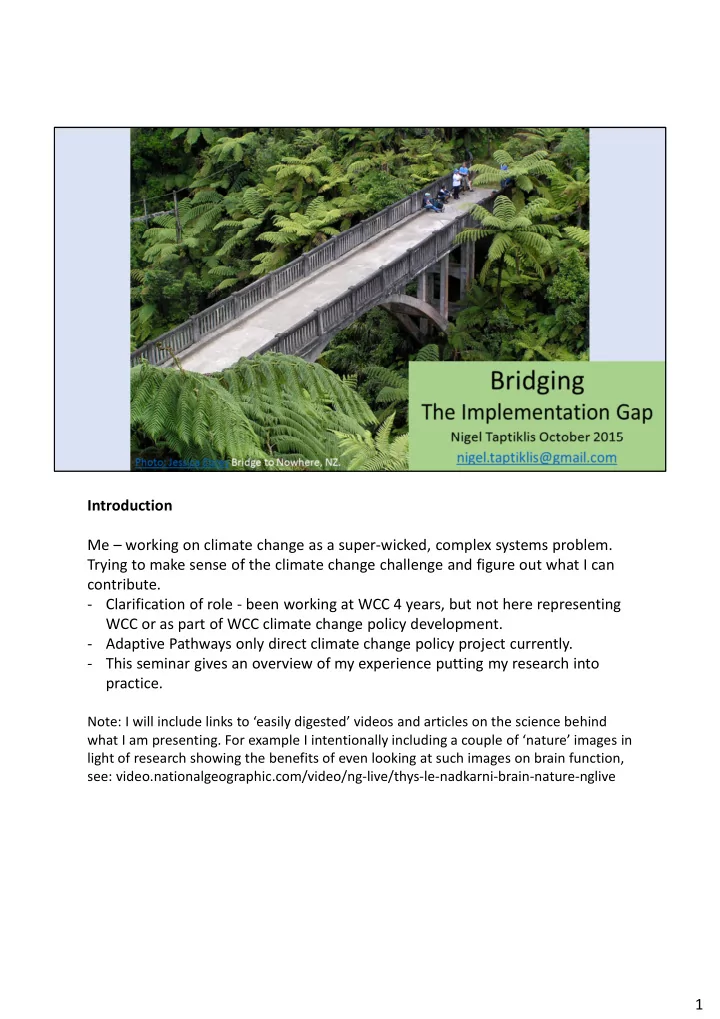
SLIDE 1 Introduction Me – working on climate change as a super-wicked, complex systems problem. Trying to make sense of the climate change challenge and figure out what I can contribute.
- Clarification of role - been working at WCC 4 years, but not here representing
WCC or as part of WCC climate change policy development.
- Adaptive Pathways only direct climate change policy project currently.
- This seminar gives an overview of my experience putting my research into
practice.
Note: I will include links to ‘easily digested’ videos and articles on the science behind what I am presenting. For example I intentionally including a couple of ‘nature’ images in light of research showing the benefits of even looking at such images on brain function, see: video.nationalgeographic.com/video/ng-live/thys-le-nadkarni-brain-nature-nglive
1
SLIDE 2
Behaviour over Time – Sigmoid Curve My experience stems from the question I’ve thought deeply on for a number of years, any many of you share. How do we generate a societal response to avoid 2 degrees plus?
Systems Thinking has been very influential on my work. Complex systems experience reinforcing and balancing feedbacks. This means that one way or another we will stop putting too much carbon dioxide into the atmosphere. (click) Either we stop, (click) or we’ll be stopped. To avoid the latter we somehow need to stabilize our emissions at 450ppm co2e or less.
2
SLIDE 3 Who’s in the room? 3 people, 1 minute each, quick introduction, what is climate change to you? 3 people, 1 minute each, quick introduction, is it possible to stop climate change? I think climate change is currently framed as:
- an impending apocalyptic/dystopian thing
- it will eat your coastal nest-egg
- we’re too small to do anything about it
- anything the government does is nanny state interference in the market.
There’s a real risk of losing the audience! Note: I was experimenting with introducing a group ‘settling’ process within a lecture theatre environment. The result was great, with a really high level of engagement and great discussion to kick off the seminar. Well worth the 10 minutes of time invested. 3
SLIDE 4
4
SLIDE 5 Planetary Boundaries Not only is time running out, we have left our safe operating space and are heading into the red. And not just on climate change, there are multiple areas where we need a better operating system for human development on spaceship earth.
- Operating system upgrade.
In January Veronika Meduna did a story on the Planetary Boundaries work and interviewed Will Steffen for Radio NZ’s Our Changing World: http://www.radionz.co.nz/national/programmes/ourchangingworld/20150129#audio- 20165060 For some world-leading local work on upgrading our organisational operating systems see this talk: Alanna Krause: Inventing a New Organizational Operating System https://www.youtube.com/watch?v=4ABqCgKi4X0
5
SLIDE 6 We’re each responsible, we all live relatively carbon intensive lives in a carbon intensive
- society. How so we turn the observers attention back on themselves?
6
SLIDE 7 What is fit for purpose?
- Operating from within the ‘wicked’ space, and creating space to operate within
the wicked space.
- Acting enough to know vs knowing enough to act
- Working through influence rather than ‘command and control’
- Our society has made huge advances by addressing the complex problems of
human development. Now we need to develop the approaches and institutions that will enable us to address wicked problems. In an increasingly interconnected world, we’ll need to spend more and more time in the wicked space. Lifehack, based in Wellington, is a great local example. Members of the Lifehack team within Enspiral have helped develop and then co-lead the Smart Energy
- Challenge. http://lifehackhq.co/
7
SLIDE 8 This is another perspective and way to frame the fit-for-purpose problem. Again, there are many ways to frame and approach wicked problems. I have a background in outdoor pursuits, and like to triangulate using different frames to help navigate.
- Creative processes hold a space for divergent, social and empathetic thinking, then
apply convergent analytic thinking to define and prototype, within iterative cycles. On the Left-Right brain framing, also see this great RSA Animate talk on TED: https://www.ted.com/talks/iain_mcgilchrist_the_divided_brain For another framing see Zaid Hassan’s A world and B world analogue https://twitter.com/zaidhassan/status/604535416897732608 (Zaid is the author of The Social Labs Revolution: A New Approach to Solving Our Most Complex Challenges).
8
SLIDE 9 Iceberg - systems thinking
- This is the model I used to structure my resilience assessment of Wellington’s water
supply system
- Systems thinking offers a worldview that can help us see the whole.
- All models are wrong, but some are useful - they can help convey complex
information so extend our cognitive capacity.
- The Iceberg illustrates that the layer beneath is key to understanding and influencing
the layer above. I have added ‘deep cognition’ to reflect insights from cognitive and behavioural sciences can help us understand how and what we think.
- The good stuff happens here, in the grey stuff right between our own ears. Our own
thinking is the most powerful level to influence systemic change, but also the hardest to grasp.
- All communication vehicles are art.
- Social learning and collective intelligence are the key to social progress and human
development.
I used knowledge of cognitive biases and information processes to get a diverse group to work together to build a socio-ecological model of Wellington’s water system. I called the mechanism ‘creative dissonance’. The Theatre of the Brain (Article) https://www.psychologytoday.com/blog/the-theater-the- brain/201312/the-neuroscience-communication Here is an infographic covering 20 cognitive biases: http://www.businessinsider.com.au/cognitive-biases-that-affect-decisions-2015-8
9
SLIDE 10 Snowball – social innovation catalyst model
- social learning catalyst model - derived from my research, got a bunch of
people together, and used their collective intelligence to sketch out a socio- ecological model of the water supply system.
- Need action, need participation, need collaboration to drive change.
- Starts with change! (including between your own ears)
- Science and design, art and language, information needs to be provided in a
form that our brains love processing it. Projects and programmes can generate new stories and experiences.
- Experience is real, grounding. If I have that experience, it affirms, strengthens
and empowers me.
- We also needs interest, motivation - Purpose! These stem from our values.
Also see the UK Behavioural Insight team’s EAST behaviour change model: http://www.behaviouralinsights.co.uk/publications/east-four-simple-ways-to- apply-behavioural-insights/ 10
SLIDE 11
Structure Diagram (aka Horrendogram) You can see the parts of the Snowball model within this structure diagram from my research (Change = Transformation). The arrows show direction of influence, where an increase in one variable affects another. An O identifies a decrease, otherwise an increase is indicated. A reinforcing feedback generates the rapid rate of acceleration needed for ‘take-off’. An O indicates a balancing feedback. Case study report available here: http://www.victoria.ac.nz/sgees/research- centres/documents/climate-resilient-water-management-in-wellington-new-zealand.pdf
11
SLIDE 12 Behaviour over Time in practice looks more like this
- My work is strategic policy, arranging the circumstances for the work that
needs to follow
- Basic shape called a Sigmoid Curve, common in nature and complex systems.
Population, acid/base titrations…
- I have been successfully leveraging off attractive prototypes, but within an
- rganisation these also tend to get ‘swooped’ by other people
- Also difficult to build an explicit programme of work due to constant
- rganisation restructuring and turnover
- Currently working on project governance to address these challenges.
APPM (Agile Policy Project Management) is an open-source project management and governance project being developed right here in Wellington, and getting great traction within the public sector: http://www.agileppm.org.nz/ https://prezi.com/c69sif5-8p- y/appm-how/ Also see this article on managing personal and organisational change: http://www.eoslifework.co.uk/transmgt1.htm
12
SLIDE 13 Multi-level Perspective
- Niches are where the action is, more attuned to the world, rather than being caught
up in their own processes
- Look to the niches – eg Enspiral, applying lean/agile to “stuff that matters”
http://www.enspiral.com/about/
- The NZCCRI is also a ‘niche’ I can partner with to do innovative work.
Note: I highly recommend the Rotmans et al. paper on transition management in public policy cited above.
13
SLIDE 14 Adaptive Cycle
- This model illustrates how resources are tied up in the mature phase, and need to be
unlocked.
- The Smart Energy Challenge was designed to combine the creative freedom of social
entrepreneurs with the resources available to the Council.
- In my role I lack creative freedom, while people in niches suffer ‘the entrepreneurs
dilemma’ due to scarce resources.
14
SLIDE 15
Examples (early) how to avoid disengagement? Need to lead with attractive and positive projects/prototype. Included in this presentation: Smart Energy Challenge Climathon 100RC Rapid Hacks Others Adaptive Pathways (in progress with NZCCRI) Keep a cool world/Kids for Climate Art project Island Bay Seawall Project (I’ve contributed but not led this one) 15
SLIDE 16
Started with an EV demonstration outside Te Papa. Pulled together in less than a moth with EV enthusiasts. This attracted plenty of positive media attention and the Smart Energy Expo to Wellington. Led to establishment of the Smart Energy Capital Fund. The Smart Energy Challenge has helped establish new startups, including an electric car- share business set to launch early 2016, and a carshare policy for Wellington. People involved are using what they have learned and doing more, Lou Sherrell from the Aro Solar team is part of the team bring Campaign Bootcamp to NZ. We also built the capacity to deliver Climaton in NZ. Thi swas the most attended in the world (70 people) and had the best support package for teams. One of the teams will present their business idea in Paris as part of COP21.
16
SLIDE 17 My priority over the last 18 months has been to connect Wellington into the 100 Resilient Cities network, to provide the wider context for ‘climate resilience’ work. 100 Resilient Cities is a global programme, that will see a network of 100 cities around the world developing resilience strategies. 200+ people attended Wellington’s launch workshop, climate change feature in the discussion, and will be incorporated within the strategy (how is yet to be determined, but I’m developing some tools with NZCCRI to help). I think the resilience framing still needs to be located within a wider “telling new stories
WCC project page here: http://wellington.govt.nz/about-wellington/resilient-wellington
17
SLIDE 18
Theory U is a social technology/process for sector innovation. It was ‘behind the curtain’ for the Land and Water Forum. MIT ran two mooc this year, with 60,000 people around the world participating. Huffington Post Article on U.Lab: http://www.huffingtonpost.com/otto-scharmer/mooc- 40-the-next-revoluti_b_7209606.html Australia/NZ Facebook group: https://www.facebook.com/groups/ulab.aus.nz/
18
SLIDE 19
I’ve developed the ‘Rapid hack’ as an introduction to the social technology used in the Smart Energy Challenge, Climathon and Theory U. Teams form and prototype something together all within a 1 hour workshop. My notes and pictures from my most recent Rapid Hack are here: https://www.loomio.org/d/K2u9bWSd/rapidhack-at-the-keep-a-cool-world-climate- change-expo-20-September
19
SLIDE 20
By simply framing the wicked problem characteristics as opportunities, we can create powerful questions to generate innovative responses.
20
SLIDE 21
Discussion: Reflections & new insights
In summary, I think the answer to this question lies in experiencing climate change
as a challenge and opportunity we can tackle. Experience is real, grounding. If I have that experience, it affirms, strengthens and empowers me.
Thanks!
21