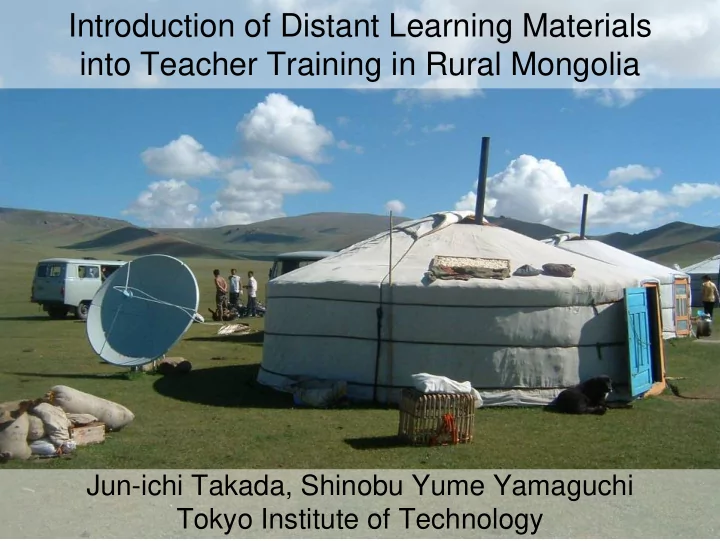
Introduction of Distant Learning Materials into Teacher Training in - - PowerPoint PPT Presentation

introduction of distant learning materials into teacher
SMART_READER_LITE
LIVE PREVIEW

Introduction of Distant Learning Materials into Teacher Training in - - PowerPoint PPT Presentation

Introduction of Distant Learning Materials into Teacher Training in Rural Mongolia Jun-ichi Takada, Shinobu Yume Yamaguchi 1 Tokyo Institute of Technology 1. A)


slide-1
SLIDE 1

1

Introduction of Distant Learning Materials into Teacher Training in Rural Mongolia

Jun-ichi Takada, Shinobu Yume Yamaguchi Tokyo Institute of Technology

slide-2
SLIDE 2

2

発表内容

1. 背景 A) 教育分野における課題 B) プロジェクトの概要 C) 遠隔教材導入のための社会基盤整備の現状 2. 遠隔教育の導入について 3. 遠隔教育導入に関する調査 A) ガイドライン B) ラジオ番組 C) VCD 教材 4. 調査結果比較分析 5. 今後の課題・留意点

slide-3
SLIDE 3

3

Recent Incidents Related to Rural Schools in Mongolia

  • Transition from socialism to capitalism in 1990’s

Drop of budget for education in GDP: 11.5%(1990)->6.8%(1998) Drop of student enrolment: 98%(1990)=>84%(1995) New education law (2003): Child-centered approach Regional gap in teacher training due to decentrarization

  • “Dzud”: natural disaster of extreme cold (2000-2001)

Death of 6,000,000 lifestocks (1/3 of whole Mongolia)

Affects of “Dzud” to Schools

Destruction of school building and dormitory Damage of heating system Loss of study time Decline of teachers’ motivation Migration of teachers to cities

slide-4
SLIDE 4

4

Project Outline

Survey of Reusable Energy Building Rehabilitation

UNESCO Mongolian Govt

Ministry of Education

UNICEF

UN

Human Security Fund Tokyo Tech

  • Global Scientific and

Information Center

  • Department of International

Development Engineering

Technical Assistance Project Team Budget

Teacher Recurrent Training

Rural Schools 20 schools in 3 provinces Building Rehabilitation and Teacher Recurrent Training Project in Gobi Provinces

Means of Distant Training

slide-5
SLIDE 5

5

Jaargalant Mandalgobi

Zavkhan Ulan Bator Bayankhongor Dundgobi

Uliastai Dundgobi

Mobile Training

  • Lecturers move by cars
  • Low population density
  • Lack of public transportation

=> Distant learning

1000 km

slide-6
SLIDE 6

6

Status of Infrastructure for Deploying Distant Learning Media

  • Electrical power network

– Dundgobi: connected to central grid – Bayankhongor, Zavkhan: village or school generator

  • Village level: hydro, diesel (stopped due to oil expense)
  • School level: engine generator, solar panel
slide-7
SLIDE 7

7

Status of Infrastructure for Deploying Distant Learning Media

  • Communication network

– Telephone available only in telecenter in the village – No Internet access

slide-8
SLIDE 8

8

Status of Infrastructure for Deploying Distant Learning Media

  • Media appliances

– National radio (LF/HF): whole country – Satellite TV: parabolic dish, more popular than terrestrial TV – Audio cassette player – VCD player: combination with TV, driven by solar cell

slide-9
SLIDE 9

9

National Project Team

State University of Education Institute of Education

  • Educational Policy
  • Collaboration in

developing contents Manual

  • Post- graduate training

department Contents

  • Departments according to the 6 selected

subjects: (Natural Science, Mathematics & informatics, Humanities, Art & Technology, History and Social Science) VCD production

  • School of Mongolian Language, Department of Journalism
  • Unit in distant education
  • Technical assistance and

airing in radio program Ministry of Education National Radio Station

Guidelines

Needs assessment for teachers

  • Baseline survey, May 2004
  • Questionnaire for teachers, Nov. 2004
  • Additional response from teachers, Dec. 2004

6 Subjects

Radio program VCD material

  • Content is 25 min
  • 4,500 USD to develop material
  • School of Mongolia Language & Art
  • 6 subjects, 10 lessons
  • Material testing in summer

training

  • Being aired in May, June (6 times X 2)
  • 15-

20 min, 6 program and its repeat next day

  • Group training is highly recommended
  • Contents developed by

SUoEd and Institute

  • f Education
  • 2,500 USD to develop and air program
  • Nationwide coverage of the program

Audio cassette material

  • 300

copies are to be distributed in June

  • Half of schools in Mongolia are to be covered
  • Science
  • Mathematics & Informatics
  • Human Science
  • Art and technology
  • History & social science
  • Teachers & student communication

Feedback

  • Content based on teachers

’ concrete questions

  • Complementary materials to

radio program and VCD

Production of distant learning materials

slide-10
SLIDE 10

10

Interview in Training Observation of Infrastructure Questionnaires

Evaluation of Distant Learning Materials

slide-11
SLIDE 11

11

Mobile Teacher Training

  • Date: July 30 – August 17, 2006
  • Participants

Province School Participants Zavkhan Uliastai Devshil 78 (from 7 villages) Bayankhongor Jaagalant 77 (from 8 villages) Dundgobi Mandalgobi Saintsaagan 124 (from 8 villages)

slide-12
SLIDE 12

12

Executive Summary Useful Media for Future Training

Zavkhan Bayankhongor Dundgobi Guideline 48% (26) 31% (12) 48% (36) Radio program 6% (11) 28% (11) 21% (16) VCD 61% (33) 89% (35) 69% (52) Mixed use 20% (11) 21% (8) 39% (20)

  • VCD is highly appreciated.

– Use of solar cell – VCD player at home

  • Radio is not preferred.

– Time constraint – Impression of “old medium”

  • Guideline is still useful.

– No appliances Training in small group at home Interest in mixed use

slide-13
SLIDE 13

13

Issues and Future Tasks

1. Enhancement of VCD materials

  • Improvement of audio and visual quality
  • Experiments and model lectures
  • More titles to cover wide subjects

2. Electrical power supply

  • Reusable energy, e.g. solar cell – policy

3. ICT infrastructure

  • Rapid change due to progress of technology
  • Internet training facility available in provincial capital
  • Best media always changing

4. Complement, not replacement

  • Mobile training is still needed.
slide-14
SLIDE 14

14

Project Sustainability

  • Use of available and affordable technology

– Running cost is majority in ICT. – Advanced technology needs more expensive human resource (technician), which may drain after project.

  • Matching with needs

– Distant training materials do not work alone. – How to use materials in training should be carefully considered and provided to teachers.

slide-15
SLIDE 15

15

Training in Uliastai, Zavkhan

slide-16
SLIDE 16

16

Training in Uliastai, Zavkhan