Introduction I So far, we have focused on problems with efficient - - PDF document

introduction
SMART_READER_LITE
LIVE PREVIEW

Introduction I So far, we have focused on problems with efficient - - PDF document

Introduction I So far, we have focused on problems with efficient algorithms I I.e., problems with algorithms that run in polynomial time: O ( n c ) for some constant c 1 Computer Science & Engineering 423/823 I Side note 1: We call


slide-1
SLIDE 1

1/48

Computer Science & Engineering 423/823 Design and Analysis of Algorithms

Lecture 10 — NP-Completeness (Chapter 34) Stephen Scott and Vinodchandran N. Variyam

2/48

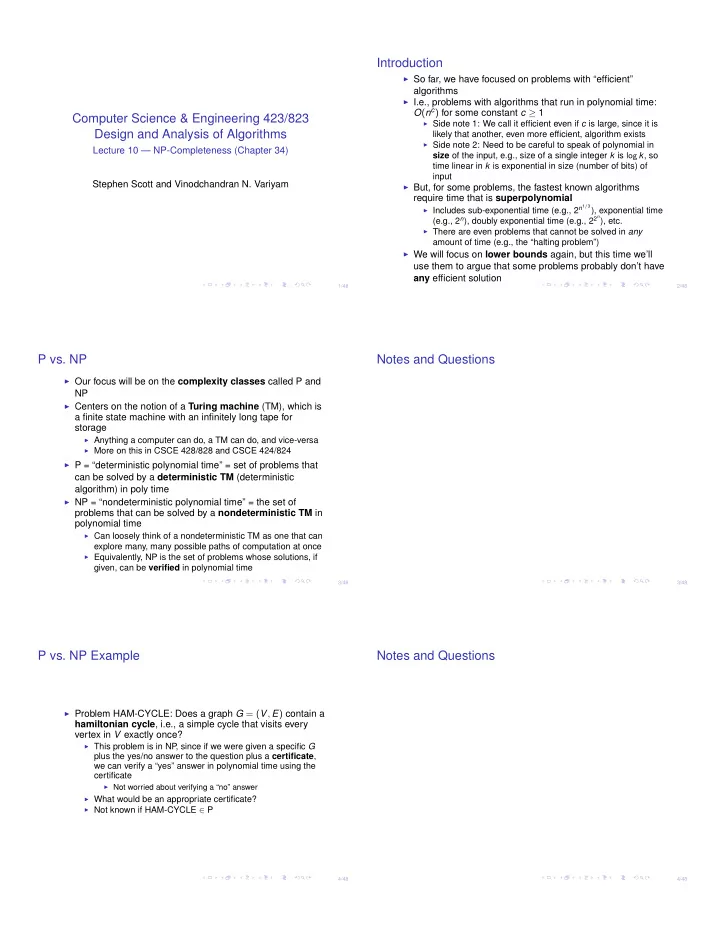
Introduction

I So far, we have focused on problems with “efficient”

algorithms

I I.e., problems with algorithms that run in polynomial time:

O(nc) for some constant c 1

I Side note 1: We call it efficient even if c is large, since it is

likely that another, even more efficient, algorithm exists

I Side note 2: Need to be careful to speak of polynomial in

size of the input, e.g., size of a single integer k is log k, so time linear in k is exponential in size (number of bits) of input

I But, for some problems, the fastest known algorithms

require time that is superpolynomial

I Includes sub-exponential time (e.g., 2n1/3), exponential time

(e.g., 2n), doubly exponential time (e.g., 22n), etc.

I There are even problems that cannot be solved in any

amount of time (e.g., the “halting problem”)

I We will focus on lower bounds again, but this time we’ll

use them to argue that some problems probably don’t have any efficient solution

3/48

P vs. NP

I Our focus will be on the complexity classes called P and

NP

I Centers on the notion of a Turing machine (TM), which is

a finite state machine with an infinitely long tape for storage

I Anything a computer can do, a TM can do, and vice-versa I More on this in CSCE 428/828 and CSCE 424/824

I P = “deterministic polynomial time” = set of problems that

can be solved by a deterministic TM (deterministic algorithm) in poly time

I NP = “nondeterministic polynomial time” = the set of

problems that can be solved by a nondeterministic TM in polynomial time

I Can loosely think of a nondeterministic TM as one that can

explore many, many possible paths of computation at once

I Equivalently, NP is the set of problems whose solutions, if

given, can be verified in polynomial time

3/48

Notes and Questions

4/48

P vs. NP Example

I Problem HAM-CYCLE: Does a graph G = (V, E) contain a

hamiltonian cycle, i.e., a simple cycle that visits every vertex in V exactly once?

I This problem is in NP

, since if we were given a specific G plus the yes/no answer to the question plus a certificate, we can verify a “yes” answer in polynomial time using the certificate

I Not worried about verifying a “no” answer I What would be an appropriate certificate? I Not known if HAM-CYCLE 2 P 4/48

Notes and Questions

slide-2
SLIDE 2

5/48

P vs. NP Example (2)

I Problem EULER: Does a directed graph G = (V, E)

contain an Euler tour, i.e., a cycle that visits every edge in E exactly once and can visit vertices multiple times?

I This problem is in P

, since we can answer the question in polynomial time by checking if each vertex’s in-degree equals its out-degree

I Does that mean that the problem is also in NP? If so, what

is the certificate?

5/48

Notes and Questions

6/48

NP-Completeness

I Any problem in P is also in NP

, since if we can efficently solve the problem, we get the poly-time verification for free

) P ✓ NP

I Not known if P ⇢ NP

, i.e., unknown if there exists a problem in NP that’s not in P

I A subset of the problems in NP is the set of NP-complete

(NPC) problems

I Every problem in NPC is at least as hard as all others in NP I These problems are believed to be intractable (no efficient

algorithm), but not yet proven to be so

I If any NPC problem is in P

, then P = NP and life is glorious

..

^ and a little bit scary (e.g., RSA public key algorithm would break)

6/48

Notes and Questions

7/48

Proving NP-Completeness

I Thus, if we prove that a problem is NPC, we can tell our

boss that we cannot find an efficient algorithm and should take a different approach

I E.g., approximation algorithm, heuristic approach

I How do we prove that a problem B is NPC?

  • 1. Prove that B 2 NP by identifying certificate that can be

used to verify a “yes” answer in polynomial time

I Typically, use the obvious choice of what causes the “yes”

(e.g., the hamiltonian cycle itself, given as a list of vertices)

I Need to argue that verification requires polynomial time I The certificate is not merely the instance, unless B ∈ P

  • 2. Show that B is as hard as any other NP problem by

showing that if we can efficiently solve B then we can efficiently solve all problems in NP

I First step is usually easy, but second looks difficult I Fortunately, part of the work has been done for us ...

7/48

Notes and Questions

slide-3
SLIDE 3

8/48

Reductions

I We will use the idea of an efficient reduction of one

problem to another to prove how hard the latter one is

I A reduction takes an instance of one problem A and

transforms it to an instance of another problem B in such a way that a solution to the instance of B yields a solution to the instance of A

I Example: How did we prove lower bounds on convex hull

and BST problems?

I Time complexity of reduction-based algorithm for A is the

time for the reduction to B plus the time to solve the instance of B

8/48

Notes and Questions

9/48

Decision Problems

I Before we go further into reductions, we simplify our lives

by focusing on decision problems

I In a decision problem, the only output of an algorithm is an

answer “yes” or “no”

I I.e., we’re not asked for a shortest path or a hamiltonian

cycle, etc.

I Not as restrictive as it may seem: Rather than asking for

the weight of a shortest path from i to j, just ask if there exists a path from i to j with weight at most k

I Such decision versions of optimization problems are no

harder than the original optimization problem, so if we show the decision version is hard, then so is the

  • ptimization version

I Decision versions are especially convenient when thinking

in terms of languages and the Turing machines that accept/reject them

9/48

Notes and Questions

10/48

Reductions (2)

I What is a reduction in the NPC sense? I Start with two problems A and B, and we want to show that

problem B is at least as hard as A

I Will reduce A to B via a polynomial-time reduction by

transforming any instance ↵ of A to some instance of B such that

  • 1. The transformation must take polynomial time (since we’re

talking about hardness in the sense of efficient vs. inefficient algorithms)

  • 2. The answer for ↵ is “yes” if and only if the answer for is

“yes”

I If such a reduction exists, then B is at least as hard as A

since if an efficient algorithm exists for B, we can solve any instance of A in polynomial time

I Notation: A P B, which reads as “A is no harder to solve

than B, modulo polynomial time reductions”

10/48

Notes and Questions

slide-4
SLIDE 4

11/48

Reductions (3)

I Same as reduction for convex hull (yielding CHSort), but

no need to transform solution to B to solution to A

I As with convex hull, reduction’s time complexity must be

strictly less than the lower bound we are proving for B’s algorithm

11/48

Notes and Questions

12/48

Reductions (4)

I But if we want to prove that a problem B is NPC, do we

have to reduce to it every problem in NP?

I No we don’t:

I If another problem A is known to be NPC, then we know

that any problem in NP reduces to it

I If we reduce A to B, then any problem in NP can reduce to

B via its reduction to A followed by A’s reduction to B

I We then can call B an NP-hard problem, which is NPC if it

is also in NP

I Still need our first NPC problem to use as a basis for our

reductions

12/48

Notes and Questions

13/48

CIRCUIT-SAT

I Our first NPC problem: CIRCUIT-SAT I An instance is a boolean combinational circuit (no

feedback, no memory)

I Question: Is there a satisfying assignment, i.e., an

assignment of inputs to the circuit that satisfies it (makes its output 1)?

13/48

Notes and Questions

slide-5
SLIDE 5

14/48

CIRCUIT-SAT (2)

Satisfiable Unsatisfiable

14/48

Notes and Questions

15/48

CIRCUIT-SAT (3)

I To prove CIRCUIT-SAT to be NPC, need to show:

  • 1. CIRCUIT-SAT 2 NP; what is its certificate that we can use

to confirm a “yes” in polynomial time?

  • 2. That any problem in NP reduces to CIRCUIT-SAT

I We’ll skip the NP-hardness proof for #2, save to say that it

leverages the existence of an algorithm that verifies certificates for some NP problem

15/48

Notes and Questions

16/48

Other NPC Problems

I We’ll use the fact that CIRCUIT-SAT is NPC to prove that

these other problems are as well:

I SAT: Does boolean formula have a satisfying

assignment?

I 3-CNF-SAT: Does 3-CNF formula have a satisfying

assignment?

I CLIQUE: Does graph G have a clique (complete subgraph)

  • f k vertices?

I VERTEX-COVER: Does graph G have a vertex cover (set

  • f vertices that touches all edges) of k vertices?

I HAM-CYCLE: Does graph G have a hamiltonian cycle? I TSP: Does complete, weighted graph G have a hamiltonian

cycle of total weight  k?

I SUBSET-SUM: Is there a subset S0 of finite set S of

integers that sum to exactly a specific target value t?

I Many more in Garey & Johnson’s book, with proofs

16/48

Notes and Questions

slide-6
SLIDE 6

17/48

Other NPC Problems (2)

(Note different types of problems reducing to each

  • ther)

17/48

Notes and Questions

18/48

How to Prove a Problem B is NP-Complete

Important to follow every one of these steps!

  • 1. Prove that the problem B is in NP

1.1 Describe a certificate that can verify a “yes” answer

I Often, the certificate is simple and obvious (but not merely

the instance)

1.2 Describe how the certificate is verified 1.3 Argue that the verification takes polynomial time

  • 2. Prove that the problem B is NP-hard

2.1 Take any other NP-complete problem A and reduce it to B

I Your reduction must transform any instance of A to some

instance of B

2.2 Prove that the reduction takes polynomial time

I The reduction is an algorithm, so analyze it like any other

2.3 Prove that the reduction is valid

I I.e., the answer is “yes” for the instance of A if and only if the

answer is “yes” for the instance of B

I Must argue both directions: “if” and “only if” I Constructive proofs work well here, e.g., “Assume the

instance of VERTEX-COVER (problem A) has a vertex cover

  • f size ≤ k. We will now construct from that a hamiltonian

cycle in problem B.”

18/48

Notes and Questions

19/48

NPC Problem: Formula Satisfiability (SAT)

I Given: A boolean formula consisting of

  • 1. n boolean variables x1, . . . , xn
  • 2. m boolean connectives from ^, _, ¬, !, and $
  • 3. Parentheses

I Question: Is there an assignment of boolean values to

x1, . . . , xn to make evaluate to 1?

I E.g.: = ((x1 ! x2) _ ¬((¬x1 $ x3) _ x4)) ^ ¬x2 has

satisfying assignment x1 = 0, x2 = 0, x3 = 1, x4 = 1 since

  • =

((0 ! 0) _ ¬((¬0 $ 1) _ 1)) ^ ¬0 = (1 _ ¬((1 $ 1) _ 1)) ^ 1 = (1 _ ¬(1 _ 1)) ^ 1 = (1 _ 0) ^ 1 = 1

19/48

Notes and Questions

slide-7
SLIDE 7

20/48

SAT is NPC

I SAT is in NP: ’s satisfying assignment certifies that the

answer is “yes” and this can be easily checked in poly time by assigning the values to the variables and evaluating

I SAT is NP-hard: Will show CIRCUIT-SAT P SAT by

reducing from CIRCUIT-SAT to SAT

I In reduction, need to map any instance (circuit) C of

CIRCUIT-SAT to some instance (formula) of SAT such that C has a satisfying assignment if and only if does

I Further, the time to do the mapping must be polynomial in

the size of the circuit (number of gates and wires), implying that ’s representation must be polynomially sized

) Do not get to simply map C to a boolean formula (can’t do in polynomial time)

20/48

Notes and Questions

21/48

SAT is NPC (2)

Define a variable in for each wire in C:

21/48

Notes and Questions

22/48

SAT is NPC (3)

I Then define a clause of for each gate that defines the

function for that gate: = x10 ^ (x4 $ ¬x3) ^ (x5 $ (x1 _ x2)) ^ (x6 $ ¬x4) ^ (x7 $ (x1 ^ x2 ^ x4)) ^ (x8 $ (x5 _ x6)) ^ (x9 $ (x6 _ x7)) ^ (x10 $ (x7 ^ x8 ^ x9))

22/48

Notes and Questions

slide-8
SLIDE 8

23/48

SAT is NPC (4)

Given C’s satisfying assignment x1 = 1, x2 = 1, x3 = 0:

  • =

x10 ^ (x4 $ ¬x3) ^ (x5 $ (x1 _ x2)) ^ (x6 $ ¬x4) ^ (x7 $ (x1 ^ x2 ^ x4)) ^ (x8 $ (x5 _ x6)) ^ (x9 $ (x6 _ x7)) ^ (x10 $ (x7 ^ x8 ^ x9))

  • =

x10 ^ (x4 $ 1) ^ (x5 $ 1) ^ (x6 $ ¬x4) ^ (x7 $ (1 ^ x4)) ^ (x8 $ (x5 _ x6)) ^ (x9 $ (x6 _ x7)) ^ (x10 $ (x7 ^ x8 ^ x9)) assign x4 = 1, x5 = 1

  • =

x10 ^ 1 ^ 1 ^ (x6 $ 0) ^ (x7 $ 1) ^ (x8 $ (1 _ x6)) ^ (x9 $ (x6 _ x7)) ^ (x10 $ (x7 ^ x8 ^ x9)) assign x6 = 0, x7 = 1

  • =

x10 ^ 1 ^ 1 ^ 1 ^ 1 ^ (x8 $ 1) ^ (x9 $ 1) ^ (x10 $ (1 ^ x8 ^ x9)) assign x8 = 1, x9 = 1

  • =

x10 ^ 1 ^ 1 ^ 1 ^ 1 ^ 1 ^ 1 ^ (x10 $ 1) assign x10 = 1

  • =

1 ^ 1 ^ 1 ^ 1 ^ 1 ^ 1 ^ 1 ^ 1= 1

23/48

Notes and Questions

24/48

SAT is NPC (5)

Given ’s satisfying assignment x1 = 1, x2 = 1, x3 = 0, x4 = 1, x5 = 1, x6 = 0, x7 = 1, x8 = 1, x9 = 1, x10 = 1, can extract x1 = 1, x2 = 1, x3 = 0 as satisfying assignment to C:

1 1 1 1 1 1 1 1 24/48

Notes and Questions

25/48

SAT is NPC (6)

I Size of is polynomial in size of C (number of gates and

wires) ) If C has a satisfying assignment, then the final output of the circuit is 1 and the value on each internal wire matches the output of the gate that feeds it

I Thus, evaluates to 1

( If has a satisfying assignment, then each of ’s clauses is satisfied, which means that each of C’s gate’s output matches its function applied to its inputs, and the final

  • utput is 1

I Since satisfying assignment for C ) satisfying assignment

for and vice-versa, we get C has a satisfying assignment if and only if does

25/48

Notes and Questions

slide-9
SLIDE 9

26/48

NPC Problem: 3-CNF Satisfiability (3-CNF-SAT)

I Given: A boolean formula that is in 3-conjunctive normal

form (3-CNF), which is a conjunction of clauses, each a disjunction of 3 literals, e.g., (x1_¬x1_¬x2)^(x3_x2_x4)^(¬x1_¬x3_¬x4)^(x4_x5_x1)

I Question: Is there an assignment of boolean values to

x1, . . . , xn to make the formula evaluate to 1?

26/48

Notes and Questions

27/48

3-CNF-SAT is NPC

I 3-CNF-SAT is in NP: The satisfying assignment certifies

that the answer is “yes” and this can be easily checked in poly time by assigning the values to the variables and evaluating

I 3-CNF-SAT is NP-hard: Will show SAT P 3-CNF-SAT I Again, need to map any instance of SAT to some

instance 000 of 3-CNF-SAT

  • 1. Parenthesize and build its parse tree, which can be

viewed as a circuit

  • 2. Assign variables to wires in this circuit, as with previous

reduction, yielding 0, a conjunction of clauses

  • 3. Use the truth table of each clause 0

i to get its DNF, then

convert it to CNF 00

i

  • 4. Add auxillary variables to each 00

i to get three literals in it,

yielding 000

i

  • 5. Final CNF formula is 000 = V

i 000 i

27/48

Notes and Questions

28/48

Building the Parse Tree

= ((x1 ! x2) _ ¬((¬x1 $ x3) _ x4)) ^ ¬x2

Might need to parenthesize to put at most two children per node

28/48

Notes and Questions

slide-10
SLIDE 10

29/48

Assign Variables to wires

0 = y1 ^ (y1 $ (y2 ^ ¬x2)) ^ (y2 $ (y3 _ y4))^ (y3 $ (x1 ! x2)) ^ (y4 $ ¬y5) ^ (y5 $ (y6 _ x4)) ^ (y6 $ (¬x1 $ x3))

29/48

Notes and Questions

30/48

Convert Each Clause to CNF

I Consider first clause 0 1 = (y1 $ (y2 ^ ¬x2)) I Truth table: y1 y2 x2 (y1 $ (y2 ^ ¬x2)) 1 1 1 1 1 1 1 1 1 1 1 1 1 1 1 1 I Can now directly read off DNF of negation:

¬0

1 = (y1^y2^x2)_(y1^¬y2^x2)_(y1^¬y2^¬x2)_(¬y1^y2^¬x2) I And use DeMorgan’s Law to convert it to CNF:

00

1 = (¬y1_¬y2_¬x2)^(¬y1_y2_¬x2)^(¬y1_y2_x2)^(y1_¬y2_x2)

30/48

Notes and Questions

31/48

Add Auxillary Variables

I Based on our construction, is satisfiable iff 00 = V i 00 i is,

where each 00

i is a CNF formula each with at most three

literals per clause

I But we need to have exactly three per clause! I Simple fix: For each clause Ci of 00,

  • 1. If Ci has three distinct literals, add it as a clause in 000
  • 2. If Ci = (`1 _ `2) for distinct literals `1 and `2, then add to 000

(`1 _ `2 _ p) ^ (`1 _ `2 _ ¬p)

  • 3. If Ci = (`), then add to 000

(` _ p _ q) ^ (` _ p _ ¬q) ^ (` _ ¬p _ q) ^ (` _ ¬p _ ¬q)

I p and q are auxillary variables, and the combinations in

which they’re added result in an expression that is satisfied if and only if the original clause is

31/48

Notes and Questions

slide-11
SLIDE 11

32/48

Proof of Correctness of Reduction

, has a satisfying assignment iff 000 does

  • 1. CIRCUIT-SAT reduction to SAT implies satisfiability

preserved from to 0

  • 2. Use of truth tables and DeMorgan’s Law ensures 00

equivalent to 0

  • 3. Addition of auxillary variables ensures 000 is satisfiable iff

00 is

I Constructing 000 from takes polynomial time

  • 1. 0 gets variables from , plus at most one variable and one

clause per operator in

  • 2. Each clause in 0 has at most 3 variables, so each truth

table has at most 8 rows, so each clause in 0 yields at most 8 clauses in 00

  • 3. Since there are only two auxillary variables, each clause in

00 yields at most 4 in 000

  • 4. Thus size of 000 is polynomial in size of , and each step

easily done in polynomial time

32/48

Notes and Questions

33/48

NPC Problem: Clique Finding (CLIQUE)

I Given: An undirected graph G = (V, E) and value k I Question: Does G contain a clique (complete subgraph) of

size k? Has a clique of size k = 6, but not of size 7

33/48

Notes and Questions

34/48

CLIQUE is NPC

I CLIQUE is in NP: A list of vertices in the clique certifies

that the answer is “yes” and this can be easily checked in poly time (how?)

I CLIQUE is NP-hard: Will show 3-CNF-SAT P CLIQUE

by mapping any instance hi of 3-CNF-SAT to some instance hG, ki of CLIQUE

I Seems strange to reduce a boolean formula to a graph, but

we will show that has a satisfying assignment iff G has a clique of size k

I Caveat: the reduction merely preserves the iff relationship;

it does not try to directly solve either problem, nor does it assume it knows what the answer is

34/48

Notes and Questions

slide-12
SLIDE 12

35/48

The Reduction

I Let = C1 ^ · · · ^ Ck be a 3-CNF formula with k clauses I For each clause Cr = (`r 1 _ `r 2 _ `r 3) put vertices vr 1, vr 2, and

vr

3 into V I Add edge (vr i , vs j ) to E if:

  • 1. r 6= s, i.e., vr

i and vs j are in separate triples

  • 2. `r

i is not the negation of `s j

I Obviously can be done in polynomial time

35/48

Notes and Questions

36/48

The Reduction (2)

= (x1 _ ¬x2 _ ¬x3) ^ (¬x1 _ x2 _ x3) ^ (x1 _ x2 _ x3) Satisfied by x2 = 0, x3 = 1

36/48

Notes and Questions

37/48

The Reduction (3)

) If has a satisfying assignment, then at least one literal in each clause is true

I Picking corresponding vertex from a true literal from each

clause yields a set V 0 of k vertices, each in a distinct triple

I Since each vertex in V 0 is in a distinct triple and literals that

are negations of each other cannot both be true in a satisfying assignment, there is an edge between each pair

  • f vertices in V 0

I V 0 is a clique of size k

( If G has a size-k clique V 0, can assign 1 to corresponding literal of each vertex in V 0

I Each vertex in its own triple, so each clause has a literal

set to 1

I Will not try to set both a literal and its negation to 1 I Get a satisfying assignment

37/48

Notes and Questions

slide-13
SLIDE 13

38/48

NPC Problem: Vertex Cover Finding (VERTEX-COVER)

I A vertex in a graph is said to cover all edges incident to it I A vertex cover of a graph is a set of vertices that covers

all edges in the graph

I Given: An undirected graph G = (V, E) and value k I Question: Does G contain a vertex cover of size k?

Has a vertex cover of size k = 2, but not of size 1

38/48

Notes and Questions

39/48

VERTEX-COVER is NPC

I VERTEX-COVER is in NP: A list of vertices in the vertex

cover certifies that the answer is “yes” and this can be easily checked in poly time

I VERTEX-COVER is NP-hard: Will show CLIQUE P

VERTEX-COVER by mapping any instance hG, ki of CLIQUE to some instance hG0, k0i of VERTEX-COVER

I Reduction is simple: Given instance hG = (V, E), ki of

CLIQUE, instance of VERTEX-COVER is hG, |V| ki, where G = (V, E) is G’s complement: E = {(u, v) : u, v 2 V, u 6= v, (u, v) 62 E}

I Easily done in polynomial time I Again, note that we are not solving the CLIQUE instance

hG, ki, merely transforming it to an instance of VERTEX-COVER

39/48

Notes and Questions

40/48

VERTEX-COVER is NPC (2)

G G

40/48

Notes and Questions

slide-14
SLIDE 14

41/48

Proof of Correctness

) Assume G has a size-k clique C0 ✓ V

I Consider edge (z, v) 2 E I If it’s in E, then (z, v) 62 E, so at least one of z and v (which

cover (z, v)) is not in C0, so at least one of them is in V \ C0

I This holds for each edge in E, so V \ C0 is a vertex cover

  • f G of size |V| k

( Assume G has a size-(|V| k) vertex cover V 0 ✓ V

I For each (z, v) 2 E, at least one of z and v is in V 0

I I.e., (z, v) 2 E ) (z 2 V 0) _ (v 2 V 0)

I By contrapositive, ¬((z 2 V 0) _ (v 2 V 0)) ) (z, v) 62 E

I I.e., if both u, v 62 V 0, then (u, v) 2 E

I Since every pair of nodes in V \ V 0 has an edge between

them in G, V \ V 0 is a clique of size |V| |V 0| = k in G

41/48

Notes and Questions

42/48

NPC Problem: Subset Sum (SUBSET-SUM)

I Given: A finite set S of positive integers and a positive

integer target t

I Question: Is there a subset S0 ✓ S whose elements sum to

t?

I E.g.,

S = {1, 2, 7, 14, 49, 98, 343, 686, 2409, 2793, 16808, 17206, 117705, 117993} and t = 138457 has a solution S0 = {1, 2, 7, 98, 343, 686, 2409, 17206, 117705}

42/48

Notes and Questions

43/48

SUBSET-SUM is NPC

I SUBSET-SUM is in NP: The subset S0 certifies that the

answer is “yes” and this can be easily checked in poly time (how?)

I SUBSET-SUM is NP-hard: Will show 3-CNF-SAT P

SUBSET-SUM by mapping any instance of 3-CNF-SAT to some instance hS, ti of SUBSET-SUM

I Make two reasonable assumptions about :

  • 1. No clause contains both a variable and its negation
  • 2. Each variable appears in at least one clause

43/48

Notes and Questions

slide-15
SLIDE 15

44/48

The Reduction

I Let have k clauses C1, . . . , Ck over n variables x1, . . . , xn I Reduction creates two numbers in S for each variable xi

and two numbers for each clause Cj

I Each number has n + k digits, the most significant n tied to

variables and least significant k tied to clauses

  • 1. Target t has a 1 in each digit tied to a variable and a 4 in

each digit tied to a clause

  • 2. For each xi, S contains integers vi and v0

i , each with a 1 in

xi’s digit and 0 for other variables. Put a 1 in Cj’s digit for vi if xi in Cj, and a 1 in Cj’s digit for v0

i if ¬xi in Cj

  • 3. For each Cj, S contains integers sj and s0

j , where sj has a 1

in Cj’s digit and 0 elsewhere, and s0

j has a 2 in Cj’s digit and

0 elsewhere

I Greatest sum of any digit is 6, so no carries when

summing integers

I Can be done in polynomial time

44/48

Notes and Questions

45/48

The Reduction (2)

C1 = (x1 _ ¬x2 _ ¬x3), C2 = (¬x1 _ ¬x2 _ ¬x3), C3 = (¬x1 _ ¬x2 _ x3), C4 = (x1 _ x2 _ x3) x1 = 0, x2 = 0, x3 = 1

45/48

Notes and Questions

46/48

Proof of Correctness

) If xi = 1 in ’s satisfying assignment, SUBSET-SUM solution S0 will have vi, otherwise v0

i I For each variable-based digit, the sum of the elements of

S0 is 1

I Since each clause is satisfied, each clause contains at

least one literal with the value 1, so each clause-based digit sums to 1, 2, or 3

I To match each clause-based digit in t, add in the

appropriate subset of slack variables si and s0

i

46/48

Notes and Questions

slide-16
SLIDE 16

47/48

Proof of Correctness (2)

( In SUBSET-SUM solution S0, for each i = 1, . . . , n, exactly

  • ne of vi and v0

i must be in S0, or sum won’t match t I If vi 2 S0, set xi = 1 in satisfying assignment, otherwise we

have v0

i 2 S0 and set xi = 0 I To get a sum of 4 in clause-based digit Cj, S0 must include

a vi or v0

i value that is 1 in that digit (since slack variables

sum to at most 3)

I Thus, if vi 2 S0 has a 1 in Cj’s position, then xi is in Cj and

we set xi = 1, so Cj is satisfied (similar argument for v0

i 2 S0 and setting xi = 0) I This holds for all clauses, so is satisfied

47/48

Notes and Questions

48/48

In-Class Exercise: Traveling Salesman Problem (TSP)

I Given: A complete, undirected graph G with nonnegative

costs on its edges, and a number k

I Question: Is there a tour that visits every city (vertex)

exactly once, finishing where it started, and has total cost  k? Has a tour of cost k = 7 Prove that TSP is NP-complete (Reduce from HAM-CYCLE, realizing that HAM-CYCLE’s instance is a graph with no costs and not necessarily complete)

48/48

Notes and Questions