Introduction Overview In this course, students will develop an - - PDF document

introduction
SMART_READER_LITE
LIVE PREVIEW

Introduction Overview In this course, students will develop an - - PDF document

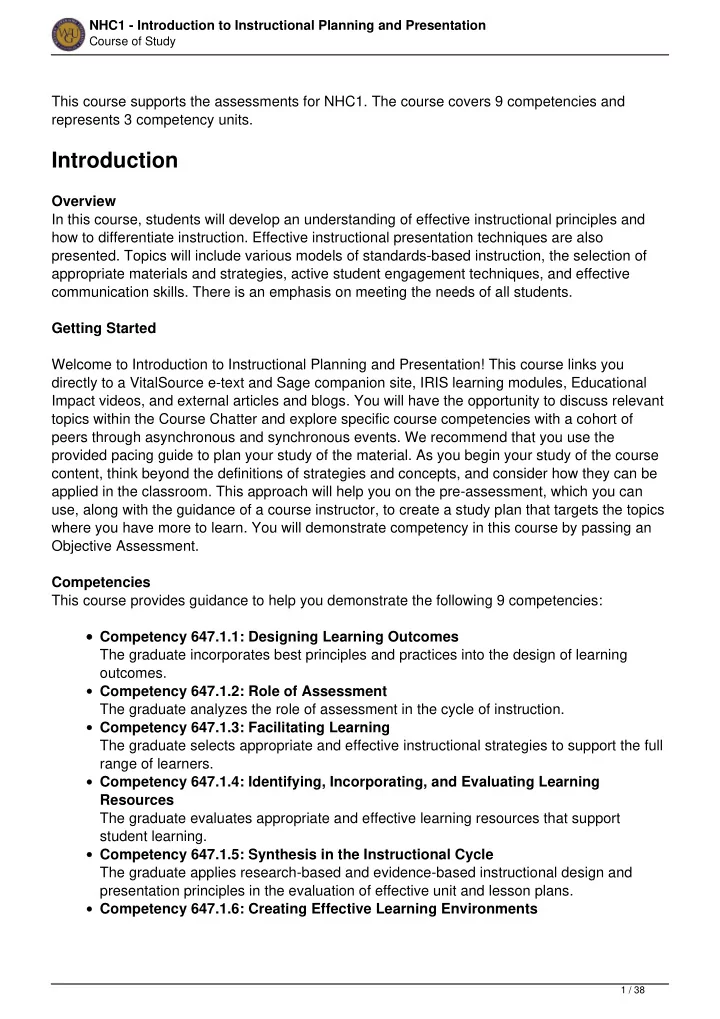
NHC1 - Introduction to Instructional Planning and Presentation Course of Study This course supports the assessments for NHC1. The course covers 9 competencies and represents 3 competency units. Introduction Overview In this course, students


slide-1
SLIDE 1

NHC1 - Introduction to Instructional Planning and Presentation

Course of Study

This course supports the assessments for NHC1. The course covers 9 competencies and represents 3 competency units.

Introduction

Overview In this course, students will develop an understanding of effective instructional principles and how to differentiate instruction. Effective instructional presentation techniques are also

  • presented. Topics will include various models of standards-based instruction, the selection of

appropriate materials and strategies, active student engagement techniques, and effective communication skills. There is an emphasis on meeting the needs of all students. Getting Started Welcome to Introduction to Instructional Planning and Presentation! This course links you directly to a VitalSource e-text and Sage companion site, IRIS learning modules, Educational Impact videos, and external articles and blogs. You will have the opportunity to discuss relevant topics within the Course Chatter and explore specific course competencies with a cohort of peers through asynchronous and synchronous events. We recommend that you use the provided pacing guide to plan your study of the material. As you begin your study of the course content, think beyond the definitions of strategies and concepts, and consider how they can be applied in the classroom. This approach will help you on the pre-assessment, which you can use, along with the guidance of a course instructor, to create a study plan that targets the topics where you have more to learn. You will demonstrate competency in this course by passing an Objective Assessment. Competencies This course provides guidance to help you demonstrate the following 9 competencies: Competency 647.1.1: Designing Learning Outcomes The graduate incorporates best principles and practices into the design of learning

  • utcomes.

Competency 647.1.2: Role of Assessment The graduate analyzes the role of assessment in the cycle of instruction. Competency 647.1.3: Facilitating Learning The graduate selects appropriate and effective instructional strategies to support the full range of learners. Competency 647.1.4: Identifying, Incorporating, and Evaluating Learning Resources The graduate evaluates appropriate and effective learning resources that support student learning. Competency 647.1.5: Synthesis in the Instructional Cycle The graduate applies research-based and evidence-based instructional design and presentation principles in the evaluation of effective unit and lesson plans. Competency 647.1.6: Creating Effective Learning Environments

1 / 38

slide-2
SLIDE 2

NHC1 - Introduction to Instructional Planning and Presentation

Course of Study

The graduate evaluates various influences on learning and instruction to ensure positive and engaging learning experiences. Competency 647.1.7: Developing Academic Language The graduate applies strategies to develop academic language through learning and instruction. Competency 647.1.8: Communication and Student Success The graduate selects appropriate and effective tools for communicating with students, colleagues, families, and others to support and facilitate student success and achievement. Competency 647.1.9: Technology, Pedagogy, Instruction, and Learning The graduate analyzes the relationships among technology, pedagogy, instruction, and learning. Teaching Dispositions Statement Please review the Statement of Teaching Dispositions. Course Instructor Assistance As you prepare to demonstrate competency in this subject, remember that course instructors stand ready to help you reach your educational goals. As subject matter experts, mentors enjoy and take pride in helping students become reflective learners, problem solvers, and critical

  • thinkers. Course instructors are excited to hear from you and eager to work with you.

Successful students report that working with a course instructor is the key to their success. Course instructors are able to share tips on approaches, tools, and skills that can help you apply the content you're studying. They also provide guidance in assessment preparation strategies and troubleshoot areas of deficiency. Even if things don't work out on your first try, course instructors act as a support system to guide you through the revision process. You should expect to work with course instructors for the duration of your coursework, so you are welcome to contact them as soon as you begin. Course instructors are fully committed to your success! Schedule a conference with an NHC1 Course Instructor by accessing this link: NHC1 CM: Make an Appointment

Preparing for Success

The information in this section is provided to detail the resources available for you to use as you complete this course.

Learning Resources

The learning resources listed in this section are required to complete the activities in this course. For many resources, WGU has provided automatic access through the course. However, you may need to manually enroll in or independently acquire other resources. Read the full instructions provided to ensure that you have access to all of your resources in a timely manner. In the following resources, you may read about No Child Left Behind (NCLB). Please be aware

2 / 38

slide-3
SLIDE 3

NHC1 - Introduction to Instructional Planning and Presentation

Course of Study

that as of December 2015, President Barack Obama replaced NCLB with the Every Student Succeeds Act (ESSA). This new act reauthorizes the 50-year-old Elementary and Secondary Education Act (ESEA), the nation's national education law and longstanding commitment to equal opportunity for all students. Although not required for this course, you are encouraged to familiarize yourself with the new act. For additional information, please visit the following links from the U.S. Department of Education: Webinar recording Read the ESEA now referred to as the ESSA Fact sheet on ESSA Transition Letter Automatically Enrolled Learning Resources You will be automatically enrolled at the activity level for the following learning resources. Simply click on the links provided in the activities to access the learning materials. VitalSource E-Texts The following textbooks are available to you as e-texts within this course. You will be directly linked to the specific readings required within the activities that follow. Moore, K.D. (2012). Effective instructional strategies: From theory to practice (3rd Ed). Los Angeles: Sage Publications, Inc. Print ISBN: 1412995728 ALERT: The digital copy of the e-text includes links to a companion website, with suggested prompts for additional reading. However, the links in the text are generic and do not provide access to WGU students. The quizzes in the companion site are not created by WGU. If you would like to access the additional information available on the textbook companion website, please use the following link: Effective Instructional Strategies Companion Site Note: These e-texts are available to you as part of your program tuition and fees, but you may purchase hard copies at your own expense through a retailer of your choice. If you choose to do so, please use the ISBN listed to ensure that you receive the correct edition. Educational Impact Educational Impact is an online resource of video training and related worksheets. Educational Impact's videos and worksheets provide students with an opportunity for learning about several important facets of modern education and observing classrooms where specific practices are implemented and problems are addressed. You will access Educational Impact modules at the activity level within this course. Additional Preparation Setting up Your Learning Journal Throughout this course, you will be presented with questions and prompts that will help you reflect on material you are studying, more deeply engage in the content, and apply what you are

3 / 38

slide-4
SLIDE 4

NHC1 - Introduction to Instructional Planning and Presentation

Course of Study

learning to your personal and professional life. They will also help you prepare for the assessments you will take later in the course. You may keep notes in this online course, blog your notes, or start an electronic file. You may also keep a paper notebook with your notes. However you choose to record your notes, be sure keep your notebook handy as you are learning the material and progressing through the course. Write responses to the questions and prompts throughout the course in your study notes. In addition to those responses, you may want to include more of your own thoughts and feelings in your notes. Think about the following: your progress through the course, including any personal misconceptions you discover and correct through your studies ways the activities and projects enhance your learning your reactions to or reflections on the activities in the course notes on topics that you want to remember and refer back to as you prepare for the assessments or begin your future teaching activities You can also use your notebook as a place to review the material from each chapter of the textbook and answer chapter review questions. Your notebook will be a great help to you as you study for the objective assessment and complete your performance tasks. As a teacher-in-training, you could consider this note-taking process a way to begin modeling good study habits for your future students. Your experiences here will help you to become a well-prepared teacher and a reflective educator. Read: The textbook for this course, Effective Instructional Strategies: From Theory to Practice, begins by posing this question, "What is the purpose of education?" Keep this in mind as you consider the content you read may affect your role as a teacher influences student learning.

Pacing Guide

The pacing guide suggests a weekly structure to pace your completion of learning activities. It is provided as a suggestion and does not represent a mandatory schedule. Follow the pacing guide carefully to complete the course in the suggested timeframe. Pacing Guide: Introduction to Instructional Planning and Presentation Note: This pacing guide does not replace the course. Please continue to refer to the course for a comprehensive list of the resources, activities and hyperlinks.

Communication and Student Success

Teachers have responsibilities for communicating with many people throughout the school year. First and foremost is communication with the students they teach and interact with on a daily

  • basis. Teachers must thus be able to understand and interact with students in ways that will

4 / 38

slide-5
SLIDE 5

NHC1 - Introduction to Instructional Planning and Presentation

Course of Study

help them learn. Teachers must also be able to communicate effectively with students' families, including those who are from varied linguistic and cultural backgrounds, and with colleagues and administrators. Keeping open channels of communication with these stakeholders is vital to student growth and

  • progress. Communication with other professionals also keeps teachers current with teaching

methods and theories.

Student Interactions

Effective communication is an important part of developing an effective school community. This topic highlights the following key concepts:

  • pportunities for communication in schools

factors that impact verbal and non-verbal communication communication strategies and approaches for difficult or confrontational situations appropriateness of communication with students effectiveness of communication and listening strategies for different situations Watch: Communication with Students As you watch the clips in this module, take notes about important ideas and examples from your

  • wn experiences that illustrate the principles presented.

In the Educational Impact Program Library, go to the program, "22 Components of Great Teaching" and view the following: Module 3, Topic A (Clips 1 & 2) Read: Teaching Diverse Students Several of the topics addressed in this chapter (the sections you are asked to skim) are the focus of other courses. Being aware of the various issues that teachers encounter will help you to prepare for the assessment in Introduction to Instructional Planning and Presentation and for your teaching career, but they are not a primary area of focus for this course of study. Read the following chapter in Effective Instructional Strategies: From Theory to Practice: Chapter 2 ("Teaching Diverse Students") Sage Student Study Site Chapter 2 You should focus on the overview on page 30, pages 33–34 ("Teacher Expectations"), and pages 48–49 (introduction to "Student Differences"). You may skim pages 30–32, 35–43, and 49–57. Reflect on how class demographics, students' varied strengths (including personal, cultural, community, and developmental assets*), language development, and learning needs impact

5 / 38

slide-6
SLIDE 6

NHC1 - Introduction to Instructional Planning and Presentation

Course of Study

lesson planning and presentation. *Assets refer to specific background information, practices, and/or experiences students bring with them to the classroom. Assets are made up of the things a teacher knows about his or her students. Assets (knowledge of students): personal: Refers to specific background information that students bring to the learning environment, such as their interests, knowledge, everyday experiences, family backgrounds, and so on, which a teacher can draw upon to support learning. cultural: Refers to the cultural backgrounds and practices that students bring to the learning environment, such as traditions, languages and dialects, worldviews, literature, art, and so on, that a teacher can draw upon to support learning. community: Refers to common backgrounds and experiences that students bring from the community where they live, such as resources, local landmarks, community events and practices, and so on, that a teacher can draw upon to support learning. developmental: Refers to specific background information about cognitive, physical, and social and emotional development that a teacher can draw upon to support student learning. Read: Engaging and Motivating Learning Read the following section of Effective Instructional Strategies: From Theory to Practice: Pages 62–74 (through "Listening Feedback") of Chapter 3 ("Engaging and Motivating Learning") Sage Student Study Site Chapter 3 In your learning journal, list the factors that have an impact on verbal and non-verbal communication.

Parent-Teacher Communication

Parent-teacher communication is a vital part of student success. The parents of your students are available to help your students succeed, to solve problems, and to help you make sure students are on track. One population of parents who are often hard to communicate with is non-English speaking parents. They may feel lost in the school setting. What can you do to make all students' parents feel comfortable about discussing their children with you? This topic highlights the following key concepts: communicating with non-English speaking parents strategies for addressing issues of student success with parents and students Create: Introductory Letter Review the following section of Effective Instructional Strategies: From Theory to Practice:

6 / 38

slide-7
SLIDE 7

NHC1 - Introduction to Instructional Planning and Presentation

Course of Study

Pages 43–47 ("Multiculturally Sensitive Communication") of Chapter 2 ("Teaching Diverse Students") In your learning journal, complete "Expansion Activity 2.1: Introductory Letter to Parents" from page 44. Read: Working with Non-English Speaking Parents As you read the following, consider strategies you may use in your classroom. Understanding Latino Parent Involvement In Education Engaging ELL Families: 20 Strategies for School Leaders How to Reach out to Parents of ELLs In your learning journal, create a list or mind map in your learning journal in response to these questions: Using the recommendations from the first article, what strategies increase communication with all non-English speaking families? What are some non-traditional ways of communicating with non-English speaking parents to keep them involved in the school community?

Productive Parent Conferences

Continual communication with parents is a vital part of school success, but parent-teacher conferences are often the only time that you will meet some of the parents in person. In this topic, you will investigate strategies for successful parent teacher conferences and ways to keep the line of communication open with parents when a traditional conference is not an

  • ption.

This topic highlights the following key concepts: strategies for preparing effectively for parent conferences artifacts and information to gather for parent conference strategies for communicating with parents of different cultural and linguistic backgrounds strategies for meeting or communicating with parents who have difficulty attending parent conferences Read: Parent Teacher Conference What are keys to a successful parent teacher conference experience for both the teacher and the parent? How does proper prior preparation for the conferences help ensure success? Read the following section of Effective Instructional Strategies: From Theory to Practice: Pages 252–253 ("Conferences") of Chapter 8 ("Evaluating and Measuring Learning")

7 / 38

slide-8
SLIDE 8

NHC1 - Introduction to Instructional Planning and Presentation

Course of Study

Sage Student Study Site chapter 8 Also read the following article: Policies & Practices: Successful Parent Conferences Based on what you have read, create a list of items that you would want to have available for parents to see at conferences. For each item on your list, explain why you would include it. Would this list change if there were specific difficulties the child or family was facing? Why or why not? Create: Plan for Conferencing Parents are often faced with situations that keep them from attending parent teacher

  • conferences. You have also read about the hesitation from non-English-speaking parents to

become involved in conferences and conversations with teachers. Read about how one parent participated in a creative way in this blog post: Parent-Teacher Conferences Across 8 Time Zones In your learning journal, answer these questions: How can you encourage and facilitate participation from the parents of all the children in your classroom? What are some alternative ways to communicate with parents who might not be able to attend conferences? Create a plan for conferencing with parents who: cannot attend due to work commitments, are incarcerated, are disabled or homebound, serve in the military and are deployed, or do not respond to your attempts at contact.

Communicating with Colleagues

Effective communication among teacher peers is vital as you start your journey as an educator. As a new teacher, you will need support, and you will become part of a team of teachers who serve students. In this topic, you will learn about working with the staff on your campus and processing information given to teachers in a positive manner. This topic highlights the following key concepts: strategies for communicating with staff, team members, and administration

8 / 38

slide-9
SLIDE 9

NHC1 - Introduction to Instructional Planning and Presentation

Course of Study

constructive criticism and professional evaluations Reflect: Communication with Colleagues As you watch the video clips, answer these questions in your learning journal: How will you model good, professional relationships for your students? What skills do you need to develop to enable you to interact with other teachers and administrators effectively? How will you shape outcomes in your school and district? In the Educational Impact Program Library, go to the program, "22 Components of Great Teaching" and view the following: Module 4, Topic A, clip 6 Open the handout "Domain 4 Rubric: Professional Responsibilities" Look at row 4d: Participating in a Professional Community on the handout. Reflect about where you currently fall on this rubric. What can you do to improve in this area? Write your thoughts in your learning journal. Watch: Constructive Feedback As you watch the video clips in this module, reflect upon and then answer these questions in your learning journal: What is the benefit of constructive feedback? How can feedback help you grow as a teacher? How can you play an active role in the feedback you receive? In the Educational Impact Program Library, go to the program, "Teacher Evaluation Using the Danielson Framework" and view the following: Module 5, Topic D, Clips 1–7

Developing Academic Language

Academic language is the oral and written language used for academic purposes. It is the means by which students develop and express content understandings. To help students communicate effectively in an academic setting, teachers must consider language demands, or the specific ways that language is used by students to participate in learning tasks. Language demands include the following: Language functions: the actionable words normally indicated in the standards and

  • utcomes

Vocabulary: discipline-specific words and/or phrases Discourse: written or spoken communication styles common within a discipline Syntax: the purposeful arrangement of words and phrases

9 / 38

slide-10
SLIDE 10

NHC1 - Introduction to Instructional Planning and Presentation

Course of Study

This course will focus on supporting students’ development of academic vocabulary.

Supporting the Development of Academic Vocabulary

Each class and subject has its own vocabulary that is essential for a student to learn in order to navigate the content effectively. In this topic, you will identify strategies that support all students as they develop content vocabulary, and you will begin to recognize the importance of modeling subject-specific terminology in context of the content being taught. This topic highlights the following key concepts: Identifying essential vocabulary to teach Introducing new vocabulary Creating definitions that are meaningful Reviewing terminology Assessing students' use of academic vocabulary Analyze: Essential Vocabulary Read the following articles: Developing Academic Language: Got Words? 8 Strategies for Teaching Academic Language Academic Language Function Toolkit Oregon K–12 Literacy Framework; Academic Language In your learning journal, answer these questions: What key concepts should educators consider when planning activities in their content classrooms that involve academic vocabulary? Why is it important for students to build a strong foundation in academic vocabulary related to all content areas? Read: Vocabulary Instruction & Assessment Read these articles: Classroom Vocabulary Assessment for Content Areas Key Literacy Component: Vocabulary In your learning journal, list the important considerations inherent in vocabulary instruction. Also, answer these questions: Why is it important for students to develop an understanding of the vocabulary for the content they are learning? What do you have to take into consideration when working with students who are English language learners (ELLs)? What do you have to take into consideration when working with students who are below grade level in reading or who have learning disorders?

10 / 38

slide-11
SLIDE 11

NHC1 - Introduction to Instructional Planning and Presentation

Course of Study

Watch: Strategies to Teach Academic Vocabulary Before you watch the video clips in this module, open and print the five handouts so you can follow along with them and complete the worksheet. As you watch the videos, compile a list of the recommended strategies for teaching academic vocabulary. In the Educational Impact Program Library, go to the program, "Designing Lessons to Inspire Thinking & Learning" and view the following: Module 3, Topic B, Clips 1–8 Watch: Strategies Based on Assessment Results Watch these two videos, in which teachers discuss using strategies to informally assess the students: Module 2: The First Pillar: The Hidden Skills of Academic Literacy Topic B: Ability to Make Sense of Abstract Academic Vocabulary (21 min) How could you use the information in these videos to design vocabulary instruction for your students? Add these to your list of recommended strategies for teaching academic vocabulary.

Language Demands

Now that you are familiar with strategies for teaching academic vocabulary, put your knowledge to use by examining a lesson and determining how to teach the essential vocabulary students will need to successfully complete it. Analyze: Vocabulary in Use Explore all the tabs on this web page so you see the full lesson and all materials: Figurative Language: Teaching Idioms Lesson Plan Identify the academic vocabulary that you need to cover with students before and during this

  • lesson. Also, answer these questions:

What other vocabulary do you need to explain to help your students be successful? How can you work with students who have are below grade level on this concept? How can you work with ELL students? What accommodations would you need to make for other students in your classroom? (Come up with at least two other types of students who may need accommodations.)

Technology, Pedagogy, Instruction, and Learning

With technology all around people every day, it is only logical that technology would become an integral part of education as well. Teachers need to understand how to effectively use technological tools that support content and enhance student learning.

Technology and Instruction

11 / 38

slide-12
SLIDE 12

NHC1 - Introduction to Instructional Planning and Presentation

Course of Study

Society is in an age of technology. This is true as well for schools and materials available to you as an educator. Although the availability of technology differs from school to school, finding ways to effectively use technology to enhance your lessons will lead you to a strategy to meet students in an arena where they are typically familiar and comfortable. In this topic, you will engage in resources to identify the benefits of Internet use and discuss safety issues that should be taken into consideration when using the Internet. You will also examine how technology can support differentiated instruction to meet the needs of all students. This topic highlights the following key concepts: factors of technology that can influence pedagogy and instruction advantages and disadvantages of Internet usage uses of technology for individualizing instruction and differentiating instruction guidelines for use of the Internet in support of instructional planning and presentation alignment to learning outcomes of a technological tools and applications Read: Technology Factors that Influence Pedagogy As you read chapter 4, consider these questions: What are key factors that influence the use of technology? What are key factors that discourage the use of technology? Read the following chapter in Effective Instructional Strategies: From Theory to Practice: Pages 90–110 (through "Technology in Planning") of Chapter 4 ("Using Classroom Technology") Sage Student Study Site chapter 4 In your learning journal, complete "Expansion Activity 4.1: Technology Literacy" on page 92. Also complete "Discussion Questions and Activities" number 1 ("Technology ability") on page 112. Of the technologies discussed in this chapter, which ones are used in your local school or district? Which technological tools will you need to use to teach effectively in your classroom? Explain in your learning journal why you think each one is necessary. Self-Assess: 21st Century Schools As you watch the video clips in this module, take notes on the following: advantages of Internet usage in instruction disadvantages of Internet usage in instruction use of technology for individualizing instruction use of technology for differentiation of instruction ways to develop guidelines for Internet usage in instructional planning ways to determine whether specific technologies are aligned to desired learning

12 / 38

slide-13
SLIDE 13

NHC1 - Introduction to Instructional Planning and Presentation

Course of Study

  • utcomes

In the Educational Impact Program Library, go to the program, "21st Century Schools" and view the following: Module 2, Topic A, Clips 1–14 After you have completed the module videos, take the module 2 assessment, “School in the New Knowledge Economy”, to check your understanding. Read: Technology for Individualized Instruction Read the following article: Scholastic Article: Student and Class Projects Using the Internet How can these projects and the different forms of technology you have read about support individualized instruction?

Creating Effective Learning Environments

A safe environment is essential for your students to learn in the classroom, and you as the teacher help build that environment. The right environment can enhance your lessons. Routines will help your day run smoothly, and create consistency for your students. Start thinking now about the learning environment you want to have. How can you create an environment in which you and your students will thrive?

Physical Learning Environments

The classroom environment is often a forgotten component of the learning environment. Primary grade teachers spend hours making the classroom inviting, colorful, and warm, but in higher grades, the thought that goes into the classroom environment is often negligible. Your classroom and its environment can play a part in the lesson, the communication, and the trust that you have with your students. In this topic you will consider many aspects of the classroom environment: how to invite your students into that environment, how to make the environment a part of your lesson, and how to make a safe environment for all students regardless of the accommodations they may need while in your classroom. This topic highlights the following key concepts: physical components of an effective learning environment meeting the physical needs of students Read: Components of the Physical Learning Environment Read the following sections of Effective Instructional Strategies: From Theory to Practice: Page135 ("Organizing for Effective Management") of Chapter 5 ("Managing the

13 / 38

slide-14
SLIDE 14

NHC1 - Introduction to Instructional Planning and Presentation

Course of Study

Classroom Environment") Sage Student Study Site Chapter 5 You will read the other pages in this chapter in a future activity. You may also want to review the following section of Effective Instructional Strategies: From Theory to Practice: Pages 68–69 ("Language of Space and Motion") of Chapter 3 ("Engaging and Motivating Learning") Sage Student Study Site Chapter 3 Answer the following questions in your learning journal: How does the physical arrangement of your classroom affect the learning environment? How can your classroom arrangement support or hinder classroom communication and student engagement? Read: Classroom Arrangement Read the following: Do Seating Arrangements Have an Impact on Student Learning? Answer the following questions in your learning journal: How does the physical arrangement of your classroom affect the learning environment? How can your classroom arrangement support or hinder classroom communication and student engagement? Create: Classroom Arrangement Create a drawing or digital image of your ideal classroom arrangement. Assume you will have the following standard items from the school: 30–35 student desks (desks with chairs or combined desk and chair) 1 teacher desk and chair 1 table with 4 chairs for small group work 2 white boards 1 book case 1 podium (overhead, document camera, etc.) If you know what classroom plans, furniture, and materials the districts and schools in your area use, plan with those in mind. Research: Meeting the Physical Needs of Students in the Classroom Work through the following module (begin with Challenge, and end with Wrap Up):

14 / 38

slide-15
SLIDE 15

NHC1 - Introduction to Instructional Planning and Presentation

Course of Study

Star Legacy Module How would you adapt your classroom arrangement (created in the previous activity) to support the needs of your students? In your learning journal, create a matrix with two columns. Label one column "need" and the

  • ther "adaptation." In the "need" column, fill in rows for each of the following:

ADD/ADHD ELL Hearing Impairment Broken Leg Cerebral Palsy Autism (mild) Visual Impairment If you have experience with other student needs, you may want to include those as additional rows in your matrix. How will you effectively adapt the learning environment so each of these populations can be successful? Fill in the "adaptation" box in each row with specific accommodations you would make to the physical classroom environment to fit the needs of various students.

Academic Learning Environments

In the previous topic, you focused on the classroom environment to support your instruction. The learning environment can also be a tool to keep students engaged, help you pace your instruction, and drive expectations for students. You will encounter several elements of engagement in this topic. First, you will learn about ways to keep students focused while still allowing them a voice in the instruction. Second, you will explore methods of pacing of instruction to meet the needs of the students. Finally, you will learn about setting expectations so that all students' needs are met. This topic highlights the following key concepts: components of a learning environment that promote engaged participation and active student voice time allocation strategies for beginning a class period effectively strategies for starting the academic year effectively Read: Environments that Promote Engagement As you read and review these sections, focus on the aspects of that section that relate to the first few days of school and establishing daily routines. When engaging this section of the competency, consider the following:

15 / 38

slide-16
SLIDE 16

NHC1 - Introduction to Instructional Planning and Presentation

Course of Study

Why is it important to begin your class or lesson effectively? What are some of the strategies that you have seen the teachers in the videos using? What makes these strategies effective? What are some strategies you would like to try when you are in the classroom? Read the following sections of Effective Instructional Strategies: From Theory to Practice: Pages 311–314 (questioning techniques) of Chapter 10 ("Using Direct Teaching Methods") Sage Student Study Site Chapter 10 Pages 136–138 ("Managing the Class") of Chapter 5 ("Managing the Classroom Environment") Sage Student Study Site: Chapter 5 You may also want to review the following section of Effective Instructional Strategies: From Theory to Practice: Pages 131–136 ("Organizing for Effective Management") of Chapter 5 ("Managing the Classroom Environment") In your learning journal, complete, "Reflect and Apply Exercise 5.1: Describe Broad Approaches to Classroom Management," on page 127 and answer these questions: How will you create an engaging learning environment for the grade level you plan to teach? What are your expectations for student participation? How much choice will your students have in the instructional components? How will you motivate your students? Watch: Effective Use of Time During a Lesson As you watch the video, consider these questions: What do you need to be aware of when thinking about the length of a lesson? What concepts from the video match the components you identified? What new concepts did you see in the video that you had not considered before? How will you address running out of time during a lesson and transitioning the next day? What other things did you learn that you have not thought of regarding instruction up to this point? Watch the following video: Module 2: Designing an Effective Learning Process: Topic B: Course Design and Lesson Planning Read: Effective Beginnings Read the following chapter in Effective Instructional Strategies: From Theory to Practice:

16 / 38

slide-17
SLIDE 17

NHC1 - Introduction to Instructional Planning and Presentation

Course of Study

Pages 215–218 ("Set Induction (Focus)") of Chapter 7 ("Developing Unit and Daily Lesson Plans") Sage Student Study Site Chapter 7 Create: Effective Start to the Year Using what you have read about in this course and previous courses (Foundational Perspectives of Education, Classroom Management and Motivation, etc.), create a plan for your first week of school. Include at least the following elements: room arrangement (which you developed in a previous activity) with explanation of how you will organize teacher space and student space and where things will be located list of policies you will need to implement for transitions, homework, etc. list of signals and signage you will use for students, including attention-getting signals description of how will you being instruction with a new group of students Watch: The First Days of School Module 4, Topic A, Clips 1–8 ("Learning Activities that Break the Ice") In your learning journal, list and/or describe activities that you might use during the First Days of School.

Social and Emotional Learning Environments

School environments are often a melting pot of personalities, beliefs, and needs. As a teacher, you are accountable not only for teaching subject matter to all students, but also for teaching those students how to interact with each other and accept each other. In this topic, you will engage in strategies to promote positive interaction among students, and you will learn how to be culturally responsive to the needs of all the students in your care. This topic highlights the following key concepts: positive social interactions among all students cultural responsiveness Read: Promoting Positive Interaction Among Students Brainstorm answers to these questions in your learning journal: What is your responsibility when planning for all students in your class? How will you meet your students' needs and the requirements of the state, the district, and the law? How will you promote positive interaction with your students? To help you answer these questions, you may want to review the following chapter in Effective

17 / 38

slide-18
SLIDE 18

NHC1 - Introduction to Instructional Planning and Presentation

Course of Study

Instructional Strategies: From Theory to Practice: Chapter 2 ("Teaching Diverse Students"); Pages 68–69 ("classroom environments") & Pages 75–85 ("motivation and participation"). Sage Student Study Site Chapter 2 Analyze: Classroom Decision Making In your learning journal, answer the questions about Todd ("Classroom Decision Making: Todd") found on page 145 of Chapter 5 ("Managing the Classroom Environment"). Also, answer these questions: What components of the learning environment could increase Todd's engagement and participation? As a teacher, how could you ensure that Todd has an active voice in this situation? Consider the following scenario: You work very closely with the special needs teacher on your campus, so you often have students mainstreamed from her class into your 8th grade science classroom. This term you have a student who is identified with autism. One of this student's behaviors is to tell on students for everything, as you might see in a primary classroom. Although your other students understand that this is part of the disability, they are beginning to get frustrated. How will you work with your students, the special needs teacher, and the student who is mainstreamed into your room to maintain a positive classroom experience for everyone?

Designing Learning Outcomes

To this point in the course, we have focused on communication, academic vocabulary, technology, and the classroom environment. These are all aspects of good planning. We now turn our attention to designing good learning outcomes. This may be one of the most difficult things that educators do, but it is also one of the most important. As you learn to craft effective learning outcomes that accurately represent what students need to learn, you will see that these

  • utcomes become the foundation of the lessons, units, and assessments you use in your
  • classroom. This section will first address standards, then objectives and finally taxonomies.

Standards

Each state decides what standards to use for its students, so it is important for you to be familiar with the standards adopted by your state. In general, standards are long-range statements of the intent for your instruction. You are accountable for making sure that your students meet the requirements set forth by the standards for your grade and content each year. This topic highlights the following key concepts: role of standards, objectives, and taxonomies in instructional planning alignment of objectives with standards

18 / 38

slide-19
SLIDE 19

NHC1 - Introduction to Instructional Planning and Presentation

Course of Study

Read: Alignment with Standards You should have read all parts of chapter 6 in previous activities. Now take some time to review the chapter and look for information specifically related to aligning curriculum to national and state standards. Review the following chapter in Effective Instructional Strategies: From Theory to Practice: Chapter 6 ("Planning and Organizing Instruction"); Pages 182–183, "Linking Standards and Objectives." Sage Student Study Site Chapter 6 Chapter 1 ("Reflections on Teacher Practice-The Standards Movement"); Page 21 Also, preview (skim) the following chapters in Effective Instructional Strategies: From Theory to Practice, looking for more information about standards to add to your notes: Chapter 7 ("Developing Unit and Daily Lesson Plans") Pages 188–189, "Planning Instruction." Explore to find several standards for the subject area or grade level that you want to teach. To do so, you may use WGU's State-Specific Standards page or view the Common Core State Standards. Watch WGU Lesson Planning Guidelines and access the WGU Lesson Plan Template used for education classes

Objectives

The foundation of your lesson designs begin with the objectives. If you do not know where to start, you will not know where to end. Creating good, measurable, relevant learning objectives is a vital skill for teachers. It is also something you will need to do repeatedly throughout the courses in your program, so be sure to focus on it now. This topic highlights the following key concepts:

  • bjectives for specific learning outcomes

major components of learning outcome statements

  • bjectives to support specific learner needs

Read: Learning Outcome Statements In your learning journal, take notes on the information presented in these websites and designated pages of text. Also, review the following websites: Instructional Goals and Objectives Setting Targets and Writing Objectives

19 / 38

slide-20
SLIDE 20

NHC1 - Introduction to Instructional Planning and Presentation

Course of Study

Read the following section of Effective Instructional Strategies: From Theory to Practice: Pages 151–176 (through "Communication of Objectives") of Chapter 6 ("Planning and Organizing Instruction") Sage Student Study Site Chapter 6 In your learning journal, complete, "Reflect and Apply Exercise 6.1: Curriculum Decisions" on page 163. Add to your notes with answers to the following questions: What are the four components of an objective (see page 170 of Chapter 6 ("Planning and Organizing Instruction")? What is the difference between a goal, an instructional objective, and an informational

  • bjective?

Why do teachers use both objectives and goals in the classroom? Watch: Objectives The video below is taken from the WGU Lesson Planning Guide. About Objectives Respond: Objectives and Learning Outcomes Respond to the scenario on page 226 ("Classroom Decision Making: Sam, Ashley, Walden, and Jennifer") of Chapter 7 ("Developing Unit and Daily Lesson Plans") in Effective Instructional Strategies: From Theory to Practice. Answer the questions and complete the activities for this scenario in your learning journal. Justify your answers with support from the reading and research you have done. Save your written objectives for the outcomes in this scenario– you may use them in a later activity.

Taxonomies

As a teacher, it is important to consider the levels of mastery that you are asking students to achieve in your instruction. Varying the levels of mastery required in instruction creates a learning environment that challenges students, and this is paramount to the success of students. In this topic, you will engage three major domains and their taxonomies as used in lesson

  • design. You will begin to understand the purpose of each, including how they apply to

instructional activities. This topic highlights the following key concepts:

20 / 38

slide-21
SLIDE 21

NHC1 - Introduction to Instructional Planning and Presentation

Course of Study

components of cognitive, affective, and psychomotor taxonomies purposes of cognitive, affective, and psychomotor taxonomies instructional activities for different levels or categories of taxonomies Watch: Bloom's Taxonomy In your learning journal, create a double entry organizer to take notes on the components of the taxonomy discussed in the videos you will watch. Leave space to add information as you find additional details in the readings. Review the following articles: Bloom's Taxonomy with Educational Objectives Assessment Primer: Learning Taxonomies SLOs, Bloom's Taxonomy, Cognitive, Psychomotor, and Affective Domains. Read: Purpose of Taxonomies Pay special attention to the psychomotor domain as it is described in the reading. Bloom labeled five levels, but Harrow (1972) and Jewett and Mullan (1977) created a four-level system. What is the difference between the two leveling systems, if any? What two levels are combined from Bloom’s taxonomy in the Harrow/Jewett/Mullan system? Read the following section of Effective Instructional Strategies: From Theory to Practice: Pages 176–183 ("Taxonomies of Objectives" through "Linking Standards and Objectives") of Chapter 6 ("Planning and Organizing Instruction") Sage Student Study Site Chapter 6 In your learning journal, complete "Reflect and Apply Exercise 6.2: Goals and Objectives" on page 183. In a previous activity, you wrote several learning objectives. Add any new information that confirms the purpose of the three taxonomies. Also, add common verbs that are used when writing objectives for each domain of the taxonomies. Watch: Components of the Taxonomies in Action As you view the videos, identify: activities within the lessons or within the discussion that meet the different levels of the affective domain ways the lesson meets multiple aspects of the cognitive domain. stages of the Psychomotor Domain (either Bloom's levels or Harrow/Jewett/Mullan) in each of the activities the teachers are using with the students in this video

21 / 38

slide-22
SLIDE 22

NHC1 - Introduction to Instructional Planning and Presentation

Course of Study

You may want to watch the videos twice so you can focus on one taxonomy during each

  • viewing. Continue to add to your notes in the double-entry organizer you began in a previous

activity. Watch the following video: Module 6: Phase Four; Topic B: Standard 4 – Challenging Thinking

Identifying, Incorporating, and Evaluating Learning Resources

As an educator, you will have to make decisions regarding how you approach the standards and objectives that guide the curriculum. In order to keep your students engaged, you must make choices about materials that will support your instruction. In this subject, you will identify materials that are engaging and appropriate. You will also align materials to learning outcomes.

Learning Resources and Instruction

The choices that you make regarding the material you use with your students can determine the success of a lesson. Engaging materials play an important role. Selecting materials that align with standards is essential, and influences both student and teacher success. Focus on learning the importance of choosing appropriate materials that support both content and learners. This topic highlights the following key concepts: effective and appropriate learning resources monitoring and evaluating student engagement with resources promoting and supporting student interaction with learning resources alignment of resources to objectives and instructional purposes Read: Choosing Materials for Instruction Note that Chapter 7 includes many example lessons and unit plan formats that you should read, understand, and take notes on to refer to later in your studies. Read the following section of Effective Instructional Strategies: From Theory to Practice, and answer the questions (pps. 191–192) in "Reflections on Teacher Practice 7.1: Rethinking Unit Planning" in your learning journal. Pages 190–191 (through "Team Planning") of Chapter 7 ("Developing Unit and Daily Lesson Plans") Sage Student Study Site Chapter 7 Also, review the following section of Effective Instructional Strategies: From Theory to Practice:

22 / 38

slide-23
SLIDE 23

NHC1 - Introduction to Instructional Planning and Presentation

Course of Study

Pages 161–163 ("Planning the Course") of Chapter 6 ("Planning and Organizing Instruction") Sage Student Study Site Chapter 6 Think about everything you have been reading on instruction, grouping, differentiation, and making sure your students learn the content. Reflect on these questions in your learning journal: How will you choose appropriate materials for the lessons and learning activities you create? How is rethinking unit planning an example of evaluating student engagement? How will you monitor and evaluate your own learning resources? Review the following: Evaluation and Selection of Learning Resources: A Guide In your learning journal, record some of the major considerations and criteria for different types

  • f learning resources. You may wish to bookmark or print out the evaluation forms in the

appendix for your future use. Evaluate: Online Resources Read this article about evaluating resources: Critical Evaluation of Internet Resources Develop a rubric to evaluate an educational website that you might use in your classroom. Choose two websites identified by the American Association of School Librarians in their "Best Websites for Teaching and Learning 2015" using the link below: Best Websites for Teaching & Learning 2015 Use the rubric you developed to evaluate your chosen websites.

Role of Assessment

What is the role of assessment in instruction and education? Different types of assessment can be used for different purposes, and you will likely employ many assessments in your classroom for diagnostic, feedback, evaluation, and more.

Using Assessment to Support Learning

Assessment is a vital part of your planning. If you are unaware of where your students are in their understanding, you will not be able to effectively plan for enrichment, remediation, or subsequent lessons. In this topic you will engage multiple assessment strategies, learn how to align assessments to your learning outcomes, and differentiate between informal and formal assessment.

23 / 38

slide-24
SLIDE 24

NHC1 - Introduction to Instructional Planning and Presentation

Course of Study

This topic highlights the following key concepts: assessment in the instructional design process purposes of various assessment and evaluation strategies evaluation strategies for specific learning outcomes applications of assessment for specific instructional purposes authentic, portfolio, and performance assessments formal and informal assessment strategies Read: Evaluating and Measuring Learning While reading this chapter, highlight or take notes on: different evaluation types qualities that are important in measuring devices sources where teachers get information used in evaluation Read the following chapter in Effective Instructional Strategies: From Theory to Practice: Chapter 8 ("Evaluating and Measuring Learning") Sage Student Study Site Chapter 8 In your learning journal, complete "Reflect and Apply Exercise 8.2: Different Types of Evaluation" found on page 257 and "Questions and Activities" numbers 2 ("Evaluation purposes") and 4 ("Evaluating students") found on page 260. Read: Constructing and Grading Tests Read the following chapter in Effective Instructional Strategies: From Theory to Practice: Chapter 9 ("Constructing and Grading Tests") Also, define the following terms in the pages in your learning journal: competitive evaluation noncompetitive evaluation performance assessment norm-referenced evaluation criterion-referenced evaluation standard scores student work sample Watch: Assessment for Learning As you watch the video clips, reflect on these questions in your learning journal: How can you use the information from your assessments to evaluate your students’ understanding? Why is it important to align the assessment to the learning objectives for the lesson?

24 / 38

slide-25
SLIDE 25

NHC1 - Introduction to Instructional Planning and Presentation

Course of Study

What is the value of multiple assessment types? In the Educational Impact Program Library, go to the program, "Assessment for Learning" and view the following: Module 1, Topic A, Clips 5–9 Download the handouts Matching Assessment Methods with Achievement Target and Authentic

  • Assessments. Fill out the blank page from the Matching Assessment Methods with Achievement

Target handout. Keep the sample (filled out) page from the handout as a reference. As you continue through this course and those courses that follow, you may want to refer to the Authentic Assessments handout as a reference for planning assessments for your lesson plans. Add the pages you downloaded to your learning journal for this course. Watch: Using Assessment in Instruction Module 3, Topic A: Domain 3 "Using Assessment in Instruction" Consider: How is assessment used in instruction? What are some successful strategies for feedback? Analyze: Effective Feedback Identify a lesson plan (one that you have created or encountered) that could be delivered using integrated teaching methods. In your learning journal, describe how you would use pacing to keep all students on track during the lesson, determine what type of feedback you would use at each stage in the lesson, and explain why that type of feedback would be effective. Watch: Performance Assessment As you watch the videos in this module, answer the following questions in your learning journal: How does the use of portfolios improve teaching and student assessment? How can students be involved in the use of portfolios? What types of materials would be best to include in student portfolios for the grade(s) and subject(s) you would teach? In the Educational Impact Program Library, go to the program, "Assessment for Learning" and view the following: Module 1, Topic C, Clips 1–3 Watch: Data Analysis in Lesson Planning As you watch the video, consider and take notes on these questions:

25 / 38

slide-26
SLIDE 26

NHC1 - Introduction to Instructional Planning and Presentation

Course of Study

How does the teacher use the assessment data to determine the next steps to take with her students? How can analyzing data determine the appropriate steps for a teacher to take with their students? Watch the following video: Module 2: Principles of Differentiated Instruction: Topic G: Frequently Asked Questions About Differentiated Instruction Watch: Authentic and Performance Assessment As you watch the video clips, in your learning journal reflect on these questions: How will assessment play a role in your planning as a classroom teacher? Why do you need to be aware of the assessments you are using in your classroom, the assessments required by your district, and the state assessment requirements? In the Educational Impact Program Library, go to the program, "Assessment for Learning" and view the following: Module 1, Topic D, Clips 1–14 Create a mind map (for examples see the Mind Mapping Samples handout in Module 1, Topic D

  • f "Assessment for Learning" in Educational Impact) for the different types of assessments.

In your mind map, distinguish between formal and informal assessments. Consider whether some assessments can be used as both formal and informal assessments. Note the difference between evaluation and assessment. Why are both types needed in the education system? Continue to add to this mind map as you learn more about the role of assessment in this course and in other courses.

Facilitating Learning

One of your primary concerns as a teacher will be facilitating student learning. This can be a daunting task when you consider that in your classroom you may have 30 students who are all at different academic levels and who all have different learning styles and needs. Luckily, there are many approaches that you can use in your educational practice to impart knowledge to students and help them develop the skills they need to be successful. As a result, it is important to learn about some of these teaching approaches and strategies so you can be better prepared for your future students.

Instructional Strategies for Whole Group Instruction

As a teacher, you will use multiple instructional strategies to impart the curriculum. One of those

26 / 38

slide-27
SLIDE 27

NHC1 - Introduction to Instructional Planning and Presentation

Course of Study

strategies is direct instruction. In this topic, you will explore the components of direct instruction and other instructional strategies to determine effective methods of whole group instruction. This topic highlights the following key concepts: components of effective direct instruction strategies for whole-group instruction questioning strategies monitoring approaches pacing strategies monitoring student comprehension in whole-group instruction feedback strategies Read: Direct Instruction In your learning journal, create a matrix (table) with three columns: one for types of direct instruction, and one each for the pros and cons of each type. Fill out the matrix using information from chapter 10. Read the following chapter in Effective Instructional Strategies: From Theory to Practice: Chapter 10 ("Using Direct Teaching Methods") Sage Student Study Site Chapter 10 In your learning journal, complete "Reflect and Apply Exercise 10.2: Questioning" in the classroom on page 316 and "Discussion Questions and Activities" numbers 2 ("Strategy selection") and 3 ("The lecture method") on page 318. Also, explain how you will use the following methods in your classroom to monitor students' progress: questioning various types of direct instruction (not just lecture) specific instructional strategies that support various groups of students In the Educational Impact Program Library, go to the program, "Charlotte Danielson's Teaching Framework" and view the following: Module 2, Topic A, Clips 1–11 Open the handout titled "The Components and Their Elements." Look at the first box titled "Planning and Preparation." Which elements of planning and preparation are most important? Which elements make you most and least comfortable? Write your thoughts in your learning journal. View: WGU Lesson Planning Guide Instructional Plan WGU Lesson Plan Template

27 / 38

slide-28
SLIDE 28

NHC1 - Introduction to Instructional Planning and Presentation

Course of Study

Watch the videos for each step in the instructional cycle. Prerequisite Skills Presentation of New Information and/or Modeling (3:16) Guided Practice (1:16) Independent Practice (1:23) Culminating or Closing Procedure/Activity/Event (1:47) Instructional Strategy (or Strategies) (1:46) Differentiated Instruction Accommodations (2:56) Analyze: Whole-Group Instruction Strategies Review the following section of Effective Instructional Strategies: From Theory to Practice: Page 316 ("Classroom Decision Making: James") of Chapter 10 ("Using Direct Teaching Methods") Sage Student Study Site Chapter 10 In your learning journal, answer questions 1–3 found on page 316, and then answer these questions: Recall a class like the one in the scenario in your past education. How did you feel about that class? How will the experience of being in a class like the one represented in the scenario influence your decisions as a teacher? What type of questioning would you suggest James adds to his lecture to keep the students engaged? An example of direct instruction is the Madeline Hunter Model. For more information on this method, go to the Educational Impact Program Library to access the program, "Designing Lessons to Inspire Thinking & Learning" and view the following: Module 1, Topic B Throughout chapters 10 and 11, you have been exposed to teaching strategies that allow teachers to pace the instruction to meet the needs of students. Think back to the videos you have viewed of teachers working with students in the classroom. Reflect on these questions in your learning journal: How does pacing drive instruction? How does pacing encourage students to think critically about the concepts being taught? How does pacing help teachers evaluate student understanding during instruction? Read: Integrated Teaching As you read Chapter 12, take notes on teaching strategies that allow teachers to monitor students' progress and giving feedback on an ongoing basis.

28 / 38

slide-29
SLIDE 29

NHC1 - Introduction to Instructional Planning and Presentation

Course of Study

Read the following chapter in Effective Instructional Strategies: From Theory to Practice: Chapter 12 ("Using Integrated Teaching Methods") Sage Student Study Site Chapter 12

Instructional Strategies for Small Group Instruction

The choices you make in your instruction will be driven by the needs of your students. One common practice is small group instruction. In this topic, you will explore the elements of cooperative learning, effective ways to monitor your students' progress in small groups, and appropriate small group activities for chosen objectives. This topic highlights the following key concepts: effective cooperative learning task structure cooperative learning strategies monitoring approaches for cooperative and collaborative learning activities strategies for monitoring student learning during and following small-group activities cooperative instructional activities for specific learners and situations Read: Authentic Teaching Methods Chapter 11 ("Using Authentic Teaching Methods") Sage Student Study Site Chapter 11 Synthesize: Cooperative Learning As you watch the video clips, answer these questions in your learning journal: What types of small groups have you used in the past? What types of small groups have you been involved in as a student? Which grouping methods have been most effective and least effective? Which new grouping method would you like to try? What problems might you encounter with this method, and how would you overcome them? In the Educational Impact Program Library, go to the program, "Effective Teaching in Diverse Classrooms" and view the following: Module 4, Topic B, Clips 7–9 You may want to review clip 7 and take notes on the different group sizes (at 15 seconds) and types (at 40 seconds). You can pause the video while you write your notes. Review the following section of Effective Instructional Strategies: From Theory to Practice: Pages 358–362 ("Cooperative Learning") of Chapter 12 ("Using Integrated Teaching Methods") Sage Student Study Site Chapter 12

29 / 38

slide-30
SLIDE 30

NHC1 - Introduction to Instructional Planning and Presentation

Course of Study

David W. Johnson, Roger T. Johnson, and Edythe Johnson Holubec have contributed enormously to the field of cooperative learning. Read the information on their organization's website to learn more about this practice and its benefits: Introduction to Cooperative Learning You may also want to explore other parts of the Cooperation.org website. Watch: Active Learning Strategies Investigate different strategies for active learning. As you watch the video clips in this module, reflect upon situations that might benefit from using each of the strategies discussed. In the Educational Impact Program Library, go to the program, "Designing Lessons to Inspire Thinking & Learning" and view the following: Module 3, Topic A Create: Activities for a Constructivist Based on what you have read and seen, answer these questions in your learning journal: What must teachers do to explain the task structure and the cooperative structure to students and parents? What is the rationale for the 'sink or swim together' perception that cooperative groups must have? In what situations in your classroom do you feel cooperative learning groups would be most effective? Watch: Literature Circles for All Disciplines in the module below. Module 4, Topic B When might you use this type of activity in your classroom? What types of student groupings might you use? Reflect: Monitoring Small Groups In your learning journal, answer the questions in Reflections on Teacher Practice 12.1: Seeking Quality found on page 352–353 of Chapter 12 ("Using Integrated Teaching Methods") in Effective Instructional Strategies: From Theory to Practice. Also, reflect on these questions: Are self-monitoring and peer evaluation effective techniques in the grade and subject you will teach? Why or why not? What method will be most effective for monitoring collaborative group work in your classroom? How will you ensure that you monitor student learning effectively in all the groups in your

30 / 38

slide-31
SLIDE 31

NHC1 - Introduction to Instructional Planning and Presentation

Course of Study

class? Watch the following videos: Module 2: Planning for Engagement; Topic C: Strategies for Engagement Answer the following questions in your learning journal: How is the teacher allowing student ownership within the project? How does this serve as a way for the teacher to monitor the students? How do the activities in the videos allow all students to be successful, regardless of levels of special accommodations? Evaluate: Strategies for Learning Outcomes Choose five objectives you have written and determine how you would use cooperative groups in your lesson to support your instruction for these objectives. You may choose from one of the following that you have read about in Chapter 12 of Effective Instructional Strategies: From Theory to Practice, Third Edition or other cooperative learning strategies: peer tutoring student team achievement division teams-games-tournament team-accelerated instruction group investigation jigsaw strategies think-pair-share In your learning journal, answer these questions: How will you monitor the students in the groups to ensure there are no "hitchhikers" of

  • thers' work?

How will you monitor the groups to ensure they understand the concepts being taught? How will you hold the groups and the individuals accountable for the required learning? Would you need to modify any activities you designed if you had students with learning disabilities or physical impairments? If so, how would you change the activities? Would English language learners be successful in the group activities? How could you modify your activities to include these in cooperative groups?

Student-Centered Approaches to Learning and Instruction

Student-centered learning is one of the most effective teaching methods. This does not mean that you will always use a constructivist approach in your classroom. Instead, you should view the constructivist strategies you learn about as an important set of tools in your planning and instruction. This topic highlights the following key concepts:

31 / 38

slide-32
SLIDE 32

NHC1 - Introduction to Instructional Planning and Presentation

Course of Study

components of a constructivist perspective learning activities consistent with a constructivist perspective of learning student-centered and teacher-centered instructional strategies effectiveness of instructional strategies in specific situations applications of student voice in instructional settings Read: Constructivist Theory Read the following section of Effective Instructional Strategies: From Theory to Practice: Pages 7–9 ("Constructivism") of Chapter 1 ("Getting Ready for the Classroom") Sage Student Study Site Chapter 1 In your learning journal, identify the major components of constructivist education. Using the search feature of the e-text (or the index if you are using a hardback version), find the different places in the book where the constructivist theory is discussed. (Avoid using the glossary at this point). Develop a definition of the constructivist theory based on how you have seen it used in the classroom. Check your definition against the definition in the glossary on page 413. How does your definition compare to the formal definition of this style of teaching? Review: Planning Instruction In your learning journal, identify and define the different approaches to planning instruction: backwards design Madeline Hunter model block scheduling

  • ther planning approaches you learned about in your readings, videos you watched, and

in other courses How do other factors, such as taxonomies or multiple intelligences, affect the way teachers design lessons? To identify and find information about the different approaches, you can use the index or search function in your e-text book. Read: Pacing for Effective Instruction Read the following chapter in Effective Instructional Strategies: From Theory to Practice: Chapter 11 ("Using Authentic Teaching Methods") Sage Student Study Site Chapter 10 Chapter 6 ("Planning and Organizing Instructions") pp. 158-159 Watch: Active Learning Strategies

32 / 38

slide-33
SLIDE 33

NHC1 - Introduction to Instructional Planning and Presentation

Course of Study

Investigate different strategies for active learning. As you watch the video clips in this module, reflect upon situations that might benefit from using each of the strategies discussed. In the Educational Impact Program Library, go to the program, "Designing Lessons to Inspire Thinking & Learning" and view the following: Module 3, Topic A Read: Planning and Monitoring Authentic Instruction Read the following in Effective Instructional Strategies: From Theory to Practice: page 344 ("Planning and Monitoring Authentic Instruction") of chapter 11 ("Using Authentic Teaching Methods") Consider a direct instruction lesson that you have seen or taught. How might you redesign that lesson in a more constructivist style?

Differentiating Instruction

Your students will likely be at different levels, have different learning styles, and need accommodations as you plan your instruction. In this topic, you will engage in a study of differentiated instruction. This gives educators the ability to set the level of instruction and expectations for each student in class. It allows students to have a voice in their own learning. This practice leads to more authentic assessment of students' abilities by targeting them at their level and engaging them in their areas of strengths. This topic highlights the following key concepts: student characteristics on which to differentiate instruction instructional strategies for differentiating instruction for a learning outcome instructional strategies for effectiveness in supporting differentiation Watch: Differentiation Strategies in the Classroom In your learning journal, explain your understanding of differentiated instruction. You may want to review the following sections in Effective Instructional Strategies: Pages 39–43 ("Teaching the Gifted and Talented Student" through "Strategies for Teaching Gifted Students") of Chapter 2 ("Teaching Diverse Students") Pages 49–57 ("Differentiated Instruction" through "Table 2.2 – Teaching Strategies to Address the Multiple Intelligences") of Chapter 2 ("Teaching Diverse Students") Pages 367–370 ("Individualized Instruction" through "Effectiveness of Individualization")

  • f Chapter 12 ("Using Integrated Teaching Methods")

What characteristics will you consider when differentiating instruction? Do you think students should put themselves in groups? Why or why not? Read: Differentiated Lessons Take notes about the steps of designing lessons as you read the following website:

33 / 38

slide-34
SLIDE 34

NHC1 - Introduction to Instructional Planning and Presentation

Course of Study

Accommodations and Modifications for Students with Disabilities – Instruction: Designing Lessons Focus on pages 85–95 of the following document from the website: Designing Lessons for the Diverse Classroom: A Handbook for Teachers The handbook Designing Lessons for the Diverse Classroom is an excellent reference with information about many aspects of lesson planning and presentation. You should bookmark this so you can come back to it throughout this course and in other courses that will require you to create lesson plans. In the Educational Impact Program Library, go to the program, "A Guide to Differentiated Instruction" and view the following: Module 3, Topic A, Clips 1–5 Also, download the handout in this topic for your reference. Analyze: Differentiation for Particular Students In the Educational Impact Program Library, go to the program, "A Guide to Differentiated Instruction" and view the following: Module 2, Topic F, Clips 1–8 Also download the three handouts in this topic for your reference. Watch: Effective Instructional Strategies As you watch the video clips in this module, take notes on: Menuing Cubing Games, activities, and instructional strategies recommended for differentiated instruction Types of assessment for differentiated instruction Methods for explaining differentiated instruction to parents In the Educational Impact Program Library, go to the program, "A Guide to Differentiated Instruction" and view the following: Module 4, Topics B Module 4, Topics D Module 4, Topics E After you have completed the module videos, take the module 4 assessment "Powerful Teaching Strategies for All Classrooms" to check your understanding.

34 / 38

slide-35
SLIDE 35

NHC1 - Introduction to Instructional Planning and Presentation

Course of Study

Synthesis in the Instructional Cycle

You have now learned about taxonomies, assessments, and different ways to group your students in the classroom, among other things. In addition to the tools you have already encountered, you will work with multiple instructional planning strategies that you will use to present information to your students. Your choices will be dependent upon the learning goals you have for the lesson you are designing. In this subject, you will be introduced to various instructional planning practices, unit planning, and lesson planning.

Instructional Planning

Long-term and short-term planning is the key to making sure your students meet the goals set by the state and district each year. In this topic, focus on the different types of lesson designs and unit plans, and how to analyze your assessment data to determine next steps with students. This topic highlights the following key concepts: approaches to the planning of instruction components of effective unit plans for various grade levels integrating components and instructional segments into a cohesive instructional unit plan extensions to a lesson plan analyzing assessment data to determine appropriate adaptations to lesson plans classic lesson planning models Research: Lesson Formats There are numerous lesson plan templates and formats that a teacher can utilize. Visit your local school district website. Many district websites contain links to elementary, middle, and high

  • schools. Within the school pages, there are often teacher-created web pages for parents and

students to visit. You may find lesson plans on those sites. Locate a lesson plan on one of these

  • sites. If you cannot find a teacher-made lesson plan or one from the district, many educators

have blogs containing information about their lesson planning efforts that you may use as a resource. In your learning journal, take note of the formats these teachers use. Are there any templates or formatting patterns that you find particularly helpful? How do these formats compare with the list

  • f WGU components?

If you already work in a school or know where you will be working or completing your field experiences, find out if that school or district uses a particular lesson plan template or format. You should use this format for your lesson plans so you do not have to reformat your plans when you begin teaching there.

35 / 38

slide-36
SLIDE 36

NHC1 - Introduction to Instructional Planning and Presentation

Course of Study

Read the following section of Effective Instructional Strategies: From Theory to Practice: Pages 215–226 ("Lesson Plan Structure" through the end) of Chapter 7 ("Developing Unit and Daily Lesson Plans") Sage Student Study Site Chapter 7 In your learning journal, do the following: Identify standards for each subject area named in the scenario on page 226 (Find the standards that would be used in your state. You can find these either by access them on your state Department of Education website [look for key words like "standards" or "assessment"] or by using the standards option in Taskstream). Identify instructional strategies that you think would be most effective in this scenario. Explain why you selected these strategies. Explain what type(s) of instruction would be most effective in this scenario. Consider the types of instruction available (inquiry-based learning, project-based learning, rotation through learning centers, use of lab activities, etc.). Design at least two short activities that address the standards you have identified (The activities should use different types of instruction.). Explain whether each activity you designed is teacher-focused or student-focused. Explain how student voice applies in this situation. What could you add to the activities

  • r change about them that would build an emphasis on student voice?

Compare: Lesson Plan Formats Review the following websites. Select at least two lesson plan templates from the sites to examine in detail. Lesson Plan Templates Quality Lesson Design edTPA Lesson Plan Templates In your learning journal, do the following: Compare the templates you have chosen and describe their strengths and weaknesses. For each template, consider how a substitute teacher or an administrator would follow a lesson that uses the template in the absence of the teacher who created the lesson. Address any elements of the template that would be confusing. Determine which of the templates shows more alignment among the components. Read: Teaching Effective Thinking Strategies At the beginning of this course (p.1), you were asked to think about the question, "What is the purpose of education?" How has your answer to this question changed? Reflect on your

  • pinions about the purpose of education and your role as a teacher in your learning journal.

Read the following chapter in Effective Instructional Strategies: From Theory to Practice:

36 / 38

slide-37
SLIDE 37

NHC1 - Introduction to Instructional Planning and Presentation

Course of Study

Chapter 7 ("Developing Unit and Daily Lesson Plans") Sage Student Study Site Chapter 7 Compare: Unit Planning for Various Grades How will unit planning differ at different grade levels? Create a matrix in your learning journal with three columns: one for grade level, one for similarities with planning for other grade levels, and one for differences from planning for other grade levels. Compare what you think the requirements will be for early childhood, elementary, middle school, and high school. How do these students differ in their educational needs? How are they alike? Look at the state standards located on your state department website or through Taskstream for each grade level in a subject you are interest in reviewing. Create: Learning and Teaching Unit In the topic for differentiation in this course, you worked on ways to differentiate a lesson to meet the need of all students. Now look at ways to extend a lesson for students. In particular, describe in your learning journal how you would differentiate a lesson and student learning in the following situations: Several students are struggling with the basic concept of the lesson. A few students need enrichment (i.e., they already understand the concept and need to have their understanding challenged to keep them engaged). Upon review of the class assessment or homework, you find most of the students were not able to demonstrate or explain the concept on their own. Now that you have decided how you will extend a lesson for students, how could you develop this into a unit? Look at your state standards and decide what other concepts need to be taught in this subject area. What additional lessons and activities would support the standards? How will you continue to ensure student engagement throughout the unit? Design the unit and then evaluate it for the following things: alignment between standards, objectives, learning tasks, and/or assessments instructional strategies and learning resources that will support diverse student needs ways in which the unit allows for the teacher to effectively engage all students elements of classic lesson planning models (i.e., Which models did you use? How effective are the components of those models as they are used in this unit?) Incorporation of informal and formal assessments to monitor student learning before, during, and after instruction

37 / 38

slide-38
SLIDE 38

NHC1 - Introduction to Instructional Planning and Presentation

Course of Study

Final Steps

Congratulations on completing the activities in this course! This course has prepared you to complete the assessments associated with this course. If you have not already been directed to complete the assessments, schedule and complete your assessments now.

Powered by TCPDF (www.tcpdf.org)

38 / 38