Introduction Ad Hoc Network decentralized. Presently they are - - PDF document

introduction
SMART_READER_LITE
LIVE PREVIEW

Introduction Ad Hoc Network decentralized. Presently they are - - PDF document

Sprite: A cheat-proof system for Mobile Ad Hoc Networks Sheng, Chen, Yang (Yale) Presented by Nikhil Shetty April 14, 2006. Introduction Ad Hoc Network decentralized. Presently they are with central authority Hence


slide-1
SLIDE 1

1

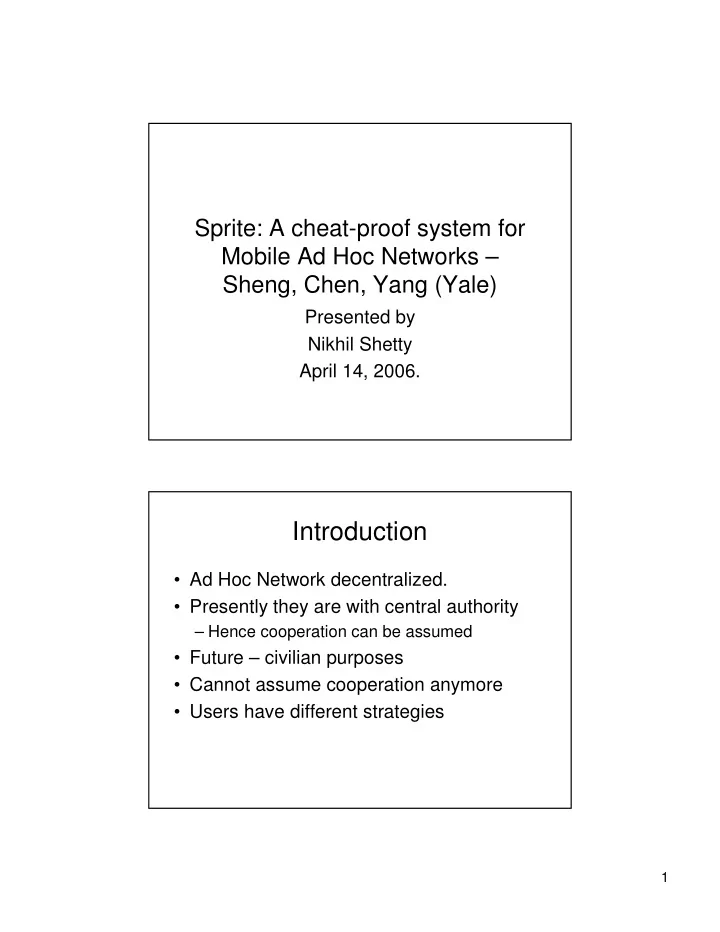
Sprite: A cheat-proof system for Mobile Ad Hoc Networks – Sheng, Chen, Yang (Yale)

Presented by Nikhil Shetty April 14, 2006.

Introduction

  • Ad Hoc Network decentralized.
  • Presently they are with central authority

– Hence cooperation can be assumed

  • Future – civilian purposes
  • Cannot assume cooperation anymore
  • Users have different strategies
slide-2
SLIDE 2

2

Protocol Requirements

  • How to stimulate cooperation?

– Provide incentives

  • Report actions honestly?

– Make truth telling the dominant strategy

  • Should have low overhead
  • Should not require tamper-proof hardware

Model

  • Two types of uncooperative nodes

– Faulty / malicious nodes – Selfish nodes

  • Model does not assume faulty / malicious

nodes

  • Selfish node is an economically rational

mode – maximize their welfare

  • Forwarding costs energy – requires

incentive

slide-3
SLIDE 3

3

Previous work

  • Reputation System

– Reputation is propagated through network – Repeated game – Selfish nodes can collude – Monitoring may not be possible

  • Virtual currency

– Put currency in packet and send – Decrement currency at forwarders – Requires tamper-proof hardware

Basic Characteristics

  • Sprite – A Simple cheat-proof credit-based

system

  • Based on Algorithmic mechanism design
  • Virtual currency used
  • No Tamper-proof hardware required
  • Use of centralized Credit Clearance

Service

slide-4
SLIDE 4

4

Architecture Overview

  • Virtual money
  • Sender loses money – incurs cost to

forward messages

  • Node can earn money in 2 ways

– Forwarding others’ messages – Buying credit from CCS

  • When they forward packets, keep receipts
  • Transfer receipts to CCS when connection

is good.

slide-5
SLIDE 5

5

Who pays whom?

  • Should we charge sender or destination or both?
  • Destination pays

– DOS Attack possible

  • Share Cost

– Sender colludes with intermediate nodes

  • If destination benefits from contents, use higher

layer to extract payment

  • Hence, only sender pays

– Self-regulating

Who gets paid?

  • Ideally, any node that has tried to forward

packet.

– Because node incurs cost

  • But decision cannot be made based on attempt

but on outcomes.

  • If next node in line says it received the packet,

CCS will pay the previous node.

  • Final receiver also gets paid something because

he is giving receipt back to the CCS.

– Incentive to forward receipts

slide-6
SLIDE 6

6

Objectives of payment

  • Prevent cheating.
  • Provide incentives to forward messages.
  • Balanced payment not required

– Sender may pay more – security overhead – Long-term outflow possible – CCS may return the money periodically.

Possible Cheating Actions

  • Node saves receipt but does not forward

message.

  • Node received message but does not

report receipt.

  • Node does not receive message but

falsely claims that it has.

  • All these can get complicated by collusion.
slide-7
SLIDE 7

7

Payment scheme v.1 Forwarding motivation

  • Beta < Alpha
  • Required so that node forwards message

and does not earn enough but just receiving it.

  • Beta should be greater than the cost of

submitting the receipt.

slide-8
SLIDE 8

8

Payment Scheme v.2 Reporting motivation

  • Beta > cost for reporting the receipt

(small).

  • However, collusion is possible
  • E.g Last node does not report the packet
  • receipt. It loses beta. But sender gains

alpha as he has to pay lesser. He can transfer some amount to the last node and they can gain a benefit of (alpha – beta).

slide-9
SLIDE 9

9

Reporting motivation

  • Make sender pay for the whole path

though the message may not have reached the destination.

  • Last nodes do not gain anything by

colluding as their payoff decreases.

  • Similarly, gain from previous collusion is

included in the price sender pays.

  • Net gain by collusion is 0.

Payment scheme v.3

slide-10
SLIDE 10

10

Preventing false receipts

  • Instead of forwarding messages, nodes

forward the receipts only.

  • Sufficient for getting credit.

Preventing false receipts

  • CASE 1: Destination colludes with

intermediate nodes.

  • Destination submits receipt for message it

has not received.

  • Pay as normal case.
  • Whether destination actually received the

packet can be validated by higher layers at

  • sender. Can make destination pay to it for

the data.

slide-11
SLIDE 11

11

Preventing false receipts

  • CASE 2: Destination does not collude with

intermediate nodes.

  • If destination does not receive the packet,

we can reduce the payoff of all the nodes by a factor of gamma.

  • Cheating nodes will not be able to recover

even cost of forwarding receipt.

A Game Model

  • Game: Submissions of receipts regarding

a given message m as a one-round game.

  • Players: The game has (d+1) players, n0,

n1, …. nd, from the sender to destination.

  • Players’ Information: Let Ti be the

information held by player ni.

– Unknown to CCS – Ti = TRUE if message m received – Ti = FALSE otherwise.

slide-12
SLIDE 12

12

Model (continued)

Where e’ is the index of the last node that has ever received the message m. Player has some information about e’ from its own information.

Model (continued)

  • Actions: Let Ai be the action of player ni.

Two possible actions: Ai is either TRUE or FALSE, i.e. by submitting a valid receipt or by withholding the receipt.

slide-13
SLIDE 13

13

Model (continued)

  • Cost of Actions: Let Ui be the cost of ni’s
  • action. Cost of sending a receipt to CCS is

very low. Let delta be the cost of forwarding receipt to another node. Then node incurs a cost of delta. Ni must compensate the node with delta.

Model (continued)

  • Payment:
slide-14
SLIDE 14

14

Model (continued)

Analysis of the Game: Security Perspective:

slide-15
SLIDE 15

15

Analysis Analysis

slide-16
SLIDE 16

16

Analysis Analysis

slide-17
SLIDE 17

17

Analysis Analysis

slide-18
SLIDE 18

18

Analysis Analysis

slide-19
SLIDE 19

19

Analysis Analysis

slide-20
SLIDE 20

20

Analysis Analysis

slide-21
SLIDE 21

21

Analysis Analysis

slide-22
SLIDE 22

22

Battery Usage - Afterthought Battery requirement

  • If c and b denote estimated credit balance

and number of messages allowed to be transmitted with the battery, if c/L < b then forward the message else don’t.

  • L is the average number of hops in a path.
  • Number of packets that I can send is less

than the max possible with the battery, then I forward the message.

slide-23
SLIDE 23

23

Conclusion

  • Cheat-proof mechanism obtained
  • analyzed with game theory.
  • Requirement of CCS
  • Requirement of receipt submission once in

a while

  • Battery not a part of the optimization.

Fixed rates for transmission.