
1/35
Computer Science & Engineering 423/823 Design and Analysis of Algorithms
Lecture 11 — Maximum Flow (Chapter 26) Stephen Scott and Vinodchandran N. Variyam
2/35
Introduction
I Can use a directed graph as a flow network to model:
I Data through communication networks, water/oil/gas through pipes,
assembly lines, etc.
I A flow network is a directed graph with two special vertices: source s
that produces flow and sink t that takes in flow
I Each directed edge is a conduit with a certain capacity (e.g., 200
gallons/hour)
I Vertices are conduit junctions I Except for s and t, flow must be conserved: The flow into a vertex must
match the flow out
I Maximum flow problem: Given a flow network, determine the
maximum amount of flow that can get from s to t
I Other application: Bipartite matching
3/35
Flow Networks
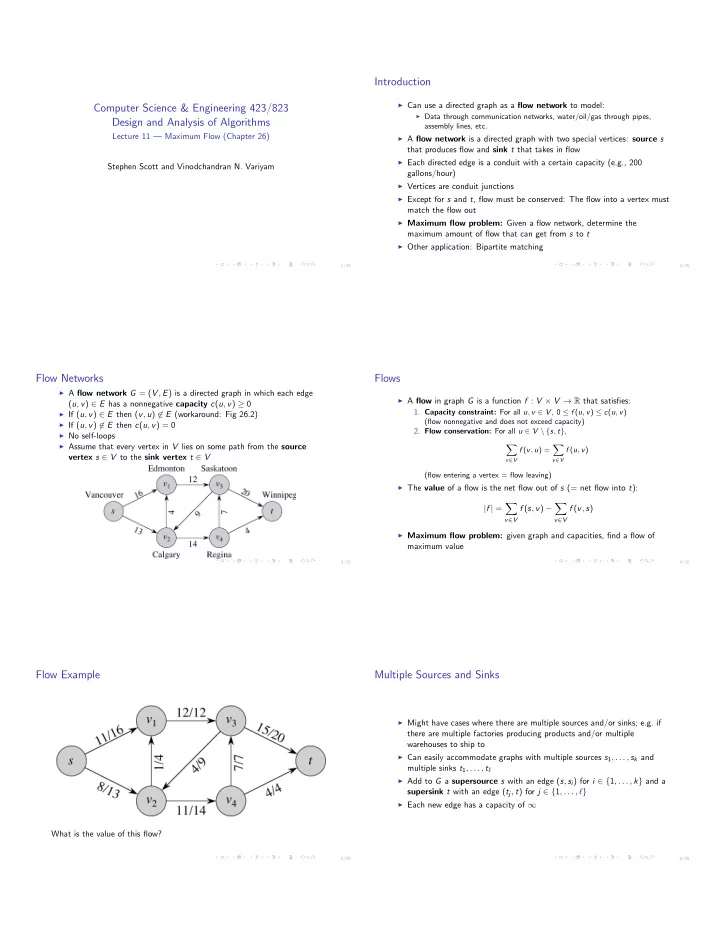
I A flow network G = (V , E) is a directed graph in which each edge
(u, v) 2 E has a nonnegative capacity c(u, v) 0
I If (u, v) 2 E then (v, u) 62 E (workaround: Fig 26.2) I If (u, v) 62 E then c(u, v) = 0 I No self-loops I Assume that every vertex in V lies on some path from the source
vertex s 2 V to the sink vertex t 2 V
4/35
Flows
I A flow in graph G is a function f : V ⇥ V ! R that satisfies:
- 1. Capacity constraint: For all u, v 2 V , 0 f (u, v) c(u, v)
(flow nonnegative and does not exceed capacity)
- 2. Flow conservation: For all u 2 V \ {s, t},
X
v2V
f (v, u) = X
v2V
f (u, v) (flow entering a vertex = flow leaving)
I The value of a flow is the net flow out of s (= net flow into t):
|f | = X
v2V
f (s, v) X
v2V
f (v, s)
I Maximum flow problem: given graph and capacities, find a flow of
maximum value
5/35
Flow Example
What is the value of this flow?
6/35
Multiple Sources and Sinks
I Might have cases where there are multiple sources and/or sinks; e.g. if
there are multiple factories producing products and/or multiple warehouses to ship to
I Can easily accommodate graphs with multiple sources s1, . . . , sk and
multiple sinks t1, . . . , t`
I Add to G a supersource s with an edge (s, si) for i 2 {1, . . . , k} and a
supersink t with an edge (tj, t) for j 2 {1, . . . , `}
I Each new edge has a capacity of 1