Introduction to Cognitive How can we discover what our brains - - PDF document

introduction to cognitive how can we discover what our
SMART_READER_LITE
LIVE PREVIEW

Introduction to Cognitive How can we discover what our brains - - PDF document

Introduction to Cognitive How can we discover what our brains Neuroscience are doing and how they are doing it? Tom Johnstone Office: 1S25 Email: i.t.johnstone Brain basics Imaging the brain Automatic threat detection


slide-1
SLIDE 1

Introduction to Cognitive Neuroscience

Tom Johnstone Office: 1S25 Email: i.t.johnstone Brain basics Imaging the brain Automatic threat detection Please check blackboard AND:

  • http://www.beclab.org.uk
  • http://www.cognitiveneurosciencearena.com/whatiscognitiveneuroscience.asp

How can we discover what our brains are doing and how they are doing it?

Churchland and Sejnowski, 1988

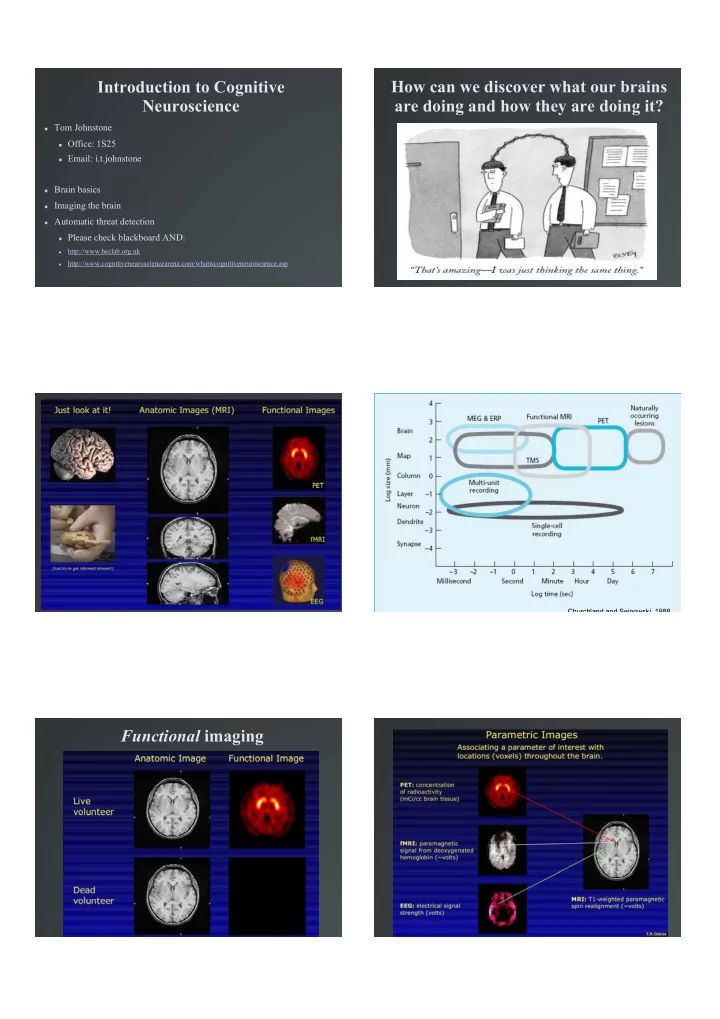
Functional imaging

slide-2
SLIDE 2

Uses radioactive tracers introduced into the blood The tracers bind to some molecule of interest in the

brain

Amount and source of emitted radiation tells us

about amount and location of molecule of interest

Used to image blood, oxygen, neurotransmitters (e.g.

Dopamine)

Slow (minutes - hours)

PET: Positron Emission Tomography PET: Positron Emission Tomography PET Tracers

Some PET Radiocompounds and Their Biomedical Applications:

  • 15O-oxygen

Oxygen metabolism

  • 15O-carbon monoxide

Blood volume

  • 15O-carbon dioxide

Blood flow

  • 13N-ammonia

Blood flow

  • 18F-fluorodeoxyglucose

Glucose metabolism

  • 18F-fluoromisonidazole

Hypoxic cell tracer

  • 11C-SCH23390

Dopamine DI receptor

  • 11C-flumazenil

Benzodiazepine receptor

(Adapted from www.austin.unimelb.edu.au/dept/nmpet/pet/detail/radionuc.html) Measuring dopamine neuromodulation in the thalamus: Using [F-18]fallypride PET to study dopamine release during a spatial attention task Christian et al., 2005: http://dx.doi.org/10.1016/j.neuroimage.2005.11.052

EEG: Electroencephalography

Measures electrical field on scalp Electric field changes with neural activity in the

brain

EEG can detect fast changes to the electrical field

(e.g. < 50 milliseconds)

Cannot tell us exactly where the source(s) of the

electrical field changes are

EEG

slide-3
SLIDE 3

EEG: Electroencephalography

http://www.mrc-cbu.cam.ac.uk/research/eeg/eeg_intro.html

MRI: Magnetic Resonance Imaging

Uses an extremely powerful electromagnet to detect

brain structure and function

Magnetic field: 3 Tesla: approx. 60,000 x Earth's

magnetic field

Functional MRI (fMRI): based on magnetic

properties of haemoglobin with and without attached

  • xygen

MRI: Magnetic Resonance Imaging

3T Siemens Trio MRI scanner

MRI: Magnetic Resonance Imaging fMRI

Detects changes in oxygenated blood concentration

due to changes in blood flow

slide-4
SLIDE 4

fMRI

Reasonable time resolution (a few seconds), but not

as fast as EEG (or many neural processes!)

Good 3D spatial resolution: can identify source of

MRI signal to within a few mm

Non-invasive, but still certain restrictions (no metal

  • r pacemakers!) and LOUD!!!

Relative measure: must always have a within-subject

control condition (no purely between-subjects designs)

FMRI: Typical experiment

Repeatedly scan participants (one complete brain

scan every 2-3 seconds) while they perform a task

Two or more conditions (e.g. Angry versus Happy

faces, easy versus difficult task, warm heat versus painful heat)

Continue until enough repetitions of each task

condition have been collected (approx. 20/condition)

Typically acquire 30-60 minutes of data

FMRI: Emotional pictures

slide-5
SLIDE 5

FMRI: Emotional pictures Questions to ask yourself whenever reading a Cognitive Neuroscience research paper:

What can it really tell us about function? Does it tell

us more than a behavioural experiment? (and is it worth the cost of $3 million per scanner, then $700 per hour)?

Would it be as convincing without the pretty pictures

  • f brains?

Are the identified regions of the brain meaningful

functional units? More generally, is the brain modular?

Is it good science?

What can it really tell us about function?

Coltheart (2004) poses the question: "Has cognitive neuroscience, or if not might it ever (in

principle, or even in practice) successfully use(d) data from cognitive neuroimaging ... to adjudicate between competing information-processing models of some cognitive system)?" (p. 21).

Coltheart, M. (2004) Brain imaging, connectionism and cognitive neuropsychology. Cognitive Neuropsychology, 2, 21-25. Coltheart, M. (2006). What has functional neuroimaging told us about the mind (so far)? Cortex, 42(3), 323-31.

Are the identified regions of the brain meaningful functional units?

Most cognitive neuroscience techniques have a

spatial resolution of half a centimetre or more. This is a large region in comparison to the size of neurons

  • r networks and nucleii of neurons.

Do the “blobs” of activation (neuroimaging), lesions

(neuropsychology) or virtual lesions (TMS) encompass more than one possible functional unit?

Example: LeDoux’s model of fear Example: Patient SM: bilateral amygdala damage

Adolphs et al. (‘94) SM 30 years, normal intelligence She had trouble: recognizing facial expressions of fear generating the facial expression of fear drawing an expression of fear
slide-6
SLIDE 6

OMG!!! My Brain Hurts!! Amygdala inputs