
SLIDE 1
Introduction to iPEPS
Philippe Corboz, Institute for Theoretical Physics, University of Amsterdam
(second lecture)
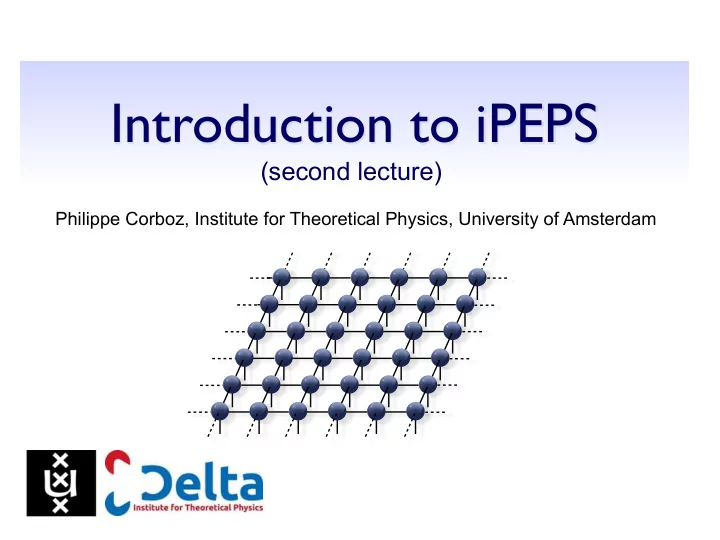
Introduction to iPEPS (second lecture) Philippe Corboz, Institute - - PowerPoint PPT Presentation
Introduction to iPEPS (second lecture) Philippe Corboz, Institute for Theoretical Physics, University of Amsterdam Outline Part I: iPEPS ansatz Part II: Contraction of PEPS / iPEPS Interlude: Example application: the
Philippe Corboz, Institute for Theoretical Physics, University of Amsterdam
(second lecture)
✦ Imaginary time evolution ✦ Variational optimization (iterative energy minimization)
✦ How large does D need to be? ✦ Comparison with 2D DMRG ✦ Comments on extrapolations
V: Advanced tensor network applications
✦ SU(N) Heisenberg models
Outline
PART III: Optimization
MPS
Structure
Variational ansatz
iterative optimization
(energy minimization) imaginary time evolution Contraction of the tensor network exact / approximate
Find the best (ground) state
|˜ Ψ
Compute
˜ Ψ|O|˜ Ψ⇥
PEPS 2D MERA 1D MERA
Summary: Tensor network algorithm for ground state
Optimization via imaginary time evolution
exp(−τ ˆ Hb)
Keep D largest singular values
U √ ˜ s √ ˜ sV
SVD s
U V †
Time Evolving Block Decimation (TEBD) algorithm
Note: MPS needs to be in canonical form
... ...
exp(β ˆ H)|Ψii
β → ∞
|ΨGSi
τ = β/n exp(−β ˆ H) = exp(−β X
b
ˆ Hb) = exp(−τ X
b
ˆ Hb) !n ≈ Y
b
exp(−τ ˆ Hb) !n
Trotter-Suzuki decomposition:
Optimization via imaginary time evolution
Cluster update Wang, Verstraete, arXiv:1110.4362 (2011)
to a bond and truncate bond back to D
exp(−τ ˆ Hb)
simple update (SVD)
★ “local” update like in TEBD ★ Cheap, but not optimal (e.g. overestimates magnetization in S=1/2 Heisenberg model)
Jiang et al, PRL 101 (2008)
full update
★ Take the full wave function into account for truncation ★ optimal, but computationally more expensive ★ Fast-full update [Phien et al, PRB 92 (2015)]
Jordan et al, PRL 101 (2008)
Optimization: simple update
A B C D
..." ..." ..." ..."
λ1 λ2 λ5 λ4 λ3 λ3 λ6 λ6 λ8 λ8 λ7 λ7
..." ..." ..." ..."
ΓA ΓB Γ
CΓD
λ6
1/2λ1
1/2λ2
1/2λ3
1/2=
A ΓA
keep only D largest singular values
˜ Γ
A˜ λ
1=
Θ
SVD$
˜ Γ
Bλ6
−1λ3
−1λ2
−1=
Γ'A ˜ Γ
Aλ8
−1λ3
−1λ4
−1=
Γ'B ˜ Γ
A
Jiang, et al., PRL 101, 090603 (2008)
g λ1 λ6 λ3 λ2 λ8 λ4 λ3 Θ
=
ΓA ΓB
Trick to make it cheaper
g λ1 λ6 λ3 λ2 λ8 λ4 λ3 ΓA ΓB
=
g
=
U sV T
=
g
SVD$
=
λ6
−1
λ3
−1
λ2
−1
=
Γ'A ˜ Γ
A
λ8
−1
λ3
−1
λ4
−1
=
Γ'B ˜ Γ
B
g
=
˜ Γ
A
˜ λ
1
˜ Γ
B
keep only D largest singular values
Optimization: full update
g A B
Environment
|˜ Ψi = g|Ψi
Environment
A' B'
≈
|Ψ0i
≈
Jordan, Orus, Vidal, Verstraete, Cirac, PRL (2008) Corboz, Orus, Bauer, Vidal, PRB 81, 165104 (2010)
|| |˜ Ψi |Ψ0i ||2 = h˜ Ψ|˜ Ψi + hΨ0|Ψ0i h˜ Ψ|Ψ0i hΨ0|˜ Ψi
Full-update: details
which is updated
=
X p A
=
Y q B
=
Environment
tensors U
(sV)
d(p0, q0) = h˜ Ψ|˜ Ψi + hΨ0|Ψ0i h˜ Ψ|Ψ0i hΨ0|˜ Ψi
“Cost-function”
+
p q p p0 q0 p0 q0 g g p† q† g† q p p† q†
≈
find new p’, and q’ to minimize: || |˜
Ψi |Ψ0i || |˜ Ψi = g|Ψ(p, q)i |Ψ0(p0, q0)i
2
Finding p’ and q’ through sweeping
= p0
0 q0
q p
∂ ∂p0⇤ d(p0, q0) = 0
Mp0
b
=
new p’
SVD
= 0
∂ ∂p0⇤
+
p0† p0
=
p0 g
Finding p’ and q’ through sweeping
= p0
0 q0
q p
∂ ∂p0⇤ d(p0, q0) = 0
Mp0
b
=
new p’
∂ ∂q0⇤ d(p0, q0) = 0
=
new q’
˜ Mq0
˜ b
d(p0, q0)
SVD
g
=
X p' A'
=
Y q' B'
Optimization: full update
g A B
Environment
|˜ Ψi = g|Ψi
Environment
A' B'
≈
|Ψ0i
≈
Jordan, Orus, Vidal, Verstraete, Cirac, PRL (2008) Corboz, Orus, Bauer, Vidal, PRB 81, 165104 (2010)
|| |˜ Ψi |Ψ0i ||2 = h˜ Ψ|˜ Ψi + hΨ0|Ψ0i h˜ Ψ|Ψ0i hΨ0|˜ Ψi
Optimization: simple vs full update
simple update
★ “local” update like in TEBD ★ Cheap, but not optimal (e.g. overestimates magnetization in S=1/2 Heisenberg model)
full update
★ Take the full wave function into account for truncation ★ optimal, but computationally more expensive
0.1 0.2 0.3 0.4 0.5 0.3 0.32 0.34 0.36 0.38 0.4 0.42 1/D m [%] Simple update Full update
exact result
Example: 2D Heisenberg model
fast full update
Phien, Bengua, Tuan, PC, Orus, PRB 92 (2015)
Variational optimization for PEPS
E = hΨ|H|Ψi hΨ|Ψi
tensor A reshaped as a vector tensor network including all Hamiltonian terms tensor network from norm term
H x = E N x
solve generalized eigenvalue problem
minimize
Verstraete, Murg, Cirac, Adv. Phys. 57 (2008)
in 1D:
ˆ H
H = N =
Variational optimization for PEPS
E = hΨ|H|Ψi hΨ|Ψi
tensor A reshaped as a vector tensor network including all Hamiltonian terms tensor network from norm term
H x = E N x
solve generalized eigenvalue problem
minimize
Verstraete, Murg, Cirac, Adv. Phys. 57 (2008)
Variational optimization for iPEPS
E = hΨ|H|Ψi hΨ|Ψi
tensor A reshaped as a vector tensor network including all Hamiltonian terms tensor network from norm term
H x = E N x
minimize
B C F G D A H D A H E B C F G D A H E D A H E B C F G D A H E D A H E E
) iPEPS
Main challenges:
✦ Solution: use corner-transfer matrix method [PC, arXiv:1605.03006] ✦ Alternative: use “channel-environments” [Vanderstraeten et al, PRB 92, arxiv:1606.09170] ✦ Or: Use PEPO (similar to 3D classical) [cf. Nishino et al. Prog. Theor. Phys 105 (2001)]
✦ Take adaptive linear combination of old and new tensor [PC, arXiv:1605.03006]
[see also Nishino et al. Prog. Theor. Phys 105 (2001), Gendiar et al. PTR 110 (2003)]
✦ Alternative: use CG approach [Vanderstraeten, Haegeman, PC, Verstraete, arXiv:1606.09170]
H-environment
E = hΨ|H|Ψi hΨ|Ψi
tensor network including all Hamiltonian terms tensor network from norm
H x = E N x
minimize
C1 C2 C3 C4 T1
T2 T3 T4 a
C2 C3 C4 T1 T2 T3 T4 a
˜ C1
... ... ... ...
+ . . .
... ... ... ... ... ... ... ... ... ... ... ...
+ + +
=
˜ C1 ➡ taking into account all Hamiltonian contributions in the infinite upper left corner
But how about H ??
H-environment
+ + + + + + + + + + + + + + + + + + +
=
hΨ| ˆ H|Ψi =
+ + + + + + + +=
... ...+
...+ +
=
... ... ... ... ... ... ... ... ... ... ... ... ... ... ... ... ... ... ... ... ...+ +
=
+ . . ˜ = =
+ + + . . .=
+ +=
+ . . .˜
... ... ... ... + . . . ... ... ... ... ... ... ... ... ... ... ... ... + + += =
= =
Local terms
Terms between a corner and an edge tensor Corner terms
H-environment: bookkeeping
CTM left move:
=
+ ++
+=
+= = = + + = = +
+ += = = ˜ C0
h4˜ T 04 ˜ C0
v4˜ C0
4T 0o
4=
+... and similarly for right-, top-, bottom-move
= +
+ + + += + = = + + = = +
+ += = = = = = ˜ C0
1˜ C0
v1˜ C0
h1˜ TT 04
0o=
Practical scheme
E = hΨ|H|Ψi hΨ|Ψi
tensor A reshaped as a vector
H x = E N x
minimize
~
λ ∈ [0.5, 1.5]
A0(λ)[x,y] = ˜ A[x,y] sin λπ − A[x,y] cos λπ.
see also [Nishino et al. PTR 105 (2001)]
E(λ)
Practical scheme
E = hΨ|H|Ψi hΨ|Ψi
tensor A reshaped as a vector
H x = E N x
minimize
~
λ ∈ [0.5, 1.5]
A0(λ)[x,y] = ˜ A[x,y] sin λπ − A[x,y] cos λπ.
see also [Nishino et al. PTR 105 (2001)]
E(λ)
Minimization scheme
A, exit
– If E(1 + ∆) < E(1) → λ = 1 + ∆, exit – else ∆ = ∆/2
Comparison: Heisenberg model
2 4 6 0.3 0.32 0.34 0.36 0.38 0.4 0.42 D m E /J
with the variational optimization
2 4 6 10
−5
10
−4
10
−3
10
−2
D ∆ Es
simple update full update variational update
Benchmark: Heisenberg model (D=4)
− −0.6685 − −0.6675 0.05 0.1 0.15 −0.669 −0.6688 −0.6686 −0.6684 τ full update variatonal update
s
Es/J
D=4
even in the limit
τ → 0
Es/J
similar computational cost
200 400 −0.669 −0.6685 −0.668 −0.6675 seconds 0.15
Run-time on laptop
Trotter step τ
Benchmark: t-J model
4 5 6 7 8 9 10 11 −1.55 −1.5 −1.45 −1.4 −1.35 D Ehole/t full update variational update
Better results by performing a few (3-5) additional steps with the variational optimization
PC, arXiv:1605.03006
Benchmark: Shastry-Sutherland model (SrCu2(BO3)2)
10 20 30 40 −0.3865 −0.386 −0.3855 −0.385 −0.3845 −0.384 −0.3835 −0.383 −0.3825 −0.382 β or iteration Es
full update variational update
Initial state: Néel state Full update: gets stuck! Variational optimization: converges to correct plaquette state (plaquette state)
J0/J = 0.7, D = 4
ˆ H = J0 X
hi,ji
Si · Sj + J X
hhi,jiidimer
Si · Sj + h X
i
Sz
i
J0 J
Benchmark: Shastry-Sutherland model + external field
ˆ H = J0 X
hi,ji
Si · Sj + J X
hhi,jiidimer
Si · Sj + h X
i
Sz
i
Oninzuka, et al.
1/8 plateau 1/4 plateau 1/3 plateau
Onizuka, et al., JPSJ 69 (2000)
★ iPEPS: crystals of bound states (for m<1/4)
[PC, F. Mila, PRL 112 (2014)]
★ Previous theories: crystals of triplets
simple update: not symmetric state! Bound state of 2 triplet excitations
2 4 6 0.02 0.04 0.06 0.08 0.1 Symmetry error D simple update full update variational
Better results also for large unit cells!
Overview: optimization in iPEPS
✦ Simple update:
Jiang et al, PRL 101 (2008)
✦ Cluster update:
Wang et al, arXiv:1110.4362
✦ Full update:
Jordan et al, PRL 101 (2008)
✦ Fast-full update:
Phien et al, PRB 92 (2015)
cheap and simple, but not accurate improved accuracy high accuracy, more expensive
✦ DMRG-like sweeping:
PC, arXiv:1605.03006
✦ CG-approach:
Vanderstraeten, Haegeman, PC, Verstraete, arXiv:1606.09170
✦ ... more to explore...! ✦ See also variational optimization in the context of 3D classical models
Nishino et al. Prog. Theor. Phys 105 (2001), Gendiar et al. Prog. Theor. Phys 110 (2003)
higher accuracy, similar cost as FFU higher accuracy, similar cost as FFU high accuracy, cheaper than FU
+ COMBINATIONS!
MPS
Structure
Variational ansatz
iterative optimization
(energy minimization) imaginary time evolution Contraction of the tensor network exact / approximate
Find the best (ground) state
|˜ Ψ
Compute
˜ Ψ|O|˜ Ψ⇥
PEPS 2D MERA 1D MERA
Summary: Tensor network algorithms (ground state)
PART IV: Computational cost & benchmarks
Computational cost
It depends on the amount of entanglement in the system!
D
(i)PEPS
D
Bond dimension 1 2 3 4 5 6 7 8
MPS
Bond dimension D
MPS for 2D system: D~exp(W) accurate for cylinders up to a certain width
Nvar ∼ D4 cost ∼ (Nvar)2.5
polynomial scaling but large exponent! MPS: k = 3 PEPS: k ≈ 10
Comparison 2D DMRG & iPEPS: 2D Heisenberg model
iPEPS D=6
(variational optimization)
iPEPS D=6 in the thermodynamic limit ~ 2’600 variational pars. MPS D=3000 on finite Ly=10 cylinder ~ 18’000’000
similar accuracy
4 orders of magnitude fewer parameters (per tensor)
2D DMRG and iPEPS provide
complementary
results!!!
Stoudenmire & White, Ann. Rev. CMP 3 (2012)
0.05 0.1 0.15 0.2
1/c
E/site
2D (est.) Torus
DMRG
MERA
Upper Bound Cylinder
Series (HVBC) DMRG, Cyl, Odd DMRG, Cyl, Even DMRG, Torus (Jiang...) Lanczos, Torus
Heisenberg model on the Kagome lattice
iPEPS
1/Daccuracy comparable to 2D DMRG YC10-4, m=6000
Classification by entanglement (2D)
high Entanglement low gapped systems band insulators, valence-bond crystals, s-wave superconductors, ... gapless systems with area law Heisenberg model, d-wave / p-wave SC, Dirac Fermions, ... systems with “1D fermi surface” free Fermions, Fermi-liquid type phases, bose-metals?
S(L) ∼ L log L
It depends on the amount of entanglement in the system!
D
Non-interacting spinless fermions (old iPEPS results)
fast convergence with D in gapped phases slow convergence in phase with 1D Fermi surface
Hfree =
[c†
rcs + c† scr − γ(c† rc† s + cscr)] − 2λ
c†
rcr
1 2 3 4 1 2 3 4 λ γ
critical gapped
1D Fermi surface
1 1.5 2 2.5 3 10
−710
−610
−510
−410
−310
−2λ Relative error of energy
γ=0 D=2 γ=0 D=4 γ=1 D=2 γ=1 D=4 γ=2 D=2 γ=2 D=4
D: bond dimension
Li et al., PRB 74, 073103 (2006)
QMC from C(L/2,L/2) 0.2 0.4 0.6 1/D iPEPS QMC extrap. linear fits quadratic fits
Benchmark S=1/2 Heisenberg model: Order parameter
strong finite D effects how to extrapolate? m ≈ 0.295 − 0.314
0.05 0.1 0.3 0.32 0.34 0.36 0.38 0.4 0.42 1/L staggered magnetization QMC from Ms2 QMC from C(L/2,L/2) QMC extrap.
strong finite size effects accurate extrapolation m = 0.30743(1)
Sandvik & Evertz, PRB 82 (2010)
H = J
SiSj +
SiSj
. . . . . . . . . . . .
J
Wenzel, Janke, PRB 79 (2009)
1 Phase diagram
Distinguish between ordered / disordered phase?
2nd order phase transition
0.3969 Dimer phase
S S S S S S S S S S
m=0 Néel phase m>0
0 0.1 0.2 0.3 0.4 0.5 0.1 0.2 0.3 1/D m J=0.39 0 0.1 0.2 0.3 0.4 0.5 0.1 0.2 0.3 1/D m J=0.3969 0 0.1 0.2 0.3 0.4 0.5 0.1 0.2 0.3 1/D m J=0.4
m=0 m~0 m>0
Distinguish between ordered / disordered phase?
Dimer phase
S S S S S S S S S S
J
1
2nd order phase transition
Phase diagram Néel phase 0.3969 m=0 m>0
0 0.1 0.2 0.3 0.4 0.5 0.1 0.2 0.3 1/D m J=0.39 0 0.1 0.2 0.3 0.4 0.5 0.1 0.2 0.3 1/D m J=0.3969 0 0.1 0.2 0.3 0.4 0.5 0.1 0.2 0.3 1/D m J=0.4
m=0 m~0 m>0
Distinguish between ordered / disordered phase?
★ Extrapolations in D are important to distinguish between
★ A better understanding how to accurately extrapolate in D would be very useful [work in progress...] ★ Goal: systematic finite bond-dimension scaling analysis (similar to finite-size scaling analysis)
Improving energy extrapolations
Motivation:
PC, PRB 93 (2016) 0.1 0.2 0.3 0.4 0.5 0.6 −1.37 −1.36 −1.35 −1.34 −1.33 −1.32 −1.31 −1.3 1/D E E(1/D) exact result
Bad estimate based
Extrapolate in truncation error instead!
0.1 0.2 0.3 0.4 0.5 0.6 −1.37 −1.36 −1.35 −1.34 −1.33 −1.32 −1.31 −1.3 1/D or w E E(1/D) E(w) exact result
ˆ H = −t P
hi,j,σi⇣ ˆ c†
iσˆcjσ + H.c. ⌘ + P
hi,ji γij⇣ ˆ c†
i"ˆc†
j# − ˆc†
i#ˆc†
j" + H.c.⌘
several competing states (e.g. Hubbard model)
Truncation error in the full update algorithm
g A B
Environment
|˜ Ψi = g|Ψi
Environment
A' B'
≈
|Ψ0i
≈
w(D) = C(D, β → ∞)/τ
C = || |˜ Ψi |Ψ0i ||
Benchmark: Hubbard model U/t=8, half filling
0.05 0.1 0.15 −0.526 −0.524 −0.522 −0.52 −0.518 −0.516 −0.514 E 1/D or w
E(1/D) E(w) DMET extrap. DMRG extrap. FNMC extrap. AFQMC extrap. AFQMC error
Example: vertical vs diagonal stripe, U/t=8, δ=1/8
0.05 0.1 0.15 0.2 0.25 0.3 0.35 −0.77 −0.76 −0.75 −0.74 −0.73 −0.72 −0.71 −0.7 −0.69 E 1/D or w
E(1/D): vertical stripe E(w): vertical stripe E(1/D): diagonal stripe E(w): diagonal stripe FNMC 20x20 FNMC 16x16 DMRG W=6 extr. AFQMC extr. DMET 5x2 cell
PC, PRB 93 (2016)
[data from LeBlanc, et al., PRX 5 (2015)]
0.24 0.10 0.15 0.14 0.00 0.16 0.15 0.14 0.24 0.10 Exploiting global abelian symmetries
Singh, Pfeifer, Vidal, PRB 83 (2011) Bauer, Corboz, Orus, Troyer, PRB 83 (2011)
Hamiltonian with symmetry, e.g. particle number conservation (U(1))
H =
N=0
N=1
N=2 larger bond dimension D can be afforded
Tensors can also be written in block form
reduces computational cost
Part V: iPEPS applications
Examples of iPEPS simulations
iPEPS is a very competitive variational method! Find new physics thanks to (largely) unbiased simulations
SU(N) Heisenberg models (square lattice)
local basis states: | "i, | #i
H = X
hi,ji
SiSj Néel order
| o i, | o i
local basis states:
H = X
hi,ji
Pij
SU(N) Heisenberg models (square lattice)
i j i j
Pij
Ground state??
Néel order
87Sr
I = 9/2 :
Nuclear spin
Nmax = 2I + 1 = 10
Identify nuclear spin states with colors:
| o i | o i | o i | o i
|Iz = 1/2i |Iz = 3/2i |Iz = 1/2i |Iz = 3/2i
SU(N) Heisenberg models (square lattice)
| o i, | o i
local basis states:
H = X
hi,ji
Pij
i j i j
Pij
Ground state??
Néel order
SU(N) Heisenberg models (square lattice)
Néel order | o i, | o i
local basis states:
H = X
hi,ji
Pij
i j i j
Pij
Cannot use QMC because
SU(N) Heisenberg models (square lattice)
Néel order | o i, | o i
local basis states:
H = X
hi,ji
Pij
i j i j
Pij
3 sub-lattice Néel order
iPEPS & DMRG (Bauer, Corboz, et al. PRB 85, 2012)
ED & flavor-wave theory (Toth et al., PRL 105, 2010)
SU(N) Heisenberg models (square lattice)
Néel order | o i, | o i
local basis states:
H = X
hi,ji
Pij
i j i j
Pij
New ground state found with iPEPS
Corboz, Läuchli, Mila, Penc, Troyer, PRL ’11
spin-orbital liquid
Wang&Vishwanath ‘09
0.1 0.2 0.3 0.4 0.5 −1 −0.95 −0.9 −0.85 −0.8 −0.75 −0.7 −0.65 −0.6 Es 1/D
2x2 unit cell 4x2 u.c. 4x4 u.c. VMC
V V
1 2 3 4 1 2
V V V V A B B A H H
Corboz, Läuchli, Penc, Troyer, Mila, PRL 107, 215301 (2011)
“Dimer-Néel” order
rotation (SU(2))
SU(4) Heisenberg model: iPEPS results
✓ .
supported by exact diagonalization results
V V
1 2 3 4 1 2
V V V V A B B A H H
“Dimer-Néel” order
Dimerization and SU(4) symmetry breaking
0.1 0.2 0.2 0.4 0.6 0.8 ∆ Eb 1/D
translational symmetry broken
0.1 0.2 0.1 0.2 0.3 0.4 m 1/D
SU(4) symmetry broken
Square lattice: iPEPS results
Corboz, Läuchli, Penc, Troyer, Mila, PRL 107, 215301 (2011)
SU(4) Heisenberg model: iPEPS results
spin-orbital liquid
Wang&Vishwanath ‘09
0.1 0.2 0.3 0.4 0.5 −1 −0.95 −0.9 −0.85 −0.8 −0.75 −0.7 −0.65 −0.6 Es 1/D
2x2 unit cell 4x2 u.c. 4x4 u.c. VMC
Linear flavor-wave theory:
(a)
“Dimer-Néel” order ?
Corboz, Läuchli, Mila, Penc, Troyer, PRL 107, 215301 (2011)
SU(4): Study as a function of bond dimension
D
D=1
product state (mean-field)
infinite ground state degeneracy studying extrapolations
D=5-16 suggests that state is stable D=16
largest D tested in this study
D
increase quantum fluctuations / increase entanglement
D=2
add quantum fluctuations
same solution as linear flavor-wave theory (a) plaquette state
D=5
Dimer-Néel ordered state
Adding quantum fluctuations systematically...
D
1
control quantum fluctuations (entanglement)
∞
D
Adding quantum fluctuations systematically...
1 ∞
control quantum fluctuations (entanglement) product state
Adding quantum fluctuations systematically...
D
1 ∞
control quantum fluctuations (entanglement) slightly entangled state
Adding quantum fluctuations systematically...
D
1 ∞
control quantum fluctuations (entanglement)
Adding quantum fluctuations systematically...
D
1 ∞
control quantum fluctuations (entanglement)
Adding quantum fluctuations systematically...
D
1 ∞
control quantum fluctuations (entanglement)
D
Adding quantum fluctuations systematically...
1 ∞
control quantum fluctuations (entanglement) strongly entangled state
Summary: SU(4) Heisenberg model
square lattice: Dimer-Néel order
Corboz, Läuchli, Penc, Troyer, Mila, PRL 107, 215301 (2011)
Checkerboard lattice: Quadrumerized!
Corboz, Penc, Mila, Läuchli, PRB 86 (2012)
consistent with ED results up to N=20 (by Andreas Läuchli)
also called “simplex solid state”, see Arovas, PRB 77 (2008)
square lattice: Dimer-Néel order
Checkerboard lattice: Quadrumerized!
Corboz, Läuchli, Penc, Troyer, Mila, PRL 107, 215301 (2011) Corboz, Penc, Mila, Läuchli, PRB 86 (2012)
Summary: SU(4) Heisenberg model
Honeycomb lattice: spin-orbital (4-color) liquid
Corboz, Lajkó, Läuchli, Penc, Mila, PRX 2 (2012)
SU(4) Honeycomb results
Low-D iPEPS solutions
Dimer-Néel ordered? 2x2 unit cell: Color ordered? (same as LFWT) 4x4 unit cell: pictures only reflect short range physics!
NO! Order parameter vanishes in the large D limit!
0.1 0.2 0.1 0.2 0.3 0.4 0.5 1/D m iPEPS 2x2 unit cell iPEPS 4x4 unit cell
NO! Order parameter vanishes in the large D limit!
0.1 0.2 0.1 0.2 0.3 0.4 0.5 ∆ Eb 1/D iPEPS 2x2 unit cell
The ground state seems to be disordered, i.e. a spin-orbital liquid!
Corboz, Lajko, Läuchli, Penc, Mila, PRX 2 (2012)
SU(N) Heisenberg models
)
SU(3) honeycomb: Plaquette state
Corboz, Läuchli, Penc, Mila, PRB 87 (2013)
SU(3) kagome: Simplex solid state
Corboz, Penc, Mila, Läuchli, PRB 86 (2012)
SU(5) square: Color order SU(3) square/triangular: 3-sublattice Néel order
Generalizations
3-color quantum Potts: superfluid phases
Bauer, Corboz, et al., PRB 85 (2012) Messio, Corboz, Mila, arXiv:1304.7676
SU(3) honeycomb lattice: competing states!
) )
0.1 0.2 0.3 0.4 0.5 −0.75 −0.7 −0.65 −0.6 −0.55 1/D or 1/N Es 2x2 unit cell dimerized state plaquette state ED
Study of the competing states as a function of D is crucial! Plaquette state Dimerized & color-
The plaquette state wins!
Corboz, Läuchli, Penc, Mila, PRB 87 (2013) Zhao et. al, PRB 85 (2012) Lee&Yang, PRB 85 (2012)
0.02 0.04 0.06 0.08 0.1 −1.1 −1.05 −1 −0.95 −0.9 Energy per site 1/D or 1/Ns iPEPS color−ordered state iPEPS plaquette state VMC chiral state VMC plaquette state ED
a)
SU(6) honeycomb lattice: competing states!
Color-ordered state
Nataf, Lajkó, PC, Läuchli, Penc, Mila, PRB 93 (2016)
Plaquette state
The plaquette state wins... but only for D>30 (full update)!
Improvements of 2D TN methods
2D Tensor networks
Monte Carlo sampling Improve extrapolations: finite-D scaling analysis Combinations, e.g.:
Symmetries Parallelization Better optimization / contraction algorithms
Extensions of 2D tensor networks methods
Finite temperature Real-time evolution Ground states Excitation spectra 3D Continuous space
2D Tensor networks
Conclusion
✓ 1D tensor networks: State-of-the-art (MPS, DMRG) ✓ 2D tensor networks: A lot of progress in recent years!
★ iPEPS can outperform state-of-the-art variational methods! ★ Novel phases in SU(N) Heisenberg models ★ New insights into the competing states in the t-J & Hubbard model ★ New understanding of the magnetization process in SrCu2(BO3)2
✓ Big room for improvement. Many possible extensions.
It’s an exciting time to work on tensor networks!
Thank you for your attention!