SLIDE 1
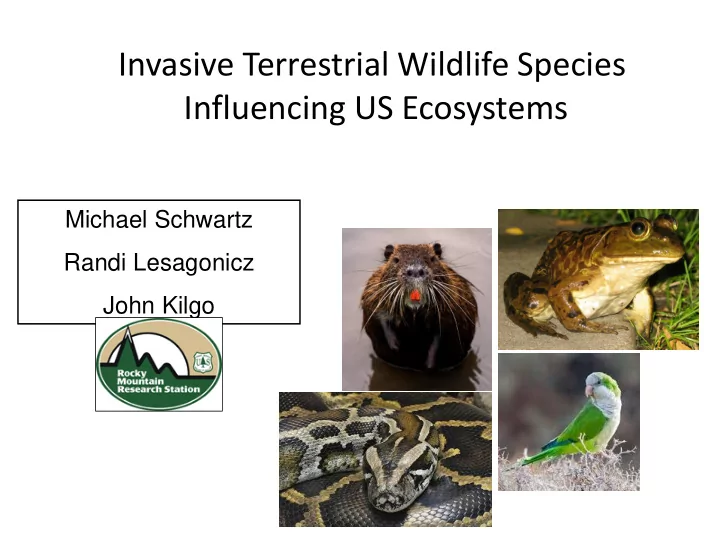
Invasive Terrestrial Wildlife Species Influencing US Ecosystems
Michael Schwartz Randi Lesagonicz John Kilgo
SLIDE 2
SLIDE 3 I. Framework for Understanding Invasive Terrestrial Wildlife (What is an ITW?) – Operational Definitions
- II. Review of Invasive Species by State and
Ecoregion / Available Resources
- III. Early Detection Essential – New Tools
(Genomics and eDNA!)
Outline
SLIDE 4 Framework for Understanding Invasive Terrestrial Wildlife (What is an ITW?)
Invasive Terrestrial Wildlife – All vertebrates in the subgroups of amphibians, reptiles, birds, and mammals that were introduced by non-natural means into the United States .
No Yes Yes
SLIDE 5 What is an Invader: Does Time Matter?
Greenhouse Frog 1875 Feral Hogs 1539 Collared Dove 1980 Wolf / Domestic Dog 40,000-12,000 ybp Polynesian Rat 400 Feral horses Mid-1500s
SLIDE 6 What is an Invader?: Does Facilitated Range Expansion Create An Invasive Species?
in AK and GA
into FL, GA
SLIDE 7 Continuous vs Discrete
What is an Invader?: Does an Invasive Species Need to Have A Disjoint Distribution?
Only CO considers them invasive, and USGS
SLIDE 8 To be an Invasive does it need to :
- 1. Have Impact? (Consequence of the
invasion?)
What is an Invader?: Other Considerations
Florida Hottentot Teal (From Africa / Madagascar) Burmese Python
SLIDE 9 Framework for Understanding Invasive Terrestrial Wildlife (What is an ITW?)
Invasive Terrestrial Wildlife – All vertebrates in the subgroups of amphibians, reptiles, birds, and mammals that were introduced by non-natural means into the United States .
- Post Pleistocene Time
- Not Including Facilitated Range Expansion
- Considered Invasive Regardless of Impact
- Considered Invasive Regardless of Trend of Expansion
- Considered Invasive if Expansion Crossed A Discrete
Geographic or Ecological Barrier
SLIDE 10
Why do We Care?
SLIDE 11 Human Expense
See Pimentel 2002
SLIDE 12 Human Expense
- Estimated 1.1 billion/yr damages
(Pimentel et al. 1999)
- Vectors for >50 human and livestock
diseases
agricultural damage
SLIDE 13 Local Species Extinctions
- 1741 introduced to Aleutian Chain
- 1910-1940 Fox farming
- After removal (39 islands)
seabird response - increase
- f nesting birds 5 fold in
10 years (Ebbert and Byrd 2000)
- Aleutian Canada Goose went
from 1000 in 1975 to 35,000 in 2000)
- Decimated Hawaii birds
- 130+ spp. (11 not endangered)
- Harper and Bunbury (2015)
SLIDE 14 Burmese Python
Invasion and Impact: Expanding and Large Per Capita Effect (Keystone) –A Deadly Combination
SLIDE 15 Road surveys totaling 56,971 km from 2003– 2011 documented:
- 99.3% decrease in the frequency of raccoon
- bservations,
- 98.9% decrease opossum
- 87.5% decrease bobcat observations
- 100% decrease in all rabbit species
SLIDE 16 Ecosystem Engineers / Keystone
Introduced:
1899 1539
Damage: burrowing, tunneling levees
road bed, dock burrowing, crops: sugarcane, rice, corn, sorghum
Cost: unknown (many multimillion $ projects)
US$1.5B / yr Crop damage, prey on livestock Damage native plant roots
SLIDE 17 I. Framework for Understanding Invasive Terrestrial Wildlife (What is an ITW?) – Operational Definitions
- II. Review of Invasive Species by State and
Ecoregion / Available Resources
- III. Early Detection Essential – New Tools
(Genomics and eDNA!)
Outline
SLIDE 18 State by State Review
- Googled “State name” and “invasive species” (not including
- ther commonwealths or protectorates)
- Compiled a list of all species considered invasive by state and
included common name, scientific name, taxa affiliation, origin, introduction method, location of release/invasion point, comments, map of current geographic range, and current ecosystem
SLIDE 19 State by State Review
- 117 web pages (75 unique sites)
- 45 State pages
- 6 Federal pages
- 13 University sites
- Remainder were NGO, County, or Other
- 464 Species on the list
SLIDE 20
Federal
SLIDE 21
SLIDE 22
Federal
SLIDE 23
State
SLIDE 24
NGO
SLIDE 25
SLIDE 26
NatureServe – imapInvasives Initiative
SLIDE 27
SLIDE 28 Center for Invasive Species and Ecosystems Health (University of Georgia)
University
SLIDE 29 State by State Review
(Evidence of reporting bias / different operational definitions)
5 10 15 20 25 30 35 5 10 15 20 25 30 35 40 45 50 55
Bin (Number of Terrestrial Invasives) > Count Florida (268) Montana (113) Alaska (55) California Many with 7 (SC, NH, OK)
SLIDE 30 Are there some ecoregions / USFS lands where invasive species are more prevalent?
- Unique species list was created from the state list
- Randomized list - top 10 species per taxa affiliation (mammals,
amphibian, reptile, bird, included 2 keystone)
- GIS data was downloaded from IUCN red list’s maps and from
the National Gap Analysis program by USGS
- Many maps in progress for reptiles and amphibians in US
(IUCN)
SLIDE 31
Burmese Python – Exotic Range Not Mapped (Excluded from our analysis)
SLIDE 32
European Hare – IUCN (but known in AK, HI, CA)
SLIDE 33
European Collared Dove
SLIDE 34
Ecoregion (Omernik 1987) Level 1
SLIDE 35
- NORTH AMERICAN DESERTS
- MEDITERRANEAN CALIFORNIA
- EASTERN TEMPERATE FORESTS
- GREAT PLAINS
- MARINE WEST COAST FOREST
- TROPICAL WET FORESTS
- NORTHERN FORESTS
- NORTHWESTERN FORESTED
MOUNTAINS
HIGHLANDS
- TEMPERATE SIERRAS
- TAIGA
- TUNDRA
Ranked Order of Ecoregions Impacted By Invaders (High to Low)
SLIDE 36 2 4 6 8 10 12 14 16 18
500,000 1,000,000 1,500,000 2,000,000 2,500,000 3,000,000
North American Deserts Mediterranean California
Invasives per Ecoregion Scaled by Area of Ecoregion
Area Invasives
SLIDE 37 Invasives per Ecoregion Scaled by Area of Ecoregion
Area Invasives
North American Deserts Mediterranean California
2 4 6 8 10 12 14 16 18
500,000 1,000,000 1,500,000 2,000,000 2,500,000 3,000,000
Tropical Wet Forest
SLIDE 38 Tropical Wet Forest
Invasives per Ecoregion Scaled by Area of Ecoregion
Area Invasives
North American Deserts Mediterranean California
2 4 6 8 10 12 14 16 18
500,000 1,000,000 1,500,000 2,000,000 2,500,000 3,000,000
Tundra Taiga
SLIDE 39 2 4 6 8 10 12 14 16 18 500,000 1,000,000 1,500,000 2,000,000 2,500,000 3,000,000
Marine West Coast Northern Forests Eastern Temperate Forest Great Plains Northwestern Forested Mts
North American Deserts Tundra Taiga Mediterranean California Tropical Wet Forest
Southern Semiarid Highlands Temperate Sierras
Invasives per Ecoregion Scaled by Area of Ecoregion
SLIDE 40 National Forest Lands - Highlights
- Invasive Terrestrial Species on All 285 USFS Units
- Starlings, House Mouse, and House Sparrow – most common
(283, 285, and 282 units)
- Feral Pigs on 101 units
- Nutria are in 4 regions
(knocking on door of 3 more)
SLIDE 41
Many Efforts to Map Terrestrial Animal Invasions Most are Local or are Not Sustained (Yet, another Server Error) Best Long Term Databases are IUCN (Europe Bias) or GAP (Incomplete) New Tools and Techniques are Available to Detect Terrestrial Invasions Research is needed to Identify where threat is greatest by USFS unit.
Conclusions
SLIDE 42 I. Framework for Understanding Invasive Terrestrial Wildlife (What is an ITW?) – Operational Definitions
- II. Review of Invasive Species by State and
Ecoregion / Available Resources
- III. Early Detection Essential – New Tools
(Genomics and eDNA!)
Outline
SLIDE 43
DNA from target species sloughed into stream Filter stream water Laboratory analysis to detect DNA of target species
eDNA Detection
Analyze results
SLIDE 44
Amplify unique DNA barcodes from each species
SLIDE 45
Pool DNA barcodes Amplify unique DNA barcodes from each species
SLIDE 46
Attach barcodes to magnetic beads Pool DNA barcodes
SLIDE 47 Attach barcodes to magnetic beads Pool DNA barcodes
eDNA sample
SLIDE 48 Capture target DNA (Eliminate non-target DNA)
eDNA sample
bacterial DNA
SLIDE 49
Sequence captured DNA
✓ ✗ ✓ ✓ ✓ ✓ ✓
SLIDE 50
SLIDE 51 eDNA and Genomics = Biodiversity Panel
Common_Name eDNA_002 eDNA_005 eDNA_008 eDNA_009 eDNA_010 eDNA_011 Stonefly - Golden Stone Mayfly - Western Green Drake Northern Pike 3 Cutthroat Trout* 7 10 8 3 Pacific Salmon 2 14 12 11 6 Rainbow Trout - inland 2 4 13 5 4 2 Whitefish* 4 8 12 10 4 Brown Trout 5 4 8 4 3 Bull Trout* 3 5 6 4 2 Brook Trout 5 4 3 2 Lake Trout 3 2 3 Grayling Slimy Sculpin (SCCC) Columbia Spotted Frog RM Tailed Frog Idaho Giant Salamander North American River Otter 2 2 American Mink 2 3 3 Beaver 4 Human 2 2 Osprey Nutria
SLIDE 52
SLIDE 53 Annamite striped rabbit Small-toothed Ferret-badger Truong Son munjtac Serow
LDNA?
SLIDE 54
DNA Demonstrates Reinvasion not Survival in NZ
SLIDE 55
Many Efforts to Map Terrestrial Animal Invasions Most are Local or are Not Sustained (Yet, another Server Error) Best Long Term Databases are IUCN (Europe Bias) or GAP (Incomplete) New Tools and Techniques are Available to Detect Terrestrial Invasions Research is needed to Identify where threat is greatest by USFS unit.
Conclusions
SLIDE 56 Databases Matter! Need Standardization
Monk parakeet
SLIDE 57 Sum Stats
- Approximately 50,000 invasive species were introduced to the US from human
movements, commerce, and trade (http://www.adfg.alaska.gov/index.cfm?adfg=invasive.main)
- Feral hogs were considered the most abundant, free-ranging, introduced ungulate in the
USA in 1991 (http://feralhogs.tamu.edu/files/2010/05/FERAL-HOGS-IN-ALABAMA.pdf)
- Property owners in PA reported $89,400.00 in damage from European Starlings in 2006
and $26,886.00 was spent to mitigate damages (http://invasivespeciescouncil.com/Profiles_Birds.aspx)
- There are over 1700 species of all taxonomic types (vertebrate, invertebrate, plant, and
disease) that are invasive to California and could be introduced and eventually be a problem (http://iscc.ca.gov/docs/californiainvasivespecieslist.pdf)
- More than 500 fish and wildlife nonnative species have been found in FL
(http://myfwc.com/wildlifehabitats/nonnatives/)
- Efforts to control invasive species in the US run $137 billion each year
(http://www.nature.org/ourinitiatives/regions/northamerica/unitedstates/colorado/color ados-top-5-invasive-species.xml)
- About 5,000 species of plants, animals, and microbes are recognized in the US as invasive
(http://ohiodnr.gov/invasivespecies)
- Invasive species are the 2nd largest threat to native biodiversity
(http://www.usm.edu/gcrl/events/docs/science.cafe.invasive.species.201410.pdf)
SLIDE 58 California: The first nutria imported into the United States went to Elizabeth Lake, California, for fur farming in 1899 (Evans, 1970). Although this attempt at fur farming was not successful, subsequent importations must have been made because by 1940, California had a small feral population of nutria (Schitoskey and others, 1972). Conditions in California are generally not favorable for nutria in the wild. A small eradication program was successful and Deems and Pursley (1978) report they were eradicated by 1978. Louisiana: First introduction near New Orleans in the early 1930s, but they were quickly trapped out (Evans, 1970; Bailey and Heidt, 1978). Brought back into Louisiana in 1938 for fur farming; the nutria escaped in 1940 by burrowing out of pens and climbing over fences damaged by a hurricane (Evans, 1970; Lowery, 1974; Bailey and Heidt, 1978). It is feral in the State and is controlled by trapping and alligators (Lowery, 1974; Deems and Pursley, 1978; Wolfe and Bradshaw, 1987). eorgia: Nutria were introduced into Georgia
- r weed control by State and Federal agencies
vans, 1970, 1983). They are now feral there eems and Pursley, 1978).
SLIDE 59 Means of Introduction: The cottonmouth from Boulder, Colorado, was intentionally introduced "by a farmer to scare away fishermen" (Livo et al., 1998). The Montgomery County, Kansas cottonmouths also were introduced intentionally (Collins, 1993). The specimen from Massachusetts may have been a released pet
- r escapee (Cardoza et al., 1993). It is not clear if the formerly
established colonies of A. piscivorus from Livingston County, Missouri, were introduced or natural (Gloyd and Conant, 1990).
Not So Fun Fact